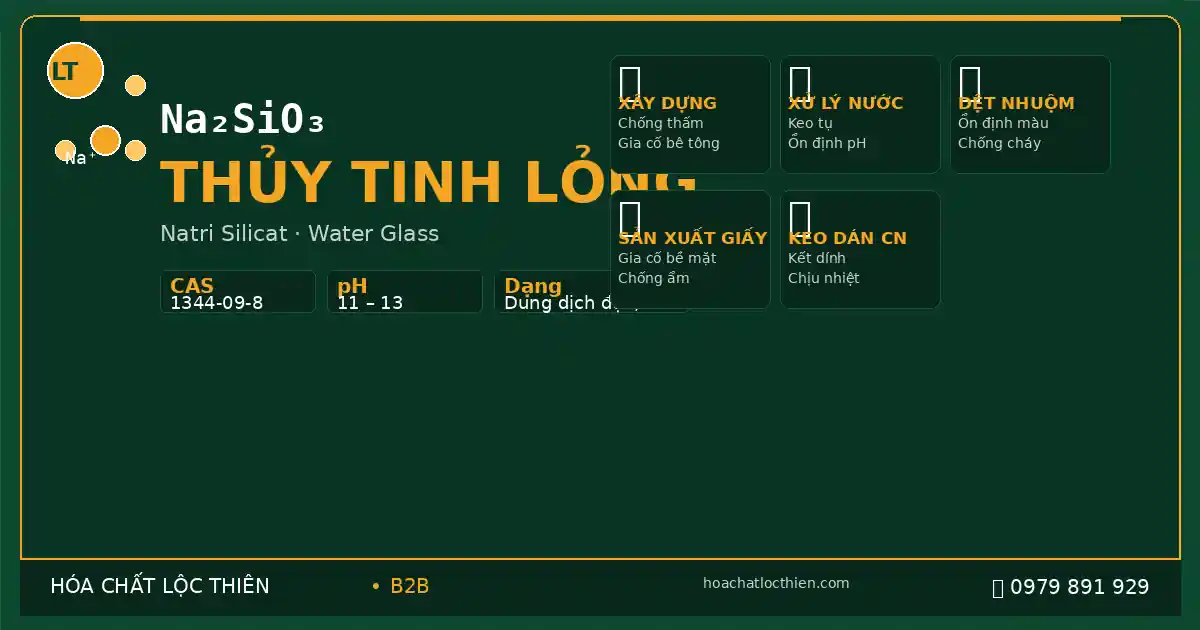
Sodium Silicate in Construction | Hóa Chất Lộc Thiên
Sodium silicate (Na₂SiO₃, CAS 1344-09-8) — water glass — is not just a paper adhesive. In construction, it is an inorganic waterproofing agent, rapid-setting additive, and concrete surface hardener that works through a chemical mechanism: reacting with calcium hydroxide (Ca(OH)₂) naturally present in cement to form calcium silicate hydrate (C-S-H) gel that fills capillary pores. No surface film — it penetrates deep into the concrete structure, protecting from within.
1. Waterproofing Mechanism — Turning Concrete into a Watertight Mass
When sodium silicate is sprayed or brushed onto a concrete surface, the alkaline solution penetrates the capillary layer and small cracks. There, Na₂SiO₃ reacts with Ca(OH)₂ — the hydration product of cement — to form water-insoluble C-S-H gel:
Na₂SiO₃ + Ca(OH)₂ → CaSiO₃·nH₂O (C-S-H gel) + NaOH
This reaction:
- Fills voids, capillaries, and micro-cracks
- Reduces concrete water permeability by up to 60% (per research in Buildings, 2024)
- Creates a permanent protective layer — C-S-H gel is the main component of cement and does not degrade over time
- If new cracks appear, the C-S-H gel continues reacting with water and Ca(OH)₂ to self-heal — known as the “Virtuous Cycle”
Unlike bitumen or polyurethane membranes that only form a surface layer, sodium silicate waterproofs by transforming the concrete’s microstructure from within — once C-S-H gel has formed, it is part of the concrete mass forever.
2. Specific Construction Applications
2.1. Waterproofing Concrete Floors, Basements, Water Tanks
This is the most common application. Brush or spray sodium silicate solution module 2.5–3.0 (density 1.35–1.50) onto clean, cured concrete (minimum 7 days old). Application rate: 0.15–0.3 L/m²/coat, depending on concrete porosity. For water tanks, swimming pools, chemical tanks: apply 2 coats 2–4 hours apart, then cure with water for 3 days.
Typical test result (Vandolovskyi, 2024): Concrete impregnated with Na₂SiO₃ showed water absorption reduced to 1.15% — a reduction of over 70% compared to untreated concrete (typically 3–6%).
2.2. Rapid-Setting Additive for Cement Mortar
Adding 1–3% sodium silicate (by cement weight) to the mixing water reduces setting time from 4–6 hours down to 20–40 minutes. Used in situations requiring fast repair: sealing actively leaking joints, pouring concrete on wet ground, tunnel patching, plugging boreholes.
Note: excessive dosage (>5%) causes near-instant setting and reduces final strength because the reaction consumes Ca(OH)₂ needed for subsequent hydration. According to Nature Scientific Reports (2025), adding sodium silicate penetrant at ≤16 kg/m³ of concrete still maintains workability equivalent to normal concrete.
2.3. Industrial Floor Hardening
Applying sodium silicate module 3.0–3.3 to industrial concrete floors (warehouses, factories, parking lots) creates a harder surface layer that resists abrasion. Mechanism: C-S-H gel densifies the surface cement paste, reduces concrete dusting, and increases abrasion resistance by 40–60%.
Procedure:
- Clean the floor surface (no dust, no grease)
- Dampen the surface with water — no standing water
- Spray undiluted sodium silicate or dilute 1:1 with water
- Wait 30–60 minutes — apply a second coat if the surface is too porous
- Rinse with water after 2–4 hours to remove excess from the surface
2.4. Fireproof Coating for Steel Structures
High-module sodium silicate (3.2–3.3) mixed with fillers such as vermiculite and perlite forms fireproof paint for steel structures. The coating withstands temperatures up to 800–1,000°C without producing toxic smoke — replacing epoxy and solvent-based paints.
3. Detailed Waterproofing Application Procedure
Step 1: Surface Preparation
- Concrete surface must be cured ≥7 days
- Clean: remove dust, grease, loose mortar, impurities
- If the surface is old or carbonated: wash with dilute calcium acetate solution to activate the reaction
- Dampen the surface — saturated with water but no standing water
Step 2: Solution Preparation
- Use sodium silicate module 2.5–3.0 (density 1.35–1.45)
- For normal concrete: dilute 1:1 with water
- For porous or old concrete: use undiluted or dilute 2:1 (silicate:water)
- Do not mix with other chemicals before application
Step 3: Application
- Low-pressure spray or brush with a paintbrush
- Coat 1: 0.15 L/m² — even, no puddles
- Coat 2: after 2–4 hours — 0.15 L/m² — apply perpendicular to coat 1
- Application temperature: 10–35°C (ideal 20–30°C)
- Avoid application during rain or intense sunlight
Step 4: Curing
- Maintain surface moisture for 48–72 hours after application
- Mist water 3–4 times/day
- Do not allow foot traffic or loads on the surface for the first 24 hours
Step 5: Quality Inspection
- Drop a few water droplets on the dry surface after 7 days: water should not absorb, forming round beads
- Measure water permeability per TCVN or ASTM
4. Technical and Safety Notes
Choosing the right module:
- Concrete waterproofing: module 2.5–3.0 (balance between penetration and reaction)
- Rapid mortar setting: module 2.0–2.5 (high alkalinity, fast reaction)
- Floor surface hardening: module 3.0–3.3 (hard film, high viscosity)
Limitations:
- Cannot waterproof dynamic cracks >2 mm
- For concrete with high pozzolan content (fly ash, slag): pre-treat surface with calcium acetate
- Do not use on ceramic tiles, granite, glass — no penetration
- Clean tools with water immediately after use — dry film is very difficult to remove
Safety:
- Sodium silicate pH 11–13 — strongly irritates skin and eyes
- Mandatory PPE: alkali-resistant gloves, splash-proof safety goggles, protective clothing
- Avoid inhaling spray mist — respirator or face mask
- Spills: absorb with sand, collect, rinse with water — do not allow into drains
5. Reference Dosage by Application
| Application | Module | Dosage | Dilution |
|---|---|---|---|
| Floor, wall, basement waterproofing | 2.5–3.0 | 0.15–0.3 L/m²/coat | 1:1 with water |
| Fast leak sealing | 2.0–2.5 | 2–4% of cement | Direct into mixing water |
| Fireproof coating | 3.2–3.3 | Undiluted + fillers | Per paint mixing ratio |
| Floor hardening | 3.0–3.3 | 0.2–0.4 L/m² | Undiluted or 2:1 |
| Water tank, pool treatment | 2.8–3.2 | 2 coats ×0.15 L/m² | 1:1 coat 1, undiluted coat 2 |
6. Buy Sodium Silicate for Construction Projects
Lộc Thiên supplies liquid sodium silicate (Na₂SiO₃, CAS 1344-09-8) in bulk with module per batch COA — confirming the correct grade for each work item before delivery. Packaging: 200L drums, 1000L IBC totes, 5–30 ton tankers. Delivery from 6 nationwide warehouses with 20 dedicated tankers.
Construction plants also needing NaOH 50% (liquid caustic soda, CAS 1310-73-2) for surface treatment or alkaline environment — Lộc Thiên supplies both. See pages: Sodium silicate overview and NaOH liquid 50%.
Contact hotline 0979 891 929 — quote within 15 minutes, batch COA/MSDS, same-day delivery to industrial parks.
Frequently Asked Questions about Sodium Silicate in Construction
Is silicate waterproofing durable? What is its lifespan?
Sodium silicate waterproofing has a lifespan of 5–10 years for indoor surfaces and 3–5 years for outdoor surfaces (exposed to UV and acid rain). Silicate reacts with Ca(OH)₂ in concrete to form stable CSH gel that does not biodegrade. To extend lifespan, apply a protective surface coating after silicate treatment. Periodic retreatment every 3–5 years is recommended for outdoor structures.
What is the mixing ratio for silicate waterproofing mortar?
Silicate mixing ratio for waterproofing mortar: dilute silicate with water at 1:1 to 1:3 depending on module and purpose. For floor waterproofing: use module 2.5–3.0, dilute 1:1, brush 2–3 coats 2–4 hours apart. For crack sealing: use a thicker mix (2:1), combined with cement to form a paste. Do not over-dilute — waterproofing effectiveness drops significantly.
Is silicate hazardous during application?
Liquid sodium silicate is alkaline (pH 11–12.5) and may irritate skin and eyes on direct contact. Full PPE required: rubber gloves, safety goggles, respirator. Work in well-ventilated areas. Silicate contains NO VOCs, no organic solvents — much safer than solvent-based waterproof coatings. When fully dry, silicate becomes inert glass — non-hazardous.
Can silicate be used on reinforced concrete?
Yes, but with caution: Silicate has an alkaline pH (11–12.5) and is compatible with concrete’s alkaline environment. However, silicate slightly reduces surface pH — this could affect the passive layer protecting rebar if applied incorrectly. Always ensure a concrete cover of ≥20 mm over rebar. Do not use silicate on heavily carbonated concrete surfaces.
Where to buy sodium silicate for construction projects?
Hóa Chất Lộc Thiên — supplies bulk liquid sodium silicate (Na₂SiO₃, CAS 1344-09-8) module 2.0–3.3, batch COA, ZDHC Level 1. 6 warehouses nationwide, 20 tankers 5–30 tons. Same-day delivery to construction sites. Call 0979 891 929 for a quote and advice on the right module for each construction item.
--- References ---
- Buildings (2024). Effects of Silicate Coatings on Concrete Durability. 14(2):381
- Nature Scientific Reports (2025). Sodium silicate mixing method in concrete. 15:16991
- Vandolovskyi et al. (2024). Improvement of Concrete Parameters. IOP Conf. Series
- PCI Paper — Lifetime Concr
Quality control: QC Phan Cẩm Thủy inspects and Võ Thị Như Hòa approves each batch of Sodium Silicate. Batch COA, certified ZDHC MRSL Level 1 (TÜV Rheinland) — transparent technical specifications.
- TCVN, ASTM — Concrete permeability test methods
QC: Phan Cẩm Thủy & Võ Thị Như Hòa. ZDHC MRSL Level 1 (TÜV Rheinland). 热线 0979 891 929.