Jar-Test Guide for FeSO4 Coagulation: Dosage, Optimal pH & Standard Procedure for Operations Engineers
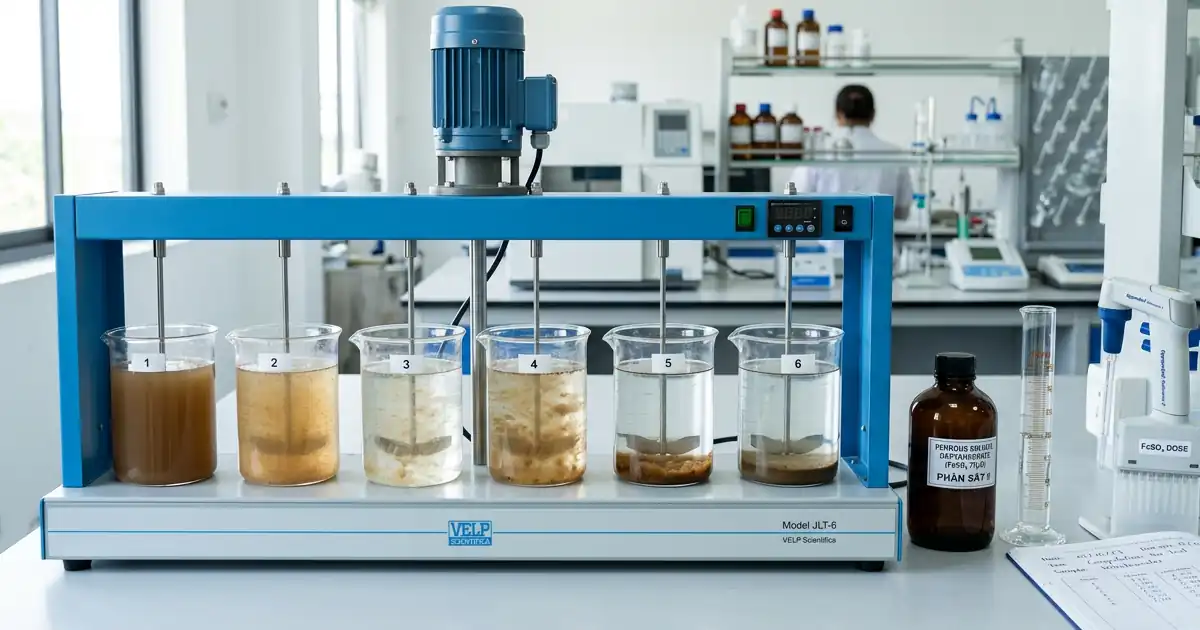
Table of contents
Jar-test with FeSO4 is a mandatory step before introducing ferrous sulfate into any wastewater treatment system. Each water source has different pollutant composition, pH, and alkalinity — there is no universal FeSO4 dosage for all water types. The 6-step procedure below helps operations engineers accurately determine the optimal dosage (80–1,200 mg/L FeSO4), coagulation pH (8–9), and settling time, reducing operational risks and chemical waste.
Why Jar-Test Before Using FeSO4?
FeSO4 (ferrous sulfate, CAS 7720-78-7) is a common inorganic coagulant for treating municipal wastewater, textile dyeing, electroplating, paper, and leachate. The coagulation mechanism of FeSO4 heavily depends on pH, alkalinity, and pollutant concentration of each water source. A FeSO4 dosage suitable for textile wastewater (500–1,200 mg/L) would be excessive for municipal wastewater (80–200 mg/L), causing waste and increased sludge volume.
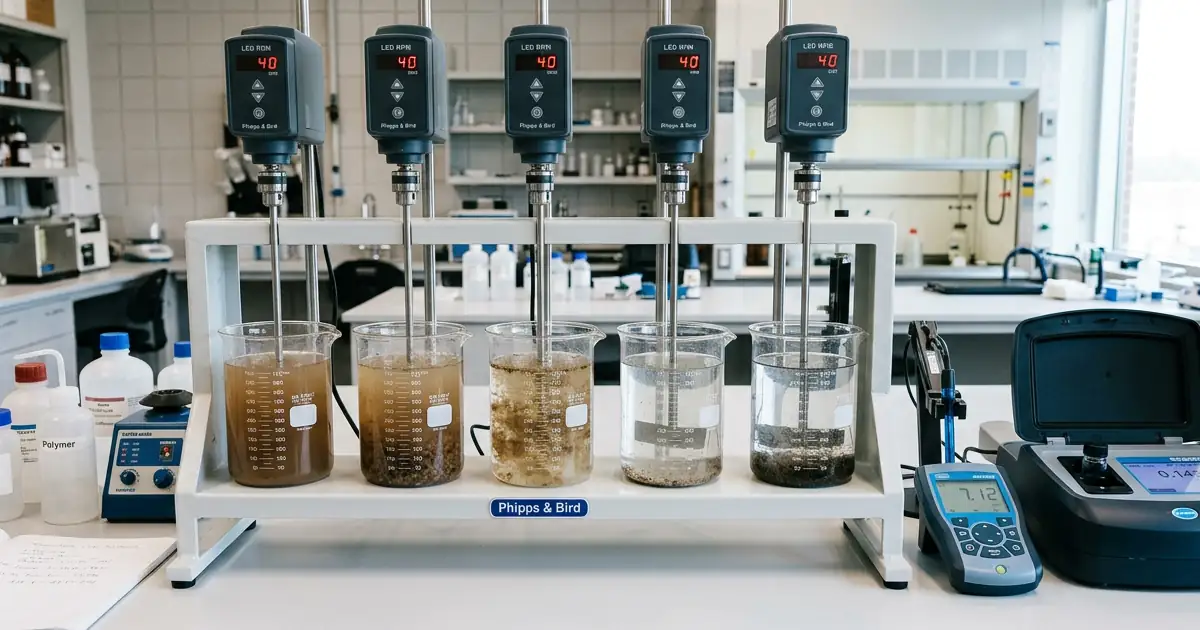
Jar-test (ASTM D2035) allows simulation of the entire coagulation-sedimentation process at lab scale using 6 beakers of 1 L each, comparing 6 different FeSO4 dosages on the same water sample. Jar-test results are the sole basis for setting operational dosages at the actual treatment plant. Skipping jar-test means operating blindly — wasting chemicals and risking effluent non-compliance with QCVN standards.
Loc Thien offers on-site jar-test support for customers purchasing FeSO4 30% liquid and FeSO4 98% solid — contact 0979 891 929 to schedule.
Coagulation Mechanism of FeSO4
FeSO4 coagulation differs from FeCl3 in that Fe²⁺ must first be oxidized to Fe³⁺ before forming Fe(OH)₃ precipitate. This process occurs in an alkaline environment (pH 8–9) with dissolved oxygen present.
Hydrolysis and oxidation reactions:
FeSO₄ → Fe²⁺ + SO₄²⁻ Fe²⁺ + ½O₂ + 2OH⁻ → 2Fe³⁺ + H₂O (oxidation in alkaline medium) Fe³⁺ + 3OH⁻ → Fe(OH)₃ (colloidal precipitate)
The Fe(OH)₃ formed are positively charged colloidal flocs that neutralize the negative charge of pollutants (suspended solids, organic matter, phosphorus, color), binding them into larger, settleable flocs.
Optimal pH 8–9. At pH below 7, Fe²⁺ remains soluble and does not form flocs. At pH above 10, Fe(OH)₃ dissolves to form ferrate complexes, losing coagulation effect. For every 10 mg FeSO₄ added, pH drops approximately 0.05–0.1 units due to H⁺ release during hydrolysis — pH must be readjusted after dosing.
Advantages over PAC/FeCl3: FeSO4 has lower cost, is suitable for high-color wastewater (textile dyeing) and Cr⁶⁺ reduction (electroplating). Disadvantages: slower coagulation rate, requires higher pH, and produces more sludge.
Equipment and Chemicals Needed
Equipment:
- 6-paddle gang stirrer (adjustable 0–300 rpm)
- 6 glass beakers, 1,000 mL (square beakers preferred to simulate actual mixing zones)
- pH meter (accuracy ± 0.05)
- Turbidity meter (NTU) or turbidity tube
- Graduated cylinders: 100 mL, 500 mL
- Pipettes 1–10 mL, analytical balance ± 0.01 g
- Glass stirring rods, thermometer
- Stopwatch
Chemicals:
- FeSO4 98% solid (FeSO₄·7H₂O) or FeSO4 30% liquid
- Lime Ca(OH)₂ 5% or NaOH 10% — for pH adjustment
- Distilled water (for stock solution preparation)
- Wastewater sample to be treated — minimum 8 L, collected at the coagulation tank inlet
6-Step Jar-Test Procedure
Step 1: Prepare FeSO4 Stock Solution (5–10%)
The FeSO4 stock solution must have a known concentration to calculate dosage accurately.
From FeSO4 98% solid: Weigh 50 g FeSO₄·7H₂O (Fe content ~20%), dissolve in distilled water, and make up to 1,000 mL → stock solution 50 g/L (5% w/v). Equivalent to 50,000 mg/L as FeSO₄·7H₂O. Each mL contains 50 mg.
From FeSO4 30% liquid: Dilute FeSO4 30% (density ~1.25 g/mL, concentration ~375 g/L) at a 1:7 ratio with distilled water → stock solution ~46 g/L (~4.6% w/v).
Note: FeSO4 stock solution is prone to oxidation (Fe²⁺ → Fe³⁺) upon air exposure — use within the same day, do not store overnight. If the solution turns yellowish-brown, it is excessively oxidized and must be freshly prepared.
Step 2: Collect Wastewater Sample
Collect a minimum of 8 L of wastewater from the coagulation tank inlet. Sample at mid-depth (not surface, not bottom). Seal tightly and transport to the lab within 2 hours.
Divide evenly into 6 beakers of 1,000 mL each (mark the level). Measure initial pH, turbidity, and temperature of the composite sample. Record these values.
Step 3: Adjust pH to 8–9
FeSO4 requires pH 8–9 for effective coagulation. Check the pH of each beaker. If the sample pH is below 7, gradually raise it using lime Ca(OH)₂ 5% (or NaOH 10%).
Procedure: Add Ca(OH)₂ 5% dropwise, stir for 30 seconds, measure pH. Repeat until pH reaches 8.0–8.5 for all 6 beakers. Record the volume of lime consumed (mL) to estimate actual operational cost.
Note: Do not raise pH above 9.5 — Fe(OH)₃ will dissolve at pH above 10, losing coagulation effect.
Step 4: Add FeSO4 at Increasing Dosages
Add the 5% FeSO4 stock solution to the 6 beakers according to the table:
| Beaker | FeSO₄·7H₂O dosage (mg/L) | Volume of 5% stock (mL) | Purpose |
|---|---|---|---|
| 1 (control) | 0 | 0 | Blank |
| 2 | X × 0.5 | X × 0.5 × 1.0 / 50 = … | Low dose |
| 3 | X × 0.75 | … | Medium-low dose |
| 4 | X | … | Medium dose (see table below) |
| 5 | X × 1.25 | … | Medium-high dose |
| 6 | X × 1.5 | … | High dose |
Example for textile dyeing wastewater — choose X = 600 mg/L:
| Beaker | Dosage (mg/L) | 5% stock (mL) into 1 L |
|---|---|---|
| 1 | 0 | 0 |
| 2 | 300 | 6.0 |
| 3 | 450 | 9.0 |
| 4 | 600 | 12.0 |
| 5 | 750 | 15.0 |
| 6 | 900 | 18.0 |
Formula: V(mL) = Dosage(mg/L) × 1(L) / C(mg/mL), with C = 50 mg/mL (5% stock).
After adding FeSO4, gently stir by hand for 10 seconds to ensure even dispersion.
Step 5: Rapid Mix — Slow Mix
Rapid mix (flash mixing): 200–250 rpm for 1–2 minutes. Purpose: uniformly disperse FeSO4 throughout the water volume, allowing Fe²⁺ to contact OH⁻ and dissolved O₂. Observation: water becomes slightly turbid, small flocs appear.
Slow mix (flocculation): 30–40 rpm for 15–20 minutes. Purpose: Fe(OH)₃ flocs collide and agglomerate into larger flocs. Observation: flocs gradually grow larger, water becomes clearer. If slow mixing is too short (<10 minutes), flocs remain small and do not settle.
Step 6: Settle for 30 Minutes — Read Results
Turn off the stirrer and let the beakers settle for 30 minutes. Record:
- After 5 minutes: Which beaker shows clear floc formation? Note the order.
- After 15 minutes: Which beaker has the clearest water? Measure surface turbidity (NTU) — use a pipette to withdraw 20 mL from 1/3 depth below the surface.
- After 30 minutes: Measure turbidity, pH, and COD (if equipment available). Observe floc size and sludge compactness.
Reading results: The optimal dosage is the lowest dosage that achieves the lowest turbidity and largest flocs. Do not choose a higher dosage just because flocs are larger — always check the settled turbidity.
Quick Dosage Reference by Wastewater Type
| Wastewater Type | FeSO₄·7H₂O dosage (mg/L) | Optimal pH | Notes |
|---|---|---|---|
| Municipal (P removal) | 80–200 | 7.0–8.0 | After biological treatment, combine with polymer |
| Textile dyeing (color removal) | 500–1,200 | 8.5–10 | Combine with lime Ca(OH)₂, large flocs |
| Electroplating (Cr⁶⁺ reduction) | FeSO₄:Cr molar ratio = 3:1 | 2–3 (reduction) → 8–9 (precipitation) | Two separate stages |
| Paper | 300–600 | 7.0–8.5 | Combine with anionic polymer |
| Leachate | 400–800 | 8.0–9.0 | Pre-treatment, combine with PAC if needed |
Note for electroplating industry: FeSO4 reduces Cr⁶⁺ to Cr³⁺ according to the reaction:
6Fe²⁺ + Cr₂O₇²⁻ + 14H⁺ → 6Fe³⁺ + 2Cr³⁺ + 7H₂O
Molar ratio FeSO₄:Cr = 3:1 (i.e., 3 moles Fe²⁺ per 1 mole Cr⁶⁺). Stage 1: adjust pH to 2–3, add FeSO4, stir for 30 minutes. Stage 2: raise pH to 8–9 with lime to precipitate Cr(OH)₃ and Fe(OH)₃. A separate jar-test is required for each stage.
How to Read Results and Optimize
After 30 minutes of settling, evaluate based on 4 criteria:
1. Turbidity (NTU): Primary criterion. The optimal dosage gives the lowest NTU. If NTU drops sharply at dosage A and does not decrease further at higher dosages — choose A.
2. Floc size: Flocs >1 mm (visible to the naked eye) are good. Small flocs (<0.5 mm) settle poorly — increase dosage or add polymer.
3. Settling time: Observe settling speed after stopping the stirrer. The beaker where flocs settle fastest (water clear after 15 minutes) is a good indicator.
4. Final pH: Check the final pH. If pH is below 6.5 or above 9, adjust before discharging to the receiving water body (per QCVN standards).
Optimization: If the initial optimal dosage is X mg/L but flocs are still small — try adding polymer (anionic 1–3 mg/L) during the slow mix step. If NTU remains high, increase pH to 8.5–9.0 and repeat the jar-test.
Common Errors and Troubleshooting
Error 1 — pH not reaching 8–9, FeSO4 does not coagulate
Cause: Low alkalinity in the wastewater, insufficient OH⁻ to oxidize Fe²⁺ to Fe³⁺ and form Fe(OH)₃. Solution: Raise pH using lime Ca(OH)₂ 5% instead of NaOH — lime adds alkalinity and promotes larger floc formation.
Error 2 — FeSO4 stock solution oxidized before use
Cause: Stock solution left overnight; Fe²⁺ converts to Fe³⁺, solution turns yellowish-brown. Actual dosage is lower than calculated. Solution: Prepare stock solution on the same day, keep sealed, use within 4–6 hours. For storage, add dilute H₂SO₄ (pH ~2) to stabilize Fe²⁺.
Error 3 — Rapid mix too short or too long
Rapid mix <30 seconds: FeSO4 not evenly dispersed, flocs non-uniform. Rapid mix >3 minutes: breaks up forming flocs. Solution: Standard 200–250 rpm for 1–2 minutes, use a stopwatch.
Error 4 — Choosing dosage based on floc size instead of turbidity
Largest flocs do not necessarily indicate optimal dosage — excess FeSO4 can cause charge reversal, re-dispersing pollutants. Solution: Always measure NTU after settling. Optimal dosage = dosage giving lowest NTU. Check COD if possible.
Error 5 — Not recording sample temperature
FeSO4 coagulation is slower at low temperatures (below 15°C). Temperature affects the oxidation rate of Fe²⁺ → Fe³⁺. Solution: Record sample temperature during jar-test; if below 15°C, increase slow mix time by 5 minutes.
Scale-Up from Jar-Test to Full-Scale System
After determining the optimal dosage from jar-test, proceed to full-scale operation in 3 steps:
1. Calculate dosage for the coagulation tank:
Actual dosage (mg/L) = Jar-test dosage (mg/L). Scale-up factor is typically 0.8–1.2 depending on tank type and mixing equipment. For mechanical rapid mix tanks, factor ~1.0. For hydraulic mix tanks, factor 1.1–1.2.
Flow rate Q (m³/h) × Actual dosage (g/m³) = FeSO4 consumption (g/h).
2. Online pH monitoring:
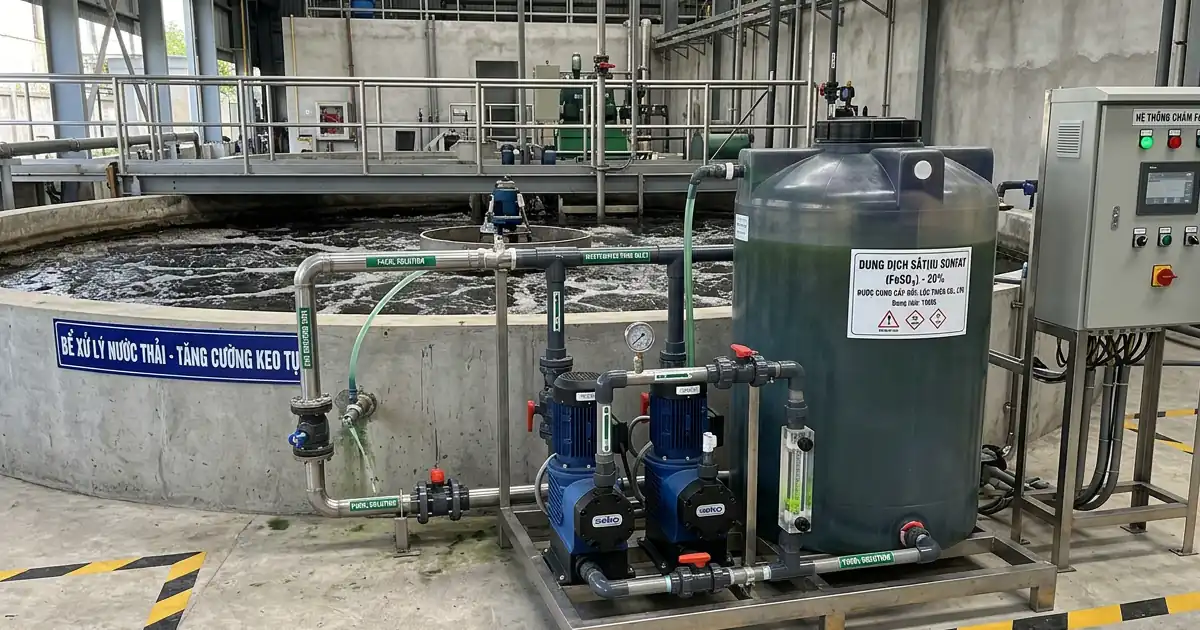
Install an online pH meter at the coagulation tank outlet. If pH drifts outside the 8–9 range, immediately adjust using Ca(OH)₂ or NaOH via dosing pump.
3. Operate, measure, fine-tune:
Run the first 24 hours at the jar-test dosage. Measure turbidity, COD, and pH after settling every 2 hours. If effluent is stable, maintain the dosage. If fluctuations occur, repeat jar-test with a fresh sample — influent quality changes seasonally and with production shifts.
Technical Support & B2B Procurement Hotline
Loc Thien Chemical specializes in direct manufacturing of FeCl₂ / FeCl₃ and direct industrial supply of basic chemicals (NaOH, HCl, H₂SO₄, PAC, NaOCl, H₂O₂, FeSO₄) with direct B2B pricing and dedicated 5–30-ton tanker delivery across Vietnam.
- Hotline / Zalo: +84 979 891 929
- Official Email: [email protected]
- Direct Manufacturer: Ferrous Chloride (FeCl₂ 30%) & Ferric Chloride (FeCl₃ 38–40%)
- Primary Supplier: NaOH 32%/45%/50%/99%, HCl 32%, H₂SO₄ 98%, PAC 30–31%, NaOCl 10–12%, H₂O₂ 35%/50%
- Compliance & Quality: FeCl₂ ZDHC MRSL v3.1 test report (Smart testing, 5 substance groups, TUV Rheinland Vietnam), ISO 9001:2015, Quatest 3, Full COA & GHS SDS
Frequently Asked Questions
Why does FeSO4 require pH 8–9 while FeCl3 only needs pH 5–7?
FeSO4 uses Fe²⁺, which must be oxidized to Fe³⁺ before forming Fe(OH)₃. This oxidation occurs most effectively at pH 8–9. FeCl3 already contains Fe³⁺ and hydrolyzes directly at pH 5–7 — no oxidation step is needed.
Can FeSO4 be replaced by FeCl3 in the jar-test?
Yes, but a separate jar-test must be run. FeCl3 coagulates faster, has a lower optimal pH, and produces less sludge. FeSO4 is cheaper and especially effective for Cr⁶⁺ reduction (electroplating) and color removal (textile dyeing). The choice of chemical should be based on parallel jar-tests of both.
What is the FeSO4 dosage for phosphorus removal in municipal wastewater?
80–200 mg/L FeSO₄·7H₂O depending on influent P concentration. Each mg of P requires approximately 9 mg FeSO₄·7H₂O (molar ratio Fe:P = 1.5:1). Jar-test helps determine the exact dosage because P exists in various forms (ortho-P, poly-P, organic-P) — each reacts differently with FeSO4.
How do FeSO4 30% liquid and 98% solid differ for jar-test?
FeSO4 liquid 30% is convenient for quick stock preparation — no weighing needed, just pipette directly. FeSO4 solid 98% requires weighing and stock preparation beforehand. Coagulation effectiveness depends on Fe²⁺ content, not solution concentration — convert to mg Fe/L for accurate comparison. See detailed comparison: Comparison of FeSO4 Liquid 30% and Solid 98%.
How often should jar-test be repeated?
Whenever influent quality changes: seasonal transitions (rain/flood dilutes water), production process changes (textile dyeing changes fabric colors, electroplating changes Cr batches), or at least once per month for stable treatment plants. Do not keep using a dosage from 6 months ago.
🛒 Need FeSO4 for wastewater coagulation? Get a quote for FeSO4 30% and FeSO4 98% — COA/MSDS per batch, tanker trucks 5–30 tons delivered to industrial parks nationwide. On-site jar-test support. Hotline 0979 891 929 — quote within 15 minutes.
Related articles:
- Pillar: FeSO4 — Industrial Ferrous Sulfate — Comprehensive overview
- Cluster 1: FeSO4 30% Liquid — Dosing Pump — No-mixing solution
- Cluster 2: Comparison of FeSO4 Liquid 30% and Solid 98% — Choose the right form
Industrial Field Operation & Batch Quality Verification
1. Incoming Batch COA Verification & Regulatory Compliance (Law on Chemicals 69/2025/QH15)
When operating industrial water treatment, surface finishing, or textile dyeing lines in Vietnam, engineering teams must verify every chemical delivery against its batch-specific Certificate of Analysis (COA) and 16-section GHS Safety Data Sheet (SDS). Under the Vietnam Law on Chemicals No. 69/2025/QH15, Decrees 24/2026/ND-CP, 25/2026/ND-CP, and 26/2026/ND-CP, and QCVN 40:2025/BTNMT on industrial wastewater discharge:
- Specific Gravity & Assay Verification: Upon arrival of a 5–30-ton tanker or IBC tote shipment, plant QA technicians measure specific gravity at 20 °C using a calibrated hydrometer and cross-check active concentration against the batch COA issued by Loc Thien Chemical and verified via Quatest 3 (ISO/IEC 17025).
- Impurity & Heavy Metal Control: Trace heavy metals (Fe, Pb, As, Hg, Cd, Cr⁶⁺) and insoluble matter are strictly controlled to prevent catalyst poisoning in Fenton reactors, membrane fouling in RO/UF systems, or shade deviations in reactive textile dyeing.
- ZDHC MRSL v3.1 Level 1 Portfolio Boundary: For export-oriented textile and footwear FDI factories, Loc Thien Chemical maintains official ZDHC MRSL v3.1 Conformance Level 1 documentation for exactly 9 core products: four products certified by TUV SUD Product Service GmbH (
NaOH,H2O2,Na2SO4,Na2CO3) and five products verified via Conformance Summary Report (CSR) and Analytical Test Report by TUV Rheinland Vietnam (H2SO4,FeCl2,HCl,Javel/NaOCl,PAC 31%).
| Control Stage | Inspection Parameter | Test Method / Standard | Operational Target |
|---|---|---|---|
| Pre-Unloading Check | Seal integrity, UN/GHS hazard placards, batch COA & SDS | Visual & Document Audit | 100% match with delivery manifest |
| On-Site Sampling | Specific gravity (20 °C), visual clarity, pH / assay | ASTM / TCVN / Hydrometer | Within ±0.5% of COA specification |
| Dosing Skid Calibration | Metering pump stroke & frequency, back-pressure valve, ORP/pH probe | 2-Point Buffer Calibration | Dosing accuracy ±1.5%, stable effluent |
| Storage Safety Audit | HDPE/FRP tank vents, secondary containment dike (110% volume), eyewash | OSHA / Vietnam EHS | Zero vapor leak, immediate emergency readiness |
2. Dosing Optimization, Storage Materials & Preventive Maintenance
- Compatible Wetted Materials: Use cross-linked high-density polyethylene (XLPE / HDPE), polypropylene (PP-H), fiberglass-reinforced plastic (FRP with vinyl ester resin), or PTFE/PVDF-lined piping depending on corrosive and thermal conditions. Avoid unlined carbon steel or incompatible elastomers.
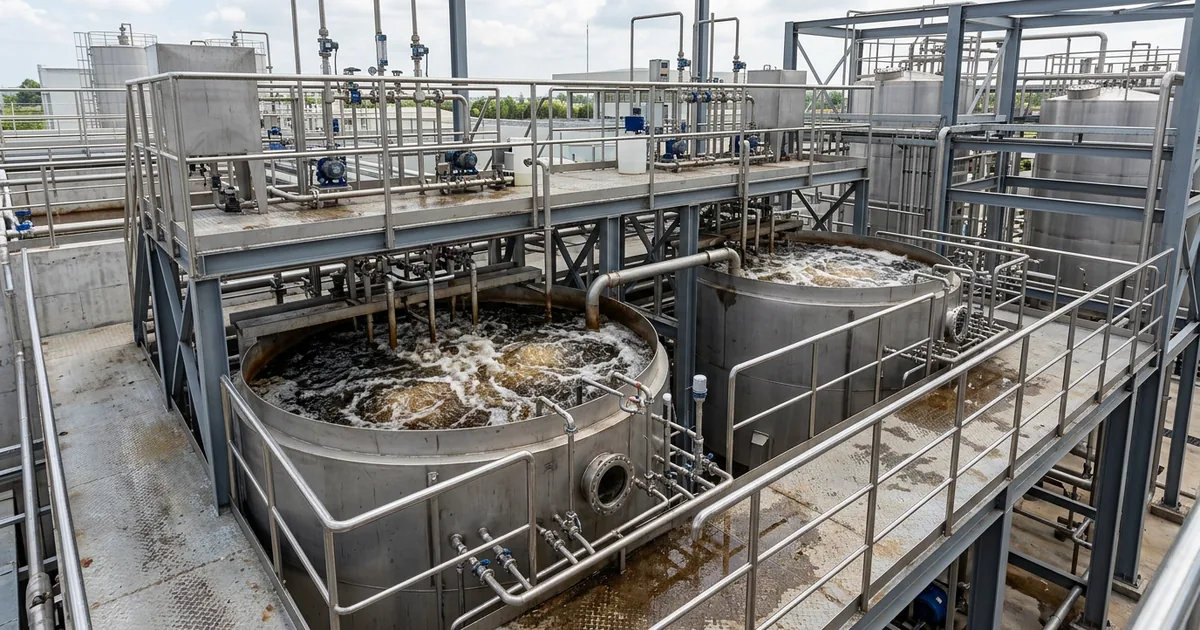
- Automated Dosing Control: Integrate diaphragm metering pumps with real-time pH, ORP (mV), turbidity, or conductivity sensors. Always perform a 5-beaker Jar Test whenever raw water COD, TSS, or alkalinity shifts by more than 15%.
- Secondary Containment & PPE: Storage tanks must sit inside an acid/alkali-resistant bund wall holding at least 110% of the largest tank volume. Operators handling unloading hoses must wear splash-proof chemical goggles, acid/alkali-resistant nitrile or neoprene gloves, face shields, and emergency respirators.
3. Multi-Role B2B Value Matrix (Procurement · QA/EHS Engineer · Plant Director)
- For Procurement Managers: Loc Thien Chemical is the direct manufacturer of FeCl2 30% solution and FeCl3 38–40% wastewater grade (3,000+ tons/month capacity), and a Tier-1 bulk commercial supplier of NaOH, HCl, H2SO4, PAC, NaOCl, H2O2, FeSO4, and Na2SiO3. Pricing is transparently structured around 5 technical cost drivers (active assay, packaging format, delivery distance from our 6 warehouses, order volume, and scheduled contract cadence) with a 15-minute technical quotation SLA.
- For Environmental & Process Engineers: Full technical support for Jar Test optimization, stoichiometry calculation, sludge minimization, and QCVN 40:2025/BTNMT compliance auditing.
- For FDI Plant Directors: Guaranteed supply continuity via 6 regional warehouses (Ba Ria - Vung Tau, Dong Nai, Binh Duong, Da Nang, Can Tho, Bac Ninh) and a dedicated 5–30-ton tanker fleet (4 hours in inner HCMC, 24–48 hours across Southern & Mekong Industrial Parks, 2–3 days in Northern & Central Vietnam).
4. Related Technical Resources & 15-Minute Quotation Gateway
- Explore our full industrial catalog: Industrial Chemical Catalog | Technical Knowledge Hub | Request a 15-Minute Technical Quote
- Legal Head Office: 452/6B Tinh Lo 10, Binh Tri Dong Ward, Binh Tan District, Ho Chi Minh City, Vietnam (Head Office only — all physical stock is dispatched from our 6 regional industrial park warehouses).
- 24/7 Technical Hotline: 0979 891 929 (Please contact hotline 0979 891 929 for detailed delivery procedures) | Official Email: [email protected]