
What is Semiconductor Technology? The Backbone of Modern Technology

Tóm tắt nội dung
- What is Semiconductor Technology?
- Comparing Semiconductor Technology and the Semiconductor Industry
- The Importance of the Semiconductor Industry
- Applications of Semiconductor Technology
- Key Technologies in the Semiconductor Industry
- 1. Chip Manufacturing Technology
- 2. Advanced Semiconductor Materials
- 3. 3D System Integration (3D IC Integration)
- 4. Quantum Chips
- 5. Photonics Technology
- Frequently Asked Questions (FAQ)
Have you ever wondered what makes smartphones, radar systems, or medical devices operate efficiently? The answer lies in semiconductor technology – the core foundation of all technological innovations in the 21st century. This is not just an industry but also the "brain" that makes electronic devices smarter and more powerful.
This article will help you answer the question "What is semiconductor technology?" and explore its important applications in daily life. From the tiny chips in smartphones to processors in supercomputers, semiconductor technology has been and continues to change the way we live and work. Let’s dive in!
What is Semiconductor Technology?
What is semiconductor technology? It is the science and engineering field that studies materials like silicon, gallium arsenide (GaAs), and graphene – substances with electrical conductivity intermediate between conductors and insulators. Thanks to this property, semiconductor technology becomes the foundation for manufacturing electronic components, from processors to sensors.
Thanks to its superior properties, semiconductor technology plays a crucial role in creating products like processors, sensors, and memory – the core components of all electronic devices. This is the foundation driving the development of modern technologies, from smartphones to artificial intelligence and space technology.
Comparing Semiconductor Technology and the Semiconductor Industry
| Criteria | Semiconductor Technology | Semiconductor Industry |
|---|---|---|
| Definition | A collection of methods, processes, and techniques using semiconductor materials to manufacture electronic components. | An industry encompassing research, production, and business activities related to semiconductor products and services. |
| Objective | Optimizing the performance of semiconductor materials in electronic applications. | Developing and providing semiconductor products and solutions for industries like consumer electronics, telecommunications, automotive, healthcare, and defense. |
| Scope | Focuses on the technical and technological aspects of semiconductor usage. | Covers research, production, business, marketing, and application of semiconductor products. |
| Key Components | - Semiconductor materials (silicon, graphene, GaAs,...) - Chip and component manufacturing processes. | - Chip manufacturers (TSMC, Intel, Samsung). - Semiconductor material suppliers (Sumco, GlobalWafers). - Chip design companies (AMD, NVIDIA). |
| Examples | Developing 3nm chip manufacturing processes, creating graphene-based photoelectric sensors. | TSMC mass-producing chips for Apple; Qualcomm developing Snapdragon processors for mobile phones. |
| Key Participants | Engineers and scientists researching semiconductor materials and processes. | Technology corporations, manufacturing plants, and supply chain participants in the semiconductor value chain. |
| Applications | - Creating processors, sensors, LEDs, and other electronic components. | - Providing semiconductor solutions for fields like AI, IoT, autonomous vehicles, and advanced medical devices. |
- Semiconductor technology is the core technical element enabling the creation of advanced electronic products.
- The semiconductor industry is a comprehensive ecosystem involving multiple companies and organizations collaborating to bring semiconductor technology into practical applications.
Semiconductor technology focuses on researching and developing processes for manufacturing components from semiconductor materials like silicon. Meanwhile, the semiconductor industry is an ecosystem comprising companies that produce, design, and market these products. For example, TSMC specializes in manufacturing chips on demand, while NVIDIA develops GPUs specifically for AI.
The Importance of the Semiconductor Industry
- Semiconductor technology is the backbone of the high-tech industry, determining the speed and performance of all electronic devices from smartphones to supercomputers. Without semiconductors, innovations like artificial intelligence or self-driving cars would not exist.
- It plays an essential role in fields ranging from consumer electronics to healthcare, energy, defense, and aerospace.
- Key Components of the Semiconductor Industry:
1. Chip Design and Development (Semiconductor Design)
- Key Processes and Tasks:
- Planning and designing integrated circuits (ICs) to optimize performance and energy consumption.
- Developing processors, memory, and system-on-chip (SoC) solutions for applications like mobile devices, computers, and artificial intelligence.
- Prominent Companies:
- AMD: Focuses on producing high-performance processors and GPUs.
- Intel: Leads in CPU development, IoT, and AI solutions.
- NVIDIA: Pioneers in GPU technology and AI hardware.
- Qualcomm: Specializes in mobile chips and wireless connectivity.
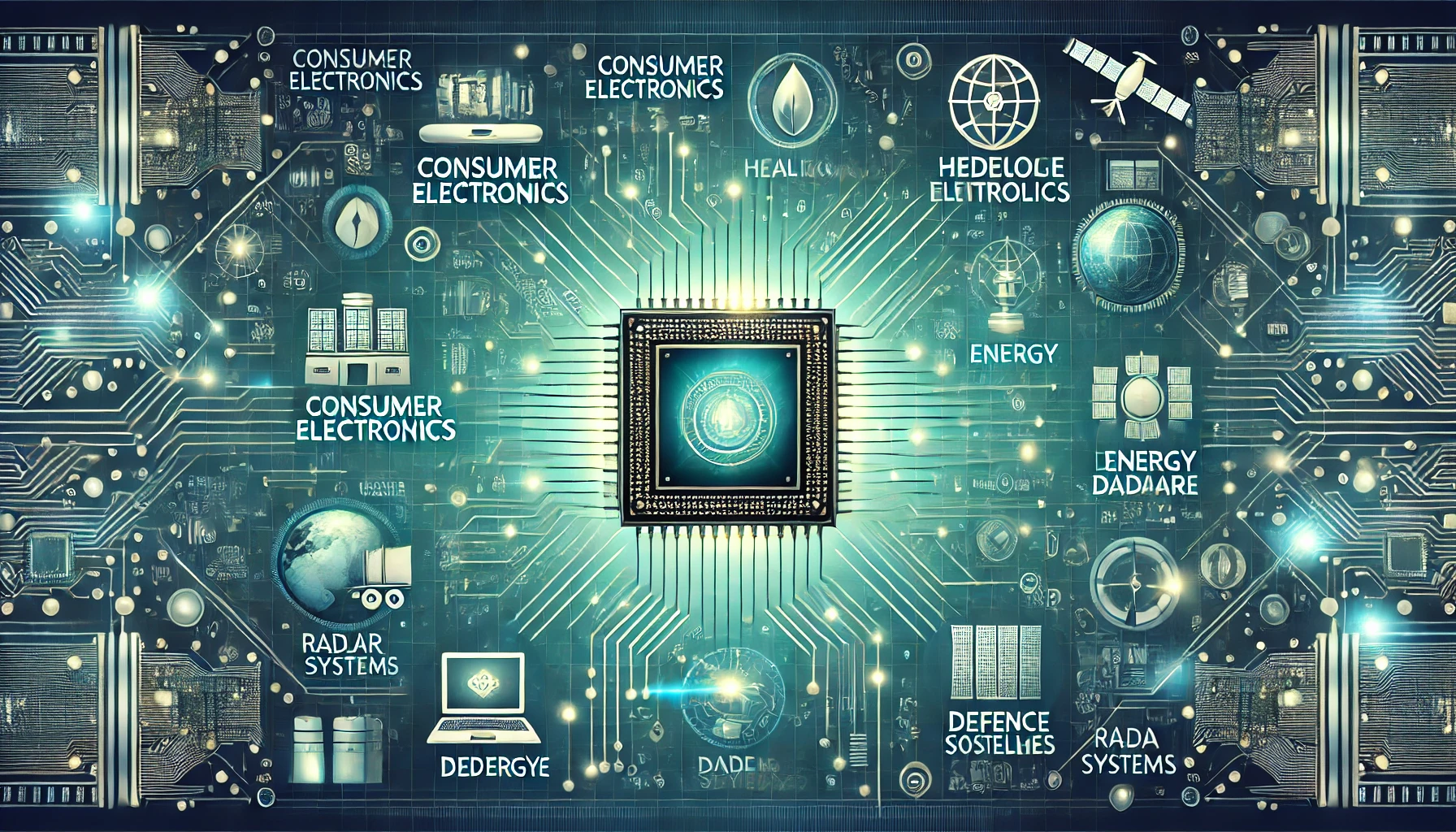 The Importance of the Semiconductor Industry
SEE MORE:
2. Semiconductor Material Production
- Key Processes:
- Manufacturing and processing silicon wafers – the core substrate material for chip production.
- Ensuring high purity (99.999999%) for optimal manufacturing efficiency.
- Leading Suppliers:
- Sumco (Japan): Specializes in silicon wafer and advanced material production.
- GlobalWafers (Taiwan): A leading supplier in the semiconductor substrate market.
3. Chip Fabrication (Semiconductor Fabrication)
- Manufacturing Process:
- Etching, printing, and creating semiconductor components from silicon wafers.
- Using advanced technologies like photolithography and ion implantation.
- Major Manufacturers:
- TSMC: A global leader in custom chip manufacturing (foundry services).
- Samsung Foundry: Provides advanced semiconductor solutions for consumer electronics and telecommunications.
- GlobalFoundries: Focuses on specialized chip production.
4. Assembly, Testing, and Packaging
- Process:
- Packaging manufactured chips into suitable modules or packages, ensuring connectivity and protection.
- Testing product performance and stability before shipment.
- Key Companies:
- ASE Group (Taiwan): The world’s largest packaging service provider.
- Amkor Technology (USA): A pioneer in advanced packaging technology for high-performance chips.
You Might Be Interested In:
Each component in the semiconductor value chain plays an essential role in creating advanced products, from mobile devices to AI systems. Collaboration among designers, manufacturers, and material suppliers ensures the continuous development and innovation of the global semiconductor industry.
Applications of Semiconductor Technology
- Consumer Electronics and Telecommunications
Semiconductor technology forms the foundation for devices like smartphones, laptops, TVs, and even 5G networks. Components like CPUs and GPUs ensure superior processing speed, energy efficiency, and fast connectivity. Central processing units (CPUs), graphics processing units (GPUs), and sensors all guarantee high performance, energy savings, and rapid connectivity in modern electronics and communication systems.
- Automotive and Renewable Energy
In the automotive industry, semiconductors support self-driving sensors, safety systems, and radar technology. In renewable energy, semiconductor chips optimize solar panel efficiency, energy storage, and smart energy management systems, contributing to sustainable resource usage.
- Artificial Intelligence
In AI and supercomputing, semiconductor chips optimize machine learning tasks and big data processing. GPUs and TPUs (Tensor Processing Units) are specially designed to accelerate computation and performance for AI systems, from image recognition to weather forecasting.
- Defense and Aerospace
Semiconductors play a core role in radar systems, navigation, and surveillance in military applications. In aerospace, semiconductor components are designed to operate reliably in harsh conditions, ensuring efficiency and reliability in space missions.
Key Technologies in the Semiconductor Industry
1. Chip Manufacturing Technology
- Photolithography Etching Process:
This foundational technology creates ultra-small structures on silicon wafers. With increasing precision, this technology has achieved 3nm resolution and is moving toward 2nm in the near future. This advancement plays a pivotal role in enhancing transistor performance and density.
2. Advanced Semiconductor Materials
- Graphene:
- Graphene – with its superior thermal and electrical conductivity – is ushering in a new era for the semiconductor industry, enabling the production of more compact and efficient devices. Additionally, 3nm etching technology and quantum chips are accelerating processing speeds to new heights. Graphene’s exceptional properties like high thermal and electrical conductivity and flexibility enhance the design of more compact and efficient semiconductor devices.
- Gallium nitride (GaN):
- GaN is an ideal material for applications requiring high energy efficiency, such as in power converters and high-speed RF devices.
3. 3D System Integration (3D IC Integration)
- This technology integrates multiple layers of stacked chips, reducing module size and enhancing processing performance. 3D integration also optimizes system-on-chip (SoC) designs, reducing power consumption and increasing data transmission speeds.
4. Quantum Chips
- Quantum chip technology is opening a new era for high-speed computing, especially in fields requiring massive data processing capabilities like artificial intelligence and quantum simulation. This is a breakthrough in solving problems that traditional computers cannot handle efficiently.
5. Photonics Technology
- Photonics is one of the key supporting technologies for high-speed data transmission applications. It involves manufacturing laser diodes, image sensors, and optical signal transmission devices, significantly reducing latency in computing systems.
These technologies not only drive the development of the semiconductor industry but also significantly impact other fields like artificial intelligence, the Internet of Things (IoT), and mobile technology. Continued investment in research and application will shape the future of global technology.
Semiconductor technology not only changes the way we live but also shapes the future of humanity. From smart devices to AI and renewable energy, semiconductors are driving sustainable development and global innovation. From smart devices to advanced systems in healthcare, energy, and defense, the semiconductor industry continuously propels human progress. Join us in embracing technological trends.
Loc Thien Chemicals Co., Ltd. is proud to be a provider of chemical and material solutions supporting various industrial sectors, including water treatment, manufacturing, and high-tech industries. With a commitment to quality and dedicated service, Loc Thien aims to contribute to sustainable development and elevate Vietnam’s industrial position in the global value chain. Let’s build a sustainable future together!
- 📞 Hotline: 0979 891 929
- 📩 Email: [email protected]
- 🌐 Website: hoachatlocthien.com
Frequently Asked Questions (FAQ)
- What is semiconductor technology and why is it important?
- It is the foundation of electronic devices, playing a decisive role in the performance and operation of all modern technological systems.
- What are the main applications of semiconductor technology?
- Semiconductor technology is used in smartphones, computers, self-driving cars, healthcare, renewable energy, and defense.
- What areas does the semiconductor industry cover?
- It includes chip design and development, semiconductor material production, chip fabrication, and assembly and packaging.
- Why is semiconductor technology called the backbone of high-tech?
- Because all smart devices, from phones and computers to AI and healthcare systems, rely on semiconductors to operate efficiently.
- What does the future of the semiconductor industry look like?
- The semiconductor industry will continue to grow strongly with technologies like AI, quantum computing, 3D integration, and advanced materials like graphene.