
Cation Polymer (PAM) Flocculant for Water Treatment -- Types, Applications & Sourcing
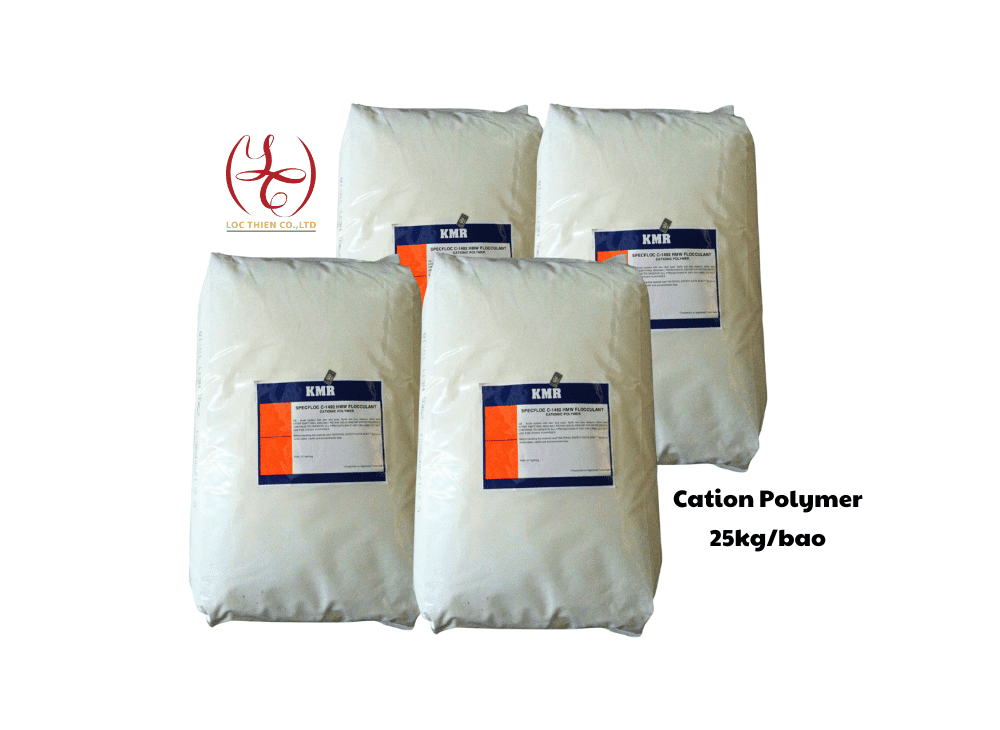
Table of contents
In this article, Loc Thien will introduce a new chemical product in the field of water treatment: Cation Polymer. As a coagulant, settling aid, and flocculant for water and sludge treatment, Loc Thien guarantees this will be the ideal chemical to make water purification easy.
Cation Polymer Chemical
Cation Polymer, also known as Polymer Cation, is a polymer compound carrying a positive charge (cation) that is widely used in wastewater treatment. It is a coagulant, settling aid, and flocculant compound that helps remove impurities and sediment from water. The chemical formula of Cation Polymer is typically represented as (C₃H₅ON)ₙ, where "n" denotes the number of repeating units in the polymer chain. Cation Polymer is an eye and skin irritant, existing as an off-white powder, highly soluble in water, odorless, highly corrosive, with high viscosity, and it remains effective in both basic and acidic environments.
 Cation Polymer packaging
Physical Properties of Cation Polymer
- State:
- Powder form: Cation Polymer typically exists as an off-white powder, which is easy to store and transport.
- When dissolved: It dissolves in water to form a viscous, highly uniform solution, suitable for many water treatment applications.
- Odor:
- Cation Polymer has no distinctive odor, making it easy to use in environments that require limited chemical odor.
- Solubility:
- It dissolves easily in water, even at room temperature. Once dissolved, the resulting solution has high viscosity, which improves the compound's coagulation and flocculation ability.
- Hygroscopicity:
- This compound has a strong ability to absorb moisture from the environment, causing it to swell quickly upon contact with water, which helps enhance efficiency in water treatment applications.
Chemical Properties of Cation Polymer
- Carries a positive charge: This charge comes from cationic functional groups such as:
- Quaternary amines: Compounds containing a quaternary ammonium group can hold a stable positive charge.
- Protonated amines: Easily accept protons in an aqueous environment, generating a positive charge.
- Phosphonium groups: Carry a stable positive charge, increasing the ability to interact with negatively charged particles.
- Effective across a wide pH range: Cation Polymer works effectively in many chemical environments:
- In acidic environments: The positive charge remains stable, effectively supporting the coagulation process.
- In alkaline environments: It does not lose activity and remains effective thanks to its stable chemical structure.
- This makes Cation Polymer suitable for many types of wastewater with different chemical properties.
- Coagulation ability: When added to wastewater, Cation Polymer interacts with negatively charged particles such as sludge, organic impurities, or inorganic compounds. This process includes:
- Charge neutralization: Suspended particles have their charge neutralized, breaking their stable state.
- Formation of large flocs: Small particles bind together, forming flocs large enough to settle quickly.
- This superior coagulation ability helps remove impurities effectively during wastewater treatment.
Thanks to these physicochemical properties, Cation Polymer becomes an ideal coagulant, capable of operating stably across a wide range of environmental conditions, from strong acid to strong alkali. Its flexibility and effectiveness have contributed significantly to the water treatment and waste management industries.
Learn more about Polymer Cation and Anion or what Poly Anion is
Properties
Product parameters are as follows:
- Molecular weight ranges from 8 million to 10 million
- Ion content ranges from 20% to 30%
- Dissolution time of cation polymer does not exceed 60 minutes
- Minimum specific gravity is 0.63g/cm3
- The product appears as small white crystals, and dissolves well in water.
- pH varies within the range of 3-10
- Viscosity of the solution at 20°C is 0.1%
Uses of Cation Polymer
Cationic polymer is well known for its use in treating industrial wastewater, domestic water, agricultural sludge waste, the paper industry, handicrafts, and animal feed, among others.
As a coagulation aid, it increases coagulation ability and helps solids such as heavy metals settle down. Cation Polymer significantly reduces suspended matter in water and improves waste settling.
Cation Polymer also increases the clarity and flow of water after removing coagulated substances. This substance also has strong water-absorbing properties as well as the ability to separate solids and liquids.
Cation Polymer used as a settling aid in water treatment.Cation Polymer is a popular choice thanks to its cost advantage and high effectiveness at low dosage. This substance does not alter the pH of either basic or acidic liquids, and it is gradually replacing the use of inorganic salts entirely.
For details on Polymer Cation C1492, you can find more information here.
Precautions and Storage
- Safety Precautions:
- Polymer Cation is a highly corrosive substance that can cause irritation and discomfort to the eyes and skin upon direct contact. Therefore, when working with it, be sure to wear complete personal protective equipment such as a mask, safety goggles, gloves, boots, and other protective gear.
- Storage:
- The product must be stored in containers made of non-corrosive materials such as stainless steel, fiberglass, or epoxy resin. Avoid using containers made of iron, copper, or aluminum, as they can corrode and degrade the product.
- When storing, place the product in a dry, cool location away from direct sunlight, water, and moisture, as Polymer Cation has a high moisture-absorbing capacity. The product should be stored in sealed containers, with a maximum storage period of 24 months at temperatures below 40°C.
Where to Buy Verified Cation Polymer
Our cationic polymer is carefully selected by Loc Thien Chemicals. Here, quality standards are extremely strict, and products are packaged in standard-quality plastic bags, making storage and transportation convenient. You can also check out other water treatment chemicals at Loc Thien to meet all your needs.
With genuine products and reasonable prices, we ensure long-term usage value while maximizing cost and time savings for our customers. So don't hesitate to contact Loc Thien at 0979 891 929 to receive a quote and consultation.
Technical Support & B2B Procurement Hotline
Loc Thien Chemical specializes in direct manufacturing of FeCl₂ / FeCl₃ and Tier-1 supply of basic industrial chemicals (NaOH, HCl, H₂SO₄, PAC, NaOCl, H₂O₂, FeSO₄) with direct B2B pricing and dedicated 5–30-ton tanker delivery across Vietnam.
- Hotline / Zalo: +84 979 891 929
- Official Email: [email protected]
- Direct Manufacturer: Ferrous Chloride (FeCl₂ 30%) & Ferric Chloride (FeCl₃ 38–40%)
- Primary Supplier: NaOH 32%/45%/50%/99%, HCl 32%, H₂SO₄ 98%, PAC 30–31%, NaOCl 10–12%, H₂O₂ 35%/50%
- Compliance & Quality: FeCl₂ ZDHC MRSL v3.1 test report (Smart testing, 5 substance groups, TUV Rheinland Vietnam), ISO 9001:2015, Quatest 3, Full COA & GHS SDS