
NaOH 32% vs 45% vs 50% — Choose Concentration by Operations
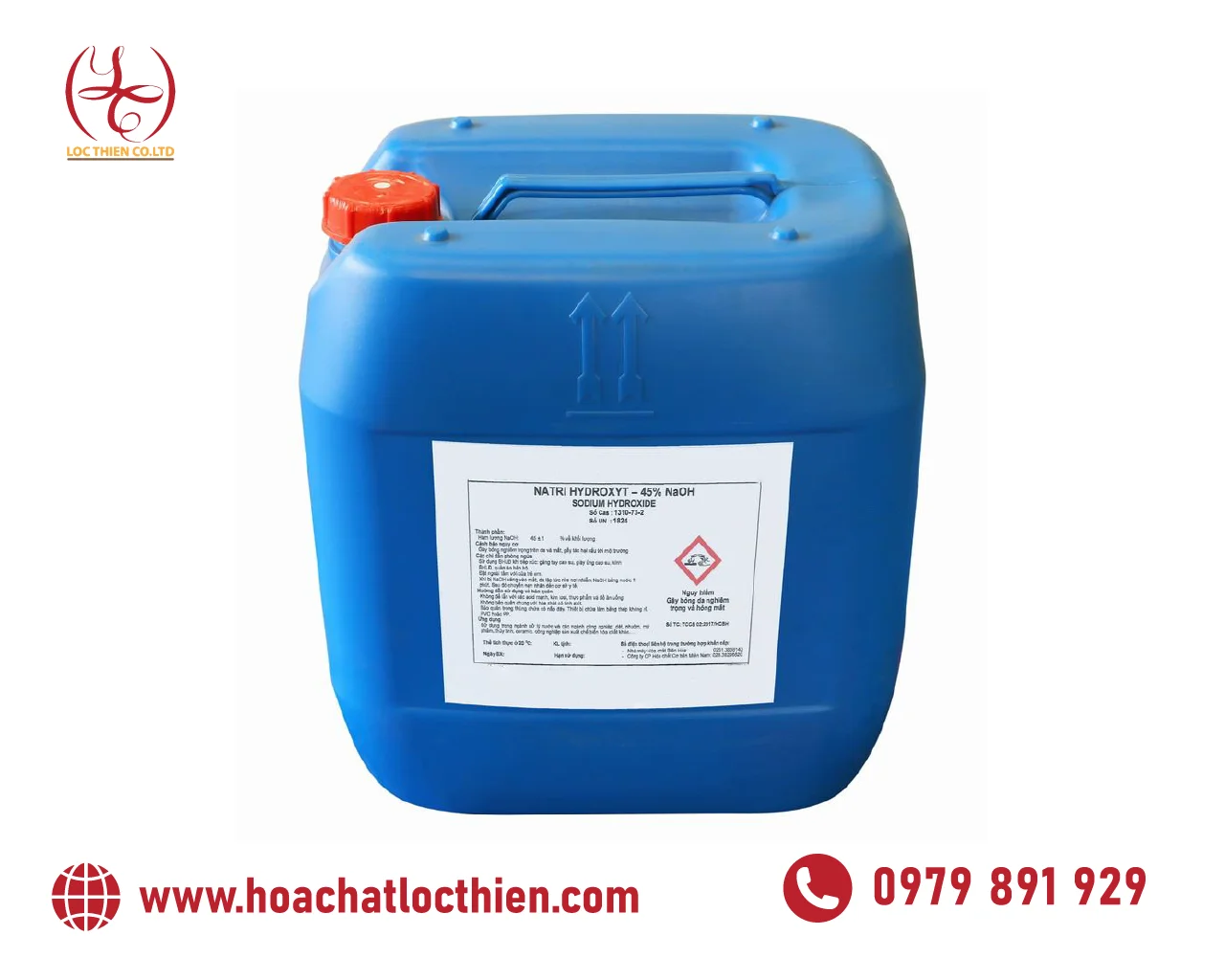
NaOH 32% vs 45% vs 50% — Choose Concentration by Operations
TL;DR: NaOH (caustic soda) at three concentrations — 32%, 45%, and 50% — has important technical differences: specific gravity 1.348 / 1.478 / 1.52 g/ml respectively, concentration-dependent freezing points, and different compatible tank materials. Operations engineers should select concentration based on dosing pump requirements, warehouse climate conditions, and industry — not price. Loc Thien supplies liquid NaOH 32%/45%/50% and flake NaOH 98% with batch COA, delivered by 5–30 ton tanker trucks nationwide from 6 warehouses. Hotline 0979 891 929.
Quick Facts on Commercial NaOH Concentrations
| Parameter | NaOH 32% | NaOH 45% | NaOH 50% |
|---|---|---|---|
| CAS | 1310-73-2 | ||
| Chemical formula | NaOH (Sodium Hydroxide — solution) | ||
| Specific gravity @20°C | 1.348 g/ml | 1.478 g/ml | 1.52 g/ml |
| Freezing point | Approx. +5°C | Approx. +6–7°C | Approx. +12°C |
| Supply packaging | Tanker truck, IBC tote, drum — on request | ||
| Documents per batch | MSDS/SDS + COA as requested | ||
| Impurity content | NaCl, Na₂CO₃ — per batch COA | ||
| Contact | Hotline 0979 891 929 — Loc Thien Chemical | ||
1. Specific Gravity of Three Concentrations: Impact on Measurement and Dosing Pumps
NaOH 32% has a specific gravity of 1.348 g/ml at 20°C, meaning each cubic meter of solution weighs 1,348 kg. At 45%, specific gravity rises to 1.478 g/ml (1,478 kg/m³), and at 50% it is 1.52 g/ml (1,520 kg/m³). This specific gravity difference directly affects how operators calculate dosage and select pump equipment. For the same volume of 1,000 liters, NaOH 50% weighs about 170 kg more than NaOH 32% — a significant enough difference to alter tank load and support structure requirements.
When designing dosing pumps, specific gravity determines motor power and discharge pressure. Diaphragm or gear pumps used for NaOH 32% may operate unstably when switched to NaOH 50% because the higher density forces the motor to produce more torque. For plants using Coriolis or magnetic flow meters, instrument accuracy depends on solution density — specific gravity parameters must be recalibrated whenever the concentration changes.
2. Freezing Point by Concentration — Cold-Weather Operating Considerations
Many engineers assume higher-concentration NaOH freezes at lower temperatures, but the opposite is true. Among the three commercial grades, NaOH 32% begins to crystallize at approximately +5°C and NaOH 45% at around +6–7°C — close to each other — while NaOH 50% crystallizes at around +12°C. Because the transition point on the phase diagram sits right around 32%, the ±1% concentration tolerance shifts the crystallization point of a 32% batch considerably (roughly +2 to +8°C for a 31–33% batch). This pattern follows the NaOH-H₂O phase diagram: at roughly 18–20% NaOH, the freezing point reaches its minimum (-28°C), then rises as concentration increases.
In Southern Vietnam's climate, dry-season night temperatures rarely drop below 15°C, so NaOH 32% (about +5°C) and 45% (about +6–7°C) are safe in outdoor tanks under normal conditions. NaOH 50% with its +12°C freezing point requires clearly more attention: if the tank is in an area where temperatures drop below 12°C overnight (Northern Vietnam, Central Highlands in winter), the solution can crystallize, clogging pipes and damaging pumps. The solution for plants using NaOH 50% with outdoor tanks is heat tracing on piping or switching to tank insulation. Crystals may not appear right away even below the crystallization point, and outdoor pipes, valves and pump heads crystallize first. Reference figures follow the NaOH–H₂O phase diagram and technical literature from caustic soda producers; the actual crystallization point depends on each batch's concentration per its COA/TDS.
3. Tank and Piping Materials Compatible with Each Concentration
NaOH at all three concentrations is highly corrosive to aluminum, zinc, and their alloys. Safe tank materials for liquid NaOH are carbon steel (black steel) for concentrations of 32% and 45% — the Fe₃O₄ oxide layer forming on the inner surface creates a protective passive film. For NaOH 50%, corrosivity is higher at temperatures above 50°C; stainless steel 304L or 316L is recommended if operating temperature exceeds this threshold.
NaOH piping must be black steel, minimum Schedule 40 thickness — never galvanized pipe, as zinc reacts with NaOH to produce hydrogen gas and corrodes rapidly. Gaskets and seals in the piping system should be PTFE or EPDM — do not use natural rubber or Buna-N as they become brittle in concentrated alkaline environments. Valves and fittings should be 304 stainless steel with a minimum working pressure of 10 bar, especially when operating with NaOH 50% and discharging via centrifugal pump.
4. NaOH Dilution Notes — Heat Release and Operating Safety
NaOH dilution generates significant heat, especially when diluting from high to low concentration. One kg of anhydrous NaOH dissolving in water releases approximately 44.2 kJ of heat, enough to raise solution temperature to 70–80°C if the rate is uncontrolled. With NaOH 50% diluted to 32%, the generated heat can melt HDPE tanks or cause steam burns to operators. Mandatory safety rule: slowly add concentrated NaOH to water while stirring continuously — never the reverse.
When diluting directly in large storage tanks (5–30 tons), design the concentrated NaOH inlet point near the agitator blade so the solution disperses quickly, avoiding thermal stratification. Mandatory PPE for this step: splash-proof safety glasses, thick nitrile or neoprene gloves, PVC apron, and chemical-resistant boots. An emergency eyewash station must be within 10 meters of the dilution area. Loc Thien recommends that every NaOH-operating plant keep the batch SDS posted at the feed and tank areas for operator reference when needed.
5. Choosing Concentration by Industry — Textile Dyeing, Paper, Oil & Gas
Each industry has a suitable NaOH concentration based on process requirements and operating conditions. The textile dyeing industry typically uses NaOH 32–45% for scouring to remove pectin, waxes, and natural impurities from cotton fibers. At 32%, the solution is less viscous, penetrates fibers more deeply, and scouring temperature (100–130°C) is easier to control. For denim and polyester-cotton dyeing plants, NaOH 45% reduces scouring water volume and shortens batch cycles.
The paper and pulp industry prioritizes NaOH 45% for alkaline pulping (kraft pulping). At this concentration, the NaOH + Na₂S mixture (white liquor) maintains stable active alkalinity in the digester, ensuring 90–95% lignin removal efficiency. The oil and gas industry — especially drilling fluids and acid gas treatment — uses NaOH 50% because strong alkalinity is needed in minimal volume. The 50% concentration is also preferred on offshore platforms to reduce supply frequency and storage tank footprint. For wastewater treatment and pH adjustment plants, NaOH 32% is sufficient and easy to dose — see the guide at how to mix NaOH for wastewater treatment.
6. Anonymous Case Study — Switching from NaOH 32% to 45% in a Textile Plant
A textile dyeing plant in Tan Tao Industrial Park (Ho Chi Minh City) operates three 20 m³ NaOH 32% storage tanks serving two scouring lines with a capacity of 120 tons of fabric per day. Pressure from transport costs and warehouse capacity drove the plant to consider switching to NaOH 45%. Loc Thien's field engineer — technician Phan Cam Thuy — surveyed the system and found: the existing carbon steel tanks could handle NaOH 45% at temperatures below 50°C, but the dosing pump needed a pump head upgrade due to the specific gravity increase from 1.348 to 1.478 g/ml.
After replacing the pump and recalibrating the flow meter, the plant switched to NaOH 45% and reduced its tanker deliveries by 2 trips per month (from 12 down to 10), saving approximately 15% in logistics costs on a total NaOH consumption of 180 tons/month. Scouring quality remained unchanged: the whiteness index and wettability of raw fabric met the same specs as when using NaOH 32%. This case study illustrates that increasing NaOH concentration is feasible if tank materials and pump equipment are verified beforehand, and a field engineer should assess the site before conversion.
7. Transporting NaOH by Tanker Truck — Key Technical Specifications
Liquid NaOH at all three concentrations is classified as a Class 8 dangerous good (corrosive), UN 1824. Tanker trucks carrying NaOH must be made of 304L stainless steel or lined carbon steel, with bottom discharge valves and a closed vapor recovery system. When delivering NaOH 32%, average discharge time for a 20-ton tanker is 40–60 minutes using the truck-mounted hydraulic pump. For NaOH 50% — specific gravity 1.52 g/ml — the pump needs higher power; some specialized tankers use a vacuum pump combined with a centrifugal pump to shorten discharge time to 35–45 minutes for the same load.
Loc Thien's tanker fleet operates on regular schedules with 5–30 ton capacity per trip, serving deliveries to industrial parks across all three regions. Before each load, the truck's safety valves, pressure gauges, and tank cleanliness are checked per internal procedures. Every delivery includes a batch COA, Vietnamese-language MSDS/SDS, and a delivery note stating the concentration and specific gravity measured at the time of dispatch. Details on delivery specifications and ordering can be found in the article buying industrial NaOH — nationwide delivery.
8. Overall Comparison of Three Concentrations — Decision Table for Engineers
| Criterion | NaOH 32% | NaOH 45% | NaOH 50% |
|---|---|---|---|
| Specific gravity @20°C | 1.348 g/ml | 1.478 g/ml | 1.52 g/ml |
| Mass per 1 m³ | 1,348 kg | 1,478 kg | 1,520 kg |
| Freezing point | ~ +5°C | ~ +6–7°C | ~ +12°C |
| Standard tank material | Carbon steel, HDPE | Carbon steel, SS304 | Carbon steel (temp <50°C), SS304L |
| Dilution heat | Lowest | Moderate | Highest |
| Dosing pump | Standard pump | Pump head upgrade needed | High-power pump needed |
| Typical industry | Wastewater, neutralization, light textile dyeing | Textile dyeing, kraft paper | Oil & gas, chemicals, heavy water treatment |
| Operating advantage | Easy dosing, freezing point about +5°C | Fewer truck trips, freezing point about +6–7°C | Highest alkalinity, smallest volume |
The table above helps operations engineers quickly compare the three options before making a decision. Choosing a concentration depends not only on chemical requirements but also on existing warehouse infrastructure (tank material, ambient temperature), current pump equipment, and delivery frequency. Loc Thien is ready to send a field engineer to survey your warehouse and equipment before recommending the right concentration — especially for plants converting from low to high concentrations.
9. NaOH Flakes 98% — Alternative to Liquid Concentrations
Beyond the three liquid concentrations, NaOH flakes 98% (25 kg bags) are an alternative for plants without liquid storage tanks or needing volume flexibility. Bulk density of flake NaOH is approximately 0.8–1.1 kg/liter (depending on porosity), and it must be dissolved into solution before use. To make NaOH 32% from flakes, every 100 kg of 98% flakes mixed with approximately 206 liters of water yields about 306 kg, or roughly 227 liters, of 32% solution (specific gravity 1.348 g/ml).
The advantage of flake NaOH is its longer shelf life compared to liquid solution (over 12 months if sealed and kept dry), but labor costs for mixing and the safety risk of dissolution (high heat release) are factors to consider. Loc Thien supplies NaOH flakes 98% with COA — with NaCl and Na₂CO₃ content reported per batch — officially imported, delivered by truck from 6 warehouses nationwide. Details on specifications and parameters can be found in the article industrial NaOH flakes — specifications and applications.
10. Storage and PPE for High-Concentration NaOH Operations
NaOH storage areas need waterproof concrete floors with spill containment bund walls at least 150 mm high, separated from acid storage areas. NaOH 50% tanks should be under a roof or enclosed to prevent rain from diluting the surface solution and causing localized lid corrosion. Warehouse ventilation should achieve at least 6 air exchanges per hour — while liquid NaOH does not evaporate at room temperature, water vapor rising from the solution surface carries alkalinity.
Minimum PPE for operating NaOH at all concentrations: splash-proof sealed safety glasses, long nitrile or neoprene gloves, PVC chemical-resistant jacket. For bottom tank valve opening and tanker truck connection, add a full-face respirator and alkali-resistant apron. An emergency eyewash station and safety shower must be within 10 meters of the transfer area — inspected weekly with documented records. Loc Thien provides MSDS/SDS with each shipment, including Vietnamese safety instructions.
11. Loc Thien's NaOH Supply Capability
Loc Thien Chemical (tax code 0313650856) supplies NaOH in all four forms: liquid 32%, 45%, 50%, and flakes 98%. The 5–30 ton tanker fleet operates on schedule from 6 strategic warehouses: Ba Ria – Vung Tau, Dong Nai, Binh Duong, Da Nang, Can Tho, Bac Ninh. Each batch has its own COA stating actual concentration, measured specific gravity, NaCl and Na₂CO₃ content — ensuring traceability for plants with ISO 9001 systems or internal audit requirements.
The field engineering team includes technicians Phan Cam Thuy and Vo Thi Nhu Hoa — specializing in concentration selection, tank and pump equipment surveys before concentration changes. For businesses new to large-scale NaOH use, Loc Thien assists with tank-piping layout design and required PPE checklists. See the price list and delivery specifications in the article NaOH price today — liquid and flake caustic soda quotes and the product page NaOH — Sodium Hydroxide — Caustic Soda.
Should you choose NaOH 32%, 45%, or 50% for your plant?
There is no single answer for all three concentrations. NaOH 32% suits wastewater treatment, neutralization, and industries needing simple dosing — advantages: low specific gravity (d=1.348), easy pumping, a freezing point of about +5°C that is safe for outdoor storage in Southern Vietnam. NaOH 45% is the optimal choice for textile dyeing and paper — freezing point about +6–7°C, close to that of 32%, fewer truck trips than 32% while easier to handle than 50%. NaOH 50% is for oil & gas and chemical industries needing strong alkalinity in minimal volume — but requires SS304L tanks, heat tracing, and high-power pumps. If still unsure, call 0979 891 929 for a Loc Thien engineer to advise based on your actual warehouse infrastructure and equipment.
12. Tank Discharge and System Cleaning Notes
NaOH discharge from storage tanks to the process basin requires a bottom discharge valve with a safety lock and Schedule 80 black steel piping. When performing periodic tank cleaning, never use hot water — the exothermic reaction between residual NaOH and hot water can cause a sudden temperature spike, generating steam pressure and tank bulging. Standard cleaning procedure: drain the solution completely, flush with cold water through the bottom valve, neutralize the flush water with dilute acid to pH 7–8 before discharge, then rinse twice with clean water.
Tank labels must clearly state: NaOH concentration, design capacity, maximum working temperature, and most recent pressure test date. Plants with multiple NaOH concentrations in the same warehouse should use color coding for each tank (e.g., light blue for 32%, dark blue for 45%, green for 50%) and keep corresponding SDS sheets in visible locations. Monthly inspection logs help detect early signs of tank wall corrosion or valve leaks.
Frequently Asked Questions About NaOH 32%–45%–50% Operations
Which NaOH concentration has the lowest freezing point?
Among the three commercial grades, NaOH 32% (about +5°C) and 45% (about +6–7°C) have close freezing points, while NaOH 50% freezes clearly higher, at about +12°C. A batch of nominal 32% (31–33% actual) can start crystallizing anywhere from about +2 to +8°C. The eutectic curve of the NaOH-H₂O system reaches its minimum at around 18–20% (far below 0°C), then rises with concentration.
Can I use the same storage tank for NaOH 32% and 45%?
Yes, if the tank is designed for the higher of the two concentrations (45%) and is thoroughly cleaned before switching. However, continuous back-and-forth switching is not recommended because the specific gravity difference causes errors in tank level readings from hydrostatic pressure sensors.
What materials cannot be used for NaOH 50% storage tanks?
Aluminum and zinc are absolutely unusable. HDPE can be used for NaOH 50% at temperatures below 40°C, but the primary recommendation is 304L or 316L stainless steel for 50%, carbon steel for 32–45% when temperature is below 50°C.
Why is NaOH 32% more common than the two higher concentrations?
NaOH 32% is the easiest to operate: low specific gravity (d=1.348), standard dosing pumps work well, minimal heat release when diluting, and compatible with standard carbon steel or HDPE tanks. It is the safe choice for plants new to large-scale NaOH use.
Is diluting NaOH from 50% down to 32% dangerous?
Yes, if the dilution rate and temperature are uncontrolled. The released heat can reach 70–80°C, bulging HDPE tanks or causing steam burns. Slowly add concentrated NaOH to cold water with continuous stirring, and have PPE + eyewash station ready in the dilution area.
When should I choose 98% flake caustic soda instead of liquid?
When the plant has no liquid storage tanks, monthly consumption is irregular, or long-term storage is needed — flake caustic soda keeps for over 12 months. Disadvantages: labor cost for mixing and high heat release risk during dissolution.
How do I verify NaOH concentration upon delivery?
Measure specific gravity with a hydrometer at 20°C and compare to the batch COA. NaOH 32% specific gravity is 1.348, 45% is 1.478, 50% is 1.52 g/ml. A significant deviation from the COA value is abnormal — report it to the supplier. Titration with standard HCl acid is a more accurate method, commonly used for incoming QC inspection.
Are tanker trucks for NaOH 50% different from those for 32%?
NaOH 50% tankers need a higher-power pump due to higher specific gravity (1.52 vs 1.348 g/ml), and the tank body is typically 304L stainless steel instead of carbon steel. Discharge time for the same load is about 10–15% longer if the pump is not upgraded.
What is the optimal storage temperature for liquid NaOH?
As a general guideline (confirm with the producer or your system designer), the optimal storage temperature for all three NaOH concentrations is 15–40°C. Below 15°C, NaOH 50% risks crystallization. Above 50°C, the corrosion rate of carbon steel tanks increases rapidly — stainless steel tanks are needed if temperature exceeds this threshold.
Does Loc Thien deliver NaOH 45% by tanker truck?
Yes. Loc Thien delivers NaOH 32%, 45%, and 50% by 5–30 ton tanker trucks from 6 warehouses nationwide. Each batch has its own COA and Vietnamese-language MSDS/SDS. Call 0979 891 929 to schedule delivery to your industrial park.
Summary: Choose NaOH Concentration by Operations, Not by Price
Three NaOH concentrations — 32%, 45%, and 50% — differ in specific gravity (1.348 / 1.478 / 1.52 g/ml), freezing point (about +5°C / +6–7°C / +12°C), compatible tank materials, and pump equipment requirements. Operations engineers choose concentration based on four factors: (1) the technological requirements of the industry, (2) existing warehouse and tank infrastructure, (3) regional climate conditions, and (4) dosing pump equipment capacity. No concentration is absolutely "better" — the right concentration is the one compatible with the plant's operating system.
Loc Thien Chemical — Tax code 0313650856 — supplies NaOH 32%, 45%, 50% in liquid form and flake caustic soda 98% with batch COA, Vietnamese-language MSDS/SDS. Tanker fleet 5–30 tons, 6 warehouses in three regions, scheduled delivery. Field engineers Phan Cam Thuy and Vo Thi Nhu Hoa are ready to survey your warehouse and advise on the right concentration. Call hotline 0979 891 929 or visit the product page NaOH — Sodium Hydroxide — Caustic Soda.
Need advice on choosing the right NaOH concentration for your plant?
Call hotline 0979 891 929 or submit a technical request — specify desired concentration, volume, and delivery location for a field engineer consultation.
Last updated: 01/09/2026.
Loc Thien Investment and Development Co., Ltd. — MST 0313650856 · 452/6B Tinh Lo 10 (Provincial Road 10), Binh Tri Dong Ward, Ho Chi Minh City · ☎ 0979 891 929 · hoachatlocthien.com
Learn more: NaOH price today — liquid and flake caustic soda quotes · Buy industrial NaOH — nationwide delivery · Industrial NaOH flakes · How to mix NaOH for wastewater treatment
QC: Phan Cam Thuy & Vo Thi Nhu Hoa. COA per lot. Hotline 0979 891 929.
Technical Support & B2B Procurement Hotline
Loc Thien Chemical specializes in direct manufacturing of FeCl₂ / FeCl₃ and direct industrial supply of basic chemicals (NaOH, HCl, H₂SO₄, PAC, NaOCl, H₂O₂, FeSO₄) with direct B2B pricing and dedicated 5–30-ton tanker delivery across Vietnam.
- Hotline / Zalo: +84 979 891 929
- Official Email: [email protected]
- Direct Manufacturer: Ferrous Chloride (FeCl₂ 30%) & Ferric Chloride (FeCl₃ 38–40%)
- Primary Supplier: NaOH 32%/45%/50%/99%, HCl 32%, H₂SO₄ 98%, PAC 30–31%, NaOCl 10–12%, H₂O₂ 35%/50%
- Compliance & Quality: FeCl₂ ZDHC MRSL v3.1 test report (Smart testing, 5 substance groups, TUV Rheinland Vietnam), ISO 9001:2015, Quatest 3, Full COA & GHS SDS