Hydrated Lime Ca(OH)2 in Boiler Flue Gas Desulfurization (FGD): Scrubbing SO2, HCl & HF Under QCVN 19:2024/BTNMT
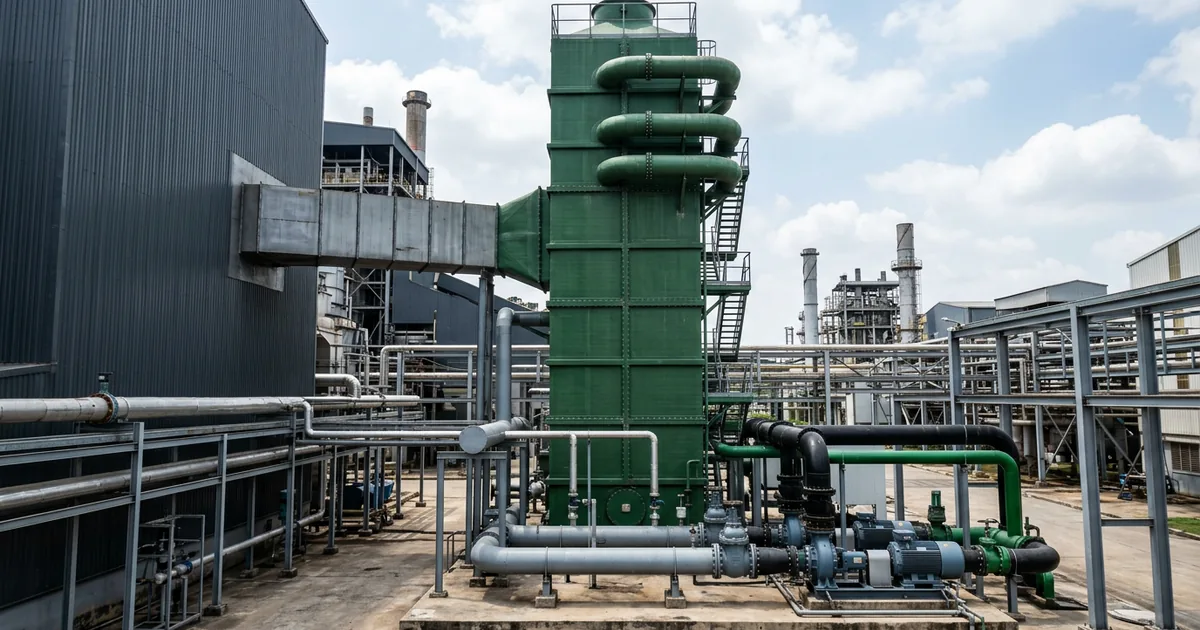
Key Technical Summary: In coal-fired, fuel-oil, and biomass industrial boilers as well as medical and hazardous waste incinerators, combustion of sulfur-, chlorine-, and fluorine-bearing fuels generates flue gas containing 500–3,500 mg/Nm3 of Sulfur Dioxide (SO2), HCl, and HF. Refined Hydrated Lime [Calcium Hydroxide Ca(OH)2, fineness ≥ 325 mesh, high BET specific surface area] serves as the primary alkaline sorbent across three Flue Gas Desulfurization (FGD) technologies: (1) Wet Lime Spray Towers with forced air oxidation (92%–98% SO2 removal, converting CaSO3 into marketable Gypsum CaSO4.2H2O at pH 5.4–6.2); (2) Semi-Dry Spray Dryer Absorbers (SDA, 85%–92% removal, zero liquid discharge); and (3) Dry Sorbent Injection (DSI) upstream of baghouse filters. Stoichiometrically, scrubbing 1.00 kg of SO2 requires 1.157 kg of pure 100% Ca(OH)2, corresponding to 1.36 kg of commercial Ca(OH)2 92% in Wet FGD (Ca/S = 1.08) or 2.07 kg in Dry DSI (Ca/S = 1.65). In Vietnam, Loc Thien Chemical (Tax ID: 0313650856) supplies industrial chemicals in bulk from 6 strategic industrial park warehouses (Ba Ria - Vung Tau, Dong Nai, Binh Duong, Da Nang, Can Tho, Bac Ninh) via a dedicated 5–30-ton tanker fleet with batch-specific COA and 16-section GHS SDS — contact hotline 0979 891 929 for a technical quote within 15 minutes.
Table of contents
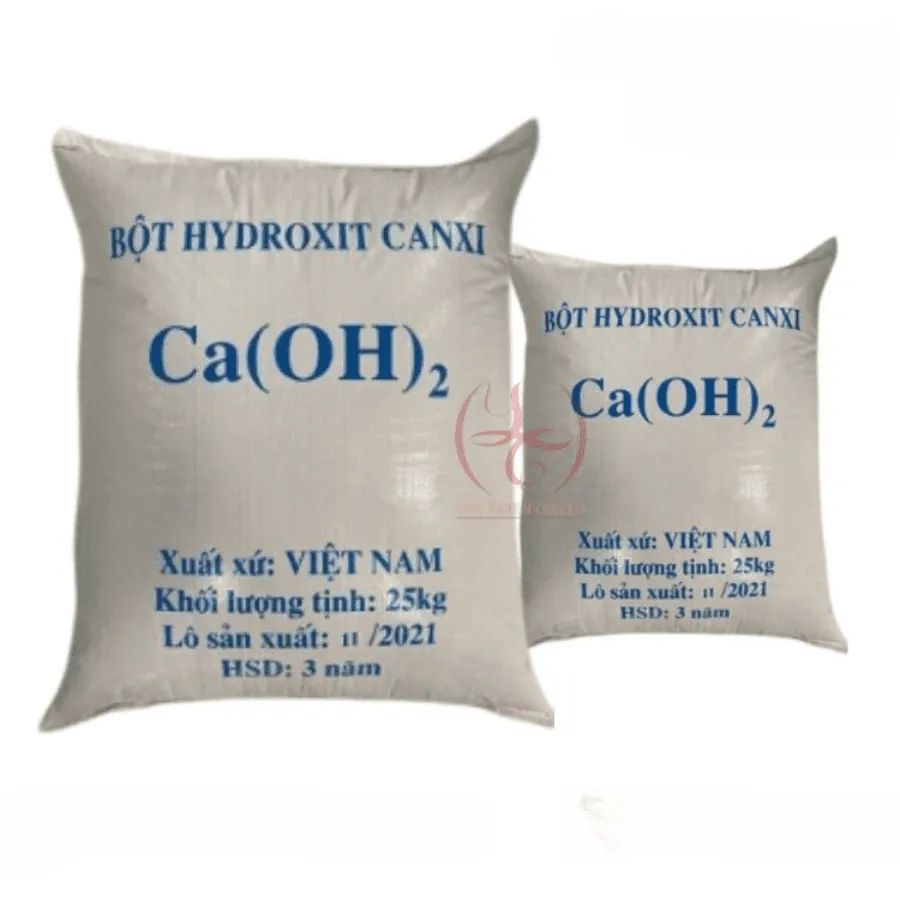
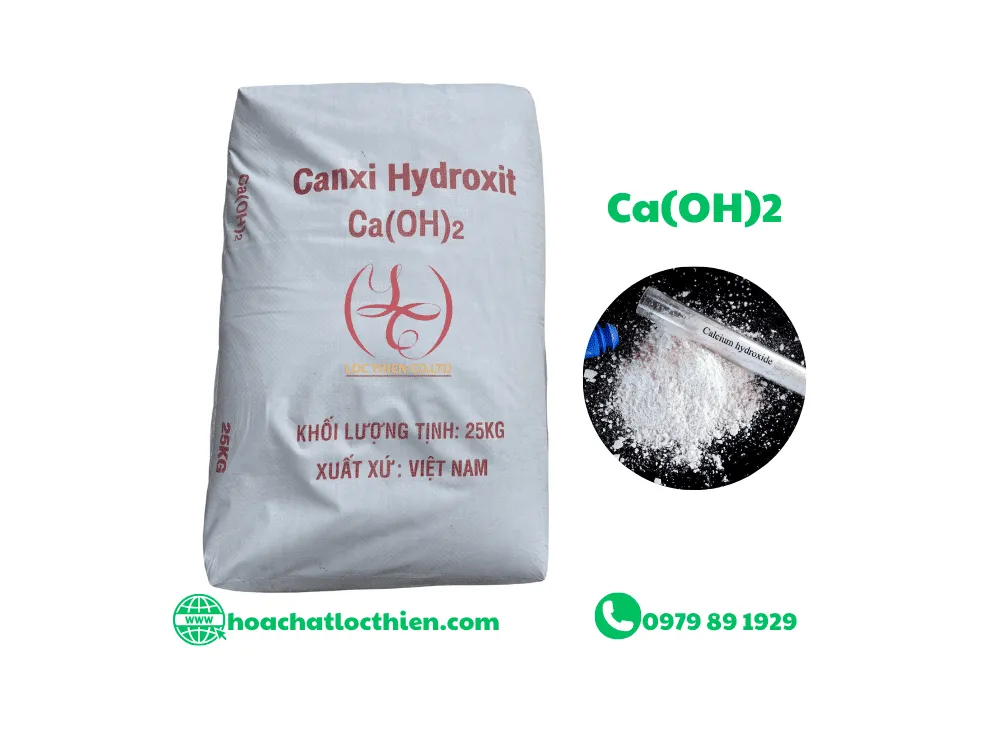
To control stack emissions from coal-fired, fuel-oil (FO), and biomass industrial boilers as well as hazardous and medical waste incinerators under Vietnam’s national industrial emission regulation QCVN 19:2024/BTNMT (SO₂ ≤ 300 mg/Nm³, HCl ≤ 50 mg/Nm³, HF ≤ 5 mg/Nm³), Industrial Hydrated Lime Ca(OH)₂ 96% (Calcium Hydroxide, CAS 1305-62-0) serves as the primary Flue Gas Desulfurization (FGD) and acid-gas sorbent. Because Ca(OH)₂ neutralizes acidic flue gases instantaneously (1.00 kg SO₂ requires 1.157 kg theoretical Ca(OH)₂) and precipitates dissolved sulfur out of the aqueous loop as marketable solid Gypsum (CaSO₄·2H₂O), ultrafine ≥ 325 mesh Ca(OH)₂ supplied by Loc Thien Chemical (Commercial Industrial Chemical Supplier — Tax ID 0313650856) is deployed across Wet Forced-Oxidation FGD Spray Towers, Semi-Dry Spray Dryer Absorbers (SDA), and Dry Sorbent Injection (DSI) baghouse systems.
1. Multiphase Reaction Chemistry of SO₂, SO₃, HCl & HF Capture and Forced Oxidation to FGD Gypsum
When sulfur-bearing coal (S = 0.5% – 3.0% w/w), heavy fuel oil, or PVC/fluoropolymer-containing industrial waste burns inside a boiler furnace at 850 – 1,200 °C, fuel sulfur oxidizes into gaseous Sulfur Dioxide (SO₂, 500 – 3,500 mg/Nm³) with 1% – 3% converting into Sulfur Trioxide (SO₃ sulfuric acid mist), alongside highly corrosive Hydrogen Chloride (HCl) and Hydrogen Fluoride (HF). Inside a hydrated lime scrubber, gas-liquid-solid mass transfer proceeds through two distinct chemical stages:
Stage 1: Acid Gas Absorption, Bisulfite Mass-Transfer Enhancement & Halide Neutralization (SO₂, SO₃, HCl, HF)
- Primary Sulfur Dioxide (
SO₂) Neutralization (Calcium Sulfite Hemihydrate Precipitation):SO₂ (gas) + Ca(OH)₂ (aq/slurry) → CaSO₃·½H₂O↓ (Calcium Sulfite Hemihydrate) + ½H₂O (ΔH = -109 kJ/mol)
- Mildly Acidic Bisulfite Dissolution Loop (
pH 5.2 – 6.0Mass-Transfer Acceleration):- In the lower absorption zone (
pH 5.2 – 6.0), newly precipitatedCaSO₃reacts with incomingSO₂to form highly soluble Calcium Bisulfite (Ca(HSO₃)₂), which eliminates liquid-film mass-transfer resistance before being re-neutralized by fresh Milk of Lime in the reaction sump: CaSO₃ + SO₂ + H₂O → Ca(HSO₃)₂ (aq)Ca(HSO₃)₂ (aq) + Ca(OH)₂ (slurry) → 2CaSO₃·½H₂O↓ + H₂O
- In the lower absorption zone (
- Sulfur Trioxide (
SO₃/ Sulfuric Acid MistH₂SO₄) Capture:SO₃ (gas) + Ca(OH)₂ + H₂O → CaSO₄·2H₂O↓ (Gypsum)
- Irreversible Strong Acid Halide (
HCl&HF) Scrubbing:- Because
HClandHFhave vastly higher acid dissociation constants thanSO₂, they react instantaneously upon entering the scrubber quench zone: 2HCl (gas) + Ca(OH)₂ → CaCl₂ (aq, soluble) + 2H₂O2HF (gas) + Ca(OH)₂ → CaF₂↓ (insoluble Fluorite precipitate) + 2H₂O
- Because
Stage 2: Forced Air Oxidation Converting CaSO₃·½H₂O into Commercial Gypsum (CaSO₄·2H₂O)
If a Wet FGD system stops at CaSO₃·½H₂O, calcium sulfite crystallizes as ultrafine, micron-sized flat platelets (5 – 15 µm) that trap water tenaciously (thixotropic sludge that resists vacuum filtration) and form sticky Sulfite Soft Scale inside nozzles. By sparging compressed air from Roots blowers into the bottom reaction sump maintained at pH = 5.2 – 5.8, dissolved bisulfite (HSO₃⁻) and CaSO₃·½H₂O are oxidized ≥ 98% into coarse prismatic FGD Gypsum (CaSO₄·2H₂O, crystal size 50 – 100 µm), which settles rapidly and dewaters easily on vacuum belt filters to ≤ 10% – 15% moisture for reuse in cement and gypsum board manufacturing:
- Forced Oxidation Reaction:
2CaSO₃·½H₂O + O₂ (air) + 3H₂O → 2CaSO₄·2H₂O↓ (Coarse Prismatic FGD Gypsum)
Table 1: Specific Consumption of Commercial Hydrated Lime Ca(OH)₂ 92% per 1 kg Acid Gas & FGD Sorbent COA
| Flue Gas Pollutant | Molar Mass (M, g/mol) | Stoichiometric Molar Ratio (Ca / Gas) | Theoretical 100% Ca(OH)₂ per 1 kg Gas (kg/kg) | Wet FGD Dosage of Ca(OH)₂ 92% (Ca/S = 1.08) | Semi-Dry SDA Dosage of Ca(OH)₂ 92% (Ca/S = 1.40) | Dry DSI Dosage of Ca(OH)₂ 92% (Ca/S = 1.65) |
|---|---|---|---|---|---|---|
Sulfur Dioxide (SO₂) | 64.06 | 1 : 1 | 1.157 kg | 1.36 kg Ca(OH)₂ 92% / kg SO₂ | 1.76 kg Ca(OH)₂ 92% / kg SO₂ | 2.07 kg Ca(OH)₂ 92% / kg SO₂ |
Sulfur Trioxide (SO₃) | 80.06 | 1 : 1 | 0.925 kg | 1.09 kg Ca(OH)₂ 92% / kg SO₃ | 1.41 kg Ca(OH)₂ 92% / kg SO₃ | 1.66 kg Ca(OH)₂ 92% / kg SO₃ |
Hydrogen Chloride (HCl) | 36.46 | 1 : 2 | 1.016 kg | 1.19 kg Ca(OH)₂ 92% / kg HCl | 1.55 kg Ca(OH)₂ 92% / kg HCl | 1.82 kg Ca(OH)₂ 92% / kg HCl |
Hydrogen Fluoride (HF) | 20.01 | 1 : 2 | 1.851 kg | 2.17 kg Ca(OH)₂ 92% / kg HF | 2.82 kg Ca(OH)₂ 92% / kg HF | 3.32 kg Ca(OH)₂ 92% / kg HF |
COA Quality Parameter (FGD-Grade Ca(OH)₂) | Specification Limit (Loc Thien Chemical) | Engineering Impact on FGD Scrubbers & Baghouse DSI |
|---|---|---|
Active Calcium Hydroxide (Ca(OH)₂) | ≥ 92.0% – 96.0% w/w | High neutralizing capacity; minimizes inert ash loading in gypsum cake |
Particle Fineness (325 Mesh / 45 µm Sieve Residue) | ≥ 98.5% passing 325 mesh (d₉₀ ≤ 35 µm) | Prevents SiC nozzle erosion in Wet FGD and ensures rapid gas-solid diffusion in DSI |
| BET Specific Surface Area & Pore Volume | BET ≥ 18 – 35 m²/g | Essential for 1.5 – 3.0 second in-duct SO₂ / HCl / HF capture upstream of baghouses |
Acid Insoluble Matter (SiO₂ + Silicates) & Moisture | Insolubles ≤ 0.50% | Moisture ≤ 0.80% | Free-flowing powder; eliminates screw-feeder bridging and slurry pump impeller wear |
Expert Technical Note — QC Specialist Phan Cam Thuy (Loc Thien Chemical): “Using low-grade agricultural lime (
Ca(OH)₂ < 80%, coarse grit> 150 mesh, silica> 4%) in an FGD loop erodes high-velocity Silicon Carbide spray nozzles within 3 months and leaves un-slakedCaOcores that blind vacuum belt filter cloths. Specifying Refined Industrial Hydrated Lime Ca(OH)₂ 96% (≥ 325 mesh) verified by batch COA guarantees> 92%sorbent utilization and stable pump operation.”
2. Engineering Comparison of Wet Lime FGD, Semi-Dry SDA, and Dry Sorbent Injection (DSI)
Depending on boiler steam capacity, fuel sulfur content, and industrial park wastewater discharge limits (TDS), environmental engineers select one of three Ca(OH)₂ scrubbing configurations:
Table 2: Engineering Comparison Matrix of Three Ca(OH)₂ Flue Gas Desulfurization Technologies
| Technical Criterion | 1. Wet Lime FGD (Open Spray Tower) | 2. Semi-Dry Spray Dryer Absorber (SDA) | 3. Dry Sorbent Injection (DSI + Baghouse) |
|---|---|---|---|
Ca(OH)₂ Feed State | 10% – 15% w/w Milk of Lime slurry sprayed via large-orifice SiC hollow-cone nozzles in an unpacked tower. | 15% – 25% w/w Lime slurry atomized (50 µm droplets) by a 10,000 rpm rotary atomizer, evaporating dry in hot flue gas. | Dry ≥ 325–400 mesh Ca(OH)₂ powder pneumatically injected into the flue duct upstream of a pulse-jet baghouse filter. |
| Operating Temperature Window | Adiabatic saturation temperature 48 – 58 °C. | 15 – 25 °C above acid dew point (Outlet 65 – 80 °C). | Flue duct temperature 130 – 220 °C ahead of filter bags. |
SO₂ Removal Efficiency | Superior: 92% – 98% (SO₂). | High: 85% – 93% (SO₂). | Moderate-to-High: 65% – 85% (SO₂). |
HCl & HF Removal Efficiency | 98% – 99.5% (HCl / HF). | 95% – 98% (HCl / HF). | 90% – 96% (HCl / HF) across the baghouse filter cake. |
Operating Ca / S Molar Ratio | Highly Economical: 1.03 – 1.12 (> 90% lime utilization). | 1.25 – 1.50. | 1.50 – 2.20 (requires secondary reaction on bag filter cake). |
Liquid-to-Gas Ratio (L/G) | 4.0 – 8.0 L/Nm³ (40% lower than CaCO₃ limestone towers). | 0.08 – 0.15 L/Nm³ (100% water evaporation inside chamber). | 0 L/Nm³ (100% Dry Process). |
Byproduct & Wastewater (Blowdown) | Produces marketable Gypsum cake (CaSO₄·2H₂O); requires FGD Blowdown bleed for CaCl₂ purge. | Zero Liquid Discharge (ZLD) — dry CaSO₃/CaSO₄/CaCl₂ ash collected in baghouse hoppers. | Zero Liquid Discharge (100% Dry) — lowest CAPEX footprint for retrofits. |
| Primary Industrial Applications | Coal/biomass boilers (≥ 20 – 100 tons steam/h), cogeneration power plants. | Medium biomass/coal boilers, waste-to-energy (WtE), glass & ceramic furnaces. | Medical & hazardous waste incinerators (paired with activated carbon for dioxins), small boilers. |
3. Four Mandatory Operating Rules to Prevent Gypsum & Carbonate Scaling in Wet Lime FGD Towers
Improper operation of a Wet Lime FGD absorber rapidly leads to plugged spray nozzles, cemented internal components, and collapsed chevron mist eliminators. Process engineers must enforce four anti-scaling rules:
- Never Use a Packed Bed Tower (Pall Rings / Tellerettes) for Lime Slurry FGD — Mandate an Open Spray Tower or Venturi/Tray Scrubber:
- Unlike clear-liquor chemical scrubbers dosed with transparent Liquid Caustic Soda NaOH 32%, a Wet Lime FGD recirculation loop carries
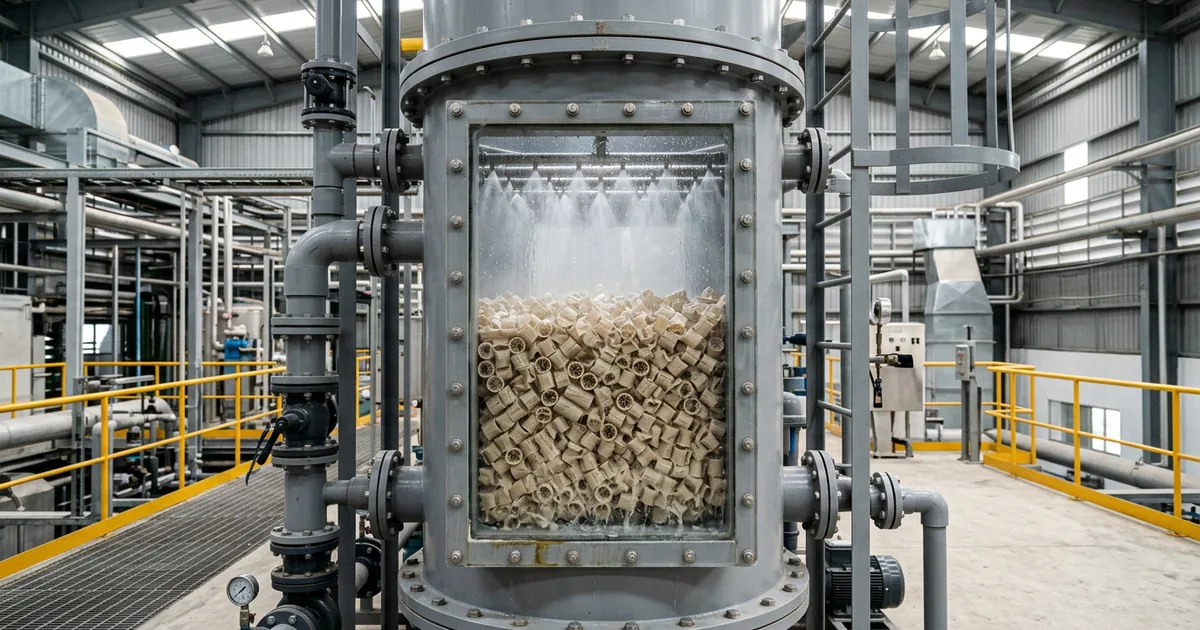
10% – 15% w/wsuspended solids (Ca(OH)₂,CaSO₃·½H₂O, andCaSO₄·2H₂Ogypsum crystals). Introducing lime slurry into a random plastic packed bed turns the packing rings into crystallization nuclei, cementing the entire bed solid within48 hours. Lime FGD absorbers must be designed as unpacked Open Spray Towers equipped with multi-level Silicon Carbide (SiC) hollow-cone spiral nozzles with large free-passage orifices (≥ 15 – 25 mm).
- Unlike clear-liquor chemical scrubbers dosed with transparent Liquid Caustic Soda NaOH 32%, a Wet Lime FGD recirculation loop carries
- Lock Recirculation Sump
pHStrictly Within the5.4 – 6.2Golden Window (Never Over-Dose Lime topH 8.0 – 11.0!):- Inexperienced operators often see the FGD sump pH at
5.5and pump excessive Milk of Lime to raise pH to8.5 – 10.0. Because boiler flue gas contains10% – 14% vol CO₂(~100×higher thanSO₂), operating atpH > 7.5causesCa(OH)₂to scrub massive quantities ofCO₂, precipitating rock-hard Calcium Carbonate (CaCO₃↓) scale while simultaneously halting the oxidation ofCaSO₃into gypsum. MaintainingpH = 5.4 – 6.2completely rejectsCO₂interference, achieves> 95%SO₂and99%HClcapture, and maximizes forced oxidation kinetics.
- Inexperienced operators often see the FGD sump pH at
- Maintain
10% – 15% w/wGypsum Seed Crystals &≥ 98%Forced Oxidation in the Reaction Sump:- Keeping a
10% – 15% TSSinventory of suspendedCaSO₄·2H₂Oseed crystals ensures that newly formed calcium sulfate precipitates via heterogeneous nucleation onto circulating seed surfaces rather than scaling FRP tower walls.
- Keeping a
- Automate Periodic High-Pressure Pulse Washing of Chevron Mist Eliminators (
Demisters):- Flush both the lower and upper faces of the chevron demister blades every
2 – 4 hoursfor30 – 60 secondsusing clarified service water at0.20 – 0.25 MPato prevent carryover gypsum encrustation.
- Flush both the lower and upper faces of the chevron demister blades every
4. Illustrative Engineering Calculation — Hourly Ca(OH)₂ Dosing & Milk of Lime Slurry Flow for a 25-Ton/h Coal Boiler
Illustrative technical calculation (Author: Process Engineer Tran Minh Tuan — QC Review: Phan Cam Thuy):
Consider a textile dyeing plant operating a 25-ton/h coal-fired fluidized-bed steam boiler with normalized dry flue gas flow Q_gas = 45,000 Nm³/h, inlet sulfur dioxide concentration C_in = 1,450 mg/Nm³, and target Wet FGD stack outlet C_out ≤ 120 mg/Nm³ (complying with QCVN 19:2024/BTNMT Column B limit ≤ 300 mg/Nm³):
- Hourly Mass of
SO₂Scrubbed (M_removed):M(SO₂) = Q_gas × (C_in - C_out) × 10⁻⁶ = 45,000 Nm³/h × (1,450 - 120) × 10⁻⁶ = 59.85 kg SO₂/hour(1,436.4 kg SO₂/dayacross 24 hours).
- Hourly Consumption of Commercial
Ca(OH)₂ 92%Powder (Ca/S = 1.08, unit factor1.36 kg lime / kg SO₂):G_lime = (59.85 kg/h × 1.157 × 1.08) ÷ 0.92 = 81.40 kg Ca(OH)₂ 92% / hour(1.954 metric tons/dayor58.6 metric tons/monthover 30 days).
- Volumetric Dosing Flow Rate of
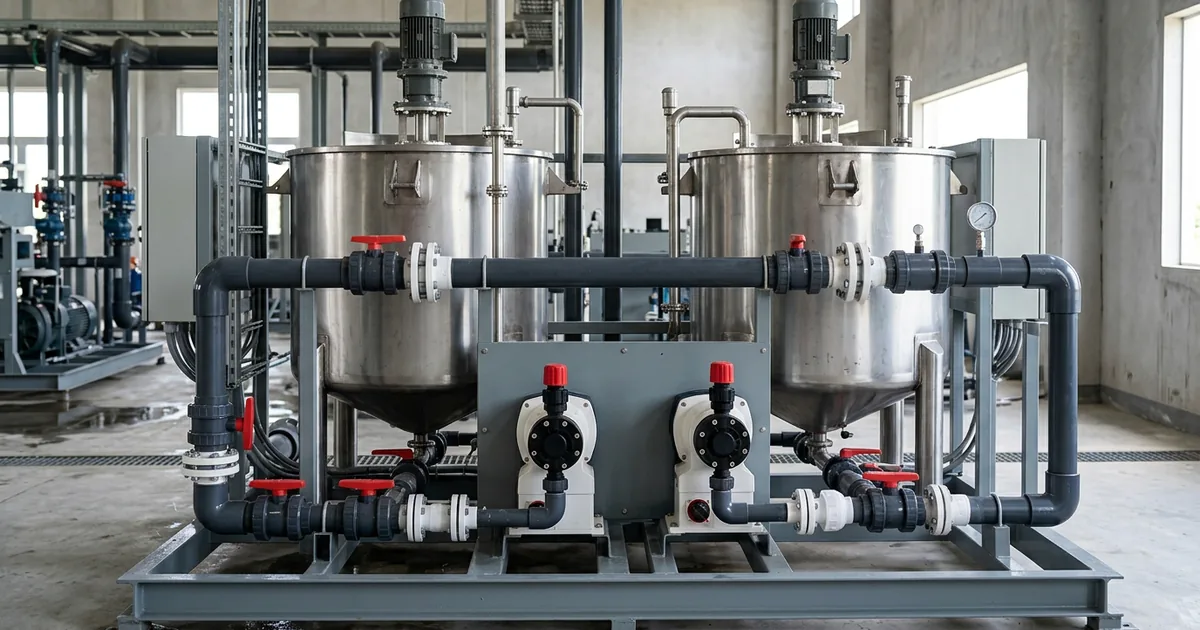
10% w/wMilk of Lime Slurry (SG = 1.072 kg/L, containing107.2 g Ca(OH)₂/L):Q_slurry = 81.40 kg/h ÷ 0.1072 kg/L = 759.3 L/hour(~0.76 m³/h, dosed via a variable-frequency peristaltic or silicon-carbide centrifugal slurry loop with ring-main velocity≥ 1.5 – 2.0 m/sto prevent line settling).
5. GHS Safety, Anti-Carbonation Storage & Multi-Role Procurement Guide (Procurement / Engineer / Accounting)
- GHS Hazard Classification & Personal Protective Equipment (MSDS Ca(OH)₂): Hydrated Lime (
Ca(OH)₂, CAS1305-62-0) is an alkaline hydroxide (pH = 12.4in saturated solution at25 °C) classified under GHS05 (Danger) and GHS07 (Warning) —H318: Causes serious eye damage,H315: Causes skin irritation, andH335: May cause respiratory irritation. Operators handling25 kgbags or silo unloading must wearEN 166sealed chemical splash goggles,N95 / FFP2particulate respirators, alkali-resistant nitrile gloves, and long-sleeved coveralls; an emergency eyewash station (ANSI Z358.1) must be installed adjacent to the lime slaking/mixing tank. - Anti-Carbonation Warehouse Storage: Store PE-lined
25 kgPP woven bags or1,000 kgjumbo bags on dry indoor pallets (RH ≤ 75%,≥ 30 cmclearance from walls). Keep bags tightly sealed to prevent atmosphericCO₂and moisture absorption (Ca(OH)₂ + CO₂ → CaCO₃ + H₂O), which degrades active neutralizing alkalinity; strictly segregate from mineral acids (HCl,H₂SO₄,HNO₃). - For Global Procurement Teams: Loc Thien Chemical supplies Refined Industrial Hydrated Lime Ca(OH)₂ 96% (≥ 325 mesh) with batch-specific COA, 16-section GHS SDS, and
3,000+ tons/monthnationwide supply capacity across 6 warehouses (Ba Ria - Vung Tau, Dong Nai, Binh Duong, Da Nang, Can Tho, Bac Ninh). Technical quotations are issued within 15 minutes (Hotline: 0979 891 929|Email: [email protected]). - For Boiler, Environmental & ETP Engineers: Synchronized supply of FGD and wet-scrubber chemicals including Caustic Soda Liquid NaOH 32%–50% (delivered via dedicated
5–30-tonchemical tankers) and Soda Ash Light Na₂CO₃ 99.2%, plus technical support for Milk of Lime ring-main design (v ≥ 1.5 m/s). - For Accounting & Tax Compliance Departments: Full compliance with Vietnamese Electronic VAT Invoices (
e-VAT Invoiceunder Decree70/2025/ND-CP), commercial contracts, certified weighbridge tickets, and bank transfer documentation for100%input VAT deduction under the2024 VAT Law.
6. Frequently Asked Questions on Hydrated Lime Ca(OH)₂ in Flue Gas Desulfurization (FGD) (FAQ)
1. Why is the recirculating slurry pH in a Wet Lime FGD absorber maintained at pH 5.2 – 5.8 rather than pH > 6.5?
Operating at pH 5.2 – 5.8 promotes complete forced oxidation of calcium sulfite (CaSO₃·½H₂O) into coarse, free-draining gypsum crystals (CaSO₄·2H₂O). Raising pH > 6.5 causes the lime slurry to absorb flue gas CO₂ (~12% vol), precipitating CaCO₃ and sulfite soft scale across spray headers and mist eliminator blades.
2. Why do Dry Sorbent Injection (DSI) and Semi-Dry Spray Dryer Absorbers (SDA) require ≥ 325 mesh (≤ 45 µm) Ca(OH)₂ powder?
Because gas-solid contact time inside SDA chambers and DSI ducts is only 1.5–3.0 seconds, ultrafine Hydrated Lime Ca(OH)₂ 96% (≥ 325 mesh) with high specific surface area (BET) is essential to maximize acid gas (SO₂, HCl, HF) neutralization across the baghouse filter cake.
3. When should a facility choose a Liquid NaOH 32% clear-liquor scrubber instead of a Ca(OH)₂ lime slurry FGD tower?
Coal and biomass power boilers with high sulfur loads (SO₂ > 1,000 mg/Nm³) achieve the lowest reagent cost using Ca(OH)₂ FGD. Smaller industrial boilers or chemical vents that want zero slurry handling and zero gypsum dewatering equipment prefer Liquid Caustic Soda NaOH 32%.
Related Technical Resources & Products
- Industry Category: Water, Wastewater & Flue Gas Treatment Chemicals
- Core Products: Refined Industrial Hydrated Lime Ca(OH)₂ 96% Vietnam (≥ 325 Mesh) · Liquid Caustic Soda NaOH 32% Vietnam
- GHS Safety Data Sheet (MSDS): MSDS Calcium Hydroxide Ca(OH)₂ (16-Section GHS)
- Engineering Dosing Calculator: Online Chemical Dosing & Neutralization Calculator
- Related Technical Guides in This Cluster:
- Technical Quotation (15-Minute SLA): Request a Bulk B2B Quotation for Hydrated Lime Ca(OH)₂ 96% & NaOH 32%