
How to Dilute 32% Hydrochloric Acid for Water Treatment
Tóm tắt nội dung
- Identifying Hydrochloric Acid (HCl)
- How to Prepare 32% HCl for Water Treatment
- Required Materials and Equipment
- Dilution Formula
- Procedure:
- 📢 Important notes:
- Practical Applications of Hydrochloric Acid Today
- Where to Buy 10%-32% Hydrochloric Acid at Competitive Prices?
- 🔥 Why Choose Loc Thien?
- Does hydrochloric acid have an expiration date? How to store HCl properly?
- Why dilute hydrochloric acid before use? Can concentrated HCl be used directly?
- Can hydrochloric acid be used for toilet/restroom cleaning? Proper usage?
- Can spilled/leaked HCl be neutralized? Emergency response?
- Can HCl be used in swimming pools? What concentration is safe?
Hydrochloric acid (HCl) is an important industrial chemical widely used in water treatment, food production, and chemical manufacturing. Understanding how to identify HCl, the dilution formula for concentrated HCl solutions, and its practical applications is essential. In this article, we will provide detailed instructions on how to prepare 32% HCl from 37% HCl, while also introducing where to purchase high-quality 10%-32% hydrochloric acid at competitive prices.
Identifying Hydrochloric Acid (HCl)
Hydrochloric Acid (HCl) is a strong inorganic acid with numerous industrial and household applications. HCl can be identified by the following characteristics:
- ✅ Distinctive odor: HCl has a pungent, strong smell that can irritate the respiratory tract upon exposure.
- ✅ Reaction with metals: When HCl reacts with zinc (Zn), iron (Fe), or aluminum (Al), it produces flammable hydrogen gas (H₂).
- ✅ Litmus paper color change: When HCl is dropped on litmus paper, it turns red, indicating a strong acidic solution.
- ✅ Reaction with limestone (CaCO₃): When hydrochloric acid is poured onto limestone, effervescence occurs due to CO₂ gas production.
👉 Safety note: When identifying HCl, always work in a well-ventilated area while wearing gloves and protective goggles to avoid direct contact.
You may be interested in:
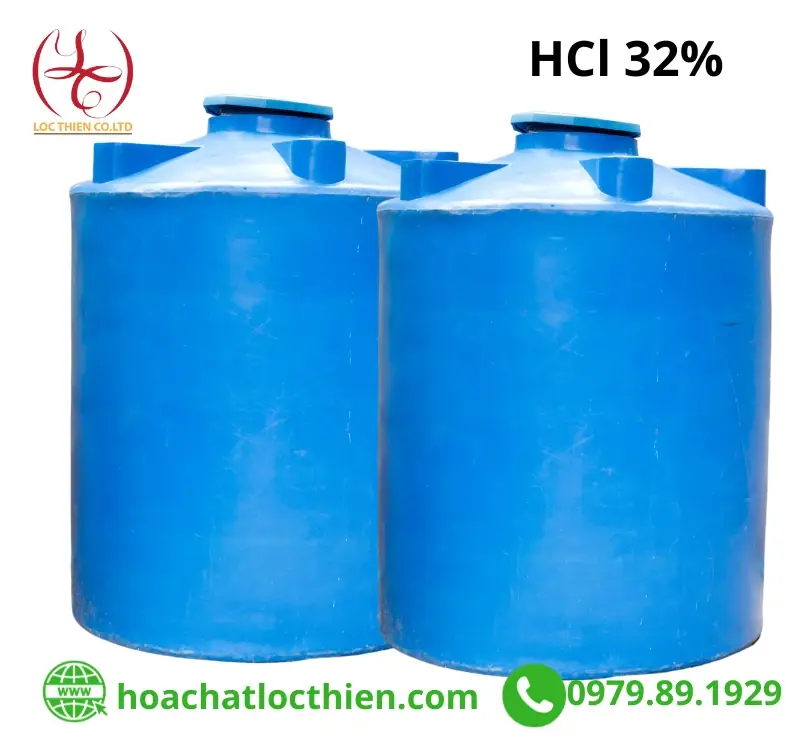
How to Prepare 32% HCl for Water Treatment
Diluting hydrochloric acid is a critical step in water treatment, requiring strict adherence to safety protocols to prevent chemical burns. Below is a detailed guide:
Required Materials and Equipment
- 🧪 Chemicals:
- Concentrated 37% HCl (Hydrochloric Acid Concentrated).
- Distilled or deionized water to ensure purity.
- 🛠 Equipment:
- Acid-resistant measuring container (glass or PP plastic).
- Protective gear: Safety goggles, chemical-resistant rubber gloves, activated carbon mask.
- Well-ventilated work area with fume extraction system.
<
Dilution Formula
To dilute 37% HCl to 32%, calculate the required amount of concentrated acid and water:
C1.V1 = C2.V2
- Where:
- C1: Initial concentration (37%).
- V1: Volume of initial solution needed.
- C2: Final concentration (32%).
- V2: Final solution volume (1 liter = 1000 ml)
- Substitute into formula:
- 37%.V1 = 32%.1000ml
- Solve the equation:
⇒ Thus, you need to measure 864.86 ml of 37% HCl, then add water to reach a total volume of 1 liter of 32% HCl solution.
Procedure:
- Step 1: Wear safety goggles and gloves; prepare a safe work area.
- Step 2: Measure 864.86 ml of 37% HCl using a measuring container.
- Step 3: Slowly pour acid into water (never the reverse) to prevent violent exothermic reactions.
- Step 4: Gently stir until the solution is fully dissolved.
📢 Important notes:
- Never add water to acid, as this may cause dangerous exothermic reactions.
- Work in a well-ventilated area or use a fume extraction system.
- If HCl contacts skin, rinse immediately with clean water for at least 15 minutes.
Practical Applications of Hydrochloric Acid Today
Hydrochloric acid has numerous practical applications across industries and daily life, including:
- Water treatment for pH adjustment, removal of metal impurities, and harmful microorganisms.
- Used in syrup production, gelatin processing, and food additive manufacturing.
- Industrial chemical production of organic and inorganic compounds like PVC, chlorides, and cleaning agents.
- Hydrochloric acid is used in pharmaceutical production and laboratory procedures.
- Rust removal, metal surface cleaning, and household cleaning products.
Learn more about HCl applications in steel industry, a common use of hydrochloric acid for metal surface cleaning and treatment.
If you're wondering where to buy HCl in Ho Chi Minh City, consider Loc Thien Chemicals for top-quality products at competitive prices.
Where to Buy 10%-32% Hydrochloric Acid at Competitive Prices?
If you're looking for 10%-32% hydrochloric acid with guaranteed quality and reasonable pricing, Loc Thien Chemicals is a reliable choice.
🔥 Why Choose Loc Thien?
- ✔ Genuine products, complete with MSDS and COA.
- ✔ Competitive pricing, attractive discounts for bulk orders.
- ✔ Nationwide delivery, fast and safe.
- ✔ Free technical consultation, dedicated support.
- 📩 Contact now:
- 📞 Hotline: 0979.89.1929
- 🌐 Website: hoachatlocthien.com
- 📧 Email: [email protected]
💡 Don't miss the opportunity to acquire high-quality chemicals at the best prices! 🚀
We're always ready to provide you with dedicated and thoughtful support.
LOC THIEN INVESTMENT DEVELOPMENT CO., LTD
- Address: 452/6B Provincial Road 10, Binh Tri Dong Ward, Ho Chi Minh City
- Phone: 0979 891 929
- Website: hoachatlocthien.com
- Fax: 0979 891 929 - HotLine: 0979 89 19 29
Does hydrochloric acid have an expiration date? How to store HCl properly?
+ Use dedicated containers: Store in HDPE plastic or acid-resistant glass to prevent corrosion.
+ Keep containers tightly sealed: Avoid air exposure to prevent HCl evaporation or moisture absorption.
+ Store in cool, dry places: Avoid direct sunlight and high temperatures that accelerate evaporation.
+ Avoid metal contact: HCl may react and damage storage materials.
📌 Pro tip: If you notice an exceptionally strong odor when opening HCl containers, the solution may have partially evaporated—check concentration before use.
Why dilute hydrochloric acid before use? Can concentrated HCl be used directly?
+ Safer handling: Reduces risks of acid burns or respiratory effects.
+ Better concentration control: Many applications like water treatment, food production, industrial cleaning require 10%-32% HCl rather than concentrated acid.
+ Prevents violent reactions: Concentrated HCl may generate heat and react violently when poured directly into water or metals.
📌 Note: When using concentrated HCl, wear full protective gear and work in fume-extracted areas to avoid inhaling acid vapors.
Can hydrochloric acid be used for toilet/restroom cleaning? Proper usage?
- How to use HCl for toilet/tile cleaning:
+ Wear rubber gloves and mask before use.
+ Dilute HCl at 1:10 ratio (1 part HCl to 10 parts water).
+ Pour slowly onto surfaces, let sit for 5-10 minutes for chemical reaction.
+ Scrub gently, then rinse thoroughly with water.
⚠ Critical warnings:
+ Never pour HCl directly into toilets containing Javel water (NaClO bleach)—this may produce toxic chlorine gas (Cl₂).
+ Avoid prolonged contact with glazed tile surfaces to prevent corrosion.
+ Work in well-ventilated areas to avoid inhaling acid vapors.
Can spilled/leaked HCl be neutralized? Emergency response?
+ Wear protective gloves and goggles to avoid direct contact.
+ Do not pour water directly on spills—this may cause violent exothermic reactions.
+ Use quicklime (CaO), sodium bicarbonate (NaHCO₃), or soda ash (Na₂CO₃) to neutralize the acid.
+ After applying neutralizers, wait 2-3 minutes, then slowly add water and clean.
+ Check air concentration with detectors or ventilate the area before resuming work.
📌 Note: If HCl contacts skin, immediately rinse with clean water for ≥15 minutes and seek medical attention if needed.
Can HCl be used in swimming pools? What concentration is safe?
Cloudy water and skin/eye irritation.
Reduced chlorine disinfection efficiency.
- How to use HCl for pool pH adjustment:
+ Test pool water pH before adjustment.
+ Use diluted 10%-15% HCl (never concentrated acid directly).
+ Pour slowly into pool areas with water circulation for even supply.
+ Recheck pH after 4-6 hours and readjust if needed.
📌 Recommended dosage:
+ For pH 7.8-8.0 → add ~0.5L 10% HCl per 50m³ water.
+ For pH >8.0 → add 1-1.5L 10% HCl per 50m³ water.
⚠ Important:
+ Never use HCl while people are swimming—wait at least 6-8 hours before reopening pool.
+ Always recheck pH after adding HCl to avoid over-acidification (pH < 7.0).
Supply of 32–35% HCl (hydrochloric acid, CAS 7647-01-0) — bulk, MSDS/COA available upon request, bulk pricing (no retail cart sales).
View specifications & contact for industrial hydrochloric acid supply · Hotline 0979 891 929