
What is Hydrochloric Acid (HCl)? Properties, Production, Applications & Where to Buy at Best Price
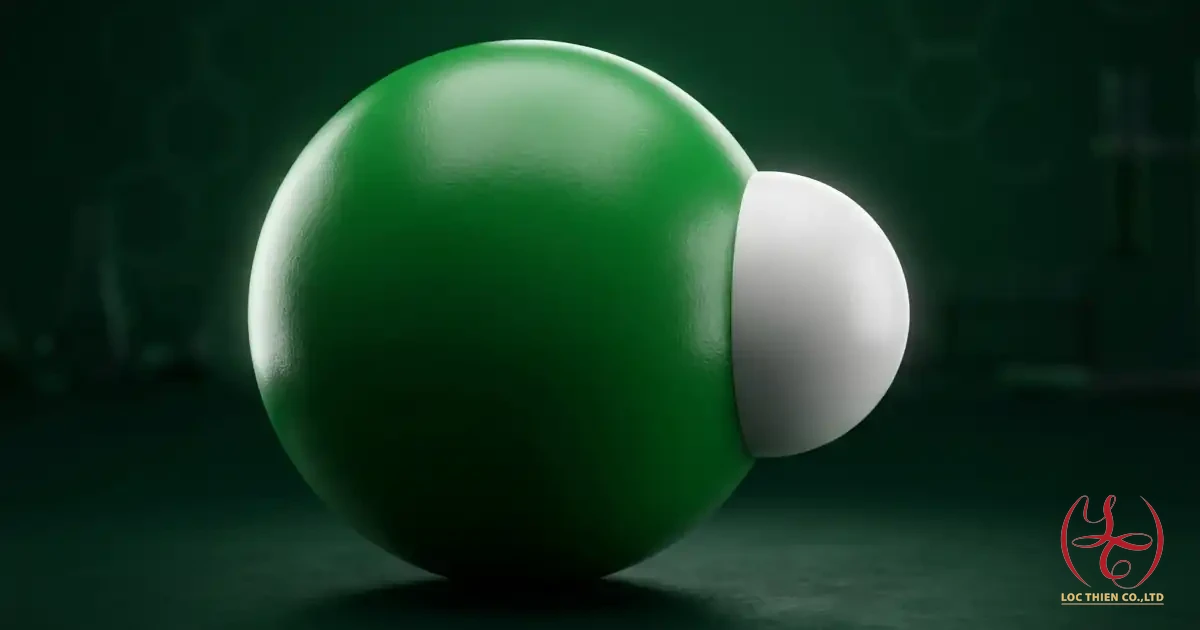
What is Hydrochloric Acid?
Hydrochloric acid (chemical formula HCl, molecular weight 36.46 g/mol, CAS 7647-01-0) is a solution of hydrogen chloride in water, belonging to the group of strong inorganic acids most widely used in industry. In commerce and engineering, it is also known by other names: hydrochloric acid, muriatic acid. It is important to distinguish between two forms. Gaseous HCl (hydrogen chloride) at ambient conditions is a colorless gas that forms white fumes in moist air, causing strong respiratory irritation. Aqueous HCl (hydrochloric acid) is a liquid obtained by dissolving hydrogen chloride gas in water, with a strongly exothermic reaction. In industry, commercial HCl is commonly available as a 32% or 35% solution, stored in FRP tanks or HDPE acid-resistant drums.
Molecular Structure and Physical Properties
The HCl molecule is formed by a polar covalent bond between hydrogen (H) and chlorine (Cl) atoms. The large electronegativity difference shifts the shared electron pair toward chlorine, creating a dipole moment that makes HCl strongly polar and easily soluble in water. Under normal conditions, HCl solution is a clear, colorless liquid, which may turn pale yellow if contaminated with iron, emits slight fumes, and has a characteristic pungent odor.
| Parameter | Value |
|---|---|
| CAS Registry Number | 7647-01-0 |
| UN Number | 1789 |
| Molecular weight | 36.46 g/mol |
| Density HCl 32% (20°C) | 1.159 g/ml |
| Density HCl 35% (20°C) | 1.174 g/ml |
| Boiling point HCl 32% | ~106°C |
| Boiling point HCl 35% | ~90°C |
| Vapor pressure HCl 32% (20°C) | ~14 mmHg |
| Vapor pressure HCl 35% (20°C) | ~30 mmHg |
| Solubility | Completely miscible with water in all proportions |
Chemical Properties
HCl is a strong acid, fully dissociating in water to form H⁺ and Cl⁻ ions. Regarding reactions with metals, HCl reacts with metals located above hydrogen in the electrochemical series. Iron reacts to form FeCl₂ and releases hydrogen gas: Fe + 2HCl → FeCl₂ + H₂. HCl does not react with copper (Cu), silver (Ag), or gold (Au) as these metals lie below hydrogen. HCl reacts with basic oxides to form chloride salts and water, directly applied in steel pickling. HCl reacts with bases — a typical neutralization reaction: NaOH + HCl → NaCl + H₂O. HCl reacts with salts of weaker acids: CaCO₃ + 2HCl → CaCl₂ + CO₂ + H₂O. The reaction with silver nitrate produces a characteristic white precipitate of AgCl used to identify chloride ions: AgNO₃ + HCl → AgCl↓ + HNO₃. Regarding reducing properties, HCl is oxidized by strong oxidizing agents such as KMnO₄ and MnO₂, releasing chlorine gas.
Production and Manufacturing Methods
In the laboratory, HCl is prepared by heating sodium chloride with concentrated sulfuric acid at 150–250°C: NaCl + H₂SO₄ → NaHSO₄ + HCl↑. Industrially, HCl is produced via three main routes. The first route is direct synthesis from H₂ and Cl₂ — burning hydrogen gas in chlorine gas yields high-purity hydrogen chloride, which is then absorbed into water to form the acid solution. This method produces a product suitable for food-grade and electronics applications. The second route is recovery as a by-product from organic chlorination processes — accounting for approximately 60–65% of global HCl production, mainly from PVC manufacturing. The third route is recovery from dye and intermediate chemical production processes. Common commercial concentrations: 32% (±1%) and 35% (±1%). See details at industrial hydrochloric acid production process.
Industrial Applications
Steel pickling: HCl removes the iron oxide layer from steel surfaces before rolling or plating — Fe₂O₃ + 6HCl → 2FeCl₃ + 3H₂O. This is the application with the highest volume consumption of HCl in metallurgy.
Water treatment and pH adjustment: 1 liter of 32% HCl contains approximately 371 g HCl, enough to neutralize about 407 g NaOH. HCl is used to lower the pH of alkaline wastewater before coagulation and biological treatment tanks. Refer to how to safely dilute 32% HCl for water treatment.
Production of intermediate chemicals: FeCl₃, CaCl₂, ZnCl₂ are all synthesized from HCl. Loc Thien uses HCl as raw material to produce FeCl₂ and FeCl₃.
Metal electroplating: HCl activates the metal substrate surface before plating, commonly used at 10–20% concentration. Details at HCl in metal electroplating: pickling, activation & pH control.
Textile dyeing: HCl adjusts the pH of dye baths and treats fabric before dyeing. See hydrochloric acid applications in textile dyeing.
Other industries: PVC production, oil and gas well fracturing, food (Food Grade used for protein hydrolysis and sugar production). Overview at applications of 32% HCl in industries.
Safety and Storage
Aqueous HCl is classified as UN 1789, dangerous goods corrosive (Corrosive Class 8). Required PPE when handling: respirator with cartridge E (acid gas absorption), chemical splash goggles, butyl gloves, and PVC apron.
Tank materials: FRP (fiberglass reinforced plastic) or HDPE (high-density polyethylene) tanks — absolutely do not use stainless steel 304/316 because chloride ions attack the passive film, causing stress corrosion cracking in a short time. HCl storage areas must be equipped with an alkaline scrubber to absorb acid vapors from tank vent openings, combined with sensors to detect HCl concentration in the air at the 5 ppm threshold.
Dilution: always add acid to water (never the reverse) to control exothermic heat. If acid splashes on skin: rinse immediately under running water for at least 15 minutes, remove contaminated clothing. If splashed in eyes: rinse continuously and seek medical attention immediately.
Distinguishing Concentrations: 32% or 35%?
The choice of HCl concentration depends on operating conditions and usage scale.
HCl 32% (density 1.159 g/ml, 20°C) has a low vapor pressure of ~14 mmHg, minimizing fuming, making it suitable for open outdoor tanks, naturally ventilated warehouses, and electroplating applications. This is a safer choice for small and medium plants without dedicated exhaust systems.
HCl 35% (density 1.174 g/ml) contains higher actual HCl content, saving approximately 9% in freight costs per kg of actual HCl. Vapor pressure ~30 mmHg means more fuming, requiring closed tanks, scrubbers, and exhaust fans. Suitable for plants using 10 tons/month or more.
Additionally, HCl 20% exists on the market with the advantage of minimal fuming. Recommended roadmap: start with HCl 32%, switch to 35% once a closed system is invested. Refer to density table for 32% and 35% HCl at 20°C and handbook for using 32%-35% HCl for businesses.
Criteria for Selecting a Reputable HCl Supplier
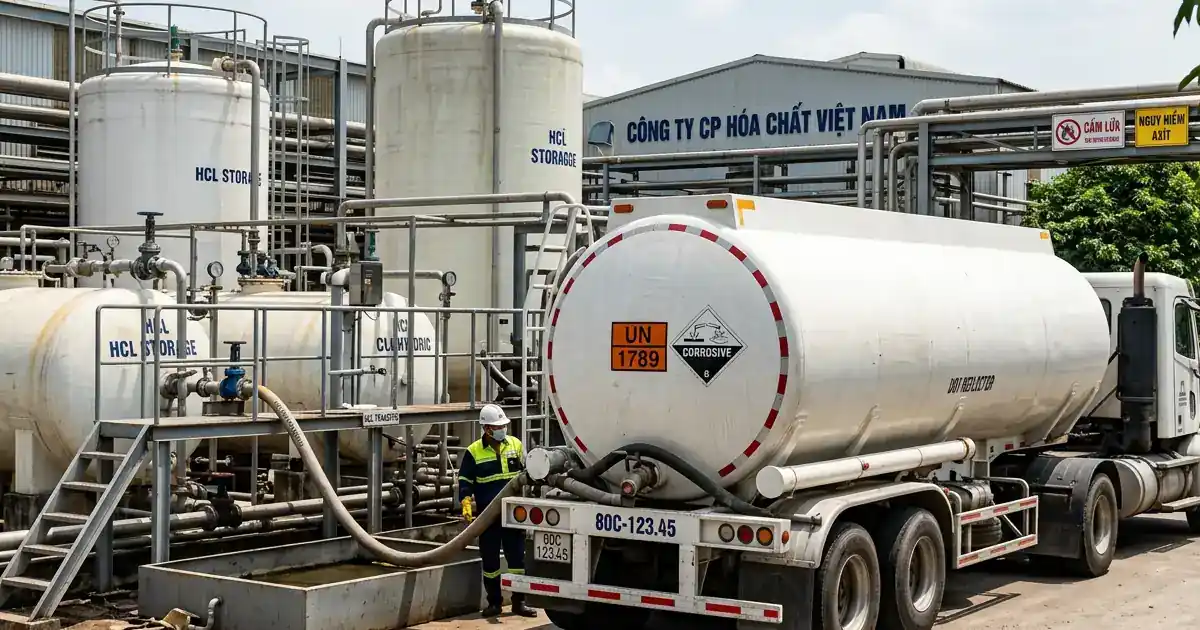 Fleet of specialized tanker trucks transporting Hydrochloric Acid HCl delivered to factories nationwide.
Businesses should evaluate HCl suppliers based on 5 criteria.
One — COA/MSDS per batch: certificate of analysis stating actual concentration and impurity specifications. For example, Loc Thien’s batch COA 2606020 shows HCl 32.07%, Fe 0.0002%, Pb < 0.0003%, residue after ignition 0.006%.
Two — specialized tanker truck capability: fleet of composite/FRP plastic-lined acid-resistant tankers, with dangerous goods transport permits, on-time delivery.
Three — warehouse network near industrial zones: shorten delivery time, manage inventory proactively, reduce storage pressure at the plant.
Four — transparent product origin: clear source (domestic or imported), valid invoices and documents.
Five — flexible long-term contract: stable price commitment per term, volume adjustment per actual production output. See more buy industrial HCl at good price delivered nationwide.
Where to Buy HCl at a Good Price? Why Choose Loc Thien?
Loc Thien (Tax code 0313650856) is a manufacturer of FeCl₂, FeCl₃ and also a large-scale supplier of 32% and 35% HCl to factories and industrial parks nationwide.
Supply capacity: a fleet of specialized dangerous goods tanker trucks, 6 warehouses across Ba Ria – Vung Tau, Dong Nai, Binh Duong, Da Nang, Can Tho and Bac Ninh — delivery within 4–48 hours depending on region.
Quality commitment: each batch comes with COA and MSDS. Loc Thien has been operating since 2016, with a technical team knowledgeable in water treatment chemicals and electroplating.
Flexible packaging: 30L can, 200L drum, 1000L IBC, or 5–30 ton tanker — suitable for all needs from small treatment stations to large-scale factories. See more latest price list for HCl 32%-35% and product page for 32%-35% HCl.
📞 Call 0979 891 929 — quote within 15 minutes, batch COA/MSDS included.
Technical Support & B2B Procurement Hotline
Loc Thien Chemical specializes in direct manufacturing of FeCl₂ / FeCl₃ and Tier-1 supply of basic industrial chemicals (NaOH, HCl, H₂SO₄, PAC, NaOCl, H₂O₂, FeSO₄) with direct B2B pricing and dedicated 5–30-ton tanker delivery across Vietnam.
- Hotline / Zalo: +84 979 891 929
- Official Email: [email protected]
- Direct Manufacturer: Ferrous Chloride (FeCl₂ 30%) & Ferric Chloride (FeCl₃ 38–40%)
- Primary Supplier: NaOH 32%/45%/50%/99%, HCl 32%, H₂SO₄ 98%, PAC 30–31%, NaOCl 10–12%, H₂O₂ 35%/50%
- Compliance & Quality: FeCl₂ ZDHC MRSL v3.1 test report (Smart testing, 5 substance groups, TUV Rheinland Vietnam), ISO 9001:2015, Quatest 3, Full COA & GHS SDS
Frequently Asked Questions
Is HCl toxic?
Aqueous HCl is highly corrosive (UN 1789), causing skin and eye burns upon direct contact. HCl vapor irritates the respiratory tract at low concentrations and damages lungs at high concentrations. Full PPE and ventilation systems are required when working.
Distinguish between HCl gas and hydrochloric acid?
HCl gas (hydrogen chloride) is a colorless gas that fumes in moist air. Hydrochloric acid is the solution obtained when dissolving HCl gas in water. In industry, the term “HCl” often refers to the commercial hydrochloric acid solution.
Should I choose HCl 32% or 35%?
Choose HCl 32% if storage is open, naturally ventilated, and usage is under 10 tons/month. Choose HCl 35% if you have closed tank systems, scrubbers, and usage above 10 tons/month — saving about 9% in freight per kg of actual HCl.
Does Loc Thien deliver to the factory?
Yes. With a fleet of specialized tanker trucks and 6 warehouses nationwide, Loc Thien delivers 32%–35% HCl directly to your plant. Expected delivery time: within 4 hours in inner Ho Chi Minh City; 24–48 hours to industrial zones in Southern Vietnam and the Mekong Delta; 2–3 days to Northern and Central Vietnam. Contact hotline 0979 891 929 for more details on the delivery process.
Is HCl 32% Food Grade?
Regular 32% HCl is industrial grade, used in pickling, water treatment, and chemical production. HCl Food Grade has higher purity, meets food standards, used for protein hydrolysis and sugar production. Be sure to distinguish between the two grades when ordering.
Does HCl 35% lose concentration over time?
Yes. HCl 35% has a vapor pressure of ~30 mmHg, HCl evaporates faster than water. If the tank is not sealed, concentration will gradually decrease over time. Periodically check with a hydrometer or request a new COA for each batch.
Can I use stainless steel tanks for HCl?
Absolutely not. Chloride ions in HCl destroy the passive Cr₂O₃ film on stainless steel surfaces, causing pitting corrosion and stress corrosion cracking. Safe materials for HCl storage are FRP, HDPE, PVC, or specialized acid-resistant plastics.
What should I look for on a COA when buying HCl?
The COA (Certificate of Analysis) states the actual concentration and impurity specifications of the batch. For example, Loc Thien’s batch COA 2606020: HCl 32.07%, Fe 0.0002%, Pb < 0.0003%. Always request COA and MSDS before receiving goods.
What are the applications of HCl in wastewater treatment?
HCl is used to lower the pH of alkaline wastewater before coagulation and biological treatment tanks. Dosage depends on influent alkalinity. For wastewater with pH > 9, approximately 0.5–1.5 liters of 32% HCl per m³ of wastewater is needed to bring pH to 6–8.
How can I quickly check HCl concentration?
Use a hydrometer to measure the density of the solution at 20°C, then consult the HCl density table to find the corresponding concentration. This method gives fast results with ±1% error.
How to handle HCl spills?
Isolate the area, wear full PPE. Neutralize spilled acid with lime powder (CaO), soda ash (Na₂CO₃), or dilute alkaline solution. Collect neutralized waste into chemical-resistant containers and dispose according to hazardous waste regulations. Do not rinse directly with water before neutralization.
What is the price of 32% HCl?
The price of 32% and 35% HCl varies by order volume, timing, and transportation costs. Contact hotline 0979 891 929 for an updated quote within 15 minutes, including batch COA and MSDS.
Does Loc Thien supply HCl to small factories?
Yes. Loc Thien supplies HCl in flexible packaging from 30L cans, 200L drums, 1000L IBCs to 5–30 ton tanker trucks. Suitable for both small treatment stations and large-scale production plants. Delivered nationwide.
Does HCl react with plastics and polymer materials?
Aqueous HCl does not react with most thermoplastics such as HDPE, PVC, and fiberglass reinforced plastic (FRP). This is why HCl storage tanks are typically made from FRP or HDPE. However, HCl may damage some natural rubber and polyamide (nylon) materials — check material compatibility before use.
How is industrial HCl transported?
32% and 35% HCl are transported by composite/FRP plastic-lined acid-resistant tanker trucks with dangerous goods transport permits (UN 1789, Class 8). Loc Thien owns a fleet of specialized tanker trucks, delivering nationwide with packaging from 5–30 ton tankers to 200L drums and 1000L IBCs to meet all volume needs.
LOC THIEN INVESTMENT DEVELOPMENT COMPANY LIMITED — Tax code 0313650856 · 452/6B Tỉnh Lộ 10, P. Binh Tri Dong, HCMC · ☎ 0979 891 929