
Hydrochloric Acid 32%–35%: A Business Guide to Selection, Usage, and Compliance
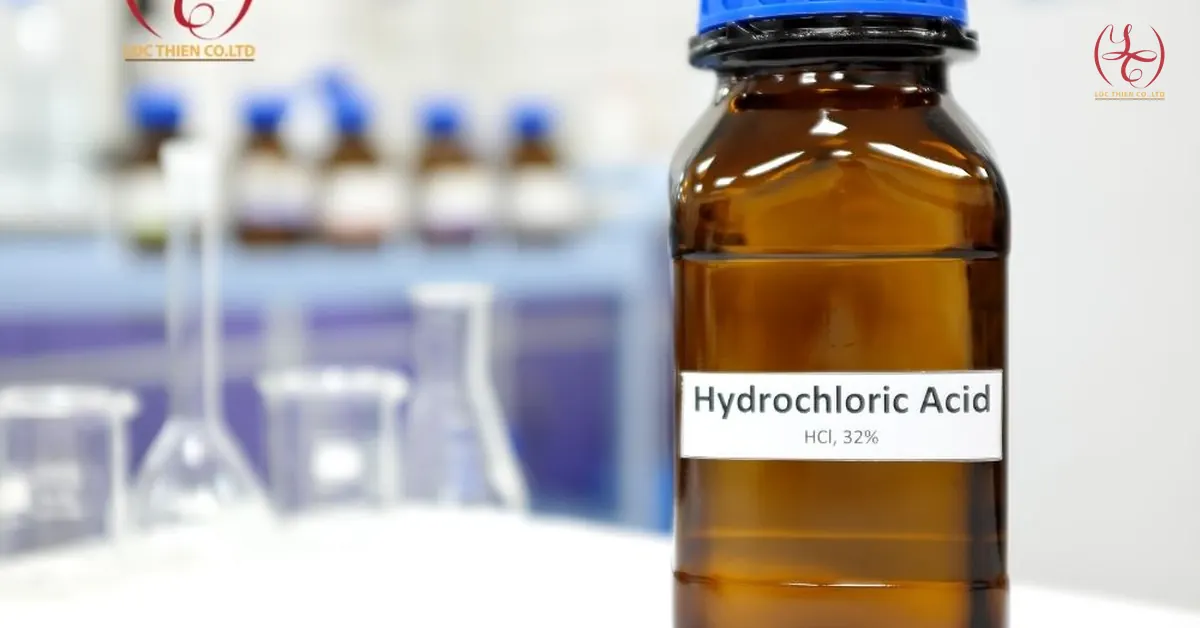
Hydrochloric Acid 32%–35%: A Business Guide to Selection, Usage, and Compliance
TL;DR: Hydrochloric acid 32%–35% represents the most common commercial concentration range for industrial applications, with specifications governed by batch-specific COAs rather than random variations. Businesses purchasing HCl must: 1) confirm concentration and packaging formats per order requirements, 2) request MSDS/SDS and batch COA documentation, and 3) prepare storage facilities, PPE, and emergency protocols before receiving tanker trucks or container shipments. This guide serves as your starting point—explaining what HCl 32–35% is, which parameters to monitor, suitable industrial applications, and a safe procurement-to-operation roadmap for enterprises.
Quick Facts About Commercial Hydrochloric Acid 32%–35%
| Parameter | Value |
|---|---|
| CAS | 7647-01-0 |
| Chemical Formula | HCl (hydrochloric acid) |
| Molecular Weight | 36.46 g/mol |
| Loc Thien's Commercial Range | 32–35% wt per batch COA |
| Packaging Options | Jerrycans, drums, IBCs, tank trucks—customized per order |
| Batch Documentation | MSDS/SDS + COA provided upon request |
| Pricing Inquiry | Hotline 0979 891 929 — submit HCl quotation request |
1. What Is Hydrochloric Acid 32%–35%, and Who Needs This Guide?
Hydrochloric acid 32%–35% is an aqueous solution of hydrogen chloride with a mass concentration between 32% and 35% as verified by batch COA. This concentration range represents Loc Thien Chemicals' standard industrial offering for foundational manufacturing processes, surface treatment, and neutralization applications. This guide targets plant engineers, HSE personnel, procurement specialists, and facility managers—professionals who require technical decision-making frameworks rather than superficial comparisons when selecting HCl grades.
If you're evaluating 32% versus 35% concentrations or need to audit regulatory compliance before procurement, this guide provides the correct starting point. It doesn't replace your batch COA or onsite technical consultations but equips you with the framework to ask precise questions, interpret specifications accurately, and avoid costly miscalculations.
2. Hydrochloric, Muriatic, Hydrogen Chloride: One Substance, Multiple Nomenclature
The terms hydrochloric acid, hydrogen chloride, muriatic acid, and commercial HCl all refer to the same chemical compound—HCl. Concentrated gaseous HCl dissolved in water yields what's generically called hydrochloric acid; "muriatic acid" typically denotes lower-grade HCl used in construction and cleaning applications. When you encounter "32% hydrochloric acid," "32% HCl," or "32% hydrogen chloride" on labels, understand these represent the same substance—but actual purity and concentration must be verified via COA.
The procurement imperative: Never rely solely on nomenclature. Two suppliers labeling products as "32% HCl" may differ substantially in actual concentration, impurity profiles, and corrosivity due to trace metal content. For businesses, product names are merely entry points—COAs constitute legal evidence.
3. Which Parameters Matter in TDS, COA, and SDS Documents?
The three essential batch documents—TDS (Technical Data Sheet), COA (Certificate of Analysis), and SDS (Safety Data Sheet)—serve distinct purposes, and you must review all three. TDS describes typical product characteristics for process design. COA provides batch-specific evidence: measured HCl concentration, density, and impurity levels. SDS is the mandatory safety document covering hazard identification, PPE requirements, spill response, and first aid.
For 32–35% HCl batches, the COA's critical columns are measured HCl concentration (wt%) and batch-specific density. In SDS documents, prioritize the Hazard Identification (GHS), PPE, and First Aid sections before introducing chemicals to your facility. Loc Thien Chemicals provides MSDS/SDS and COA documentation with each shipment—request these when placing orders, not after delivery.
4. Which Industries Use 32–35% HCl, and When Is It Inappropriate?
Hydrochloric acid 32–35% suits processes requiring strong, controllable acidity: steel pickling, metal surface treatment, alkali neutralization in plants, wastewater pH adjustment prior to treatment systems, food processing (at appropriate grades), and certain chemical intermediate production. For neutralization and wastewater applications, 32% concentration often suffices with easier dosing control.
Avoid this concentration when: 1) you require food-grade purity but receive unverified industrial-grade material, 2) your storage tanks use corrosion-prone materials, or 3) your facility lacks proper containment, ventilation, and PPE. HCl 35% demands more stringent storage materials and transfer protocols than 32%. Base concentration selection on application requirements and existing infrastructure—not just pricing.
5. Key Safety Risks During Storage, Dilution, and Transfer
The three primary HCl operational hazards are: 1) acid vapor inhalation, 2) skin/eye contact with solution, and 3) material corrosion leading to spills. HCl vapors form when opening tanks, pouring containers, or during exothermic dilution—without proper ventilation, enclosed-space vapor concentrations escalate rapidly, causing respiratory tract irritation.
The cardinal dilution rule: Always add acid to water, never water to concentrated acid. Adding water to acid creates localized heat spikes that may cause boiling and acid splashing. HCl storage areas require corrosion-resistant flooring, spill containment, compatible tank materials, and accessible emergency eyewash stations. All first-aid instructions here conclude with one imperative: Seek immediate medical attention—never attempt prolonged self-treatment.
6. 2026 Legal Obligations Businesses Must Verify Before Procurement
Before receiving HCl shipments, businesses must audit evolving 2026 regulatory obligations—particularly regarding chemical classification, labeling, and safety documentation transitions. As a hazardous chemical, HCl requires GHS-compliant classification/labeling, Vietnamese SDS availability, proper storage, and regulatory reporting—all constituting user responsibilities beyond supplier obligations.
Your mandatory checklist: 1) Maintain hazardous chemical inventories, 2) Archive batch SDS/COA documentation, 3) Provide chemical safety training, and 4) Implement spill response protocols. While suppliers must provide compliant documentation, onsite implementation remains your responsibility. If your compliance systems are transitioning, verify SDS version alignment with storage practices.
7. 32% vs. 35% HCl: What Data Should Guide Your Selection?
The practical differences between 32% and 35% HCl lie in density, HCl mass per unit volume, transportation costs, and storage infrastructure requirements. The table below uses 20°C handbook density as reference—actual batch concentrations must be verified via COA, not pre-calculated values.
| Criterion | 32% HCl | 35% HCl |
|---|---|---|
| Density @20°C (handbook) | 1.159 g/mL | ≈1.174 g/mL (interpolated) |
| HCl Mass in 1 m³ Solution | ≈371 kg HCl (handbook) | Higher (greater mass concentration) |
| Concentration Level | Common, easier dosing, familiar infrastructure | More concentrated, reduces transport volume per HCl unit |
| Transport Cost per HCl Unit | Reference | Potential volume savings but requires higher-concentration storage |
| Typical Applications | Neutralization, wastewater, light cleaning | Pickling, surface treatment requiring higher activity |
| Critical Assumptions | Comparison valid only for standardized batches at 20°C; actual transport/storage costs vary by route and materials | |
Choosing between 32% and 35% isn't purely numerical. If your facility handles large-volume alkali neutralization, 32% offers familiar dosing. For high-volume steel pickling where transport efficiency matters, 35% reduces shipments but demands higher-concentration storage and PPE. Have your field engineers finalize selection based on application and infrastructure.
For detailed concentration-density relationships, consult Loc Thien's HCl density by concentration table—a supplementary reference for your decisions.
8. Hydrochloric Acid Density and Baumé Scale by Concentration @20°C
The table below provides reference data for HCl solution density versus mass concentration at 20°C, 1 atm—essential for concentration-volume conversions during process design or dosing calculations. The 35% value is interpolated between 34% and 36%; always verify actual batch values via COA.
| HCl Concentration (wt%) | Density @20°C (g/mL) | Baumé Scale |
|---|---|---|
| 10% | 1.048 | 6.6 |
| 20% | 1.098 | 13 |
| 30% | 1.149 | 19 |
| 32% | 1.159 | 20 |
| 34% | 1.169 | 21 |
| 35% | ≈1.174 (interpolated) | — |
| 36% | 1.179 | 22 |
| 38% | 1.189 | 23 |
Practical application: At 32% concentration (1.159 g/mL density), one cubic meter of solution weighs approximately 1,159 kg containing about 371 kg HCl. Operators use similar logic for quick neutralization dosing or receiving concentration verification. Remember: These are 20°C handbook reference values—actual commercial batches must comply with COA data.
9. Jerrycans, Drums, IBCs, or Tank Trucks: Key Procurement Questions
Loc Thien Chemicals offers flexible 32–35% HCl packaging: jerrycans, drums, IBCs, and tank trucks—with no fixed minimum order quantities. Jerrycans suit labs and small-quantity users; drums serve medium demand; IBCs and tank trucks cater to bulk consumers with scheduled deliveries. When ordering, confirm: 1) batch concentration, 2) packaging format, 3) lead time, and 4) delivery routes to finalize logistics costs.
| Packaging | Ideal For | Supplier Questions |
|---|---|---|
| Jerrycans | Small quantities, labs, intermittent use | Container volume, included labels/SDS, shelf life |
| Drums | Medium consumption, facilities with drum handling | Drum material, spill containment, delivery schedule |
| IBCs | High-volume, continuous transfer systems | Tank condition, valve compatibility, pre-load inspection |
| Tank Trucks | Very large volumes, scheduled deliveries | Transfer procedures, delivery timing, route constraints |
Before delivery, confirm: 1) COA-specified concentration, 2) included documentation, and 3) unloading responsibilities. Tank truck recipients need prepared receiving areas, compatible connections, and trained personnel. Never wait until delivery to establish protocols—clarify during ordering.
10. How to Submit Effective HCl RFQs for Accurate Quotations
An effective hydrochloric acid RFQ must specify four elements: concentration (32%, 35%, or range), packaging, volume, and delivery location. Omitting any element forces suppliers to guess, potentially misaligning quotes with your actual needs. Loc Thien Chemicals provides batch-specific pricing upon request—no fixed public price lists exist due to concentration, packaging, and route variables.
Submit RFQs by clearly stating: 1) Required HCl concentration, 2) Packaging (jerrycans/drums/IBCs/tank trucks), 3) Per-shipment volume and frequency, and 4) Delivery address/timing. For long-term planning, disclose your timeline to receive packaging optimization suggestions beyond mere pricing. To begin, submit an HCl quotation request or call 0979 891 929.
11. Essential Documentation and Tools Before HCl Operation
Before introducing HCl to your processes, secure three documents: 1) SDS (safety data) for hazard/first-aid information, 2) Batch COA for actual concentration, and 3) Internal protocols covering dilution, transfer, and spill response. Loc Thien provides MSDS/SDS and COA with each shipment—request these when ordering, not post-delivery.
Supplemental resources: Consult open-source HCl property data at PubChem CID 313, and use Loc Thien's HCl density by concentration table for design conversions. Our 32–35% hydrochloric acid product page summarizes packaging and documentation for pre-purchase verification.
12. When to Request Loc Thien's Onsite Engineering Consultation
Loc Thien Chemicals—a 32–35% hydrochloric acid supplier providing batch-specific MSDS/COA and nationwide tank truck delivery—offers onsite engineering consultations when businesses face unresolved challenges: concentration selection for specific processes, tank truck receiving area design, or recurring spill incidents. If your storage tanks show corrosion or mist forms during dilution, these indicate need for professional assessment.
Onsite engineers help not only with concentration selection but also transfer protocol reviews, storage material compatibility, and COA integration into daily operations. This proves particularly valuable when adopting HCl or scaling up from jerrycans to IBCs/tank trucks. Call 0979 891 929 to discuss your situation and schedule assessments if needed.
13. Deep-Dive Articles: Addressing Your Specific Questions
This guide serves as your entry point; for specialized inquiries, consult Loc Thien's existing technical articles. For concentration-density relationships in dosing calculations, read HCl density by concentration tables. For regional procurement and delivery specifics, see Southern Vietnam HCl procurement to understand delivery routes and order placement considerations.
If your needs extend beyond these articles—such as tank truck volumes, internal COA requirements, or storage design—don't hesitate to engage directly. This structure provides progression from overview to implementation: the guide explains "what to choose," while specialized articles detail "how to execute."
FAQ—Frequent Business Questions About 32–35% Hydrochloric Acid
What's the MOQ for 32–35% HCl?
Minimum order quantities (MOQs) depend on packaging and delivery routes, typically starting at jerrycan/drum levels and increasing for IBCs/tank trucks. No universal fixed quantity applies across all regions. For each order, specify desired volumes to receive appropriate packaging recommendations and delivery scheduling.
How is 32% vs. 35% HCl priced?
Pricing isn't fixed but quoted per batch based on concentration, packaging, volume, and delivery route. With clear requirements, suppliers provide batch-specific pricing. Submit complete concentration, packaging, volume, and location details for accurate quotes.
Why does batch COA matter for quality?
The Certificate of Analysis (COA) provides batch-specific evidence of concentration and parameters—making it more authoritative than generic labels. When receiving HCl, verify COA concentrations against your requirements. Loc Thien provides COAs with each shipment for pre-operation verification.
Where do tank trucks deliver, and how long does it take?
Loc Thien schedules tank truck deliveries by route and region, with timing dependent on destination. When ordering, specify delivery address and timing requirements to confirm schedules. Tank truck recipients must prepare designated transfer areas with trained personnel.
How to store HCl safely?
HCl storage requires corrosion-resistant flooring, spill containment, adequate ventilation, and compatible tank materials. Keep away from corrosion-prone metals and strong oxidizers. Maintain accessible SDS documentation and secure storage areas.
What PPE is required for HCl handling?
Use chemical-resistant gloves, splash goggles, acid-resistant aprons/coveralls, and additional protection if vapor exposure occurs. Transfer areas require SDS-recommended respirators. Install emergency eyewash stations and showers near work areas.
Why must acid be added to water, not vice versa?
Dissolution is exothermic; adding water to concentrated acid creates localized heat spikes that may cause boiling and acid ejection. Conversely, slowly adding acid to larger water volumes enables heat dissipation and control. This is mandatory for HCl dilution.
How does HCl differ from H2SO4 in plant applications?
Both are strong acids but differ fundamentally: HCl forms corrosive vapors requiring ventilation, while H2SO4 exhibits different corrosion mechanisms and greater dilution heat. Selection depends on application and storage materials—never substitute without material/process reviews.
What distinguishes food-grade from industrial HCl?
Food-grade HCl meets stricter purity and impurity limits for food processing. Industrial-grade suits cleaning, water treatment, and manufacturing. For food applications, explicitly request food-grade material with corresponding COAs.
How to respond to HCl spills?
Isolate the area, evacuate personnel, ventilate, and neutralize/absorb per SDS protocols. Never touch spilled acid directly. After initial response, ensure exposed individuals receive immediate medical evaluation—never self-assess exposure severity.
Safe HCl Procurement-to-Operation Roadmap: Business Summary
In summary, proper 32–35% hydrochloric acid procurement and usage involves four steps: 1) Determine concentration and packaging per actual application, 2) Submit detailed RFQs for accurate batch pricing, 3) Request MSDS/SDS and COA documentation pre-delivery, and 4) Prepare storage, PPE, and emergency protocols before receiving shipments.
If you're still evaluating 32% versus 35% or need to establish tank truck protocols for high-volume consumption, contact us for facility-specific consultations. Loc Thien Chemicals supplies 32–35% hydrochloric acid with batch-specific MSDS/COA in jerrycan, drum, IBC, and tank truck configurations.
Ready to order or need concentration selection advice?
Call 0979 891 929 or submit an HCl quotation request—specify concentration, packaging, volume, and delivery location for batch-accurate pricing.
Last updated: August 08, 2026.