
FeCl3 (Ferric Chloride): Complete Guide to Properties, Applications & Pricing
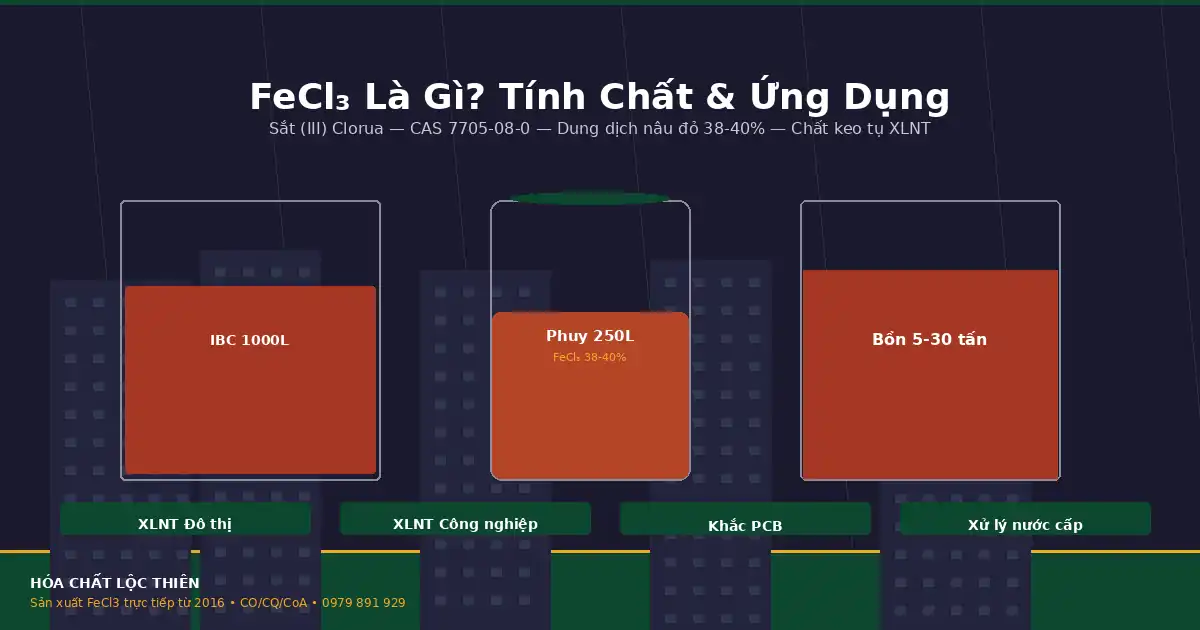
- Characteristic reddish-brown color: FeCl3 36–40% solution is reddish-brown; FeCl3·6H₂O crystals are brownish-yellow; anhydrous form is dark brown with a greenish luster.
- Fully soluble in water: FeCl3 is highly soluble, releases heat upon dissolution, and forms a strong acidic solution with pH around 1–2.
- Top coagulant: Fe³⁺ hydrolyzes to form heavy Fe(OH)₃ flocs that settle quickly, with [superior phosphate removal compared to PAC](https://hoachatlocthien.com/en/fecl3-vs-pac-keo-tu).
- Characteristic reaction with NaOH: Produces a reddish-brown Fe(OH)₃ precipitate — a reaction used to identify Fe³⁺ ions.
- Directly manufactured in Vietnam: Loc Thien produces FeCl3 36–40% with batch-specific COA/MSDS, differentiating from imported Chinese products.
What is FeCl3?
FeCl3 — full chemical name Iron(III) Chloride, also known as Ferric Chloride — is an inorganic compound of iron and chlorine with the molecular formula FeCl3, where iron is in the +3 oxidation state. It is one of the two most common iron chloride salts in industry (alongside FeCl2 — Iron(II) Chloride). The most common commercial form in Vietnam is FeCl3 36–40% solution, produced by reacting iron oxide with hydrochloric acid or by oxidizing FeCl2 with chlorine gas. FeCl3 also exists as hydrated crystals FeCl3·6H₂O (brownish-yellow) and in anhydrous form (dark brown). Other names in Vietnamese: Ferric Chloride (FeCl3), ferrous sulfate 3, Ferric Chloride. CAS Registry Number: 7705-08-0. Loc Thien supplies FeCl3 as a solution only; solid forms are not part of the product range.
Physical Properties of FeCl3
FeCl3 has three notable physical characteristics that engineers in procurement and operations need to know. First, color is an important identifier: FeCl3 36–40% solution has a characteristic reddish-brown color due to the Fe(H₂O)₆³⁺ complex, while FeCl3·6H₂O crystals are brownish-yellow and the anhydrous form is dark brown with a greenish luster. Second, FeCl3 is fully soluble in water with very high solubility (approximately 920 g/L at 20°C for the crystalline form), and the dissolution process is significantly exothermic. The resulting solution is strongly acidic (pH around 1–2) due to the hydrolysis reaction Fe³⁺ + 3H₂O ⇌ Fe(OH)₃ + 3H⁺. Third, the specific gravity of FeCl3 36–40% is approximately 1.42–1.45 g/ml at 20°C — about 42–45% heavier than water, which must be considered when designing storage tanks and calculating dosing pump head pressure.
Chemical Properties of FeCl3
The chemical properties of FeCl3 revolve around the Fe³⁺ ion — a strong Lewis acid and moderate oxidizing agent. The five most important reactions in industrial practice:
- Hydrolysis in water: Fe³⁺ + 3H₂O ⇌ Fe(OH)₃↓ + 3H⁺ — produces a reddish-brown Fe(OH)₃ precipitate and releases acid; this is the core coagulation mechanism.
- Reaction with NaOH: FeCl3 + 3NaOH → Fe(OH)₃↓ (reddish-brown) + 3NaCl — used to identify Fe³⁺ ions in the laboratory.
- Reaction with AgNO3: FeCl3 + 3AgNO3 → 3AgCl↓ (white) + Fe(NO3)3 — identifies Cl⁻ ions.
- Reaction with metals: 2FeCl3 + Fe → 3FeCl2 (corrosion of iron — compare FeCl2 vs FeCl3); 2FeCl3 + 2Al → 2Fe + 2AlCl3 (thermite reaction).
- Redox reactions: FeCl3 oxidizes Cu (PCB etching), H₂S (odor removal), and certain organic compounds.
FeCl3 is a strong electrolyte — it dissociates completely in water into Fe³⁺ and 3Cl⁻. Due to its acidity and complex-forming ability, FeCl3 is also used as a Lewis acid catalyst in organic synthesis (Friedel-Crafts reactions).
Industrial Applications of FeCl3
FeCl3 is one of the most versatile chemicals in industry, with four main application groups:
| Application | Description | Reference Dosage |
|---|---|---|
| Coagulation in water treatment | Fe³⁺ hydrolyzes to form heavy Fe(OH)₃ flocs that settle quickly, removing phosphate as insoluble FePO4↓ | Determined via jar-test |
| PCB etching | 2FeCl3 + Cu → 2FeCl2 + CuCl2 — dissolves copper to create printed circuit traces | 30–40% solution |
| Textile dyeing | Mordant — Fe³⁺ forms stable complexes between dye and fiber | Low concentration, batch-wise |
| Organic synthesis | Lewis acid catalyst for Friedel-Crafts reactions, aromatic chlorination | Process-dependent |
Additionally, FeCl3 is used for H₂S removal in sewer systems and storage tanks (forming Fe₂S₃ precipitate), treating electroplating wastewater (co-precipitating heavy metals), and in photography (developer). With its wide range of applications, FeCl3 is a foundational chemical at most industrial parks with centralized wastewater treatment plants. See the detailed guide on FeCl3 applications in water treatment for dosage and mechanism information.
Technical Specifications of FeCl3 36–40% — Loc Thien
| Parameter | Value | Notes |
|---|---|---|
| Chemical name | Iron(III) Chloride | Ferric Chloride |
| Formula | FeCl3 | Anhydrous form |
| CAS | 7705-08-0 | — |
| Commercial concentration | 36–40% | Solution form |
| Color | Reddish-brown | Characteristic |
| Specific gravity (20°C) | 1.40–1.45 g/mL | Per lot COA |
| pH (stock solution) | 1–2 | Strong acid |
| Packaging | 200L drum, 1000L IBC, tanker truck 5–30 tons | HDPE/Composite |
| COA/MSDS | Per batch | — |
| Manufacturing | Loc Thien — directly produced in Vietnam | No intermediaries |
Technical Support & B2B Procurement Hotline
Loc Thien Chemical specializes in direct manufacturing of FeCl₂ / FeCl₃ and Tier-1 supply of basic industrial chemicals (NaOH, HCl, H₂SO₄, PAC, NaOCl, H₂O₂, FeSO₄) with direct B2B pricing and dedicated 5–30-ton tanker delivery across Vietnam.
- Hotline / Zalo: +84 979 891 929
- Official Email: [email protected]
- Direct Manufacturer: Ferrous Chloride (FeCl₂ 15–30%) & Ferric Chloride (FeCl₃ 38–40%)
- Primary Supplier: NaOH 32%/45%/50%/99%, HCl 32%, H₂SO₄ 98%, PAC 30–31%, NaOCl 10–12%, H₂O₂ 35%/50%
- Compliance & Quality: ZDHC Gateway Level 1, ISO 9001:2015, Quatest 3 Certified, Full COA & GHS SDS
Frequently Asked Questions about FeCl3
📖 Related:
What color is FeCl3?
FeCl3 color varies by form: 36–40% solution is reddish-brown; hydrated crystals FeCl3·6H₂O are brownish-yellow; anhydrous form is dark brown with a greenish luster. The reddish-brown color of the solution is due to the Fe(H₂O)₆³⁺ complex.
What color is FeCl3 precipitate?
When reacting with NaOH or in an alkaline environment, FeCl3 forms a reddish-brown Fe(OH)₃ precipitate. This is a characteristic reaction used to identify Fe³⁺ ions. This precipitate is insoluble in water and excess alkali.
Is FeCl3 toxic?
FeCl3 is not acutely toxic but is highly corrosive — it causes skin burns and severe eye damage upon direct contact. Ingestion causes gastrointestinal burns. Full PPE is required when working with FeCl3.
Is FeCl3 soluble in water?
Yes, FeCl3 is highly soluble in water — solubility approximately 920 g/L at 20°C for the crystalline form. The dissolution process is exothermic. The resulting solution is strongly acidic due to hydrolysis.
Is FeCl3 a strong or weak electrolyte?
FeCl3 is a strong electrolyte — it dissociates completely in water into Fe³⁺ and 3Cl⁻ ions, conducting electricity well in solution.
How to identify Fe³⁺ ions in FeCl3?
Two simple methods: (1) Add NaOH solution — a reddish-brown Fe(OH)₃ precipitate appears; (2) Add KSCN or NH₄SCN solution — the solution turns blood-red due to the formation of the Fe(SCN)₃ complex.
How does FeCl3 differ from FeCl2?
The core difference is the iron oxidation state: FeCl3 contains Fe³⁺ (iron III), FeCl2 contains Fe²⁺ (iron II). FeCl3 is mainly used for coagulation, FeCl2 for reducing Cr⁶⁺ and CN⁻. FeCl3 is reddish-brown, FeCl2 is pale green. See more comparison of FeCl2 and FeCl3. For safety procedures when working with FeCl3, refer to the safety guide for storage and transport of FeCl3.
Why Choose Loc Thien for FeCl3?
Get a Quote for FeCl3 36–40%
Call 0979 891 929 — Loc Thien will send a quote for FeCl3 36–40% within 15 minutes. Directly manufactured in Vietnam, COA/MSDS per batch from the factory. Buy industrial FeCl3 with delivery via a fleet of tanker trucks (5–30 tons) from 6 warehouses nationwide. Free jar-test technical support for new customers.
Related FeCl3 Resources
- How to Read FeCl3 COA & TDS — Verification Guide
- FeCl3 Supply in Binh Duong & Dong Nai
- FeCl3 Dosage & Dilution for Electroplating Wastewater
LOC THIEN INVESTMENT DEVELOPMENT COMPANY LIMITED Tax ID 0313650856 — Hotline: 0979 891 929 — Website: https://hoachatlocthien.com/