
NaOH Safety — Caustic Burn Treatment & PPE for Industrial Plants
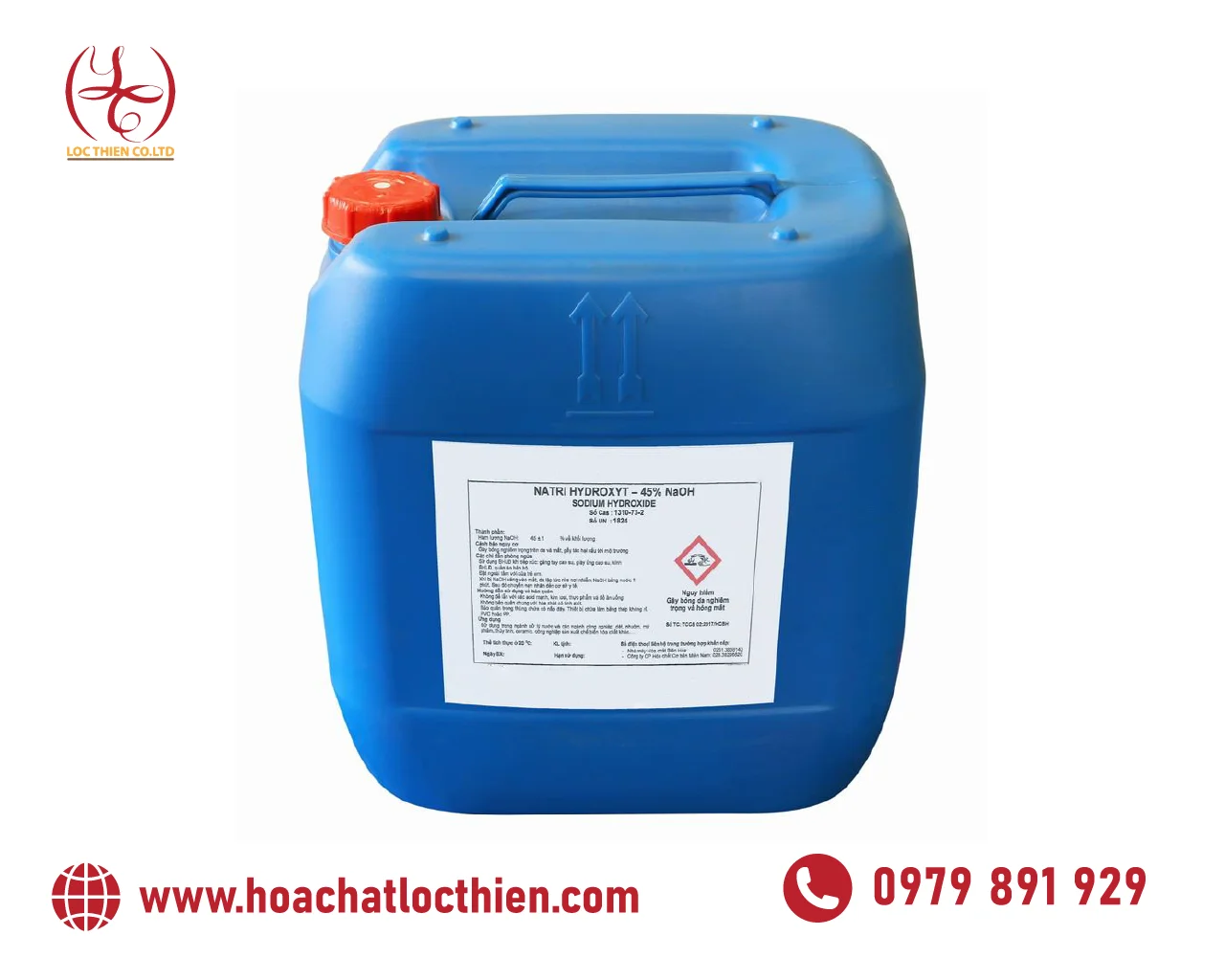
NaOH Safety — Caustic Burn Treatment & PPE for Industrial Plants
TL;DR: NaOH (caustic soda, CAS 1310-73-2) is a strong alkali chemical that causes deep burns through tissue saponification — fundamentally different from acid burns. Correct first aid: rinse under running water for 20 minutes, DO NOT neutralize with acid. Mandatory PPE includes thick nitrile gloves, chemical splash goggles, PVC apron, and rubber boots. Hóa Chất Lộc Thiên supplies NaOH 32% and 50% with batch COA/MSDS, delivered to industrial parks nationwide by 5–30 ton tanker trucks.
How NaOH Causes Caustic Burns — Mechanism Differs from Acid Burns
NaOH is a strong base (1% solution pH ~13). When it contacts living tissue, it causes liquefactive necrosis — different from acid burns which cause coagulative necrosis. In the caustic burn mechanism, OH⁻ ions saponify fats in cell membranes, breaking down collagen protein and glycosaminoglycan structures, causing damage to penetrate deep into the subcutaneous layer without the protective eschar formed by acid burns.
Consequence: caustic burns often do not hurt immediately (pain appears minutes to hours later), but tissue damage continues to progress. According to CDC ATSDR, the severity of NaOH burns may not be accurately assessable until 24–48 hours after exposure — the burn may be much deeper than initial presentation suggests.
NaOH concentration and hazard level table:
| NaOH Concentration | Hazard Level | Typical Symptoms |
|---|---|---|
| <1% | Mild irritation | Dry skin, mild itching, reversible after washing |
| 1–5% | Strong irritation | Red skin, burning sensation, mild epithelial damage |
| 5–10% | Skin corrosion | Blisters, 1st–2nd degree chemical burn, requires immediate washing |
| 10–25% | Deep burn | Tissue necrosis, dermal layer damage, delayed pain |
| 25–50% | Very deep burn | Rapid tissue saponification, risk of tendon/bone damage |
| >50% (solid form) | Immediate danger | Extremely severe chemical burn, vision loss if splashed in eyes |
Solid NaOH (flakes/prills) and concentrated solutions (32%, 50%) both cause severe burns. Particularly dangerous: NaOH powder/flakes are strongly hygroscopic — when they contact damp skin, they form a concentrated solution directly at the contact point, accelerating tissue saponification.
Caustic NaOH Burn First Aid — Correct Action During the “Golden Hour”
Principle 1: Rinse with water, DO NOT neutralize with acid
The most common mistake when treating caustic burns is using dilute acid (vinegar, citric acid) to neutralize. The neutralization reaction NaOH + acid is strongly exothermic — the heat generated adds thermal burns on top of the chemical burn, worsening tissue damage. Guidelines from CCOHS, CDC ATSDR, and OSHA all agree: do not use neutralizing agents, only rinse with water.
Standard First Aid Procedure:
-
Skin contact with NaOH:
- Remove contaminated clothing, shoes, and jewelry immediately (wear protective gloves when doing so)
- Brush off any solid chemical remaining on the skin before rinsing (do not rub)
- Flush under gently running water for at least 20 minutes, preferably 60 minutes
- Do not interrupt the rinsing process — continue rinsing while awaiting transport to hospital
- Take the victim to a medical facility immediately after rinsing — NaOH burns require specialist assessment
-
Eye splashed with NaOH:
- This is the most urgent situation — corneal damage can be permanent
- Flush eyes under gentle running water for at least 30 minutes, keeping eyelids open
- Remove contact lenses if possible (do not delay flushing)
- Call emergency services immediately — requires ophthalmologist evaluation
- Continue flushing during transport
-
Inhaled NaOH vapor/mist:
- Move the victim to fresh air
- If breathing difficulty: administer oxygen if available
- Call emergency services — pulmonary edema may appear after several hours
-
Swallowed NaOH:
- DO NOT induce vomiting — alkali will burn the esophagus a second time during regurgitation
- Give plain water to drink if the victim is conscious and can swallow
- Take to emergency immediately — requires endoscopy to assess esophageal/stomach damage
🛒 Need various NaOH grades? Get a quote for NaOH 32% — batch COA/MSDS, delivered to industrial parks nationwide. | Get a quote for NaOH 50% — batch COA/MSDS, delivered by tanker truck nationwide. Hotline 0979 891 929.
PPE (Personal Protective Equipment) When Working with NaOH
Per OSHA recommendations (29 CFR 1910.132) and ANSI Z87.1 standards, minimum PPE when handling NaOH:
Gloves — the most important choice
| Glove Type | NaOH Resistance | Notes |
|---|---|---|
| Nitrile (≥0.4mm) | Good | Suitable for NaOH ≤50%, breakthrough time >30 min |
| Neoprene | Very good | Withstands concentrated NaOH, suitable for prolonged immersion |
| Butyl rubber | Excellent | Optimal barrier, use for extended contact |
| PVC | Good | Economical, suitable for short tasks |
| Latex (thin <0.3mm) | NOT suitable | Rapid breakthrough, easily torn |
Practical recommendation: thick nitrile gloves ≥0.4mm offer the best balance of cost and protection for routine operations. For contact with NaOH 50% or prolonged immersion — use neoprene or butyl.
Eye and Face Protection
- Chemical splash goggles — meeting ANSI Z87.1
- When splash risk is high (valve operation, dispensing): add a face shield
- Regular safety glasses are NOT sufficient — liquid NaOH can flow through gaps into the eyes
Body Protection
- PVC apron or neoprene apron — impervious to alkali chemicals
- When handling large volumes (tanker trucks, storage tanks): chemical-resistant suit
- Chemical-resistant rubber boots — do not use fabric or leather footwear
Respiratory Protection
- When solid NaOH dust or mist is present: N95/P100 respirator or half-mask with P100/OV cartridge
- When concentration >2 mg/m³ (OSHA PEL ceiling): full-facepiece respirator with supplied air or PAPR
- Mixing areas: install local exhaust ventilation
NaOH Spill Response Procedures
Small Spill (≤5 liters or ≤1 kg):
- Evacuate non-essential personnel from the area
- Wear full PPE (nitrile gloves, chemical goggles, apron)
- Solid NaOH: collect using dry tools (plastic shovel, rubber brush) into a sealed container — do not add water
- Liquid NaOH: use inert absorbent materials (sand, vermiculite, diatomaceous earth) — do not use sawdust or paper (may react)
- Collect absorbed material into a chemical waste container
- Neutralize remaining surface with dilute acid (HCl 1–5% or vinegar) — check pH reaches 6–8
- Clean the area with water, collect wash water into waste container
Large Spill (storage tank, tanker truck):
- Activate emergency procedures — call professional response team
- Build a dike around the spill area using sand or inert material
- Prevent flow into drains or waterways — NaOH pH>12.5 is prohibited from discharge into municipal drainage systems
- Pump remaining NaOH solution into an alkali-resistant intermediate container
- Neutralize remaining spill area with dilute acid to pH 6–8
- Report to environmental authorities if spill volume ≥1,000 lbs (approx. 454 kg) — per CERCLA
Required emergency equipment in work areas:
- Emergency eyewash station — within 10 seconds travel
- Safety shower — ANSI Z358.1
- NaOH spill response kit
- First aid instructions posted in the area
Safe NaOH Storage in Industrial Plants
- NaOH storage tanks: carbon steel or 304 stainless steel are suitable — do not use aluminum, zinc, or tin (NaOH reacts with these metals producing flammable H₂ gas)
- Dry, cool, ventilated area, away from moisture (NaOH is strongly hygroscopic → caking)
- Isolate from acids (HCl, H₂SO₄), organic materials, and oxidizers
- Containers must have breather valves — pressure buildup can cause bulging or rupture
- Before opening a concentrated NaOH container: check for bulging — if bulging, call a specialist
Lộc Thiên’s Safety Commitment — Reliable NaOH Supply
Hóa Chất Lộc Thiên supplies NaOH 32% (specific gravity 1.348 at 20°C) and NaOH 50% (specific gravity 1.52 at 20°C) with batch-specific COA/MSDS — actual test data, not rounded. QC team Phan Cẩm Thủy and Võ Thị Như Hòa control quality before dispatch.
Lộc Thiên has 6 warehouses nationwide (HCMC, Đồng Nai, BR-VT, Cần Thơ, Đà Nẵng, Bắc Ninh) and a fleet of 5–30 ton tanker trucks ensuring same-day delivery within HCMC and 24-hour delivery to Southern industrial parks.
Plant customers receive safety instructions with MSDS documentation and handling procedures upon first delivery.
Frequently Asked Questions (FAQ)
Is NaOH burn different from acid burn?
Yes. NaOH causes liquefactive necrosis, penetrating deep with difficult initial assessment. Acid burns typically create a coagulated eschar that self-limits the injury.
What if I accidentally neutralized NaOH with vinegar?
Not recommended. The exothermic reaction can add thermal burns on top of the chemical burn, worsening tissue damage. Water rinsing is correct.
What is the minimum PPE when diluting concentrated NaOH?
Chemical splash goggles, thick nitrile gloves ≥0.4mm, PVC apron, rubber boots. Add a face shield when dispensing.
At what concentration is NaOH dangerous?
Above 1% already causes strong irritation. Above 10% causes deep chemical burns. NaOH 32% and 50% require full PPE.
What if I inhale NaOH dust?
Move to fresh air immediately. If breathing difficulty — administer oxygen. Pulmonary edema may appear late, requires medical monitoring.
Why not induce vomiting when NaOH is swallowed?
Because NaOH will burn the esophagus a second time during regurgitation. Give water and take to emergency immediately.
What NaOH concentrations does Lộc Thiên sell?
Lộc Thiên supplies NaOH 32% (solution) and NaOH 50% (solution) — batch COA/MSDS.
Request a Quote
Contact Hóa Chất Lộc Thiên for a NaOH 32%, NaOH 50% quote based on quantity. Download full MSDS and actual batch COA. Hotline 0979 891 929.
=====
QC: Phan Cẩm Thủy & Võ Thị Như Hòa. Batch COA. ZDHC MRSL Level 1 (TÜV Rheinland). Hotline 0979 891 929.