
Sodium Silicate Na₂SiO₃ Complete Guide — Real COA
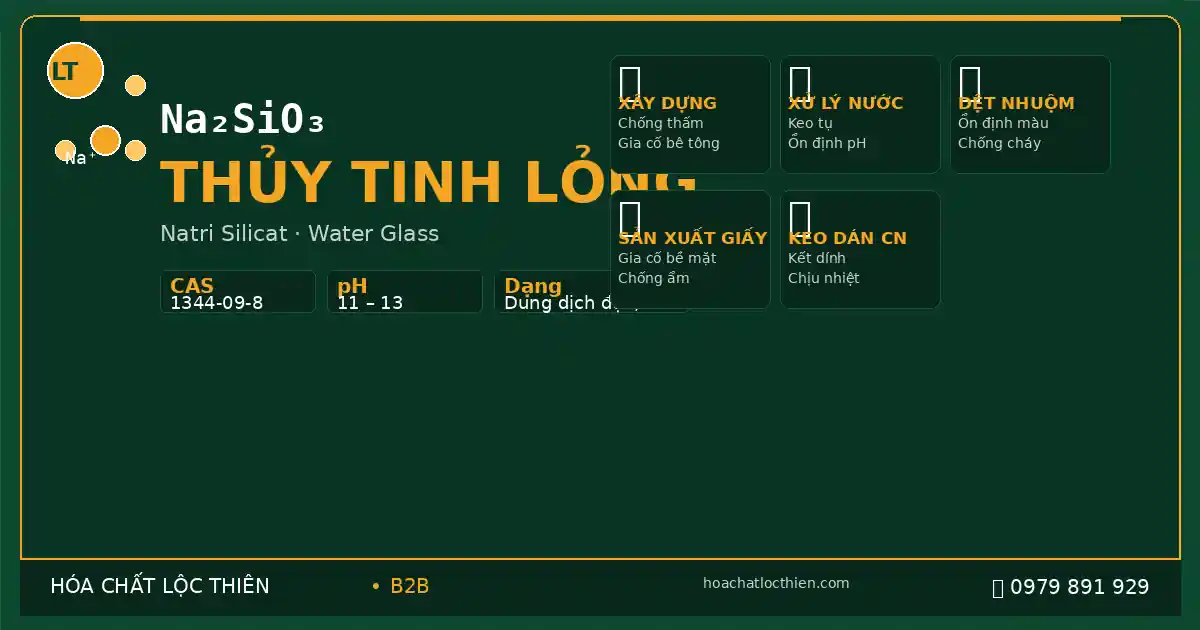
Table of contents
TL;DR: Sodium silicate (Na₂SiO₃, CAS 1344-09-8), also called water glass, is an inorganic compound in strongly alkaline solution form (pH 11–13) with a Specific Gravity of 1.35–1.55 g/mL and Module SiO₂/Na₂O ratio of 2.0–3.3. Loc Thien supplies bulk sodium silicate in grades N26–N32, with batch COA, MSDS and delivery to Industrial Parks. The QC team Phan Cam Thuy and Vo Thi Nhu Hoa inspect every batch before shipment.
What Is Sodium Silicate (Water Glass)?
Sodium silicate, also called water glass or liquid glass, is the sodium salt of silicic acid with the chemical formula Na₂SiO₃ or Na₂O·nSiO₂. Its CAS number is 1344-09-8 and EC number 215-687-4. This compound was first discovered in 1640 by Jan Baptist van Helmont when he combined alkali with molten silica. Commercial product is manufactured by melting quartz sand (SiO₂) with soda ash (Na₂CO₃) at 1,300–1,500°C, then dissolving the glass mass in water. The resulting solution is a viscous liquid, clear to slightly turbid, pH 11–13. Chemically, sodium silicate exists in three main forms: metasilicate (Na₂SiO₃), orthosilicate (Na₄SiO₄) and pyrosilicate (Na₆Si₂O₇), of which metasilicate is most common. In the EU food additives list, this substance is designated E550, used as a stabilizer and anti-caking agent.
Chemical Structure and Formula
Commercial sodium silicate has the formula Na₂O·nSiO₂, where n is the molar ratio between SiO₂ and Na₂O, called the Module. The molar mass of anhydrous metasilicate is 122.06 g/mol; commercial solution is approximately 284.22 g/mol. This compound is registered with ECHA under EC number 215-687-4. The molecular structure in solution is a network of SiO₄⁴⁻ units linked through shared oxygen atoms (Si–O–Si), with Na⁺ ions distributed in the interlayer space — giving it characteristic adhesion and film-forming properties. The product exists in three forms: viscous liquid solution (most common), solid (glass mass after melting), and powder (after spray drying). Liquid solution accounts for over 85% of global output due to direct application without re-dissolution.
Detailed Technical Specifications — Batch COA
Loc Thien’s sodium silicate is supplied in grades N28, N30 and N32 with the specifications below. Each batch comes with a COA (Certificate of Analysis) inspected by the QC department — batch codes are marked on each drum, IBC and delivery documentation.
| Parameter | Grade N28 | Grade N30 | Grade N32 | Method |
|---|---|---|---|---|
| Specific Gravity @ 30°C (g/mL) | 1.41–1.43 | 1.45–1.47 | 1.40–1.50 | Hydrometer |
| Total Solids (Na₂O + SiO₂) | 37.0–39.0% | ≥ 40.0% | 37.5–38.6% | Gravimetric |
| Module (molar ratio SiO₂:Na₂O) | 2.65–2.85 | 2.9–3.1 | 3.1–3.3 | 64TCN 38-86 |
| pH (1% solution) | 12.8 | 12.8 | 12.8 | pH meter |
| Viscosity @ 20°C (cP) | 200–600 | — | — | Viscometer |
General specifications: module 2.0–3.3; Specific Gravity 1.35–1.55 g/mL; solids content 35–45%; pH 11–13. Loc Thien’s QC department checks every parameter on the COA before shipment. Technicians Phan Cam Thuy and Vo Thi Nhu Hoa are directly responsible for quality inspection of incoming and outgoing liquid chemicals.
Module — this is the most important parameter when evaluating sodium silicate. The Module (molar ratio SiO₂/Na₂O) determines physical-chemical characteristics: low module (2.0–2.5) gives low viscosity, strong alkaline reaction; high module (3.0–3.3) gives high viscosity, hard film after drying, suitable for heat-resistant adhesives.
🛒 Need batch COA for sodium silicate? Quote for Sodium Silicate (water glass) grade N28–N32 — batch COA/MSDS, delivery to Industrial Parks nationwide. Hotline 0979 891 929.
Module SiO₂/Na₂O Comparison — Choosing the Right Grade
The Module is the decisive parameter when selecting sodium silicate for each specific application. There is no single correct grade — only the grade matched to the factory’s technological requirements.
| Module | SiO₂/Na₂O Ratio | Viscosity | Alkalinity | Film Characteristic | Main Applications |
|---|---|---|---|---|---|
| Low 2.0–2.5 | Low SiO₂ | Low | High | Weak film, fast dissolution | Water treatment, detergents, soap production, peroxide stabilizer |
| Medium 2.5–3.0 | Balanced | Medium | Medium | Stable film | Carton board adhesive, packaging, construction, acid-resistant cement |
| High 3.0–3.3 | High SiO₂ | Very high | Low | Hard, heat-resistant film | Fire-retardant paint, heat-resistant adhesive, metal casting, welding rods |
Grade N28 (module 2.65–2.85) belongs to the medium group — suitable for paper adhesive, construction. Grade N30 (module 2.9–3.1) is at the medium–high threshold — can be used for both carton adhesive and basic heat-resistant applications. Grade N32 (module 3.1–3.3) is the highest grade — producing the hardest film, suitable for structural steel fire-retardant paint and welding rod coating.
Na₂SiO₃ vs K₂SiO₃: Potassium silicate (K₂SiO₃) has lower alkalinity, dissolves faster and produces a transparent film — often used in high-quality paints and ceramic glazes. The cost of K₂SiO₃ is 1.5–2 times higher than sodium silicate, so Na₂SiO₃ is the economical choice for most industries.
Specific Gravity and Practical Significance
The Specific Gravity of sodium silicate ranges from 1.35–1.55 g/mL and depends directly on the module as well as solids content. This is a commonly misunderstood point: high Specific Gravity does not equal good quality — Specific Gravity only indicates total solids content, not the module or adhesive properties. A batch of sodium silicate grade N32 (module 3.2) may have a Specific Gravity of 1.41 g/mL but viscosity over 8,000 cP due to the dense SiO₂ network, while grade N26 (module 2.6) with Specific Gravity 1.47 g/mL has viscosity of only 700 cP because of high Na₂O content relaxing the network.
| Module | SiO₂/Na₂O weight ratio | Solids (%) | Viscosity @ 20°C (cP) | Specific Gravity (g/mL) | Application |
|---|---|---|---|---|---|
| 3.25 | 3.25 | 39.2 | 8,300 | 1.41 | Paperboard, fiberboard, refractory cement |
| 3.22 | 3.22 | 38.7 | 4,000 | 1.41 | Concrete casting adhesive, metal |
| 2.88 | 2.88 | 42.7 | 9,600 | 1.47 | Carton board adhesive |
| 2.84 | 2.84 | 43.1 | 700 | 1.17 | Metal casting adhesive |
The table shows two batches with the same Specific Gravity of 1.41 g/mL but different modules (3.25 vs 3.22), producing completely different viscosity and applications. Therefore, when evaluating a batch, buyers should request a COA showing both module and Specific Gravity — not rely solely on Specific Gravity for pricing.
Industrial Applications (7+ Industries)
Sodium silicate appears in at least 8 key industries thanks to three characteristics: inorganic adhesion, alkalinity and film-forming ability.
1. Inorganic heat-resistant adhesive: This is the largest application of sodium silicate. In corrugated board production, sodium silicate solution with module 2.5–3.0 combined with starch acts as the base adhesive for the fluted medium. The adhesion of silicate glue to cellulose surfaces is due to the chemical reaction between SiO₂ and OH⁻ on the fiber surface, forming hydrogen bonds.
2. Passive fire protection: High-module sodium silicate (3.0–3.3) is the main component in fire-retardant paint for steel structures. When exposed to high temperatures, the hydrated silicate film releases water vapor and forms an insulating intumescent foam layer — delaying the time for steel to reach the critical temperature of 540°C by 60–120 minutes depending on film thickness. Used in mineral wool fire-resistant panels and fireproof mortar.
3. Water treatment: Sodium silicate acts as a stabilizer and corrosion inhibitor in industrial water systems. Soluble silica from sodium silicate forms a protective layer on steel pipes through the reaction: Na₂SiO₃ + Fe → FeSiO₃ + Na₂O. This film prevents oxygen and chlorine from corroding pipes, especially in boiler water systems and cooling towers.
4. Paper and packaging production: Beyond adhesives, sodium silicate also serves as a surface strengthening agent for paper, improving water resistance and print flatness. In pulp bleaching, silicate stabilizes H₂O₂ — maintaining a slow peroxide decomposition rate, increasing bleaching efficiency.
5. Construction: Sodium silicate reacts with Ca(OH)₂ in cement to form calcium silicate hydrate (CSH) — a reaction that fills capillary pores in concrete, improving water resistance. Used as a waterproofing admixture for exterior walls, sprayed onto old concrete surfaces to extend service life. In acid-resistant cement, low-module sodium silicate is combined with heat-resistant minerals.
6. Industrial detergents and soap: The alkalinity of Na₂SiO₃ helps raise the pH of cleaning solutions, breaking down grease and fats. At the same time, silica has anti-redeposition properties — keeping dirt suspended in solution rather than re-depositing on clean surfaces.
7. Agriculture: Seed treatment with dilute sodium silicate solution helps stimulate germination and increase seedling resistance to fungal diseases by activating the plant’s natural defense mechanisms.
8. Ceramic production — cold glaze: Shortens the firing cycle.
Case study: A carton paper factory in Song Than 2 Industrial Park switched from starch glue to a mixed starch + N30 adhesive (module 2.9–3.1) — reducing adhesive costs by 15%, increasing line speed from 120 to 150 m/min without loss of bond strength (verified by peel test).
Usage and Dilution Guide
Commercial sodium silicate has a concentration of 35–45% solids. The module must be determined before dilution to scale to the appropriate ratio. Basic rule: always add silicate to water (never the reverse) to avoid localized gel formation. Stir continuously during dilution.
Basic dilution steps:
- Measure the required amount of water at 30–40°C (warm water accelerates dissolution, reduces viscosity).
- Slowly add sodium silicate to the water, stirring with a mechanical impeller or circulation.
- After reaching homogeneity, cool to room temperature.
- Check pH or Specific Gravity to confirm actual concentration.
Avoid sudden mixing with strong acids — the reaction between sodium silicate and sulfuric acid (or HCl) is strongly exothermic and produces precipitated silica gel. When alkali neutralization is required for wastewater treatment, add slowly and continuously with vigorous stirring to control pH (see detailed guide at industrial silicate usage process).
Storage: Container must be sealed after each use. Store in a cool place, temperature 5–35°C, avoid freezing (temperature <0°C may cause reversible gelation). Water treatment chemicals in liquid form have similar storage requirements.
Safety and Storage
Sodium silicate is not classified as dangerous goods by UN (no UN number required), but with pH 11–13 it is still corrosive to skin and mucous membranes. Direct contact causes eye and skin irritation — PPE required: chemical gloves, safety goggles and chemical-resistant apron when handling the solution.
Specific safety measures:
- Use nitrile or neoprene gloves (natural rubber is not sufficiently alkali-resistant over time).
- Use splash-proof chemical goggles — not regular glasses.
- If splashed in eyes — flush continuously for 15 minutes under running water, seek medical attention.
- On skin — wash with soap and warm water, do not use acid to neutralize.
Storage:
- Temperature 5–35°C. Below 0°C the solution may solidify or gel — if this occurs, it can be re-liquified at 30–40°C with stirring, but this is not recommended as it affects uniformity.
- Avoid CO₂ — silicate reacts with atmospheric CO₂ to form silica precipitate (SiO₂·nH₂O), reducing concentration.
- Shelf life: 12 months from production date in sealed original packaging.
- Packaging: 30L plastic can, 200L steel/plastic drum, 1,000L IBC, tanker truck per order (thousands of liters up to 20 tons).
Sodium silicate has no strong incompatibility with NaOH liquid caustic soda and H₂O₂ hydrogen peroxide when stored in separate areas, but should not be stored in the same container. H₂SO₄ sulfuric acid is a strong acid — when used to neutralize sodium silicate in wastewater treatment, it must be done in corrosion-resistant equipment with an exhaust fan.
Quotation and Purchase of Sodium Silicate at Loc Thien
Loc Thien supplies bulk sodium silicate water glass with a module range of 2.55–3.3 corresponding to grades N26, N28, N30, N32. Warehouse network spans 6 locations nationwide: Ba Ria – Vung Tau, Dong Nai, Binh Duong, Da Nang, Can Tho and Bac Ninh. A fleet of tanker trucks (capacity 5–30 tons) delivers to Industrial Parks within 24–48 hours in southern provinces and within 2–3 days for Central and Northern regions.
Associated services:
- Batch-specific COA — full data on module, Specific Gravity, Na₂O, SiO₂, viscosity.
- MSDS/SDS upon request.
- Sample testing support before bulk ordering.
- Downstream bundling: Order sodium silicate + NaOH liquid caustic soda + H₂O₂ hydrogen peroxide in the same shipment, reducing transport costs for factories.
Packaging options: 30L can (testing, samples), 200L drum (medium production), 1,000L IBC (large production), tanker truck (factory consumption 20+ tons/month).
QC inspection: Technicians Phan Cam Thuy and Vo Thi Nhu Hoa are responsible for batch parameter verification before shipment. Batch COA and MSDS available upon request.
Technical Support & B2B Procurement Hotline
Loc Thien Chemical specializes in direct manufacturing of FeCl₂ / FeCl₃ and direct industrial supply of basic chemicals (NaOH, HCl, H₂SO₄, PAC, NaOCl, H₂O₂, FeSO₄) with direct B2B pricing and dedicated 5–30-ton tanker delivery across Vietnam.
- Hotline / Zalo: +84 979 891 929
- Official Email: [email protected]
- Direct Manufacturer: Ferrous Chloride (FeCl₂ 30%) & Ferric Chloride (FeCl₃ 38–40%)
- Primary Supplier: NaOH 32%/45%/50%/99%, HCl 32%, H₂SO₄ 98%, PAC 30–31%, NaOCl 10–12%, H₂O₂ 35%/50%
- Compliance & Quality: FeCl₂ ZDHC MRSL v3.1 test report (Smart testing, 5 substance groups, TUV Rheinland Vietnam), ISO 9001:2015, Quatest 3, Full COA & GHS SDS
Frequently Asked Questions (FAQ)
Is sodium silicate toxic?
Sodium silicate is not toxic like organic compounds or heavy metals, but it is corrosive to skin (pH 11–13) as it is a strong alkali. Avoid direct contact; rinse immediately with water if splashed on skin or eyes.
What is the difference between Module 2.0 and 3.0?
Low module (2.0–2.5) gives low viscosity, high alkalinity — used in water treatment, cleaning. High module (3.0–3.3) gives hard, heat-resistant film — used for heat-resistant adhesives, fire-retardant paint.
Can water glass be used for waterproofing?
Yes. Sodium silicate reacts with Ca(OH)₂ in cement to form calcium silicate hydrate (CSH) that fills capillary pores, reducing water permeability. Used by spraying directly onto concrete surfaces or mixing into waterproofing mortar.
What is the difference between sodium silicate and potassium silicate?
K₂SiO₃ dissolves faster, produces a transparent film and has lower alkalinity — used in high-quality paints, ceramic glazes. Na₂SiO₃ is cheaper and more common, accounting for >90% of global water glass output.
Where to buy bulk sodium silicate?
Loc Thien — 6 warehouses nationwide, a fleet of tanker trucks 5–30 tons, delivery to Industrial Parks. Batch COA, MSDS. Hotline 0979 891 929.
What parameters are on the sodium silicate COA?
Module (molar ratio SiO₂/Na₂O), Specific Gravity (g/mL), solids content (Na₂O + SiO₂, %), pH, viscosity (cP), Fe content if applicable. Analytical method per 64TCN 38-86.
How long can water glass be stored?
6–12 months in sealed original packaging, temperature 5–35°C, avoid direct sunlight and CO₂ exposure. If gelled due to cold, it can be recovered by heating to 30–40°C and stirring.
Can water glass be used in food?
Grade E550 (pure sodium silicate) is permitted by the EU as a stabilizer and anti-caking agent in food at limited doses. Industrial grade — not for food use.
🛒 Need Sodium Silicate (water glass)? Quote for Sodium Silicate Na₂SiO₃ grade N28–N32 — batch COA/MSDS, delivery to Industrial Parks nationwide. Hotline 0979 891 929.
This article has been reviewed by Loc Thien’s QC Department — Technicians Phan Cam Thuy and Vo Thi Nhu Hoa. All technical parameters are based on actual batch COA. Request batch-specific COA via hotline or quotation form.
See also: NaOH liquid caustic soda | Sulfuric Acid H₂SO₄ | Water treatment chemicals | Chemicals for the paper and packaging industry