
Sodium Silicate in Paper Production — Filler & Adhesive
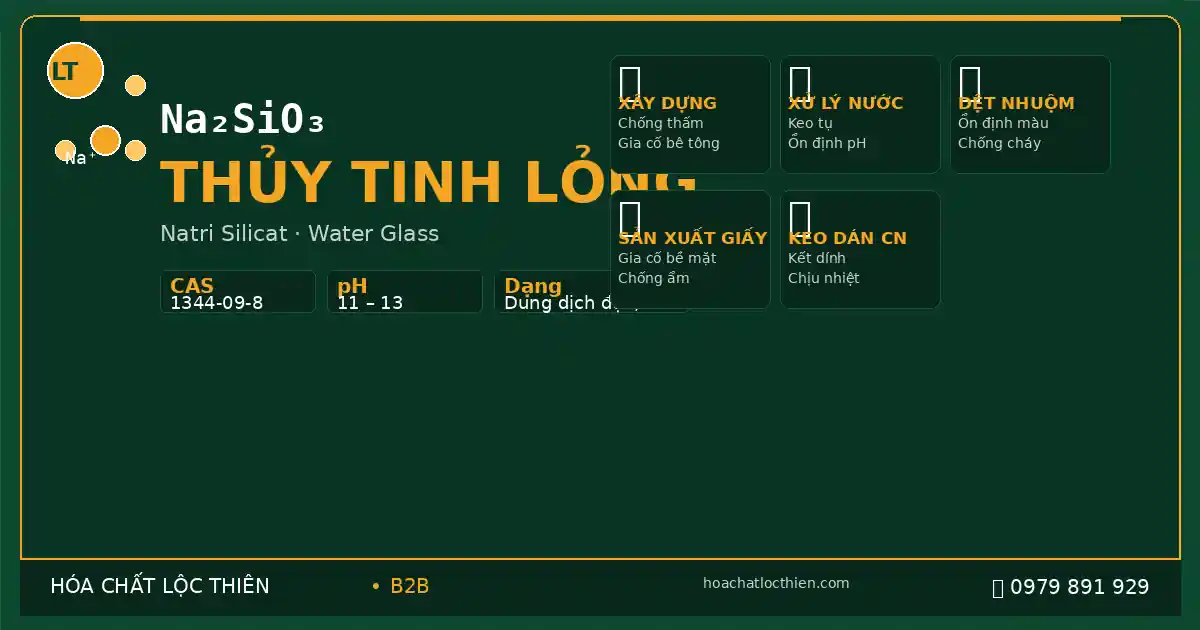
Table of contents
Sodium silicate (Na₂SiO₃, CAS 1344-09-8) — also known as water glass — is a versatile inorganic chemical in the paper and packaging industry. It plays three main roles: filler to increase stiffness, binder between kraft paper layers, and surface adhesive for corrugated carton. No single sodium silicate grade fits all stages — choosing the right module (SiO₂:Na₂O ratio) determines output quality.
1. Role of Sodium Silicate in Paper Production
In the paper and packaging production line, sodium silicate appears at various stages thanks to its mild alkalinity (pH 11–13), film-forming ability, and lower cost compared to organic adhesives.
1.1. Reinforcing Filler for Kraft Paper
When added to the pulp at the wet-end stage, sodium silicate acts as an active filler — not only filling gaps between cellulose fibers but also forming chemical bonds with the fibers. The mechanism: silicate ions (SiO₃²⁻) react with metal cations (Ca²⁺, Al³⁺) in the pulp system to form calcium silicate hydrate (C-S-H) gel that attaches to fiber surfaces, increasing tensile strength and stiffness of the final product.
According to research from US Patent 10041211, a blend of sodium silicate and precipitated calcium carbonate (PCC) increases filler content by an additional 5% (from 20% to 25%) without compromising paper strength, while also reducing dusting on printing surfaces. Typical dosage: 0.5–2% sodium silicate by dry weight of PCC, combined with PAC (poly-aluminum chloride) at 1–5 kg per ton of paper.
1.2. Adhesive in Corrugated Carton and Paper Tube Production
In carton box production, sodium silicate replaces starch adhesive in applications requiring moisture and heat resistance. Water glass adhesive penetrates deeply into the paper fiber structure, forming a hard inorganic bond after drying. Module 2.8–3.0 provides the best adhesion for corrugated carton production — this ratio balances sufficient viscosity for even coating on corrugated flutes with fast enough setting time to hold the fold.
For industrial paper tube production (core-board), cores, and cardboard tubes, sodium silicate module 3.0–3.3 is preferred because it forms a hard, compression-resistant film, especially when tubes must bear the weight of heavy paper rolls.
1.3. Stabilizer in Pulp Bleaching
In H₂O₂ pulp bleaching processes, sodium silicate acts as a stabilizer — preventing H₂O₂ from decomposing too rapidly due to catalysis by metal ions (Fe²⁺, Mn²⁺) in the water. Module 2.0–2.5 (high alkalinity, low viscosity) suits this role because of its stronger complexing ability with heavy metals, keeping H₂O₂ stable throughout the bleaching process.
2. Module 2.0 vs 3.3 Comparison — Choosing the Right One for the Application
Module = molar ratio SiO₂/Na₂O. This parameter determines almost all properties of sodium silicate.
Module 2.0–2.5 (low ratio):
- Low viscosity (~60–200 cP), easy to pump and dilute
- High alkalinity (pH ~12–13) — suitable as bleaching stabilizer, wastewater treatment
- Dry film is brittle, moderate adhesion
- Lower cost — used for applications not requiring high mechanical strength
Module 3.0–3.3 (high ratio):
- High viscosity (~1,500–9,600 cP), forms thicker film
- Lower alkalinity (pH ~11) — safer for paper fibers
- Hard dry film, good compression resistance
- Fast setting time — ideal for paper tube and load-bearing carton adhesives
Quick comparison table:
| Parameter | Module 2.0–2.5 | Module 3.0–3.3 |
|---|---|---|
| Main application | Bleaching stabilizer, recycled pulp | Paper tube adhesive, carton, heat-resistant |
| Viscosity (20°C) | 60–800 cP | 900–9,600 cP |
| pH | 12–13 | 11–12 |
| Dry film hardness | Low–medium | High |
| Setting time | Slow | Fast |
| Cost | Lower | Higher |
Module selection conclusion: Carton and paper tube adhesive → choose module 2.8–3.3. Bleaching aid → choose module 2.0–2.5. Loc Thien delivers with batch COA — confirm module when ordering.
3. Actual COA — Loc Thien Sodium Silicate
Each Loc Thien sodium silicate shipment comes with a COA (Certificate of Analysis) with the following specifications. Below are the product parameter ranges — exact values on each batch COA:
Technical specifications table:
| Item | Parameter | Test Method |
|---|---|---|
| Formula | Na₂SiO₃ / Na₂O·nSiO₂ | — |
| CAS | 1344-09-8 | — |
| Product form | Liquid solution, clear to slightly turbid | Visual |
| Module (SiO₂:Na₂O) | 2.0–3.3 (per batch COA) | Titration HCl 0.5N + KF |
| Density (20°C) | 1.35–1.55 g/mL | Hydrometer |
| Solids content | 35–45% | Drying at 105°C to constant weight |
| pH (1% solution) | 11–13 | pH meter |
| Na₂O | 9–12% (w/w) | Titration HCl 0.5N, bromthymol blue indicator |
| SiO₂ | 26–31% (w/w) | Gravimetric / KF titration |
| Insoluble residue | ≤0.5% (w/w) | G4 filter, drying at 105°C |
Packaging specifications:
- 30L jerrycans, 200L drums (steel or plastic), 1000L IBC totes
- Dedicated 5–30 ton tankers for bulk volumes
- Documentation: MSDS/SDS + COA as required
Note: For high module (3.0–3.3), solution viscosity may increase if stored beyond 12 months or at low ambient temperature. Check flowability before feeding into dosing pumps.
4. Batch Quality Documentation
Loc Thien provides batch-specific COA and MSDS — plants can use these documents to cross-check specifications before introducing the chemical into production.
5. Reference Mixing Ratios
Carton adhesive formula (module 2.8–3.2):
- Sodium silicate as supplied — 70–80% by volume
- Water — 20–30% by volume (adjust viscosity to 800–1,200 cP)
- Optionally add 0.5% nanoclay to increase toughness by 25% (per Faria et al., 2025 — article in Cellulose journal)
Bleaching aid formula (module 2.0–2.5):
- Sodium silicate — 1–3% by dry pulp weight
- H₂O₂ — 2–5% by dry pulp weight
- NaOH — adjust pH to 10.5–11
- Bleaching temperature: 60–80°C, time 45–90 minutes
6. Operational Notes
- Do not mix sodium silicate with strong acids (HCl, H₂SO₄) outside the process — the reaction instantaneously forms silica gel, clogging pipes.
- Equipment cleaning: After using water glass adhesive, rinse immediately with hot water (>60°C) before the film hardens.
- Storage: Keep lid tightly sealed after use — avoid absorbing CO₂ from air, which forms silica precipitate. Shelf life: 6–12 months from manufacturing date.
- PPE: Alkali-resistant gloves, safety goggles — sodium silicate at pH 11–13 causes skin and eye irritation.
Technical Support & B2B Procurement Hotline
Loc Thien Chemical specializes in direct manufacturing of FeCl₂ / FeCl₃ and direct industrial supply of basic chemicals (NaOH, HCl, H₂SO₄, PAC, NaOCl, H₂O₂, FeSO₄) with direct B2B pricing and dedicated 5–30-ton tanker delivery across Vietnam.
- Hotline / Zalo: +84 979 891 929
- Official Email: [email protected]
- Direct Manufacturer: Ferrous Chloride (FeCl₂ 30%) & Ferric Chloride (FeCl₃ 38–40%)
- Primary Supplier: NaOH 32%/45%/50%/99%, HCl 32%, H₂SO₄ 98%, PAC 30–31%, NaOCl 10–12%, H₂O₂ 35%/50%
- Compliance & Quality: FeCl₂ ZDHC MRSL v3.1 test report (Smart testing, 5 substance groups, TUV Rheinland Vietnam), ISO 9001:2015, Quatest 3, Full COA & GHS SDS
Frequently Asked Questions about Sodium Silicate in Paper Production
What dosage of sodium silicate is used in paper production?
The dosage depends on the purpose: as kraft paper filler: 2–5% of dry pulp weight; as carton adhesive: 10–15% (diluted with water at 1:1 to 1:3 ratio); as pulp preservation aid: 0.5–1%. Consult the batch COA and perform a jar test before application. Loc Thien supplies various module grades — call 0979 891 929.
Which Na₂SiO₃ module is suitable for carton adhesive?
Module 3.2–3.3 (high SiO₂:Na₂O) is most suitable for carton adhesive due to high viscosity, fast drying time, and strong bonding strength. Module 2.0–2.5 is more suitable for paper filler and preservation aids. Loc Thien supplies all modules — contact 0979 891 929 for advice on selecting the right grade.
Does silicate affect paper whiteness?
No. Sodium silicate at recommended dosage (2–5%) does not reduce paper whiteness. When used as a filler, silicate is a clear, colorless liquid — it does not affect the finished paper color. In paper bleaching processes, silicate also helps stabilize H₂O₂, reducing bleaching agent consumption and maintaining more stable whiteness.
Can silicate be replaced by other chemicals in paper production?
Silicate can be replaced by kaolin or CaCO₃ as a filler, but silicate has the advantage of being a liquid that is easy to dose, generates no dust, and has lower cost. As a carton adhesive, starch can substitute but requires cooking and longer drying time. Silicate remains the most economical choice for most paper mills in Vietnam.
Where to buy sodium silicate for paper mills?
Loc Thien Chemical — supplies bulk sodium silicate module 2.0–3.3, batch COA. 6 warehouses nationwide, a fleet of tankers of 5–30 tons. Delivery to industrial parks per our delivery policy. Call 0979 891 929 for a quote and advice on the right module for your paper production line.
7. Buy Bulk Sodium Silicate for Paper Mills
Loc Thien supplies liquid sodium silicate in bulk by drum, IBC, or tanker. Delivery from 6 nationwide warehouses — Ba Ria – Vung Tau, Dong Nai, Binh Duong, Da Nang, Can Tho and Bac Ninh — to all industrial parks. Expected delivery time: within 4 hours in inner Ho Chi Minh City; 24–48 hours to industrial zones in Southern Vietnam and the Mekong Delta; 2–3 days to Northern and Central Vietnam. Contact hotline 0979 891 929 for more details on the delivery process.
Paper mills can source Na₂SiO₃ + NaOH (liquid caustic soda) + H₂O₂ from a single source — optimizing logistics and ensuring consistent quality. Contact hotline 0979 891 929 — quote within 15 minutes, batch COA/MSDS.
--- References ---
- US Patent 10041211 — Method of increasing filler content in paper or paperboard
- Faria et al. (2025). Multilayer paper composites. Cellulose 32(7): 4525–4552
Quality control: QC Specialist Phan Cam Thuy inspects and Vo Thi Nhu Hoa approves each batch of Sodium Silicate. Batch COA — precise module ratio and density.
- TCVN / Liquid sodium silicate standard — physical and chemical specifications