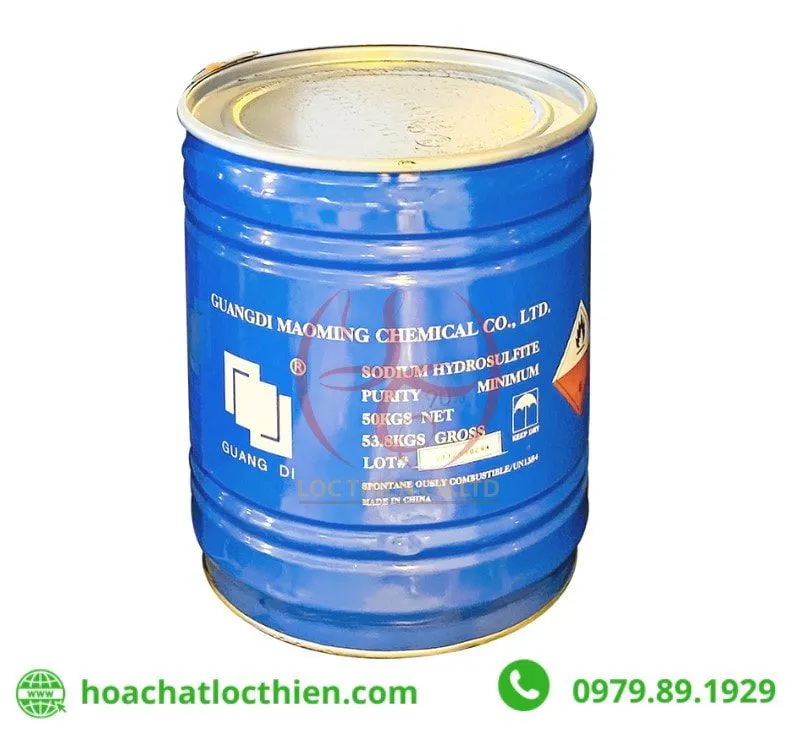
Sodium hydrosulfite Na2S2O4 in 50 kg drums, a reducing bleach that decomposes in hot water and acids and oxidizes in air. Loc Thien, hotline 0979 891 929
Sodium Hydrosulfite (Na2S2O4), It typically exists as a white crystalline powder with a distinctive, strong odor. It is soluble in water, readily decomposes in hot water and acidic solutions, is easily oxidized by air, and is flammable.
Packaging specifications: 50 kg per box; Country of origin: Germany/China/Italy.
Product name: Sodium Hydrosulfite (Na₂S₂O₄)
Also known as: Sodium Hydrosulfite, Sugar Bleach, Sodium Dithionite, Sodium Hydrosulfide
Chemical formula: Na₂S₂O₄
CAS number: 7775-14-6
Origin: Germany, China, Italy – Leading countries in the production of high-quality industrial chemicals.
Packing: 50 kg per drum – Standard packaging, easy to store, safe for transport, and particularly suitable for industries that require sodium hydrosulfite.
What is sodium hydrosulfite?
Sodium Hydrosulfite (Na₂S₂O₄) is an important industrial compound that acts as a strong reducing agent and is widely used in many fields. It exists as a white crystalline powder with a distinctive odor; it is easily soluble in water but oxidizes rapidly upon contact with air. In particular, Na₂S₂O₄ and Sodium Hydrosulfide It is flammable and decomposes rapidly when exposed to hot water or acids.
With its powerful deodorizing ability, Na₂S₂O₄ is primarily used in Textile Dyeing industry to remove excess color, water treatment to remove residual chlorine and oxidizing impurities, as well as in chemical production. It is also known by other names such as Natri Dithionite or Sodium Dithionite.
Physical and Chemical Properties of Sodium Hydrosulfite:
Physical properties of Na₂S₂O₄:
Form of existence: A white crystalline powder that readily absorbs moisture when exposed to air.
Melting point: ~65-70°C, prone to decomposition at high temperatures.
Molecular weight: 174,11 g/mol.
Density: 2.38 g/cm³, which helps identify the substance during storage.
Water solubility: 18.2 g/100 ml in 20°C—dissolves well but is not stable over the long term.
Chemical properties of Na₂S₂O₄:
As a strong reducing agent, Na₂S₂O₄ It is capable of reducing metal oxides and removing color from organic compounds, particularly in Textile Dyeing.
Sodium Hydrosulfite It is unstable in water and air: When exposed to oxygen, it decomposes into sodium bisulfite (NaHSO₃) and sodium thiosulfate (Na₂S₂O₃).
Sodium Hydrosulfide It also has similar properties in certain specialized industrial applications.
Effects in a strongly acidic environment: Reacts vigorously and generates a large amount of heat when combined with HCl.
Solution Sodium hydrosulfite It is heat-resistant, but oxidizes slowly when exposed to air
2S2O42- + H2O → S2O32- + 2HSO3–
Solution Natri dithionite It is acidic and decomposes to form sodium thiosulfate and sodium bisulfite. The reaction rate increases with rising temperature or in a strongly acidic environment.
2Na2S2O4 + H2O → Na2S2O3 + 2NaHSO3
In the presence of oxygen, it decomposes into sodium bisulfate and sodium bisulfite.
Na2S2O4 + O2 + H2O → NaHSO4 + NaHSO3
In an alkaline solution (pH 9-11) Na2S2O4 It is stable and decomposes at a rate of approximately 1% per hour. It is a strong reducing agent and decomposes into sodium salt.2Carbon Monoxide3 and Na2S.
3Na2S2O4 + 6NaOH → 5Na2SO3 + Na2S + 3H2O
Sugar undergoes an oxidation-reduction reaction with acid HCl and releases a large amount of heat.
2Na2S2O4 + 4HCl → 2H2S2O4 + 4NaCl
Chemical formula Na₂S₂O₄
Applications of sodium hydrosulfite:
Sodium Hydrosulfite (Na2S2O4) is a strong reducing agent and is commonly used in a variety of applications, particularly in the Textile Dyeing industry. Below are some of the main applications of natri dithionite:
Textile Dyeing: Sugar bleaching agent is a strong reducing agent capable of reducing the oxide compounds of dyes, helping to remove impurities and brighten the color of fabrics. As a result, it is widely used in the process of removing color from dyes in the Textile Dyeing industry. In addition, Sodium Hydrosulfide There are also a number of important applications in this industry.
Water treatmentNa₂S₂O₄ It is used in water treatment to remove oxidizable substances, remove residual Chlorine, and ensure the quality of the treated water. In particular, Sodium Hydrosulfite It also helps improve industrial water treatment processes. See more:Water treatment chemicals
Cleaning agent: The strong reducing agent of Na2S2O4 making it a component of certain cleaning agents, particularly in paper production.
Laboratory: Sodium hydrosulfide can also be used in certain specialized reduction processes in the Laboratory to create the necessary reaction conditions.
Restoring the reduction process in chemistry: It is used in certain applications to regenerate oxidized reducing agents.
Applications in the Food and Pharmaceutical Industries: Sodium dithionite is also used in the food and pharmaceutical industries as an antioxidant and an acid inhibitor.
Reducing sulfate in distilled water and solvents: It is used to reduce the sulfate content in distilled water and laboratory solvents
Laboratory: Used in chemical reactions that require a strongly reducing environment.
Pharmaceuticals & Food: Used as a preservative and antioxidant in certain specialized products.
Precautions for the Use and Storage of Sodium Hydrosulfite:
Comply with safety measures: Sodium dithionite It is a substance that is quite sensitive to oxygen, so it must be stored and used in an oxygen-free environment. When handling it, chemical safety precautions must be followed.
Avoid exposure to air: Na2S2O4 It should be stored in an oxygen-free environment to prevent unwanted oxidation.
Avoid light and high temperatures: It is an unstable substance and may decompose when exposed to light and high temperatures. Therefore, it should be stored at low temperatures and in the dark.
Storage Instructions for Sodium Hydrosulfite:
Sealed packaging: Na₂S₂O₄ must be stored in airtight containers to prevent exposure to air and maintain the chemical’s strong reducing properties.
Store at a low temperature: This chemical should be stored in a dry, cool, well-ventilated area, away from high temperatures, to prevent decomposition.
Periodic quality inspections: If sodium hydrosulfite shows signs of discoloration or emits an unusual odor, it should be inspected to ensure it has not degraded or become contaminated.
Avoid mixing with other substances: Avoid contact with strong oxidizing agents and other substances that may react with Natri hydrosunfite.
Proper preparation: When using Na2S2O4 During chemical processes, strictly follow safety rules and the manufacturer’s instructions.
Where to buy sodium hydrosulfite:
Natri dithionite (Na2S2O4) do Loc Thien Company The product is supplied in steel drums, each weighing 50 kg and lined with a double layer of PE film. The product will be packed in sturdy, durable drums to ensure better transportation and storage.
Sodium hydrosulfite At Loc Thien Chemicals, we always meet our customers’ needs with high-quality products of verified origin at the most competitive prices. Above all, our customers receive dedicated support and advice from our team of staff.
Customers who wish to purchase Natri hydrosunfite Please contact us immediately Hotline: 0979 891 929 or visit website: hoachatlocthien.com, we are always ready to serve you.
Loc Thien Investment and Development Co., Ltd. is a Vietnam-based industrial chemical supplier. We focus on process-grade supply, logistics support and quotation on request.
Address: 452/6B Tỉnh Lộ 10, Binh Tri Dong Ward, Ho Chi Minh City
Frequently Asked Questions (FAQ) About Sodium Hydrosulfite (Na₂S₂O₄)
Is sodium hydrosulfite toxic? Does it affect health?
Sodium hydrosulfite (Na₂S₂O₄) is not a highly toxic chemical, but it can cause irritation to the skin, eyes, and respiratory system if exposed to it for a long time or if its dust is inhaled. When exposed to water and air, it can release SO₂ gas, which can irritate the respiratory tract. Therefore, when using this substance, protective measures such as wearing a mask, gloves, and safety goggles should be taken. If accidental direct contact occurs, rinse the affected area immediately with water and seek medical advice if any signs of irritation appear.
Can sodium hydrosulfite be used as a substitute for other reducing agents in industry?
Na₂S₂O₄ is a strong reducing agent and is widely used in Textile Dyeing, water treatment, and paper production. However, in some cases, it can be replaced by other reducing agents such as sodium bisulfite (NaHSO₃) or sodium thiosulfate (Na₂S₂O₃), depending on the specific requirements of the production process. Nevertheless, sodium hydrosulfite remains the preferred choice due to its strong reducing power, rapid reaction rate, and cost-effectiveness in many applications.
Can sodium hydrosulfite be used in the food industry?
Although sodium hydrosulfite is a strong reducing agent and is used in many industries, it is not widely used in food. Some countries may allow the use of Na₂S₂O₄ in very low dosages as an antioxidant or food preservative. However, because it can decompose to form SO₂ gas, which may have adverse health effects, it is necessary to check the specific regulations of each country before using it in the food industry.
Is sodium hydrosulfite compatible with other chemicals? Are there any hazardous reactions to be aware of?
Sodium hydrosulfite reacts vigorously with oxidizing agents such as Chlorine, Nitric Acid, and hydrogen peroxide. When combined with strong acids such as HCl, it can generate heat and produce toxic SO₂ gas. Additionally, if exposed to oxygen in the air or moisture, it may decompose and release irritating sulfur compounds. Therefore, when using Na₂S₂O₄, avoid mixing it with incompatible chemicals and store it in a dry, airtight container to prevent decomposition or unwanted reactions.
How can spilled or leaked sodium hydrosulfite be safely handled?
If sodium hydrosulfite is spilled, first ensure the area is well-ventilated to avoid inhaling gases produced by the chemical’s reaction with air or water vapor. Then, use a dry absorbent material such as sand or lime powder to collect the spilled chemical. Do not use water directly, as this may accelerate decomposition and the release of SO₂ gas. Finally, collect the chemical in a dedicated container and dispose of it in accordance with regulations for hazardous industrial waste.
Product Specifications (Sodium Hydrosulfite Na₂S₂O₄ for Sugar Refining, 50 kg)
Product name
Sodium Hydrosulfite (Sugar Bleach / Na₂S₂O₄)
English Name / Alias
Sodium hydrosulfite, Sodium dithionite, Hydro
Chemical formula
Na2S2O4
CAS Number
7775-14-6
Content
≥ 85% - 90%
Type / Color
A white or light gray crystalline powder with a faint sulfur odor
Packing specifications
50kg Safety Steel Drum ()
Origin
Germany / China
Applications
Bleaching in Textile Dyeing, pulp, and clay industries; chemical reduction and oxidation treatment
CAS Number / Entity: CAS Number: 7775-14-6 (Sodium Hydrosulfite). Na₂S₂O₄ sugar bleaching agent, 50 kg drums, safely packaged for use.
English Name / Industry Designation: Trade names: sodium hydrosulfite, sodium dithionite (sodium hydrosulfite Na₂SO₄, 50 kg drums). We supply reliable sodium hydrosulfite (Na₂SO₄) in 50kg drums and genuine sodium hydrosulfite (Na₂SO₄) in 50kg drums.