
PAC vs Alum — Choosing the Optimal Coagulant for Wastewater Treatment
TL;DR: PAC (CAS 1327-41-9) and Alum (Al₂(SO₄)₃, CAS 10043-01-3) are both aluminum-based coagulants. PAC outperforms alum: wider pH range 5.0–9.0 (alum 6.5–7.5), 30–50% lower dosage, 30–50% less sludge, less equipment corrosion, stable performance in cold water <10°C. Alum has lower per-kg price but higher total treatment cost per m³ due to pH adjustment chemicals and sludge handling. Hóa Chất Lộc Thiên supplies both — consult based on jar-test results. ☎ 0979 891 929.
What Are PAC and Alum? Chemical Definitions and Formulas
PAC — Polyaluminium Chloride (CAS 1327-41-9)
PAC is a pre-hydrolyzed aluminum polymer with general formula [Al₂(OH)ₙCl₆₋ₙ]ₘ, CAS 1327-41-9. Unlike traditional alum, PAC is partially hydrolyzed during manufacturing — it starts coagulating immediately upon contact with water, without requiring a prolonged hydrolysis phase. Its multi-aluminum (polymeric) structure creates larger, more stable flocs compared to single-ion coagulation. PAC has a basicity index of 45–85% — the OH/Al ratio determines the degree of polymerization and directly impacts coagulation efficiency. Hóa Chất Lộc Thiên supplies PAC powder 31% with ZDHC Level 1 certification (248162921-02a) and liquid PAC 10–17%, with batch-specific COA.
Alum — Aluminum Sulfate (CAS 10043-01-3)
Alum (Aluminum Sulfate), formula Al₂(SO₄)₃·14H₂O, CAS 10043-01-3, is the traditional coagulant used in water treatment for over 100 years. Mechanism: when dissolved in water, Al₂(SO₄)₃ dissociates into Al³⁺ and SO₄²⁻ ions, then Al³⁺ hydrolyzes to form Al(OH)₃ precipitate for coagulation. This process consumes natural alkalinity in water, releasing H⁺ and lowering pH — which is why alum typically requires lime or NaOH to maintain optimal pH. Lộc Thiên supplies alum powder/crystal ≥17% Al₂O₃, with batch COA.
Core Difference: Pre-hydrolyzed Polymer vs Traditional Sulfate Salt
The fundamental difference lies in chemical structure: PAC is a multi-nuclear polymer already pre-hydrolyzed — Al³⁺ ions are linked through OH bridges forming long polymer chains, immediately active for coagulation. Alum is a single salt Al₂(SO₄)₃ requiring in-water hydrolysis — a process dependent on temperature, pH, and source water alkalinity, slower and less stable. The SO₄²⁻ group in alum causes equipment corrosion and strong pH reduction — two operational issues that PAC does not have.
Detailed Comparison Table — PAC vs Alum
| Criteria | PAC (Polyaluminium Chloride) | Alum (Aluminum Sulfate) |
|---|---|---|
| CAS | 1327-41-9 | 10043-01-3 |
| Formula | [Al₂(OH)ₙCl₆₋ₙ]ₘ | Al₂(SO₄)₃·14H₂O |
| Lộc Thiên form | Powder 31% · Liquid 10–17% | Powder/crystal ≥17% Al₂O₃ |
| Optimal pH range | 5.0 – 9.0 (wide) | 6.5 – 7.5 (narrow) |
| Dosage | 30–50% lower than alum | Higher |
| Coagulation speed | Fast, large flocs, quick settling | Slow – medium |
| Sludge volume | Reduced 30–50% | More |
| Cold water performance (<10°C) | Stable | Significantly reduced |
| Residual aluminum in treated water | Lower | Higher |
| Equipment corrosion | Low | High (SO₄²⁻ group) |
| pH impact on water | Minimal pH change | Strong pH reduction |
| Per-kg price | 20–30% higher | Lower |
| Total cost per m³ treated | Lower (saves pH chemicals + sludge handling) | Higher (needs pH chemicals + sludge handling) |
| Documentation | COA/MSDS per batch, ZDHC (powder 31%) | COA/MSDS per batch |
Operating pH Range — Why It Matters
PAC operates effectively across pH 5.0–9.0, while alum is only optimal at 6.5–7.5. For plants receiving source water with seasonal or production-driven pH fluctuations, PAC enables stable operation without continuous pH adjustment. Alum strongly reduces pH when dissolved — each mg/L Al₂(SO₄)₃ consumes approximately 0.5 mg/L CaCO₃ alkalinity — forcing NaOH or lime supplementation costing 20–50 million VND/year depending on capacity. A 5,000 m³/day textile dyeing plant switching from alum to PAC saved 12 million VND/month on NaOH pH adjustment (verified by actual jar-test data).
Dosage and Sludge — How PAC Saves Money
PAC dosage is 30–50% lower than alum at the same influent turbidity. Example: domestic wastewater at 150 NTU requires PAC powder 31% at 15–25 mg/L, while alum needs 30–50 mg/L. PAC sludge volume is reduced 30–50% because PAC flocs are denser, with less water content — reducing clarifier load and sludge disposal costs (1.5–3.5 million VND/ton). PAC sludge filters 15–30% faster than alum sludge, saving electricity and filter aid chemicals. For a 10,000 m³/day plant, 30% sludge reduction equals 60–90 million VND/year savings.
Total Cost of Operation — The Long-term Math
PAC per-kg purchase price is 20–30% higher than alum, but total cost per m³ is lower. TCO analysis for a 5,000 m³/day plant: PAC saves 25–40% vs alum on total operating costs. Reasons: PAC dosage 30–50% lower, saves pH chemicals (NaOH/HCl) 15–30 million VND/year, reduces sludge handling costs 30–50%, and lowers equipment maintenance due to minimal corrosion. With alum, hidden costs from tank and pipe corrosion can reach 80–120 million VND/year — 3–4 times higher than PAC. Purchase price is only the tip of the iceberg; total cost per m³ is the real purchase decision.
Cold Water and Seasonal Performance — Real Applications
PAC maintains stable coagulation performance at temperatures <10°C thanks to its pre-hydrolyzed polymer structure. Alum performance drops 20–40% in cold water because Al³⁺ hydrolysis slows 2–3 times compared to 25°C. Northern water treatment plants operating in winter (raw water temperature 8–12°C) routinely report alum flocs being small, settling slowly, and increased dosage failing to improve results. Switching to PAC stabilizes effluent quality without increasing dosage — a year-round solution independent of weather.
Industry Applications — When to Choose Which
PAC is the flexible choice for most applications: drinking water supply (NSF/ANSI 60 certified, residual Al <0.05 mg/L), textile dyeing wastewater (PAC 31% powder removes 90–99% color, ZDHC Level 1), domestic wastewater (liquid PAC 10–17% for cost savings), wastewater with fluctuating pH. Alum is suitable when source water has stable pH (6.8–7.5) and low turbidity, the plant has a tight budget, has pH adjustment systems and corrosion-resistant equipment. Textile dyeing wastewater — PAC 31% is optimal thanks to superior color removal efficiency compared to alum (15–25% difference in color removal at equivalent molar dosage).
Jar-Test Guide — How to Choose the Right Chemical for Your System
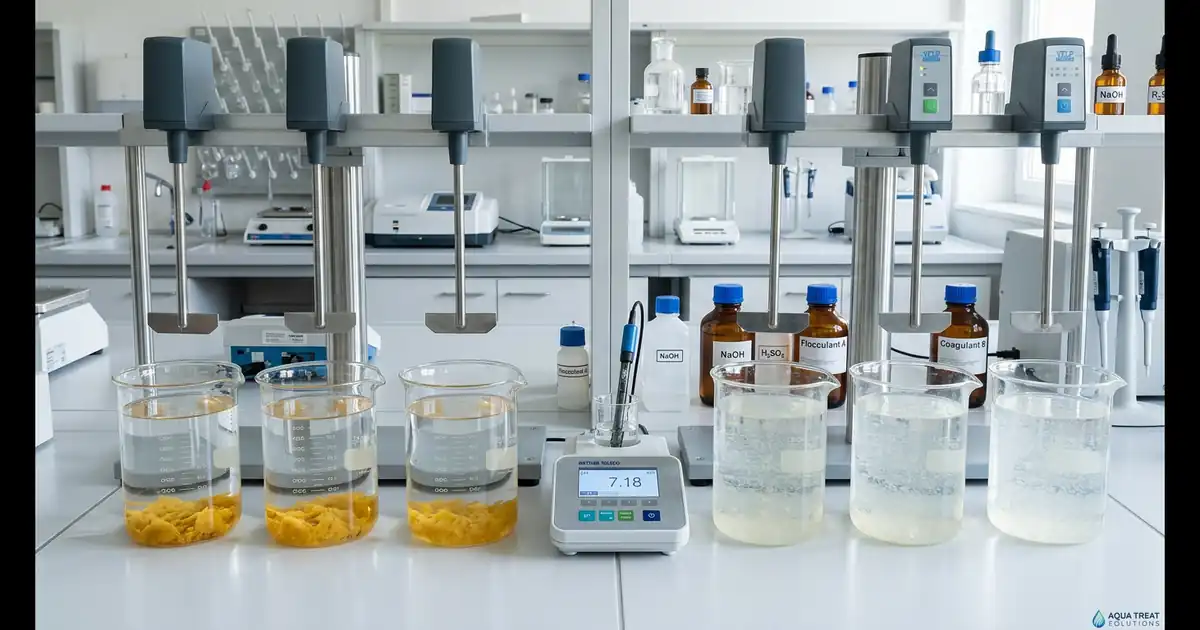
The 6-jar jar-test is the standard procedure for comparing PAC and alum on your actual plant water sample. Prepare 6 × 1,000 mL jars with the same water sample: 3 jars for PAC at 10, 20, 30 mg/L, 3 jars for alum at 20, 40, 60 mg/L (alum dosage roughly double PAC). Rapid mix at 200 rpm for 1 minute, slow mix at 40 rpm for 15 minutes, settle for 10 minutes. Measure turbidity (NTU), pH, settled sludge volume (mL/L), and time to first visible floc. PAC typically forms flocs in 2–3 minutes with larger size, 30–50% less sludge than alum at equivalent dosage. Jar-test allows dosage optimization and confirms which coagulant performs better on your specific water stream.
Frequently Asked Questions (FAQ)
Can PAC and alum be used interchangeably?
Yes, but a jar-test is needed. PAC is generally more effective across a wider pH range, while alum is suitable if water is stable and budget is constrained.
Why is PAC more expensive per kg but cheaper overall?
Because PAC dosage is 30–50% lower, sludge volume is reduced 30–50%, no pH adjustment chemicals are needed, and equipment corrosion is minimal.
Which is more corrosive to equipment?
Alum (SO₄²⁻) is significantly more corrosive than PAC. PAC is safer for pipes, pumps, and storage tanks.
Can PAC be used for drinking water?
Yes. PAC meets NSF/ANSI 60 and AWWA B408 standards for drinking water. Alum also meets AWWA B403 for potable water.
Which coagulant is best for textile dyeing wastewater?
PAC 31% powder is optimal thanks to its high color removal efficiency, large floc formation, and fast settling — ZDHC Level 1 certified (Lộc Thiên).
👉 View PAC Powder 31% — Real COA, ZDHC, delivered to industrial parks 👉 View Alum Sulfate — powder/crystal ≥17% Al₂O₃ 👉 PAC Knowledge Hub — full article collection 👉 FeCl₃ vs PAC — iron vs aluminum coagulants
Related Articles
See also: FeCl₃ vs Alum — iron vs aluminum coagulant comparison — choosing between two main coagulant families.
Read the guide: Jar-Test Procedure — 5-Step SOP for Coagulant Optimization — standard jar-test technique for plant operators.
Learn more: PAC Combined with Polymer — optimizing coagulation for difficult wastewater — blending solutions for complex wastewater.
References: HydroChemix (2026), NSF/ANSI 60, AWWA B408, AWWA B403, ZDHC MRSL Level 1 (248162921-02a), actual COA from Hóa Chất Lộc Thiên.
LOC THIEN INVESTMENT DEVELOPMENT CO., LTD — Tax Code 0313650856 · Hotline: 0979 891 929 · Email: [email protected]
Hóa Chất Lộc Thiên (Tax Code 0313650856) — technical team led by KTV Phan Cẩm Thùy & Võ Thị Như Hòa, providing free jar-test consultation, supplying PAC 31% ZDHC Level 1 and Alum Al₂(SO₄)₃ with batch COA. 6 warehouses nationwide, 20 tank trucks 5–30 tons, same-day delivery to industrial parks. Call 0979 891 929 for consultation and quotation.