
SEMI Standards for Semiconductor Chemicals: SEMI C1–C93 Guide for FDI Fabs in Vietnam
SEMI Standards for Semiconductor Chemicals: SEMI C1–C93 Guide
TL;DR: The SEMI C-series standards are the global technical framework for liquid chemicals used in semiconductor manufacturing, from C1 (analytical guide) to C93. This article explains the four G2–G5 purity tiers, required test methods, key standards for each major chemical, and how to select a SEMI-compliant supplier for FDI fabs in Vietnam.
What Are SEMI Standards? — An Overview of the SEMI Standards System
SEMI (Semiconductor Equipment and Materials International) is the global semiconductor industry standards organization, founded in 1970 in the United States, with over 2,500 member companies worldwide including chip manufacturers, equipment makers, and materials suppliers. The SEMI International Standards are the most widely recognized technical standards in the industry, covering the entire supply chain from silicon ingots, chemicals, specialty gases, lithography equipment, to packaging and testing.
SEMI C-Series (Process Chemicals) — Over 60 Standards from C1 to C93
The SEMI C-series (Process Chemicals) volume includes more than 60 standards for liquid and gaseous chemicals used in semiconductor manufacturing. Each standard defines specific limits for metallic impurities, particles, water content, analytical methods, and certification procedures for each chemical type. Key standards include SEMI C1 (Guide for Analysis of Liquid Chemicals — the foundational standard), C21 (NH₄OH), C27 (HCl), C30 (H₂O₂), C35 (HF), C41 (IPA), C44 (H₂SO₄), and C93 (supplementary standards for next-generation chemicals).
Role: Ensuring Purity and Consistency in Wet Processes
In chip manufacturing, wet processes (cleaning, etching, rinsing steps using liquid chemicals) account for approximately 30–40% of all wafer processing steps. A single metallic impurity at the sub-ppb level at the gate oxide interface can shift threshold voltage by several millivolts, causing fatal device failures. SEMI standards ensure that every chemical lot meets the same purity threshold regardless of supplier or geographic region.
SEMI C1 — Guide for Analysis of Liquid Chemicals: The Foundational Standard
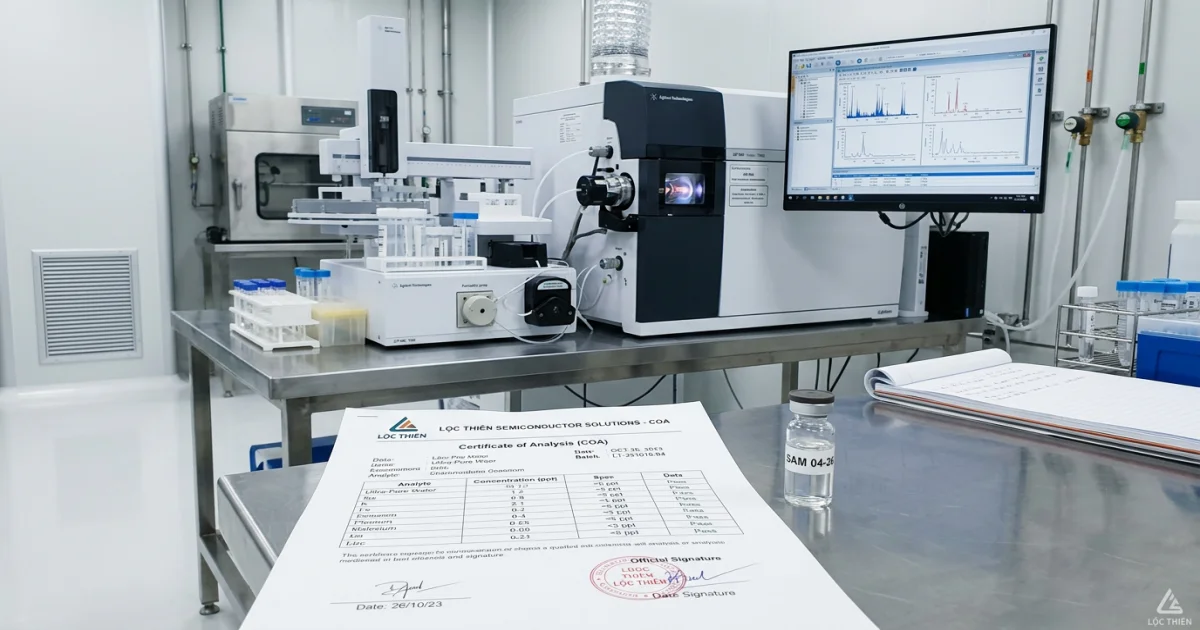
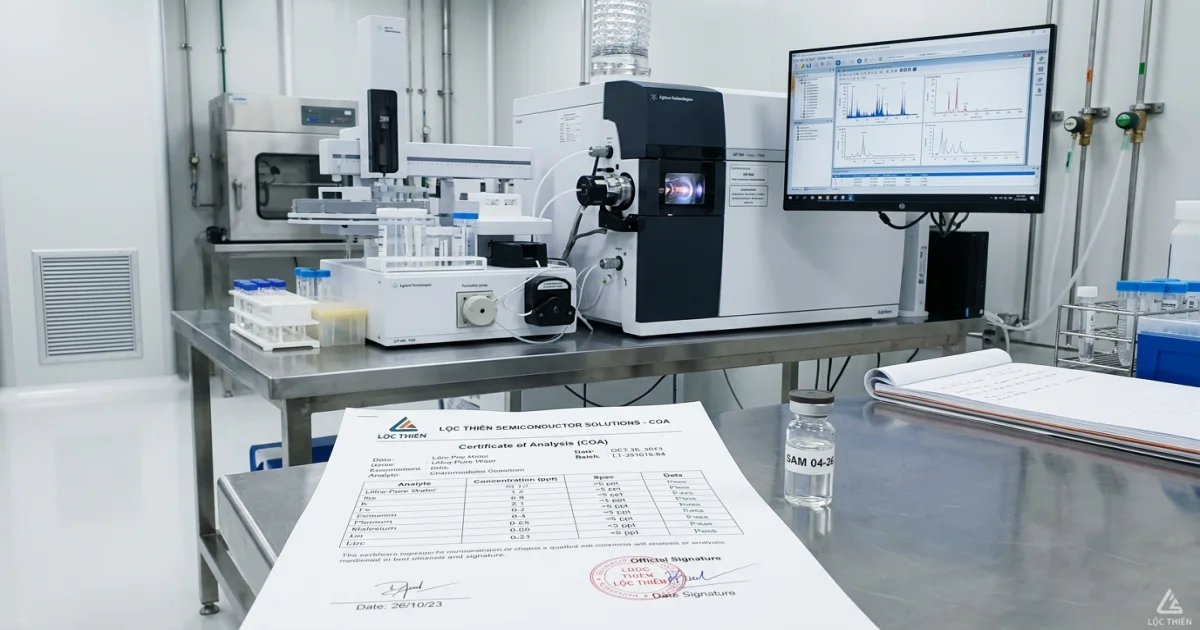
SEMI C1 is the cornerstone of the entire C-series. It defines standardized analytical methods (ICP-MS, LPC, KF titration), validation procedures, method detection limit requirements, and COA documentation standards. Every other C-series standard (C21, C27, C30, C35, etc.) references SEMI C1 as the basis for its test methods. When a supplier claims “SEMI compliance,” the first thing to verify is whether they follow SEMI C1 analytical protocols.
Expert Insight: “When qualifying a supplier for a fab, SEMI C1 is the first standard we check in the COA. If the supplier does not disclose detailed ICP-MS and LPC methods, they cannot demonstrate genuine SEMI understanding and compliance.” — Technical Specialist Phan Cẩm Thùy, Liquid Chemical Oversight Advisor, Loc Thien
The Four SEMI C1 Purity Tiers: G2, G3, G4, G5
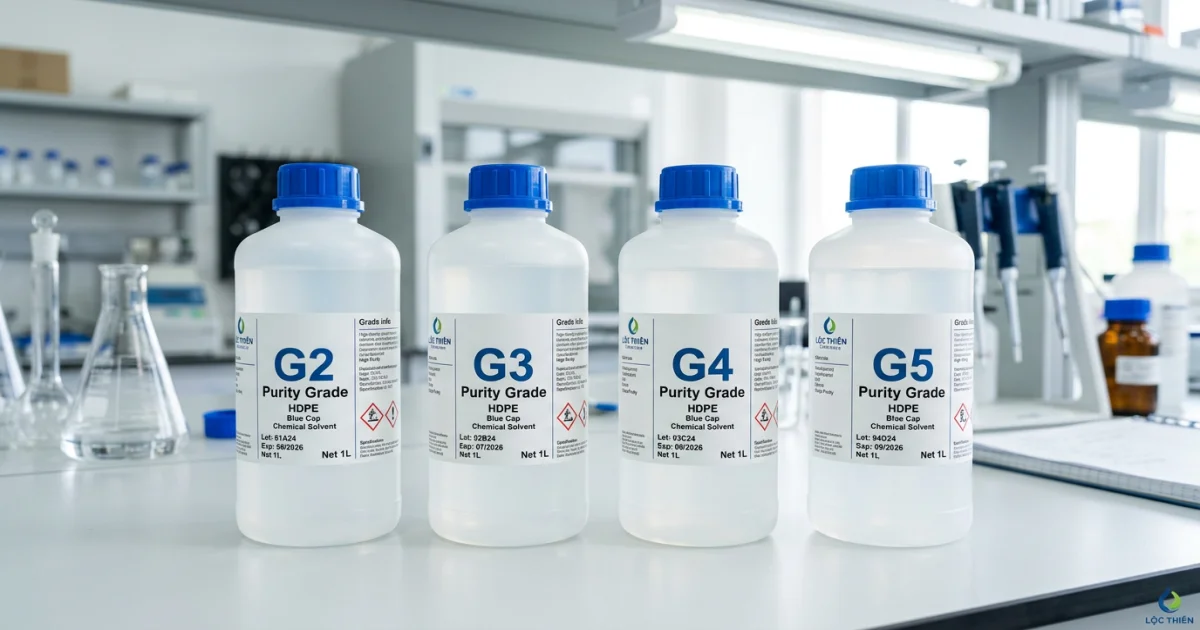
SEMI C1 defines four main purity tiers (G2–G5) corresponding to technology nodes from mature (≥180nm) to the most advanced (sub-7nm). The differences between tiers span four key parameters: total metals per element (ppb), particle count, controlled particle size, and water content (ppm).
| Grade | Technology Node | Total Metals (ICP-MS) | Particles ≥0.5 μm | Water (KF) | Assay |
|---|---|---|---|---|---|
| G2 (Tier A) | ≥180nm (150–200mm wafers) | ≤10 ppb/element | ≤100 ct/mL | ≤50 ppm | ≥99.9% |
| G3 (Tier B) | 45–180nm (200–300mm wafers) | ≤2 ppb/element | ≤20 ct/mL | ≤20 ppm | ≥99.99% |
| G4 (Tier C) | 14–45nm (300mm wafers) | ≤0.5 ppb/element | ≤10 ct/mL | ≤10 ppm | ≥99.999% |
| G5 (Tier D) | Sub-7nm (EUV, GAA) | <0.1 ppb/element | ≤5 ct/mL | ≤5 ppm | ≥99.9999% |
G2 — Entry Level (150–200mm wafers, ≥180nm nodes): Metals ≤10 ppb
G2 is the entry-level electronic grade suitable for 150–200mm wafers and ≥180nm nodes (mature technology, low-density ICs). Total metals ≤10 ppb per element, particles ≤100 ct/mL at ≥0.5 μm. G2 chemicals are produced using conventional distillation equipment with standard cleanroom fill.
G3 — 200–300mm Fabs (45–180nm nodes): Metals ≤2 ppb, Particles ≤20 ct/mL
G3 applies to 200–300mm fabs at 45–180nm nodes — mature chip lines such as 130nm, 90nm, 65nm. Metals ≤2 ppb per element (ICP-MS), particles ≤20 ct/mL at ≥0.5 μm and ≤100 ct/mL at ≥0.2 μm. G3 requires ion exchange purification in addition to distillation and ISO Class 5 or better fill environments.
G4 — Advanced (300mm wafers, 14–45nm nodes): Metals ≤0.5 ppb, In-line LPC
G4 is specified for 300mm wafer fabs at 14–45nm nodes — modern chip lines including 28nm, 20nm, 14nm. Metals ≤0.5 ppb per element (28-element ICP-MS scan required). Particles ≤10 ct/mL at ≥0.5 μm and ≤50 ct/mL at ≥0.2 μm. G4 requires multi-stage distillation with ion exchange, certified ultra-clean containers, and ISO Class 3–4 fill with in-line LPC certification per container.
G5 — Ultra-High Purity (Sub-7nm, EUV): Metals <0.1 ppb, Per-container CoA
G5 is the highest SEMI C1 tier, required for sub-7nm logic, EUV lithography, and Marangoni drying. Total metals <0.1 ppb per element (full 28 elements including low-level Sn, Sb, Bi). Particles ≤5 ct/mL at ≥0.5 μm and ≤20 ct/mL at ≥0.2 μm. G5 requires dedicated production campaigns with validated ultra-clean fill lines, and every container must carry a full CoA with individual element ICP-MS data.
SEMI C1 Analytical Methods
ICP-MS — 28 Elements: Na, Mg, Al, K, Ca, Ti, V, Cr, Mn, Fe, Co, Ni, Cu, Zn, As, Sr, Mo, Ag, Cd, Sn, Sb, Ba, W, Au, Pb, Bi, and User-defined
ICP-MS (Inductively Coupled Plasma Mass Spectrometry) is the mandatory method for metallic impurity quantification at G3 and above. SEMI C1 specifies a minimum of 28 elements: Na, Mg, Al, K, Ca, Ti, V, Cr, Mn, Fe, Co, Ni, Cu, Zn, As, Sr, Mo, Ag, Cd, Sn, Sb, Ba, W, Au, Pb, Bi, and user-defined elements (commonly Ge, In). Detection limits must be verified by method blanks and certified reference materials with each analytical run. For G5, detection limits must reach sub-ppt levels.
LPC (Liquid Particle Counting) — In-line Required for G4–G5
LPC uses a laser particle counter (typically HIAC ROYCO or equivalent) calibrated with NIST-traceable polystyrene latex (PSL) size standards. For G4 and G5 tiers, SEMI C1 requires in-line LPC during fill (rather than offline sampling) because manual sampling introduces particles from sampling vessels. The fill certification protocol specifies the number of volume samples and required statistical confidence interval.
Karl Fischer Titration — Coulometric Required for G5 (<5 ppm H₂O)
Water content is measured by KF titration: volumetric for G2–G3, coulometric mandatory for G4–G5 with a detection limit of ≤1 ppm. Sampling protocol specifies N₂ purging of the titration vessel and use of anhydrous reagents to prevent ambient moisture contamination. For G5 (≤5 ppm H₂O), coulometric KF is the only method with sufficient sensitivity.
Method Validation and Certified Reference Materials
All analytical methods used in SEMI standards must be validated per SEMI C1 §7. This includes determination of method detection limits, precision, accuracy, recovery studies (75–125% at 50% of specification level), and use of Certified Reference Materials (CRMs) for each element. Suppliers must disclose instrument serial numbers and calibration dates on the COA.
Key SEMI Standards for Common Semiconductor Chemicals
SEMI C21 — Ammonium Hydroxide (NH₄OH) — for RCA SC-1
SEMI C21 defines grades of NH₄OH used in RCA Standard Clean SC-1 (NH₄OH + H₂O₂ + H₂O), the first cleaning step in the traditional RCA process. Semiconductor-grade NH₄OH requires NH₃ content of 28–30%, metals from ≤10 ppb (G2) to <0.1 ppb (G5), and specifications for particles, carbonates, and chlorides. Loc Thien imports NH₄OH SEMI-grade directly from Japan.
🛒 Need NH₄OH SEMI-grade? Request Quote for Ammonium Hydroxide NH₄OH 28–30% SEMI — Lot-specific COA/MSDS, nationwide industrial zone delivery. Hotline 0979 891 929.
SEMI C27 — Hydrochloric Acid (HCl) — for RCA SC-2
SEMI C27 (formerly C1.7, C7.2, C8.2) defines grades of HCl used in SC-2 (HCl + H₂O₂ + H₂O) to remove alkali and heavy metal contaminants from wafer surfaces. Tier D of C27 requires each element <10 ppt. HCl 36–38% is the standard concentration for fabs. Loc Thien supplies HCl SEMI-grade imported from Korea with lot-specific COA.
SEMI C30 — Hydrogen Peroxide (H₂O₂) — 5 Grades for Cleaning + Etching
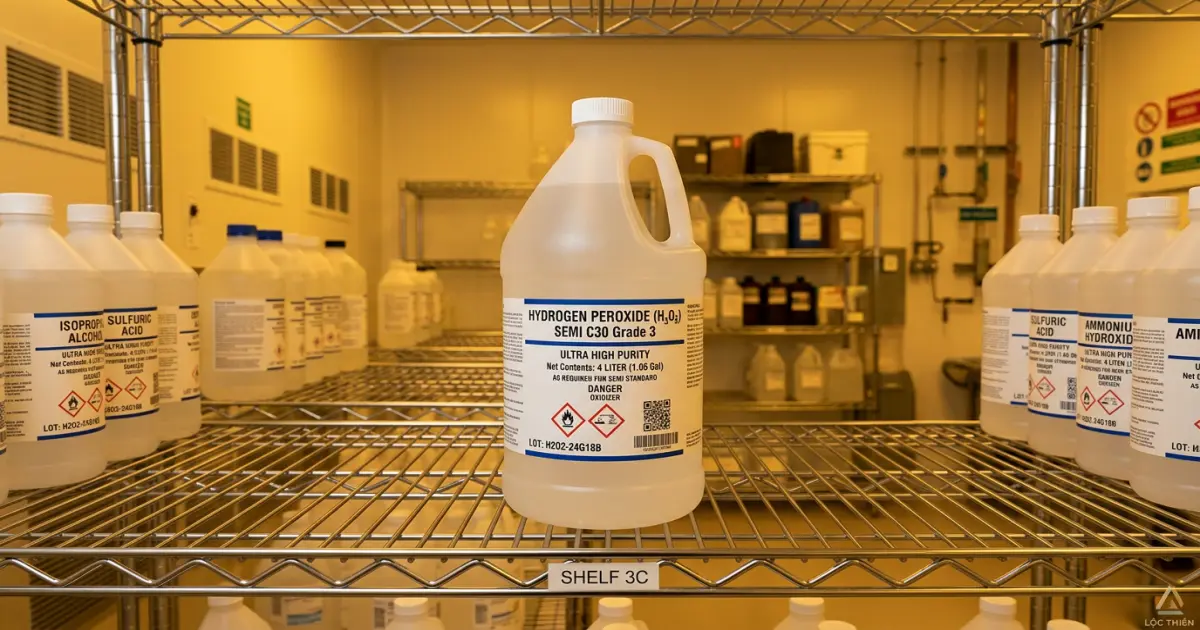
SEMI C30 specifies 5 Grades and 1 Tier for semiconductor-grade H₂O₂, replacing older standards C1.9, C7.5, C8.5, C11.4, C12.4. H₂O₂ is the most critical chemical in wet cleaning (SC-1, SC-2, Piranha clean). Semiconductor grade requires H₂O₂ 30–32% with metallic impurities per tier from G2 to G5. Current revision: SEMI C30-1223.
🛒 Need H₂O₂ SEMI-grade? Request Quote for Hydrogen Peroxide H₂O₂ 30–32% SEMI — Lot-specific COA/MSDS, nationwide industrial zone delivery. Hotline 0979 891 929.
SEMI C35 — Hydrofluoric Acid (HF) — for Oxide Strip
SEMI C35 (inactive status but still in use) defines grades of HF for oxide strip and surface conditioning. HF 49% is the standard concentration, with metals from ≤10 ppb (G2) to <0.1 ppb (G5). HF is one of the most difficult chemicals to analyze due to its high corrosivity, requiring sapphire/PFA sample introduction systems.
SEMI C44 — Sulfuric Acid (H₂SO₄) — for Piranha Clean
SEMI C44 (current revision C44-1223) specifies 2 Grades and 3 Tiers for semiconductor-grade H₂SO₄. Tier C requires metals ≤100 ppt, Tier D ≤10 ppt. H₂SO₄ 96–98% is used in Piranha clean (H₂SO₄ + H₂O₂) for complete organic removal from wafer surfaces. Loc Thien supplies H₂SO₄ SEMI-grade through direct import.
🛒 Need H₂SO₄ SEMI-grade? Request Quote for Sulfuric Acid H₂SO₄ 96–98% SEMI — Lot-specific COA/MSDS, nationwide industrial zone delivery. Hotline 0979 891 929.
SEMI C41 — Isopropyl Alcohol (IPA) — for Marangoni Drying
SEMI C41 defines grades of 2-propanol (IPA, CAS 67-63-0) for semiconductor use. IPA is the highest-volume wet process solvent consumed in fabs, ranging from G2 (≥99.9%) to G5 (≥99.9999% — 6N). G5 IPA with ≤5 ppm water is the standard for Marangoni drying, where the surface tension gradient between IPA vapor and DI water determines wafer drying quality. G5 IPA is also specified for EUV pellicle cleaning.
How to Select a SEMI-Compliant Supplier for FDI Fabs in Vietnam
FDI fabs in Vietnam — from Korean OSAT in Bac Ninh to Intel’s facility in HCMC and a semiconductor packaging plant — all require suppliers to demonstrate SEMI compliance through complete analytical documentation. Selecting the right supplier directly affects fab yield and the ability to pass international customer audits.
COA Requirements: Actual Measured Values, Not “Pass/Fail”
A SEMI C1-compliant COA must include: lot number and batch size, claimed SEMI tier (G2/G3/G4/G5), assay result, individual element ICP-MS data (actual measured values — not “pass/fail”), LPC data (actual count ± uncertainty), KF water result, instrument serial numbers and calibration dates, and analyst signature. If a supplier provides only “pass/fail” COA without actual measurement data, this indicates non-compliance.
Fill Environment Audit: ISO Class 3–5, Cleanroom Fill, In-line LPC
The fill environment is the decisive factor for SEMI-grade chemical quality. G2 requires ISO Class 5 or better, G3 requires ISO Class 5+, G4 requires ISO Class 3–4, G5 requires ISO Class 3 with in-line LPC on every container. Suppliers must have certified cleanroom fill stations with periodic re-certification and cross-contamination control procedures between lots.
Supplier Qualification Protocol: Periodic Re-qualification
SEMI has no formal supplier certification program — “SEMI compliance” is self-declared based on adherence to standards. Therefore, fabs must establish internal qualification procedures: initial supplier audit (including fill line inspection, lab review, sample retention protocol), periodic CoA verification (minimum annually), and re-qualification whenever production processes change.
Loc Thien Advantage: Direct Import, 6 Warehouses Across 3 Regions, Lot-Specific COA
Loc Thien (Tax ID 0313650856) is a direct importer and supplier of SEMI-grade chemicals from leading manufacturers in Japan, Korea, and the United States. With 6 warehouses across 3 regions (HCMC, Dong Nai, BR-VT, Can Tho, Da Nang, Bac Ninh), Loc Thien ensures on-time delivery to key industrial zones. Every chemical lot comes with an actual analysis COA — ICP-MS per element, LPC, KF water — fully meeting SEMI C1 documentation requirements.
Frequently Asked Questions (FAQ)
What is SEMI C1?
SEMI C1 is the Guide for Analysis of Liquid Chemicals, the foundational semiconductor industry standard that defines analytical methods (ICP-MS, LPC, KF titration), four G2–G5 purity tiers, and COA documentation requirements for liquid chemicals used in chip manufacturing. All other C-series standards reference SEMI C1.
How do G2, G3, G4, and G5 differ?
The four tiers differ in allowable impurity limits. G2: ≤10 ppb metals/element, ≥180nm nodes. G3: ≤2 ppb, 45–180nm. G4: ≤0.5 ppb, 14–45nm. G5: <0.1 ppb, sub-7nm. Higher tiers require stricter analytical methods (28-element ICP-MS, in-line LPC, coulometric KF).
What are the 28 elements in ICP-MS analysis?
The 28 elements include: Na, Mg, Al, K, Ca, Ti, V, Cr, Mn, Fe, Co, Ni, Cu, Zn, As, Sr, Mo, Ag, Cd, Sn, Sb, Ba, W, Au, Pb, Bi, and user-defined elements (commonly Ge, In). This is the SEMI C1 minimum requirement for G3–G5 tier analysis.
How is in-line LPC different from offline sampling?
In-line LPC measures particles in the flowing stream during fill, without intermediate sampling. Offline sampling draws a sample into a clean bottle and measures later — this process introduces additional particles from the sampling tool and container, skewing results. SEMI C1 requires in-line LPC for G4 and G5 tiers.
What certification does a supplier need to prove SEMI compliance?
SEMI does not issue supplier certifications — “SEMI compliance” is based on self-declaration. Suppliers must provide complete COA (ICP-MS actual values, LPC, KF, assay), fill environment certification (ISO Class), and accept customer audits. COA without actual measurement data is a red flag for non-compliance.
What SEMI-grade chemicals does Loc Thien supply?
Loc Thien directly imports and supplies NH₄OH, HCl, H₂O₂, HF, H₂SO₄, IPA, and other semiconductor chemicals meeting SEMI grade G2–G5. Each lot includes a full COA with ICP-MS 28-element analysis. Contact 0979 891 929 for quotes and technical consultation.
Request a Quote
Need help selecting the right SEMI grade for your fab? Contact the Loc Thien technical team for COA support, specifications, and volume-based pricing.
📞 Hotline: 0979 891 929
🌐 Website: hoachatlocthien.com (/en)
📧 Email: [email protected]