How to Prepare 5% – 10% Milk of Lime Slurry [Ca(OH)2] & Design Non-Clogging Recirculation Loops for Dosing Pumps
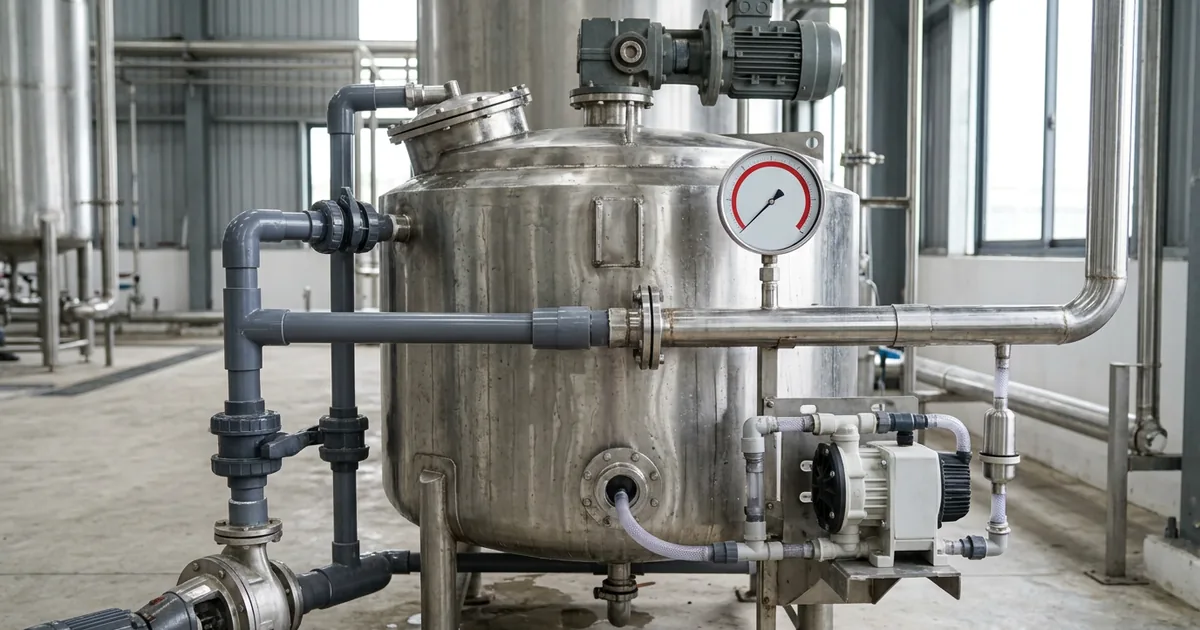
Key Technical Summary: Unlike Liquid Caustic Soda (NaOH) which dissolves completely into a homogeneous solution, Hydrated Lime [Calcium Hydroxide, Ca(OH)2] has an extremely low saturation solubility in water (only 1.65 g/L at 20 °C, decreasing inversely to 1.41 g/L at 40 °C). Consequently, when preparing industrial Milk of Lime slurry at 5%–10% w/w (51.8–107.2 g Ca(OH)2/L) for acid wastewater neutralization or Fluoride/Phosphate precipitation, over 98% of the lime exists as suspended solid particles that settle rapidly whenever pipe flow velocity drops below 0.9 m/s. To permanently eliminate check-valve jamming and cemented uPVC dosing lines, plants must implement four engineering controls: (1) Specify refined Ca(OH)2 powder ≥ 325 mesh (≤ 45 µm, purity ≥ 90%–96%, acid-insoluble grit ≤ 1.0%); (2) Use mechanical turbine agitation (1.5–2.5 kW/m3) instead of air sparging (which forms CaCO3 scale from CO2); (3) Replace dead-end dosing pipes with a continuous Ring-Main Recirculation Loop at 1.2–1.8 m/s; and (4) Flush periodically with clean water or dilute 2%–5% HCl. In Vietnam, Loc Thien Chemical (Tax ID: 0313650856) supplies industrial chemicals in bulk from 6 strategic industrial park warehouses (Ba Ria - Vung Tau, Dong Nai, Binh Duong, Da Nang, Can Tho, Bac Ninh) via a dedicated 5–30-ton tanker fleet with batch-specific COA and 16-section GHS SDS — contact hotline 0979 891 929 for a technical quote within 15 minutes.
Table of contents
In industrial wastewater treatment plants (WWTPs) and flue-gas desulfurization (FGD) scrubbers, Industrial Hydrated Lime Ca(OH)₂ is the most cost-effective alkaline reagent for acidic effluent neutralization, heavy-metal hydroxide co-precipitation (Cu²⁺, Ni²⁺, Zn²⁺, Cr³⁺), and high-strength Fluoride (CaF₂↓) or Phosphate (Ca₅(PO₄)₃OH↓) removal. Yet across many facilities, lime dosing skids suffer chronic maintenance downtime due to jammed metering pump ball check valves, caked tank bottoms, and rock-hard plugged uPVC pipelines. The root cause lies in solid–liquid two-phase slurry hydraulics: the saturation solubility of Calcium Hydroxide at 20 °C is only 1.65 g/L (0.165% w/w), meaning that inside an industrial 5%–10% w/w Milk of Lime slurry (51.8–107.2 g Ca(OH)₂/L), over 98.4% of the lime exists as suspended solid micro-crystals. Permanently eliminating pump and pipeline blockage requires combining refined ≥ 325 mesh (≤ 45 µm) grit-free Ca(OH)₂ powder with baffled mechanical turbine agitation (1.5–2.5 kW/m³) and a continuous Turbulent Ring-Main Recirculation Loop operating at 1.2 – 1.8 m/s.
1. Retrograde Solubility Thermodynamics of Ca(OH)₂ & Specific Gravity Table for 1% – 20% Milk of Lime
1.1. Why Milk of Lime is a Two-Phase Suspension Slurry Rather Than a True Solution
Unlike Sodium Hydroxide (NaOH, solubility 1,090 g/L at 20 °C) which dissolves completely into a single-phase transparent liquid, Calcium Hydroxide [Ca(OH)₂, molar mass M = 74.093 g/mol] exhibits a mildly exothermic lattice dissolution enthalpy (ΔH_sol = -16.7 kJ/mol). By Le Chatelier’s principle, exothermic dissolution causes retrograde (inverse) solubility—meaning Ca(OH)₂ becomes less soluble as water temperature rises:
- At
0 °C: Saturation solubility =1.85 g Ca(OH)₂ / L(0.185% w/w). - At
10 °C: Saturation solubility =1.76 g Ca(OH)₂ / L(0.176% w/w). - At
20 °C: Saturation solubility =1.65 g Ca(OH)₂ / L(0.165% w/w; saturated clear supernatant “Limewater” reaches equilibriumpH = 12.45). - At
30 °C: Saturation solubility =1.53 g Ca(OH)₂ / L(0.153% w/w). - At
40 °C: Saturation solubility =1.41 g Ca(OH)₂ / L(0.141% w/w). - At
80 °C: Saturation solubility drops to just0.94 g Ca(OH)₂ / L.
If an industrial WWTP attempted to dose only clear saturated limewater (1.65 g/L), neutralizing a daily acid load requiring 100 kg Ca(OH)₂/day would demand preparing and pumping 60,600 liters (60.6 m³/day) of water! Consequently, industrial plants always prepare and meter Ca(OH)₂ as an opaque white aqueous suspension—Milk of Lime Slurry (5% to 10% w/w)—where the 1.65 g/L dissolved fraction reacts immediately with H⁺ ions in the neutralization tank while the 98.4% suspended solid Ca(OH)₂ particles dissolve instantaneously to replenish equilibrium.
Table 1: Specific Gravity, Baume, Viscosity, and Makeup Recipe for 1,000 Liters (1 m³) of Milk of Lime Slurry at 20 °C
Slurry Concentration (% w/w Ca(OH)₂) | Slurry Specific Gravity at 20 °C (d, kg/L) | Baume Degree (°Be at 20 °C) | Mass of Ca(OH)₂ Powder per 1 m³ (kg/m³) | Volume of Clean Water per 1 m³ (L/m³) | Apparent Viscosity (cP) | Engineering Operating Recommendation |
|---|---|---|---|---|---|---|
1.0% | 1.006 | 0.9 °Be | 10.1 kg | 995.9 L | 1.2 cP | Very dilute suspension; low clogging risk but requires oversized tanks. |
2.0% | 1.013 | 1.9 °Be | 20.3 kg | 992.7 L | 1.6 cP | Municipal potable water pH conditioning & alkalinity remineralization. |
3.0% | 1.021 | 3.0 °Be | 30.6 kg | 990.4 L | 2.1 cP | Suitable for small WWTPs (≤ 300 m³/day) using short hose pumps. |
5.0% (Optimal Standard) | 1.035 | 4.9 °Be | 51.8 kg | 983.2 L | 4.5 cP | Golden ratio for automated pH dosing; Newtonian flow, highly pumpable. |
8.0% | 1.057 | 7.8 °Be | 84.6 kg | 972.4 L | 12.0 cP | Standard concentration for medium-to-large industrial WWTPs. |
10.0% (Upper Slurry Limit) | 1.072 | 9.7 °Be | 107.2 kg | 964.8 L | 28.0 cP | Maximum recommended concentration for pressurized ring-main loops. |
15.0% | 1.111 | 14.5 °Be | 166.7 kg | 944.3 L | 95.0 cP | Non-Newtonian yield-stress behavior begins; requires progressive cavity pump. |
20.0% | 1.152 | 19.1 °Be | 230.4 kg | 921.6 L | 280.0 cP | High-viscosity paste; restricted to rotary atomizers in Semi-Dry FGD towers. |
2. Three Root Causes of Lime Dosing Pump Jamming & Pipeline Cementation
Why do lime dosing pipelines at many wastewater treatment plants plug solid like concrete every 48–72 hours? Hydraulic and chemical root-cause analysis identifies three primary failure mechanisms:
- Line Velocity Below Critical Settling Velocity (
v < 0.9 m/s) in Dead-End Dosing Lines: SolidCa(OH)₂crystals have a true particle density of2.24 g/cm³. Maintaining homogeneous suspension inside a horizontal pipe requires fully developed turbulent flow (Reynolds numberRe ≥ 4,000) at a minimum Critical Carrying Velocity ofv_min = 0.9 – 1.1 m/s(design target1.2 – 1.8 m/s). When a plant uses a small solenoid diaphragm pump pushing intermittent pulses through a dead-end pipe—or when the pH controller stops the pump once target pH is reached—the stagnant column of10%lime slurry settles into a stratified bed within3–5 minutes, packing90°elbows and ball check-valve seats solid. - Carbonation Scaling from Air-Blower Sparging & Hard Makeup Water (
CaCO₃↓Limestone Crust): When mixing tanks are left uncovered or—worse—agitated using compressed air blowers instead of mechanical shaft mixers, atmospheric Carbon Dioxide (CO₂,~400 ppm) reacts continuously with dissolvedCa(OH)₂to precipitate insoluble calcite scale (Calcium Carbonate,CaCO₃↓). Similarly, diluting lime with high-bicarbonate hard water precipitatesCaCO₃:- Air Sparging Carbonation:
Ca(OH)₂ + CO₂ (air) → CaCO₃↓ (rock-hard pipe & pH probe scale) + H₂O - Hard Water Bicarbonate Reaction:
Ca(OH)₂ + Ca(HCO₃)₂ → 2CaCO₃↓ + 2H₂OMandatory Rule: Strictly prohibit compressed-air sparging in lime slurry tanks! Air bubbling turns the mixing tank into aCO₂scrubber that destroys activeOH⁻alkalinity and generates tens of kilograms of limestone scale daily.
- Air Sparging Carbonation:
- Coarse Unslaked Cores & Silica Grit (
SiO₂ > 100 µm) in Low-Grade Artisanal Lime: By Stokes’ hindering settling law (v_s ∝ d_p²), a150 µmquartz sand or unslaked limestone grit particle settles11 to 25 timesfaster than a refined30–45 µm(325 mesh) hydrated lime particle. Low-grade lime (< 75% Ca(OH)₂, grit> 5%–10%) immediately forms a heavy sand layer at the tank bottom, scoring PTFE diaphragms and wedging ball check valves open.
3. Non-Clogging Lime Slurry System Design Matrix & Worked Engineering Example
Table 2: Engineering Standards for Zero-Blockage Milk of Lime Dosing Systems
| System Component | Common Faulty Practice (Causes Chronic Plugging) | Loc Thien Engineering Standard (100% Non-Clogging) |
|---|---|---|
Ca(OH)₂ Powder Specification | Artisanal or crude lime (Ca(OH)₂ ≤ 75%, high sand grit > 150 µm). | Refined Industrial Ca(OH)₂ ≥ 90%–96%, fineness ≥ 325 mesh (≤ 45 µm passing ≥ 95%), acid-insoluble silica grit ≤ 1.0%. |
| Slurry Tank Geometry & Agitation | Flat-bottom square tank; compressed air bubbling or undersized off-center mixer. | Cylindrical cone-bottom tank with 4 vertical wall baffles (W = D/12) + dual-impeller 45° pitched-blade turbine (120–200 rpm, tip speed 1.5–2.2 m/s, 1.5–2.5 kW/m³) running 24/7 + 1–2 mm stainless top loading screen. |
| Pump Suction Nozzle Location | Connected directly to the lowest bottom drain port. | Side-wall suction nozzle mounted 150–250 mm above tank floor (reserving the bottom center DN50 full-bore ball valve strictly for weekly grit blowdown). |
| Slurry Transfer & Dosing Pump | Small dual-ball check valve solenoid diaphragm pump lifting from tank top. | Peristaltic Hose Pump (valveless), Progressive Cavity (Mono) Pump, or Open-Impeller Centrifugal / AODD Slurry Pump installed with flooded suction below tank level. |
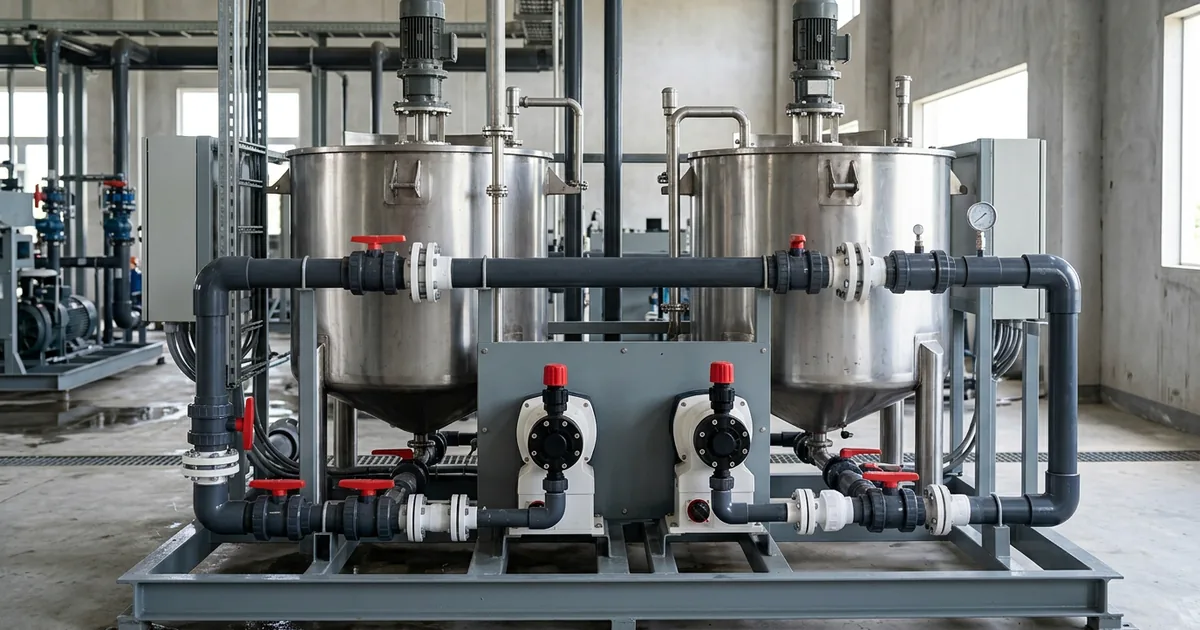
| Piping Architecture | Dead-end line with sharp 90° elbows; start/stop pump control. | Continuous Pressurized Ring-Main Recirculation Loop circulating 24/7 from tank bottom past reaction basins and back to tank top at 1.2 – 1.8 m/s using long-radius bends (R ≥ 5D or 2 × 45° elbows). |
| pH Dosing Modulation | Turning dosing pump motor ON/OFF directly, leaving slurry stagnant in pipe. | Pneumatic Pinch Valve or Diaphragm Drop-Valve on a short vertical branch (≤ 30–50 cm) discharging in free air 20 cm above the wastewater surface (never submerge the lime discharge tip!). |
| Auto-Flushing & CIP Descaling | Waiting until pipe is blocked solid before cutting uPVC pipe. | PLC 90–120 sec clean-water auto-flush upon pump shutdown; periodic 15–20 min CIP circulation with 3%–5% dilute Hydrochloric Acid (HCl) to dissolve CaCO₃ scale. |
Technical Illustration (Worked Example — Sizing a Non-Clogging 10% Milk of Lime Recirculation Loop): An electronics & glass manufacturing WWTP treats
Q = 1,200 m³/day(50 m³/h) of acidic fluoride wastewater requiring0.85 kg Ca(OH)₂ per m³(42.5 kg Ca(OH)₂/h, equivalent toQ_dose = 396 L/hof10% w/wMilk of Lime slurry,d = 1.072 kg/L):
- Selecting Ring-Main Pipe Diameter (
DN25 / 1 inch, internal diameterID = 27.2 mm): To maintain a turbulent carrying velocity ofv = 1.45 m/s(> 1.2 m/scritical threshold), the continuous recirculation pump flow rate must be:Q_loop = (π ÷ 4) × (0.0272 m)² × 1.45 m/s × 3,600 s/h = 3.03 m³/h(3,030 L/hor50.5 L/min).- Hydraulic Operation: A
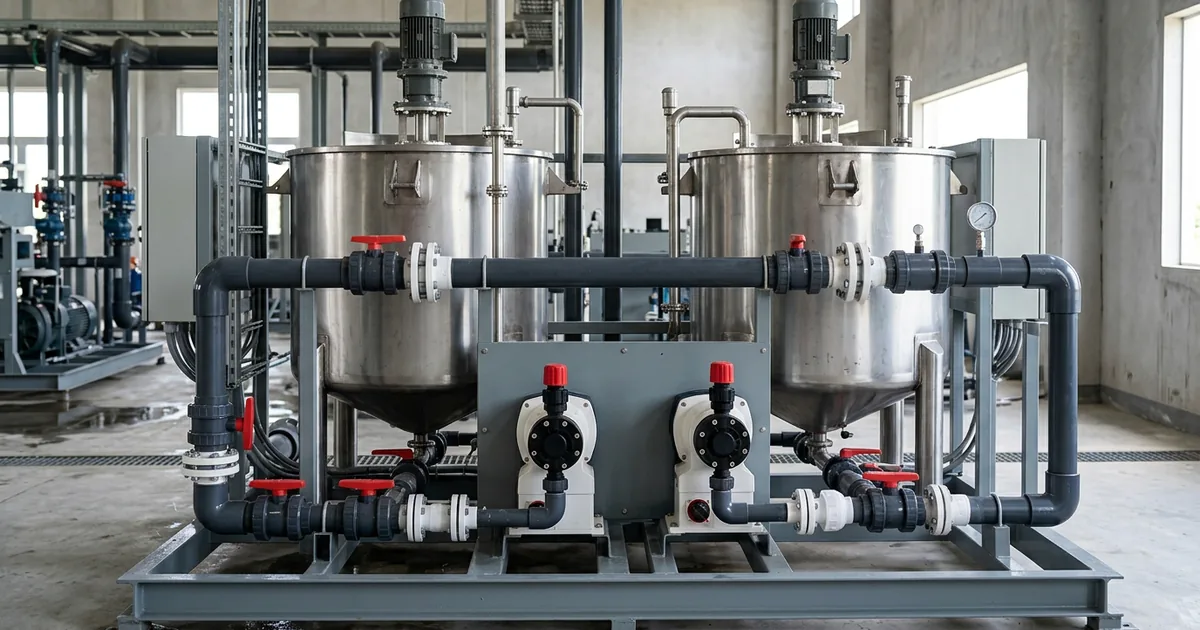
3.5 m³/hopen-impeller centrifugal slurry pump (or1.5 inchAODD pump) circulates the10%slurry continuously at1.45 m/sfrom the2,000 Lbaffled mixing tank, past the neutralization basin drop-tee, and back to the tank top via a back-pressure diaphragm valve (~1.0–1.5 bar). When the pH controller calls for alkali, the pneumatic pinch valve above the basin opens on a modulated duty cycle to draw396 L/hwhile the remaining2,634 L/hreturns turbulently to the tank—guaranteeing zero settling in the pipeline.
Technical QC Insight — Specialist Vo Thi Nhu Hoa (Quality Control Lab — Loc Thien Chemical): “Over 80% of check-valve jamming and bottom caking in
10% Ca(OH)₂lime slurry tanks originate from coarse particle size and unburned grit (SiO₂,CaCO₃cores) rather than pump failure. Across every batch of Hydrated LimeCa(OH)₂ ≥ 96%dispatched by Loc Thien, our QC lab enforces 325-mesh (45 µm) sieve residue≤ 1.5% w/wand acid-insoluble matter≤ 0.8%, keeping slurry suspension uniform at loop velocities ofv = 1.5 – 2.2 m/s.”
4. Technical Verification & Industrial Compliance Guide (3-Role FDI Reference)
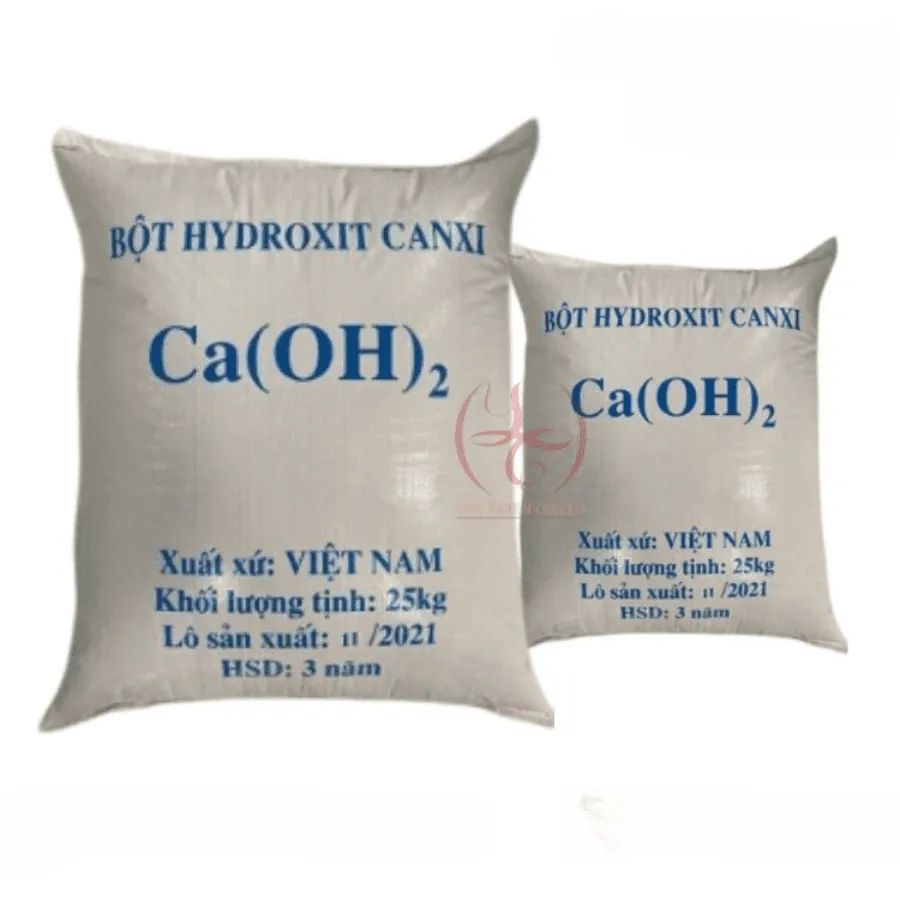
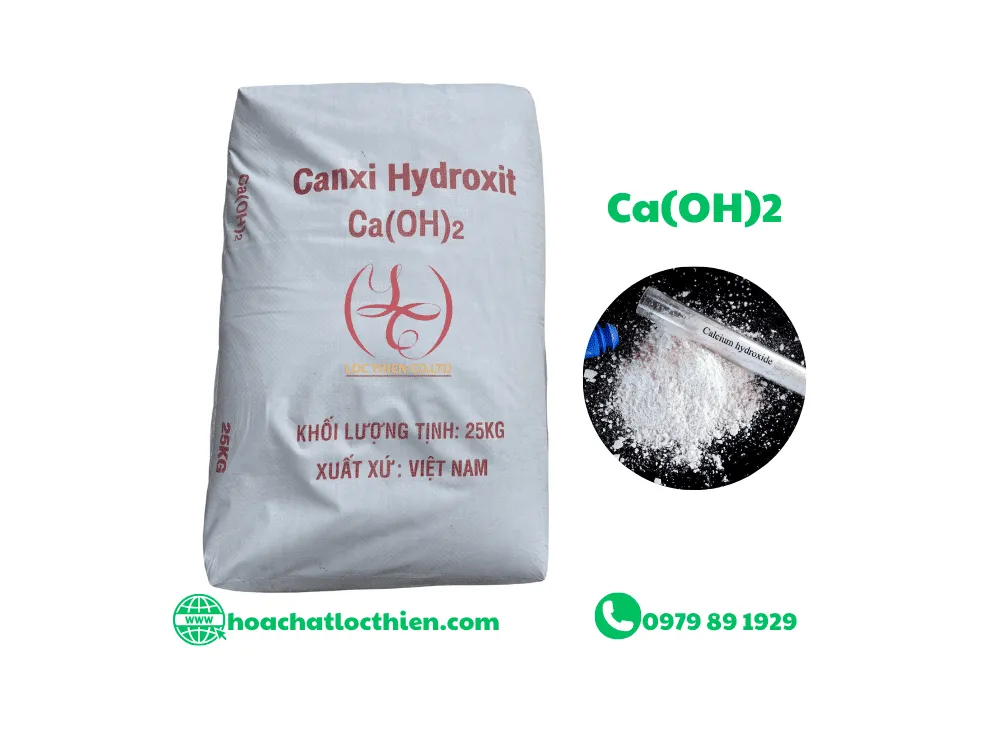
Loc Thien Chemical supplies high-purity, ultra-fine Industrial Hydrated Lime (Ca(OH)₂ 90% – 96%, ≥ 325 Mesh) engineered specifically for automated slurry dosing systems across Vietnam:
- For Global Procurement & Supply Chain Teams: Our refined
Ca(OH)₂is stocked across 6 strategic warehouses (Ba Ria – Vung Tau, Dong Nai, Binh Duong, Da Nang, Can Tho, and Bac Ninh) in moisture-proof PE-lined25 kgwoven bags and1,000 kgjumbo bags, supported by a3,000+ tons/monthlogistics network and5–30-tontransport fleet. We provide technical quotations within 15 minutes and guaranteed delivery SLAs (4 hours in Ho Chi Minh City, 24–48 hours across Southern & Mekong Delta industrial zones, and 2–3 days in Northern & Central Vietnam). (Note on Regulatory Scope:Ca(OH)₂is an inorganic mineral alkali outside the scope of the 9 ZDHC-certified products; where textile mills require a ZDHC-certified liquid alkali, please specify ourTÜV SÜD ZDHC MRSL v3.1 Level 1certified Liquid Caustic SodaNaOH 32%–50%). - For Process, QA/QC & EHS Engineers: Every shipment is accompanied by a batch-specific Certificate of Analysis (
Batch COA) verifying activeCa(OH)₂assay (≥ 90%–96%), particle size distribution (≥ 95%passing325 mesh / 45 µm), low acid-insoluble silica grit (≤ 1.0%), and low moisture (≤ 1.0%), together with a compliant 16-Section GHS Safety Data Sheet (MSDS) aligned with Vietnam’s Law on Chemicals No.69/2025/QH15and Decrees24–26/2026/ND-CP. - For Accounting, Tax & Audit Teams: All commercial deliveries include certified weighbridge tickets, signed delivery receipts, and official Vietnamese Electronic VAT Invoices (
e-VAT Invoices) issued byLOC THIEN INVESTMENT DEVELOPMENT COMPANY LIMITED(Tax ID:0313650856).
5. Frequently Asked Questions on 10% Lime Slurry (Ca(OH)₂) Preparation & Anti-Clogging Design (FAQ)
1. Why is a 5%–10% w/w Ca(OH)₂ mixture a suspended slurry rather than a true solution?
The equilibrium solubility of Ca(OH)₂ in water at 25 °C is only 1.60 g/L (0.16% w/w). At industrial dosing strengths of 5%–10% w/w (52–106 g/L), over 98% of the hydrated lime remains as suspended solid particles, requiring 24/7 mechanical agitation and a minimum pipeline velocity of v ≥ 1.2–1.5 m/s to prevent settling.
2. Why must sharp 90° elbows and standard ball valves be avoided in lime slurry piping loops?
Sharp 90° elbows create low-velocity dead zones (v < 0.5 m/s) where suspended Ca(OH)₂ and grit rapidly pack into rock-hard scale. Slurry loops must use long-radius bends (R ≥ 5D), full-port diaphragm or pinch valves, and a pressurized recirculation return line back to the mixing tank.
3. How can operators dissolve hardened CaCO₃ scale inside lime dosing lines without dismantling the piping?
Install a periodic Clean-in-Place (CIP) flushing connection using dilute 3%–5% Hydrochloric Acid (HCl) circulated for 15–20 minutes (CaCO₃ + 2HCl → CaCl₂ + H₂O + CO₂↑), followed by a clean water flush before resuming lime dosing.
Related Technical Resources & Products
- Specialized Chemical Category: Industrial Water & Wastewater Treatment Chemicals
- Standard Industrial Products: Refined Calcium Hydroxide Ca(OH)₂ 96% Vietnam | Industrial Hydrated Lime Powder Ca(OH)₂
- GHS 16-Section Safety Data Sheet: MSDS Calcium Hydroxide Ca(OH)₂
- Online Engineering Calculator: Interactive Chemical Dosing & Slurry Flow Rate Calculator
- Related Technical Guides in This Cluster:
- 15-Minute Technical Quotation & Bulk Supply: Request a Technical Quotation for Bulk Ca(OH)₂ — Hotline
0979 891 929(tel:0979891929) — Email[email protected].