
Case Study Jar Test FeCl3 — Optimizing Dosage for 3 Types of Wastewater (Domestic, Textile, Electroplating)
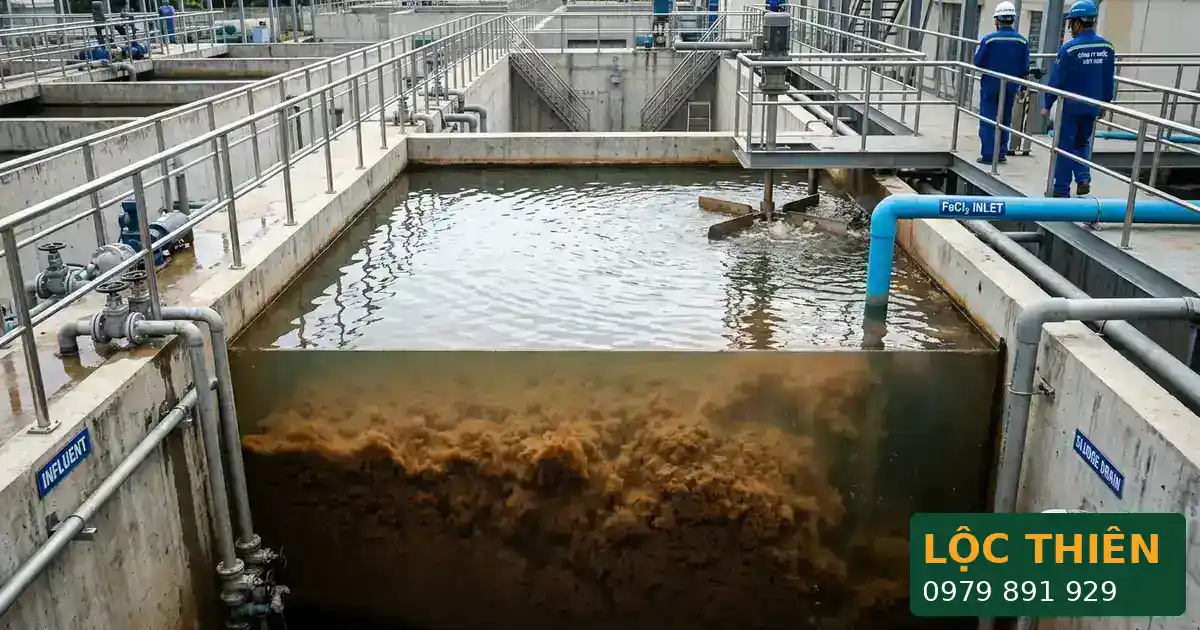
TL;DR: The jar test is a mandatory step before scaling up FeCl3 in industrial wastewater treatment systems. Skipping the jar test means guessing the dosage — wasting chemicals and risking effluent that fails to meet QCVN standards. This article analyzes 3 real-world scenarios from (anonymized) wastewater treatment plants using FeCl3 supplied by Loc Thien Chemical: domestic wastewater from a 10,000-resident area (optimal dosage 150–200 ppm, COD reduction >85%, SS reduction >90%), textile wastewater at 500 m³/day capacity (optimal dosage 300–400 ppm, color reduction >90%), and Cr-Ni electroplating wastewater (optimal dosage 400–500 ppm, Ni²⁺ reduction from 25 to <0.5 ppm). Each scenario includes a full jar test table with dosage, pH, turbidity, COD, and heavy metals data, along with in-depth analysis. Loc Thien provides free on-site jar test support — call 0979 891 929 to schedule.
This article is for wastewater treatment plant (WWTP) operation engineers, factory owners, and industrial chemical buyers looking for real data to determine the optimal FeCl3 dosage before full-scale implementation.
1. Principle of Jar Test with FeCl3
FeCl3 (Ferric Chloride, CAS 7705-08-0) is an inorganic coagulant that works through this mechanism: Fe³⁺ ions hydrolyze in water, forming positively charged Fe(OH)₃ colloidal particles. These colloids neutralize the negative charge of pollutants (suspended solids, organic matter, phosphorus, color), binding them into larger, heavier flocs that readily settle to the tank bottom.
Reaction Mechanism:
Fe³⁺ + 3OH⁻ → Fe(OH)₃ (colloid) Fe(OH)₃ + pollutant particles (negative) → charge neutralization → flocs → settling
5 Standard Jar Test Steps with FeCl3:
- Prepare 1% FeCl3 solution — add 2.5 mL of liquid 40% FeCl3 to 1 L of distilled water (equivalent to 10,000 ppm)
- Prepare 6 beakers — fill each beaker with 500 mL of wastewater, dose FeCl3 at increasing levels: 50, 100, 150, 200, 250, 300 ppm (or a wider range depending on wastewater type)
- Flash mixing — 100–150 rpm for 1 minute, ensuring immediate and uniform FeCl3 dispersion in the wastewater stream
- Slow mixing (flocculation) — 30–40 rpm for 15 minutes, allowing flocs to grow and agglomerate
- Quiet settling (sedimentation) — 15 minutes, then measure post-settling turbidity (NTU), COD, SS, and pH
Optimal pH for FeCl3: 5–8. If the wastewater pH is outside this range, adjust it using 10% NaOH or 10% H₂SO₄ before adding FeCl3. Coagulation efficiency is highest at pH 5.5–7.0.
Dosage Conversion Table for Liquid 40% FeCl3:
| Active Dose (ppm FeCl3 40%) | FeCl3 Volume per m³ Wastewater (L) |
|---|---|
| 100 ppm | 0.25 L/m³ |
| 200 ppm | 0.50 L/m³ |
| 300 ppm | 0.75 L/m³ |
| 400 ppm | 1.00 L/m³ |
| 500 ppm | 1.25 L/m³ |
Formula: V(L/m³) = Dose (ppm) / (FeCl3 content × specific gravity × 10,000). For liquid FeCl3 at 40% with a specific gravity of 1.42 g/mL, 100 ppm ≈ 0.25 L/m³.
2. Scenario #1 — Domestic Wastewater (Residential Area, 10,000 Residents)
Influent Characteristics
A centralized WWTP serving a residential area of approximately 10,000 people in a Southern province. Wastewater is from households, restaurants, and a wholesale market. Jar test influent data:
- Flow rate: ~2,500 m³/day
- Influent COD: ~400 mg/L
- Influent SS: ~250 mg/L
- Influent pH: 6.8
- Turbidity: ~120 NTU
FeCl3 Jar Test Results
| Beaker | FeCl3 Dose (ppm) | pH after FeCl3 | Turbidity (NTU) | Post-COD (mg/L) | Post-SS (mg/L) |
|---|---|---|---|---|---|
| 1 | 50 | 6.5 | 45 | 280 | 180 |
| 2 | 100 | 6.2 | 18 | 160 | 75 |
| 3 | 150 | 5.9 | 6 | 85 | 28 |
| 4 | 200 | 5.6 | 4 | 60 | 15 |
| 5 | 250 | 5.3 | 3 | 55 | 10 |
| 6 | 300 | 5.1 | 5 | 70 | 20 |
Conclusion
- Optimal dosage: 150–200 ppm — at 150 ppm, COD decreased from 400 to 85 mg/L (efficiency 79%) and SS decreased from 250 to 28 mg/L (efficiency 89%). At 200 ppm, COD decreased by 85% and SS by 94%, with turbidity at 4 NTU.
- At doses >250 ppm, efficiency did not improve significantly and pH dropped below 5.5, risking floc re-dissolution and requiring additional alkalinity. At 300 ppm, turbidity increased slightly (5 NTU) and COD rose again (70 mg/L) due to overdosing (restabilization).
- Operational recommendation: Dose 40% FeCl3 at 0.375–0.50 L/m³ into the reaction tank, with flash mixing at 120 rpm for 1 minute, followed by slow mixing at 35 rpm for 15 minutes. Maintain post-coagulation pH at 5.6–5.9 to achieve COD <100 mg/L and SS <30 mg/L, meeting QCVN 14:2008/BTNMT (Column B).
3. Scenario #2 — Textile Dyeing Wastewater (500 m³/day)
Influent Characteristics
A textile dyeing factory in a Northern Industrial Park specializing in denim and polyester fabric production. Treatment capacity is 500 m³/day. This wastewater type is challenging due to high color and organic load.
- Influent COD: ~800 mg/L
- Color: ~500 Pt-Co (deep blue from reactive dyes)
- Influent pH: 7.5–9.0 (slightly alkaline due to caustic soda used in dyeing)
- Influent SS: ~180 mg/L
- Turbidity: ~200 NTU
FeCl3 Color Removal Mechanism
FeCl3 removes color from textile wastewater through two parallel mechanisms:
- Chemical precipitation: Fe³⁺ ions react with negatively charged dye molecules (especially reactive, direct, and vat dyes) to form insoluble complexes.
- Adsorption: Fe(OH)₃ flocs have a large surface area, adsorbing remaining dye molecules and carrying them to the settling tank bottom.
Unlike PAC (Poly Aluminium Chloride), which is less effective for color removal at pH >7, FeCl3 maintains stable color removal efficiency across a pH range of 5.5–7.5 and produces heavier, faster-settling flocs.
FeCl3 Jar Test Results (pH adjusted to 6–7 with NaOH before test)
| Beaker | FeCl3 Dose (ppm) | Post-pH | Post-Color (Pt-Co) | Post-COD (mg/L) | Post-SS (mg/L) |
|---|---|---|---|---|---|
| 1 | 100 | 6.8 | 350 | 620 | 140 |
| 2 | 200 | 6.4 | 180 | 410 | 85 |
| 3 | 300 | 6.0 | 65 | 220 | 35 |
| 4 | 350 | 5.8 | 40 | 170 | 22 |
| 5 | 400 | 5.6 | 25 | 150 | 18 |
| 6 | 500 | 5.2 | 30 | 175 | 20 |
Conclusion
- Optimal dosage: 300–400 ppm — at 350 ppm, color decreased from 500 to 40 Pt-Co (>92%), COD decreased from 800 to 170 mg/L (79%), and SS decreased by 88%. At 400 ppm, color reduction exceeded 95% (25 Pt-Co) and COD reached 150 mg/L.
- For textile wastewater, pH must be adjusted to 6–7 before the jar test. FeCl3 is highly effective for color removal at this pH. However, if pH >7.5, Fe³⁺ ions tend to form hydroxide complexes prematurely before reacting with the dyes, reducing efficiency.
- At 500 ppm, color and COD showed a slight increase — a sign of overdosing (restabilization). Flocs break apart, re-dispersing pollutants into the water.
- Operational recommendation: Dose 40% FeCl3 at 0.75–1.0 L/m³, combined with 2–5 ppm of anionic polymer as a coagulant aid. For textile wastewater, extend the slow mixing time to 20 minutes to allow sufficient floc growth.
4. Scenario #3 — Electroplating Wastewater (Cr-Ni Plating)
Influent Characteristics
An electroplating plant in Dong Nai Industrial Park specializing in decorative Chrome and Nickel plating for automotive parts. Wastewater originates from plating, rinsing, and passivation stages. This is hazardous wastewater requiring stringent treatment per QCVN 40:2025/BTNMT (replacing QCVN 40:2011, effective September 1, 2025).
- Influent pH: 3–5 (strong acid from plating solutions)
- Ni²⁺: 15–30 ppm
- Total Cr: 5–10 ppm (mainly Cr³⁺, some Cr⁶⁺)
- COD: ~150 mg/L (organic impurities from plating baths)
- SS: ~80 mg/L
Treatment Mechanism
In electroplating wastewater, FeCl3 plays a dual role:
- Coagulation: Fe(OH)₃ adsorbs and carries Ni(OH)₂ and Cr(OH)₃ down to the settling tank. Metal hydroxides formed at pH 8–9 are fine colloidal particles that settle poorly without a coagulant aid. Fe(OH)₃ acts as a weighting agent — its dense flocs help rapidly settle all Ni(OH)₂ and Cr(OH)₃.
- Co-precipitation: Fe³⁺ forms hydroxide simultaneously with Ni²⁺ and Cr³⁺, creating mixed flocs with a higher density than pure Ni(OH)₃ flocs alone.
FeCl3 Jar Test Results (pH raised to 7–9 with NaOH after FeCl3)
| Beaker | FeCl3 Dose (ppm) | Post-pH | Post-Ni²⁺ (ppm) | Post-Total Cr (ppm) | Post-COD (mg/L) |
|---|---|---|---|---|---|
| 1 | 200 | 8.5 | 8.2 | 2.5 | 65 |
| 2 | 300 | 8.3 | 3.1 | 1.0 | 42 |
| 3 | 400 | 8.1 | 0.8 | 0.2 | 28 |
| 4 | 450 | 8.0 | 0.4 | 0.08 | 22 |
| 5 | 500 | 7.8 | 0.3 | 0.05 | 18 |
| 6 | 600 | 7.5 | 0.2 | 0.04 | 15 |
Conclusion
- Optimal dosage: 400–500 ppm — at 450 ppm, Ni²⁺ decreased from 25 to 0.4 ppm (efficiency >98%), total Cr decreased from 8 to 0.08 ppm (99%), and COD decreased >85%.
- Effluent Ni²⁺ met QCVN 40:2025/BTNMT (replacing QCVN 40:2011, effective September 1, 2025) Column A (≤0.5 ppm) starting at a dose of 450 ppm (0.8 ppm at 400 ppm met Column B ≤1.0 ppm). To achieve Column A, a dose of ≥450 ppm is required.
- Total Cr met Column A (≤0.1 ppm) from a dose of 450 ppm.
- Key factor: Post-coagulation pH must reach 7.8–8.5. If pH <7.5, Ni(OH)₂ does not precipitate completely; if pH >9.5, Cr(OH)₃ risks re-dissolution.
- Operational recommendation: A 3-step process — (1) dose 40% FeCl3 at 1.0–1.25 L/m³ into the reaction tank at pH 3–5, (2) raise pH to 8.0–8.5 using 50% NaOH, (3) dose 3–5 ppm of anionic polymer as a coagulant aid before the Lamella clarifier.
5. Summary Table & Dosage Recommendations
| Wastewater Type | Optimal Dosage (ppm FeCl3) | Optimal pH | COD Reduction | SS / Color Reduction |
|---|---|---|---|---|
| Domestic (Residential) | 150–200 | 5.6–5.9 | 79–85% | SS reduction 89–94% |
| Textile Dyeing | 300–400 | 5.6–6.0 | 73–81% | Color reduction 92–95% |
| Electroplating (Cr-Ni) | 400–500 | 7.8–8.5 | 81–88% | Ni²⁺ 98%, Cr 99% |
Important Scaling-Up Rule: The jar test dosage is the active dosage. In actual operation, add 10–15% as a safety margin to account for hourly pollutant concentration fluctuations, wet-season flow variations, and influent quality changes. Always maintain pH within the recommended range, especially for textile and electroplating wastewater — this is the critical factor for performance.
Technical Support & B2B Procurement Hotline
Loc Thien Chemical specializes in direct manufacturing of FeCl₂ / FeCl₃ and Tier-1 supply of basic industrial chemicals (NaOH, HCl, H₂SO₄, PAC, NaOCl, H₂O₂, FeSO₄) with direct B2B pricing and dedicated 5–30-ton tanker delivery across Vietnam.
- Hotline / Zalo: +84 979 891 929
- Official Email: [email protected]
- Direct Manufacturer: Ferrous Chloride (FeCl₂ 30%) & Ferric Chloride (FeCl₃ 38–40%)
- Primary Supplier: NaOH 32%/45%/50%/99%, HCl 32%, H₂SO₄ 98%, PAC 30–31%, NaOCl 10–12%, H₂O₂ 35%/50%
- Compliance & Quality: FeCl₂ ZDHC MRSL v3.1 test report (Smart testing, 5 substance groups, TUV Rheinland Vietnam), ISO 9001:2015, Quatest 3, Full COA & GHS SDS
Frequently Asked Questions (FAQ)
1. Should FeCl3 be combined with polymer?
Yes. FeCl3 doses of 150–500 ppm typically produce small, slow-settling flocs. Adding 2–5 ppm of anionic polymer at the end of the slow mixing phase helps bind small flocs into larger ones, increasing settling speed by 2–3 times. However, do not add the polymer simultaneously with FeCl3 — allow 5–10 minutes for FeCl3 to form initial flocs first.
2. Is FeCl3 or PAC better for textile dyeing wastewater?
FeCl3 is superior for color removal thanks to its dual precipitation + adsorption mechanism. PAC is generally weaker when treating reactive dye colors at pH >7. FeCl3 also produces heavier flocs than PAC, which is advantageous for gravity settling. While FeCl3 generates more sludge, it is easier to dewater than PAC sludge. See more in our FeCl3 vs PAC comparison.
3. What are the signs of FeCl3 overdosing?
Post-settling water turns yellowish-brown or slightly turbid, flocs are fragmented, sludge floats on the settling tank surface, and pH drops sharply below 5.0. When overdosed, Fe(OH)₃ colloids carry excess positive charge and repel each other — a phenomenon known as restabilization. Reduce the dosage immediately and check the pH.
4. What is the settling time after a FeCl3 jar test?
In a laboratory jar test, the standard settling time is 15 minutes. For full-scale settling tanks (horizontal flow or Lamella), the hydraulic retention time is 45–90 minutes. With polymer aid, settling time can be reduced by 30–40%.
5. Can FeCl3 be used for paper mill wastewater?
Yes. FeCl3 is commonly used in paper mill wastewater treatment to coagulate lignin and suspended solids. The starting dosage is typically 200–400 ppm at pH 5.5–7.0. FeCl3 helps reduce COD by 60–75% and removes the dark brown color of paper wastewater through lignin adsorption. However, for wastewater high in CaCO₃ content, PAC is often more economical due to lower alkali consumption for pH adjustment.
6. Which form of FeCl3 should I buy?
Loc Thien Chemical supplies FeCl3 only as a liquid solution (36–40%), which allows direct dosing without preparation. Dosing is set from the jar test result at your plant; see the FeCl3 price list for specifications and quotation. Delivery is by 5–30 ton tanker trucks.
7. What is the CAS number and concentration of FeCl3?
FeCl3 has CAS 7705-08-0. Loc Thien’s product has a concentration of 36–40% (liquid form), specific gravity of 1.40–1.45 g/mL, and a stock solution pH of 1–2. COA is provided per batch (guide to reading FeCl3 COA). Tax Code: 0313650856. Delivery is available from 6 warehouses nationwide: Ba Ria – Vung Tau, Dong Nai, Binh Duong, Da Nang, Can Tho and Bac Ninh.
Loc Thien’s FeCl3 Supply Capability
Loc Thien Chemical is a direct manufacturer and large-scale supplier of FeCl3, offering:
- Production plant: FeCl3 36–40% meeting industrial standards, with COA per batch
- 6 warehouses across 3 regions: Ba Ria – Vung Tau, Dong Nai, Binh Duong, Da Nang, Can Tho and Bac Ninh
- a fleet of specialized tanker trucks: transporting liquid FeCl3 (5–30 tons) directly to customer storage tanks, expected delivery: within 4 hours in inner Ho Chi Minh City; 24–48 hours to industrial parks in southern and western Vietnam; 2–3 days to northern and central Vietnam
- Comprehensive technical support: free on-site jar test consultation, FeCl3 dosage optimization, chemical conversion support, and trial operation
- Tax Code: 0313650856
Get Free Jar Test Support
Loc Thien’s technical team provides direct on-site jar test support at your WWTP — determining the optimal FeCl3 dosage before you purchase in bulk.
Hotline: 0979 891 929 | Website: hoachatlocthien.com
Please prepare: 5 L of wastewater sample · system flow rate (m³/day) · target treatment parameters (COD, SS, color, heavy metals). Our commitment: support within 48 hours · accurate measurement data · no-purchase-obligation consultation.
See also:
- What is FeCl3 — properties and general applications
- How to prepare FeCl3 for electroplating wastewater treatment — detailed dosage
- FeCl3 vs PAC for coagulation — in-depth comparison
- Industrial FeCl3 price list — latest prices
- FeCl3 applications for industrial wastewater treatment
LOC THIEN INVESTMENT DEVELOPMENT CO., LTD — Tax Code 0313650856
- Address: 452/6B Tinh Lo 10 (Provincial Road 10), Binh Tri Dong Ward, Binh Tan District, Ho Chi Minh City
- Phone: 0979 891 929
- Hotline: 0979 891 929
- Website: hoachatlocthien.com