
FeCl2 Fenton for Textile Dyeing Wastewater: Case Study & Process
Textile dyeing wastewater contains COD 500–3,000 mg/L and color 150–250 Pt-Co, making it difficult to treat with conventional chemical coagulation. The A-Z guide to Fenton reaction with FeCl₂ — replacing traditional FeSO₄ — achieves color removal efficiency of 90–98% and COD reduction of 60–85%, helping effluent meet QCVN 40:2025 (replacing QCVN 40:2011, effective 01/09/2025) Column A (color ≤ 50 Pt-Co, COD ≤ 75 mg/L). This article cites data from a 2023 Industry and Trade Magazine study on actual wastewater from two textile dyeing factories in Ho Chi Minh City.
Are you a wastewater treatment plant operations engineer? Are you struggling with post-biological color not meeting QCVN standards? Do you want to know how FeCl₂ — a chemical directly produced by Loc Thien — can replace FeSO₄ in the Fenton system? This article is for you. We don’t write textbook theory — we present real Jartest data from 6 wastewater samples taken directly from 2 large textile dyeing factories in Ho Chi Minh City. You will have in hand: the verified optimal Fe²⁺:H₂O₂ ratio, a 5-step process ready for implementation, and a comparison table of FeCl₂ vs FeSO₄ to guide your purchasing decision. Call 0979 891 929 to get a FeCl₂ quote in 15 minutes — delivery to industrial parks nationwide.
Problem Statement — Challenges in Textile Dyeing Wastewater Treatment
Textile dyeing wastewater has high color (150–1,000 Pt-Co), COD ranging from 500–3,000 mg/L and can reach 10,000 mg/L in the scouring/bleaching stage. Main components include residual dyes (azo, reactive, disperse), starch sizing, surfactants, and organic acids — all difficult to biodegrade. Among them, azo dyes account for 60–70% of total color and have stable aromatic ring structures that are hard to break by conventional chemical coagulation (PAC/alum). This is why factories are switching to advanced oxidation processes (AOP) like Fenton instead of simple coagulation.
QCVN 40:2025/BTNMT (replacing QCVN 40:2011, effective September 1, 2025) Column A stipulates color ≤ 50 Pt-Co and COD ≤ 75 mg/L for industrial wastewater discharged into Type A receiving water bodies. After the biological treatment unit (Aerotank + sedimentation), COD is significantly reduced but residual color often remains at 150–250 Pt-Co — not meeting the standard. This is the bottleneck forcing factories to add an advanced oxidation process (AOP) stage, typically Fenton.
Real Case Study — Fenton Treatment of Textile Dyeing Wastewater from Industry and Trade Magazine 2023 Study
The study by Nguyen Thi Thu Hien, Tran Ngoc Bao Luan (Ho Chi Minh City University of Natural Resources and Environment) and Tran Thi Kim Hong (Ho Chi Minh City University of Technology), published in the Industry and Trade Magazine in 2023, evaluated the effectiveness of the Fenton reaction on actual wastewater from two textile dyeing factories in Ho Chi Minh City. Results showed that Fenton achieved an effluent color of 21 Pt-Co from an influent of 150–250 Pt-Co — far exceeding QCVN 40 Column A — with a Fe²⁺:H₂O₂ molar ratio of 1:10 (laboratory conditions of the study; for field operation we recommend a Fe²⁺:H₂O₂ molar ratio of 1:3–1:5, confirmed by jar test) at pH 3.0. This provides real data for designing Fenton systems for post-biological textile dyeing wastewater.
Subjects and Methods
Influent wastewater was collected after the biological treatment unit (Aerotank + sedimentation) from two factories:
- Thai Tuan Garment and Textile Co., Ltd. — 3 samples labeled T1, T2, T3
- Saigon Joubo Textile Joint Venture Co. — 3 samples labeled S1, S2, S3
Experiments were conducted using a Jartest model with 1,000 mL beakers. Chemicals used included FeSO₄.7H₂O and H₂O₂ at 30–35% concentration.
Key Results
| Parameter | Value |
|---|---|
| Optimal pH | 2.9–3.2 (rounded to pH 3.0) |
| Fe²⁺:H₂O₂ molar ratio in the study (clean water, no sludge) | 1:10 |
| Fe²⁺:H₂O₂ molar ratio (with biological sludge) | 0.4:10 to 0.9:10 |
| Influent color | 150–250 Pt-Co |
| Effluent color | 21 Pt-Co (meets QCVN 40) |
| FeSO₄.7H₂O dosage (reference) | 150–400 mg/L |
| H₂O₂ dosage (reference) | 240–400 mg/L |
With a Fe²⁺:H₂O₂ ratio of 1:10 and pH 3.0, the study achieved an effluent color of 21 Pt-Co — less than half the QCVN 40 Column A threshold (50 Pt-Co). This demonstrates the superior effectiveness of Fenton in treating textile dyeing color in the post-biological stage.
Why FeCl₂ for Fenton Instead of FeSO₄?
The original study used FeSO₄.7H₂O, but liquid FeCl₂ for industrial wastewater treatment offers distinct operational advantages for industrial scale. FeCl₂ exists as a 30% solution, directly pumpable without the need for dissolution like crystalline FeSO₄. Unlike FeSO₄, FeCl₂ does not form sulfate scale (CaSO₄) — a factor that often causes scaling in pipes and equipment in continuously operated Fenton systems. The table below compares the two chemicals for the same purpose: supplying Fe²⁺ ions for the Fenton reaction.
Comparison of FeCl₂ and FeSO₄.7H₂O
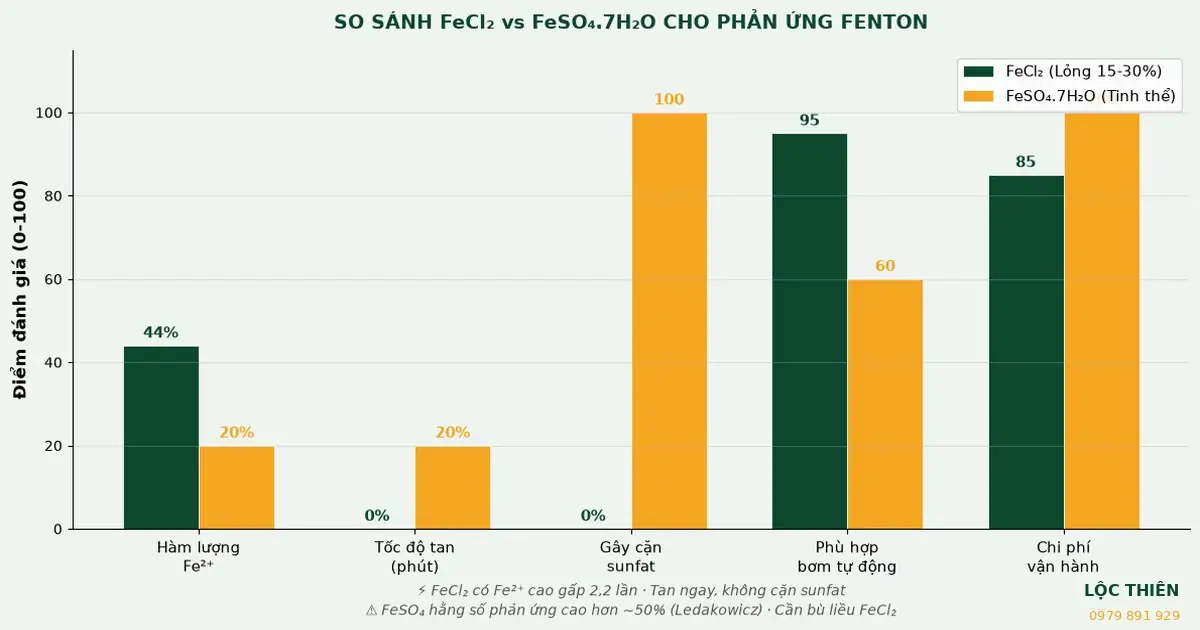
| Criterion | FeCl₂ (liquid solution 30%) | FeSO₄.7H₂O (crystals) |
|---|---|---|
| Fe²⁺ content | ~44% (by dry weight) | ~20% |
| Equivalent Fe²⁺ content | 2.2 times higher than FeSO₄.7H₂O | Baseline |
| Physical form | Liquid solution, direct pumping | Crystals, requires prior dissolution |
| Dissolution rate | Instant — no waiting | Requires 15–30 minutes stirring |
| Sulfate scale (SO₄²⁻) | No scale formation | Forms CaSO₄ — pipe scaling |
| Reaction rate constant | ~50% lower than FeSO₄ (Ledakowicz) | ~50% higher |
| Residual chlorine risk | High doses may generate Cl₂ | None (USP Technologies) |
Dosage compensation: Because the reaction rate constant of FeCl₂ is about 50% lower than FeSO₄ (according to Ledakowicz), the FeCl₂ dosage needs to be increased to compensate. In practice, the required amount of Fe²⁺ is equivalent — only the mass of chemical to be pumped differs.
Comparison conclusion: USP Technologies states that “chloride or sulfate salt does not matter” — both provide Fe²⁺ effectively. Liquid FeCl₂ reduces operational labor (no dissolution), does not form sulfate scale, and is suitable for automated dosing pump systems.
Need a FeCl₂ quote for your Fenton system? Call 0979 891 929 — Loc Thien directly manufactures, delivers IBC/tanker nationwide, competitive pricing based on monthly volume.
5-Step Fenton Process with FeCl₂ — Operational Data
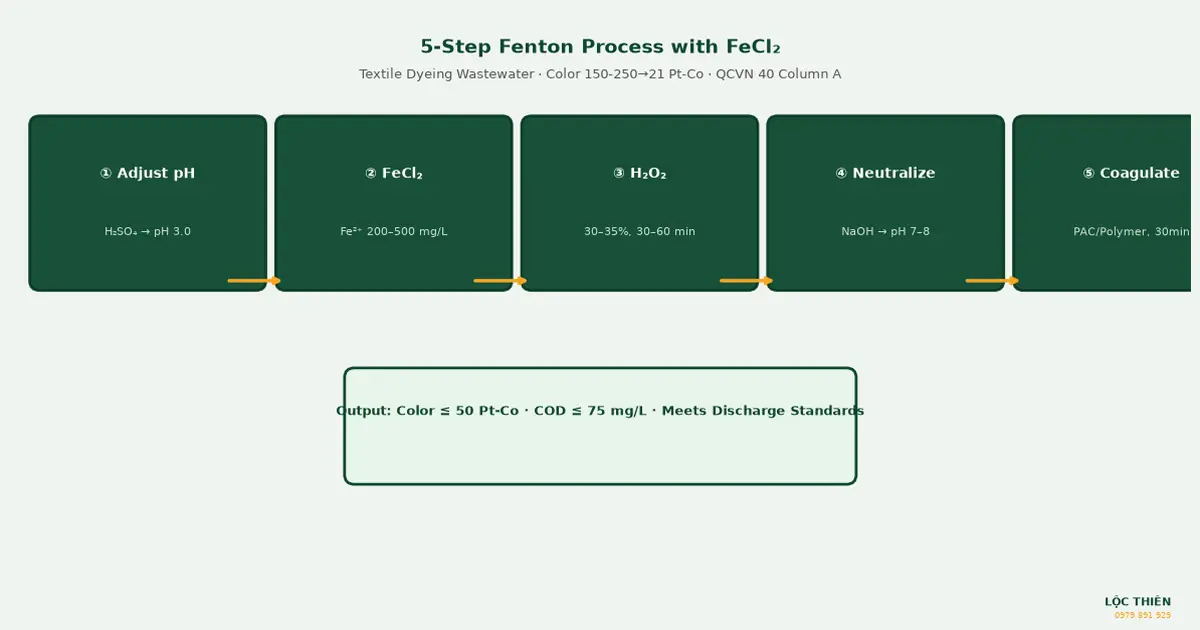
The process below applies to post-biological textile dyeing wastewater, extracted from research results and technical documents. The five steps are designed sequentially: pH adjustment → FeCl₂ dosing → H₂O₂ dosing → neutralization → coagulation and sedimentation. Study parameters are based on the Fe²⁺:H₂O₂ molar ratio of 1:10 at pH 3.0 — the laboratory condition from the 2023 Industry and Trade Magazine study. The entire process can be automated with dosing pumps and a pH controller.
Step 1: Adjust pH to 3.0
Use 98% H₂SO₄ to lower pH from 6–8 to 3.0 (optimal threshold). Monitor continuously with a pH meter. H₂SO₄ consumption ranges from 100–300 mg/L depending on the alkalinity of the influent wastewater.
Step 2: Dose FeCl₂ — Fe²⁺ Source
Pump liquid FeCl₂ at 30% concentration into the reaction tank. Based on active Fe²⁺, the dosage is equivalent to FeSO₄.7H₂O (150–400 mg/L) — meaning approximately 200–500 mg/L of FeCl₂ (30% liquid). Rapid mixing at 100–150 rpm. Contact time: 5 minutes.
Step 3: Dose H₂O₂ — Generate Hydroxyl Radicals
H₂O₂ at 30–35% concentration with a dosage of 240–400 mg/L, maintaining a Fe²⁺:H₂O₂ molar ratio of 1:10 as in the study (field operation recommends 1:3–1:5, confirmed by jar test; applies when no biological sludge is present). The Fenton reaction proceeds deeply over 30–60 minutes, with slow mixing at 30–40 rpm.
Step 4: Neutralization — End the Reaction
Raise pH from 3.0 to 7–8 using 30% NaOH. At neutral pH, excess Fe²⁺ and Fe³⁺ ions precipitate as Fe(OH)₂ and Fe(OH)₃, carrying down some of the color and dissolved COD.
Step 5: Supplementary Coagulation and Sedimentation
Dose PAC specifically for post-Fenton supplementary coagulation at 10–30 mg/L combined with anionic polymer at 1–3 mg/L. Slow mixing for 15 minutes, then static settling for 30 minutes. Flocs form large and sturdy, settling quickly — clear water achieves color ≤ 50 Pt-Co.
Downstream Hook — Loc Thien Chemicals in the Textile Dyeing Wastewater Treatment Line
Loc Thien Chemicals is a direct manufacturer of FeCl₂ and a large-scale supplier of water treatment chemicals. Below is a table mapping all stages in the 5-step Fenton process — all chemicals are available from Loc Thien:
| Treatment Stage | Chemical | Role | Supplied by Loc Thien? |
|---|---|---|---|
| pH Adjustment | H₂SO₄ 98% | Lower pH from 6–8 to 3.0 | ✅ Yes |
| Fenton Reaction | FeCl₂ 30% + H₂O₂ 30–35% | Generate OH· radicals to break color structures | ✅ FeCl₂ (directly manufactured) |
| Neutralization | NaOH 32%/50% | Raise pH to 7–8, precipitate Fe(OH)₃ | ✅ Yes |
| Supplementary Coagulation | PAC (powder/liquid) | Increase floc size, reduce residual COD | ✅ Yes |
| Coagulant Aid | Anionic polymer | Form large flocs, fast settling | ✅ Yes |
Loc Thien FeCl₂ — liquid solution 30%, CAS 7758-94-3. Directly manufactured, 6 warehouses nationwide (Ba Ria – Vung Tau, Dong Nai, Binh Duong, Da Nang, Can Tho and Bac Ninh), a fleet of tanker trucks of 5–30 tons. Delivery options: tanker truck (per m³), IBC 1,000 L, drum 200 L. Expected delivery time: within 4 hours in inner Ho Chi Minh City; 24–48 hours to industrial parks in southern and western Vietnam; 2–3 days to northern and central Vietnam.
See more FeCl₂ direct manufacturer price list and detailed TDS.
Technical Support & B2B Procurement Hotline
Loc Thien Chemical specializes in direct manufacturing of FeCl₂ / FeCl₃ and Tier-1 supply of basic industrial chemicals (NaOH, HCl, H₂SO₄, PAC, NaOCl, H₂O₂, FeSO₄) with direct B2B pricing and dedicated 5–30-ton tanker delivery across Vietnam.
- Hotline / Zalo: +84 979 891 929
- Official Email: [email protected]
- Direct Manufacturer: Ferrous Chloride (FeCl₂ 30%) & Ferric Chloride (FeCl₃ 38–40%)
- Primary Supplier: NaOH 32%/45%/50%/99%, HCl 32%, H₂SO₄ 98%, PAC 30–31%, NaOCl 10–12%, H₂O₂ 35%/50%
- Compliance & Quality: FeCl₂ ZDHC MRSL v3.1 test report (Smart testing, 5 substance groups, TUV Rheinland Vietnam), ISO 9001:2015, Quatest 3, Full COA & GHS SDS
Frequently Asked Questions (FAQ)
Can FeCl₂ Fenton treat wastewater containing biological sludge?
Yes, but the chemical ratio needs adjustment. The study showed that when wastewater samples contained activated sludge, the Fe²⁺:H₂O₂ ratio decreased from 1:10 to 0.4:10 to 0.9:10, because the biological sludge consumes part of the H₂O₂ before the Fenton reaction occurs. Color removal efficiency under these conditions still exceeds 85%, sufficient for effluent to meet QCVN 40 Column A. Recommendation: control incoming sludge with an effective secondary clarifier to avoid H₂O₂ waste.
What is the specific FeCl₂ dosage for 1 m³ of textile dyeing wastewater?
Equivalent to FeSO₄.7H₂O 150–400 mg/L — meaning approximately 200–500 mg/L of 30% liquid FeCl₂. The exact dosage depends on actual color, COD, and sludge content in the sample. A Jartest should be run before operation to determine the optimal point.
Is FeCl₂ hazardous to handle?
FeCl₂ is a mildly corrosive chemical (pH 2–3 in 30% solution). Operation requires acid-resistant dosing pumps (PVC/PVDF), nitrile gloves, and safety goggles. There is no risk of Cl₂ generation at typical Fenton dosages (< 500 mg/L of 30% FeCl₂). Store in sealed HDPE tanks, away from direct sunlight to prevent oxidation of Fe²⁺ → Fe³⁺.
Can FeSO₄ be replaced by FeCl₂ in a Fenton Jartest?
Absolutely. Prepare 30% liquid FeCl₂, dilute 10 times with clean water for easy accurate dosing via micropipette. Adjust dosage based on actual Fe²⁺ content — FeCl₂ contains 2.2 times more Fe²⁺ than FeSO₄.7H₂O, so the volume of chemical to be dosed will be significantly less. Jartest results with FeCl₂ and FeSO₄ give equivalent color removal efficiency at the same active Fe²⁺ concentration.
After Fenton, what additional steps are needed before discharge?
Neutralize with NaOH to pH 7–8, supplementary coagulation with PAC (10–30 mg/L) and anionic polymer (1–3 mg/L), static settling for 30 minutes. Clear water after settling meets QCVN 40 Column A for color (≤ 50 Pt-Co) and COD (≤ 75 mg/L). Fe(OH)₃ sludge is periodically collected, dewatered, and disposed of according to industrial waste regulations. Note: do not discharge post-Fenton water directly to the receiving water body without settling — fine iron sludge will cause secondary color.
Where to buy FeCl₂ for textile dyeing wastewater treatment plants?
Contact Loc Thien Chemicals for FeCl₂ pricing and technical consultation — directly manufactured FeCl₂ 30%, delivered nationwide by tanker/IBC/drum. COA provided per batch, Jartest support to determine optimal dosage for your system. Hotline 0979 891 929 — quote in 15 minutes, delivery within 4 hours in Ho Chi Minh City.
How does FeCl₂ Fenton compare to Ozone for textile dyeing wastewater treatment?
Fenton has lower capital investment than Ozone because it does not require specialized ozone generators, but operating costs come from continuous chemicals (FeCl₂ + H₂O₂ + NaOH). Ozone does not generate iron sludge but has high equipment cost and high power consumption, suitable for plants >1,000 m³/day. For small to medium scale (50–500 m³/day), Fenton offers better ROI due to low investment and locally available chemicals.
Is FeCl₂ used in the textile dyeing industry for purposes other than Fenton?
Yes. FeCl₂ is also used to reduce Cr⁶⁺ to Cr³⁺ in electroplating wastewater, to form Fe(OH)₃ as a coagulant in heavy metal treatment, and to remove residual chlorine after the Javel (bleach) stage. In textile dyeing, FeCl₂ can also be used for direct coagulation of reactive dyes at pH 6–8. See details on FeCl₂ applications in textile dyeing.
Conclusion — Should You Implement Fenton with FeCl₂ for Your Textile Dyeing Wastewater Treatment Plant?
Data from the 2023 Industry and Trade Magazine study shows that Fenton achieves an effluent color of 21 Pt-Co from an influent of 150–250 Pt-Co — far exceeding QCVN 40 Column A. Combining with liquid FeCl₂ reduces dissolution labor, eliminates sulfate scaling risk, and facilitates easy automation.
See more detailed comparison of FeCl₂, FeSO₄, and PAC for wastewater treatment for a comprehensive evaluation of the three chemicals before choosing a solution, or refer to FeCl₂ applications in the textile dyeing industry beyond the Fenton reaction.
Contact Loc Thien Chemicals:
- Hotline/Zalo: 0979 891 929
- Email: [email protected]
- Delivery: 6 warehouses across 3 regions, a fleet of tanker trucks 5–30 tons, delivery to industrial parks nationwide
- Quote time: 15 minutes — call now or send a message