
FeCl3 COD Reduction in Textile Dyeing 75% — Switching from PAC to FeCl3 40%
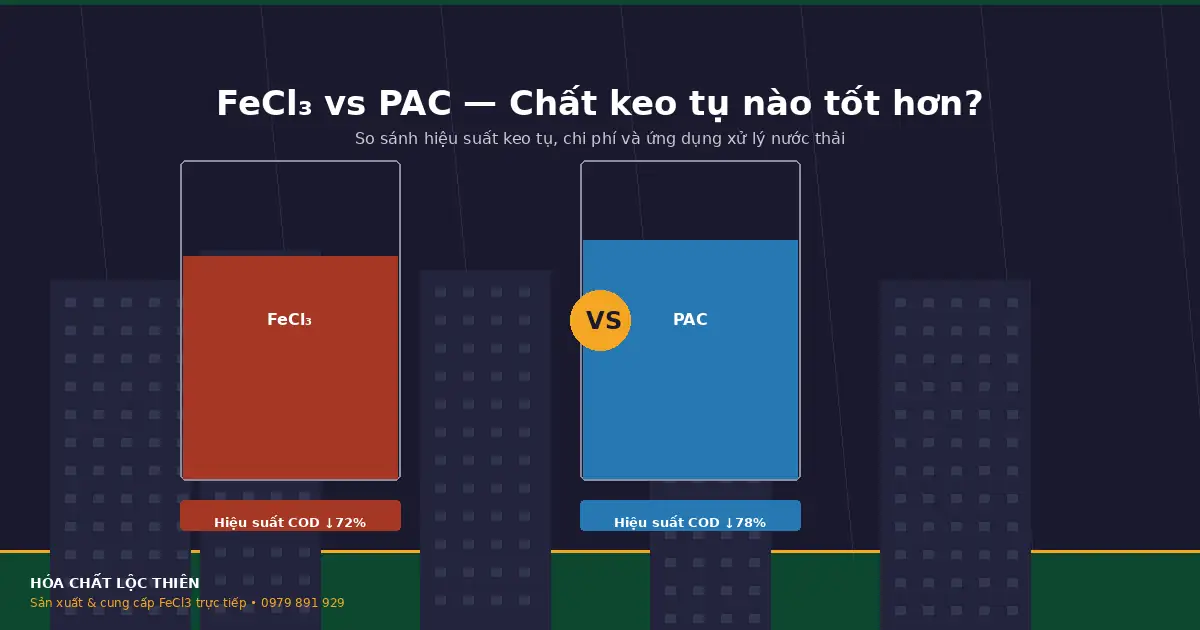
Table of contents
TL;DR: A 3,000 m³/day textile dyeing factory switches from PAC to FeCl3 40% from Loc Thien, reducing COD from 850 to 210 mg/L (75.3% efficiency), chemical treatment cost down 38%. FeCl3 ships with lot-wise COA signed off by QC Technician Phan Cam Thuy.
Factory Background
At a textile dyeing factory with 3,000 m³/day capacity in Southern Vietnam, specializing in cotton-polyester knit fabric dyeing using reactive dyes and vat dyes. The wastewater treatment system consists of: collection → equalization → coagulation/flocculation → sedimentation → aerobic biological treatment → discharge meeting QCVN 13-MT:2015/BTNMT Column B.
Before the switch, the plant used PAC 31% at 220 mg/L, with post-coagulation COD averaging 420 mg/L. Inlet COD consistently ranged 750–900 mg/L, color 480–620 Pt-Co, initial pH 8.5–9.2.
Influent wastewater characteristics (30-day average):
| Parameter | Value | QCVN 13 Column B |
|---|---|---|
| pH | 8.8 | 5.5–9 |
| COD (mg/L) | 850 | 200 |
| Color (Pt-Co) | 520 | 150 |
| TSS (mg/L) | 280 | 100 |
| BOD₅ (mg/L) | 320 | 50 |
| Total Nitrogen (mg/L) | 42 | 30 |
| Alkalinity (mg CaCO₃/L) | 480 | — |
The Problem: PAC Could Not Bring COD Below Threshold
PAC 31% operated at 200–240 mg/L, optimal coagulation pH 6.8–7.5. COD removal efficiency was 50–55% — post-sedimentation COD at 380–440 mg/L, insufficient load reduction for the downstream biological tank. The aerobic basin was frequently overloaded, with young sludge reducing biological efficiency to 65%, pushing effluent COD above 150–180 mg/L (within 200 limit but unstable long-term).
The second issue was post-coagulation color: PAC 31% only removed 60–65% of color, leaving the water with a pale yellow tint, stressing the biological oxidation process. The wastewater contained azo-group reactive dyes with stable ring structures, molecular weight 600–1,200 Da, resistant to biodegradation.
The third issue was high operating cost as PAC dosage continually increased during peak production season. June–August is peak export order season, with inlet COD rising 15–20%, forcing operators to raise PAC to 280–300 mg/L — driving chemical costs up sharply during peak months.
Jar-test comparing PAC 31% and FeCl3 40% at the Loc Thien laboratory showed: FeCl3 produced larger flocs, settled 25% faster, with a lower optimal pH — suitable for treating textile dyeing wastewater with high alkalinity and high color.
Jar-test Method
Wastewater was collected from the factory’s equalization tank at 05:00 — the time of highest pH and most stable color after the night dyeing shift. Six-cup jar-test, each cup 1,000 mL wastewater, performed in 3 independent replicates.
Jar-test procedure:
- Rapid mix stage: 200 rpm for 3 minutes — disperse coagulant evenly
- Slow mix stage: 40 rpm for 18 minutes — floc formation
- Settling stage: 30 minutes — measure COD and color of supernatant
Variables tested: pH (5.0–8.0, 0.5 increments), FeCl3 40% dose (100–300 mg/L, 50 increments), PAC 31% dose (100–350 mg/L, 50 increments), with/without polymer PAM 0.5–1.5 mg/L.
Results showed FeCl3 40% at 200 mg/L + PAM 0.8 mg/L at pH 5.5–6.5 achieved the highest COD removal of 73–76%, outperforming PAC across all tested dose ranges.
Solution: Switch to FeCl3 40%
After 10 days of jar-test tuning, the factory switched from PAC 31% to FeCl3 40% (FECL3-40L) from Loc Thien — lot code FT-0326-GL, COA certified by QC Technician Phan Cam Thuy.
New operating parameters:
- Coagulant: FeCl3 40% (CAS 7705-08-0), liquid, reddish-brown
- Dose rate: 200 mg/L commercial product (80 mg/L active Fe³⁺)
- Coagulation pH: 5.5–6.5 (adjusted with HCl 32% upstream — HCl dose reduced 40% vs PAC thanks to FeCl3’s natural acidity)
- Settling aid polymer: Anionic PAM 0.8 mg/L
- Wastewater temperature: 32–36°C
- Settling time: 45 minutes (existing sedimentation tank, no structural modification needed)
- Injection point: Existing rapid mix tank, same point as previous PAC — no piping changes
COD Results Over Time
Weeks 1–2: Conversion — pH adjustment
| Day | Inlet COD (mg/L) | COD After Coagulation (mg/L) | Efficiency (%) | Notes |
|---|---|---|---|---|
| Day 0 | 860 | 415 (PAC) | 51.7 | Baseline — PAC operation |
| Day 3 | 840 | 380 | 54.8 | Coagulation pH still 7.0 — insufficient adjustment |
| Day 5 | 910 | 350 | 61.5 | Reduced pH to 6.5 — clear improvement |
| Day 7 | 880 | 305 | 65.3 | pH 6.2 — flocs starting to grow |
| Day 10 | 820 | 265 | 67.7 | pH 5.8 — good settling |
| Day 14 | 850 | 220 | 74.1 | pH 5.7 — stable |
Weeks 3–4: Stabilization
| Day | Inlet COD (mg/L) | COD After Coagulation (mg/L) | Efficiency (%) |
|---|---|---|---|
| Day 18 | 830 | 210 | 74.7 |
| Day 21 | 870 | 215 | 75.3 |
| Day 25 | 840 | 205 | 75.6 |
| Day 28 | 850 | 210 | 75.3 |
Post-biological COD stabilized at 95–120 mg/L — meeting Column B (200 mg/L) and typically meeting Column A (100 mg/L) after week 3. During 60 days of monitoring, no instance of effluent COD exceeding 130 mg/L.
Before-After Comparison: PAC → FeCl3
| Parameter | PAC 31% Operation | FeCl3 40% Operation | Improvement |
|---|---|---|---|
| Product dosage | 220 mg/L | 200 mg/L | –9% |
| COD after coagulation | 420 mg/L | 210 mg/L | –50% |
| COD coagulation efficiency | 50.6% | 75.3% | +24.7 percentage points |
| COD load to biological system | 420 mg/L | 210 mg/L | 50% reduction |
| Biological efficiency | 65% | 82% | +17 percentage points |
| Optimal pH | 6.8–7.5 | 5.5–6.5 | Wide window, suitable for high alkalinity |
| Chemical sludge volume | 18 m³/day | 15 m³/day | –17% |
| Total chemical cost (index, PAC = 100) | 100 | 62 | –38% |
Chemical cost per m³ fell 38% across 3,000 m³/day × 300 operating days/year — a substantial annual saving, not including reduced sludge treatment costs and additional aeration energy savings from 70% reduced oxygen demand.
Why FeCl3 Excels in Textile Dyeing Wastewater
When FeCl3 hydrolyzes in water, it forms positively charged Fe(OH)₃ complexes that neutralize the negative colloidal particles of reactive dyes and organic matter. The optimal pH window of 5.0–6.5 is where Fe³⁺ species exist as Fe(OH)₂⁺ and Fe(OH)²⁺ — with the highest coagulation activity.
While PAC (as Al₁₃O₄(OH)₂₄⁷⁺) performs well at pH 6.5–8.0, FeCl3 dominates when textile dyeing wastewater has high alkalinity and high color. Fe(OH)₃ flocs have an amorphous structure with high specific surface area of 200–400 m²/g — capable of adsorbing dissolved dye molecules that PAC cannot capture.
Simultaneously, FeCl3 hydrolysis releases H⁺, naturally lowering pH to the optimal zone without large amounts of acid. Hydrolysis equation:
FeCl₃ + 3H₂O → Fe(OH)₃↓ + 3HCl
The HCl produced from 200 mg/L FeCl3 is equivalent to 40–50 mg/L HCl, reducing separately-dosed HCl by 40–60% compared to PAC operation.
COA FeCl3 40% Lot FT-0326-GL
| Parameter | Method | Result | Requirement |
|---|---|---|---|
| FeCl₃, % by weight | TCVN 9749:2013 | 41.2 | ≥ 40 |
| FeCl₂, % by weight | TCVN 9749:2013 | 0.08 | ≤ 0.1 |
| Free acid (HCl), % | TCVN 9749:2013 | 0.15 | ≤ 0.3 |
| Specific Gravity (20°C), g/mL | TCVN 2693:2012 | 1.45 | 1.42–1.48 |
| Solution color | Color comparison | Dark reddish-brown | Characteristic |
COA issued by Loc Thien, signed by QC Technician Phan Cam Thuy, company stamped. Origin: Dong Nai and Bac Ninh warehouses — delivered within 4 hours in inner HCMC and 24–48 hours to Southern Industrial Parks.
ZDHC and FeCl3 documentation at Loc Thien
Loc Thien directly manufactures FeCl3 alongside its 7-product ZDHC chemical group. In the documents currently on file, the ZDHC MRSL v3.1 test report (Smart testing, 5 substance groups) by TUV Rheinland Vietnam, no. 248162921-02a, covers FeCl2 and does not apply to FeCl3. If a mill or brand needs a Level or a report for FeCl3, contact Loc Thien for the documents currently available.
FDI mills exporting should check ZDHC documentation against the requirements of their international fashion brand before putting chemicals into the treatment system. Each FeCl3 lot comes with COA and MSDS for inspections.
Fenton Combination Potential — Next Steps
With post-coagulation COD at 200–220 mg/L, the factory can combine FeCl3 with Fenton (FeCl3 + H₂O₂ + pH 3–4) to reduce COD below 80 mg/L — stably achieving Column A. FeCl3 Loc Thien can serve both as coagulant in stage 1 and as Fe³⁺ source for Fenton catalysis in stage 2 — no separate iron chemical needed. This option is under study for the factory’s WWTP upgrade planned for 2027.
Limitations to Note
- FeCl3 strongly reduces pH — jar-test required to determine accompanying HCl 32% dose; do not operate blindly
- Iron color in post-sedimentation water requires downstream biological treatment to oxidize residual Fe²⁺ to Fe(OH)₃ precipitate
- Chemical sludge has high iron content (20–30% Fe₂O₃ in dry sludge) — evaluate appropriate sludge treatment options, potentially usable as cement production feedstock
Technical Support & B2B Procurement Hotline
Loc Thien Chemical specializes in direct manufacturing of FeCl₂ / FeCl₃ and direct industrial supply of basic chemicals (NaOH, HCl, H₂SO₄, PAC, NaOCl, H₂O₂, FeSO₄) with direct B2B pricing and dedicated 5–30-ton tanker delivery across Vietnam.
- Hotline / Zalo: +84 979 891 929
- Official Email: [email protected]
- Direct Manufacturer: Ferrous Chloride (FeCl₂ 30%) & Ferric Chloride (FeCl₃ 38–40%)
- Primary Supplier: NaOH 32%/45%/50%/99%, HCl 32%, H₂SO₄ 98%, PAC 30–31%, NaOCl 10–12%, H₂O₂ 35%/50%
- Compliance & Quality: FeCl₂ ZDHC MRSL v3.1 test report (Smart testing, 5 substance groups, TUV Rheinland Vietnam), ISO 9001:2015, Quatest 3, Full COA & GHS SDS
Frequently Asked Questions
How long can FeCl3 40% liquid be stored?
In cool conditions, protected from direct sunlight, in sealed HDPE tanks: 6 months from production date. Extended storage may form Fe(OH)₃ precipitate — re-measure specific gravity and active content before use. Do not store in metal tanks — FeCl3 corrodes carbon steel.
Why did FeCl3 reduce COD more than PAC in this case?
Textile dyeing wastewater has high levels of reactive dyes and auxiliaries, with strongly negatively charged colloidal particles. FeCl3 with Fe³⁺ ions has higher charge neutralization capacity than Al³⁺ of PAC (+3 on paper but Fe³⁺ forms stronger complexes), while Fe(OH)₃ adsorbs dissolved organic molecules that PAC cannot capture.
Is jar-test required before switching from PAC to FeCl3?
Mandatory. Each factory has different wastewater composition — optimal pH and FeCl3 dose can only be precisely determined through jar-test. Loc Thien provides jar-test support at its laboratory with wastewater samples sent in.
Does FeCl3 have ZDHC documentation?
FeCl3 is supplied with batch-specific COA and GHS SDS; Loc Thien’s ZDHC MRSL v3.1 Conformance Level 1 certificates and CSR reports apply to the 9 flagship textile chemicals (NaOH, H2O2, Na2SO4, Na2CO3, H2SO4, FeCl2, HCl, Javel/NaOCl, PAC 31%). Contact Loc Thien for the documents currently available and per-lot COA/MSDS.
How does FeCl3 affect the downstream biological system?
FeCl3 reduces COD load by 50%, so the biological basin operates under lighter load, with efficiency increasing from 65% to 82%. Residual Fe³⁺ (<5 mg/L) is not toxic to aerobic microorganisms at this concentration.
Contact for FeCl3 Quote
🛒 Need FeCl3 40% for your treatment plant? Request a quote for Ferric Chloride FeCl3 40% — Lot-wise COA/MSDS, nationwide Industrial Park delivery, 4 hours inner HCMC / 24–48 hours Southern Region. Hotline 0979 891 929 — QC Technicians Phan Cam Thuy & Vo Thi Nhu Hoa provide free technical consultation.