
FeCl3 for PCB — Comparison of 4 Copper Etchants: FeCl3, HNO3, (NH4)2S2O8, CuCl2
1. FeCl3 — Traditional Copper Etchant
Reaction Mechanism
FeCl3 etches copper via a simple redox reaction:
2FeCl₃ + Cu → 2FeCl₂ + CuCl₂
- Fe³⁺ (iron(III)) is reduced to Fe²⁺ (iron(II))
- Cu⁰ (metallic copper) is oxidized to Cu²⁺ (copper(II))
- Products: FeCl₂ and CuCl₂ are both water-soluble — no residue on PCB traces
Optimal Operating Parameters
| Parameter | Recommended Value | Notes |
|---|---|---|
| FeCl₃ concentration | 300–500 g/L | Lower → slower; higher → wasteful, increased viscosity |
| Temperature | 40–50°C | Below 40°C slow; above 55°C rapid evaporation, concentration drop |
| Etch time (1 oz Cu PCB) | 10–20 minutes | Depends on concentration, temperature, and agitation |
| Optimal pH | < 2.0 | FeCl3 works well in acidic environment |
| Agitation | Required — gentle stirring or recirculation | Avoid local depletion slowing etching |
Advantages
- Lowest cost among the four — FeCl3 is readily available, domestically produced, 50-70% cheaper than ammonium persulfate
- No toxic gas generation — no NO₂ like HNO3, no NH₃
- Easy to control — concentration measured by hydrometer, flexible timing
- Ready-to-use solution — Loc Thien’s liquid FeCl3 36–40% is ready to use, no powder mixing needed
- Simple storage — sealed tank at room temperature, long bath life
Disadvantages
- Moderate speed — slower than HNO3 and (NH4)2S2O8, requires heating
- Moderate undercut — can produce 0.05–0.15 mm undercut if time is not controlled
- Difficult to regenerate — compared to CuCl2, regenerating FeCl3 is more complex (requires oxidation of Fe²⁺ to Fe³⁺)
- Fe(OH)₃ residue — if pH >3, Fe³⁺ hydrolyzes to form yellow-brown hydroxide that sticks to traces
2. HNO3 — Fast but Dangerous
Reaction Mechanism
3Cu + 8HNO₃ → 3Cu(NO₃)₂ + 2NO↑ + 4H₂O
The reaction produces NO gas — when exposed to air, NO oxidizes to NO₂ (red-brown, toxic). Concentrated HNO3 (65-70%) reacts violently, exothermic with NO₂ fumes.
Operating Parameters
| Parameter | Value |
|---|---|
| HNO₃ concentration | 25–40% (diluted) |
| Temperature | 25–40°C (no heating required) |
| Etch time | 2–5 minutes — fastest |
| Undercut | 0.1–0.3 mm — high |
| Mask effect | Attacks organic mask |
Advantages
- Highest speed — 2–5 times faster than FeCl3
- No heating needed — exothermic reaction self-heats
- Suitable for large scale — mass production of simple PCBs
Disadvantages
- NO₂ is highly toxic — OSHA PEL only 5 ppm, causes pulmonary edema
- High undercut — unsuitable for fine-line PCBs (<0.2 mm line width)
- Attacks mask — photoresist and solder mask are attacked
- Not regenerable — HNO3 is completely consumed
- Hazardous storage — concentrated HNO3 is a strong oxidizer, incompatible with many chemicals
- Requires fume extraction system — significant investment for exhaust fans + scrubber
3. (NH4)2S2O8 — High Speed for Thin PCBs
Reaction Mechanism
S₂O₈²⁻ + 2e⁻ → 2SO₄²⁻
The persulfate ion (S₂O₈²⁻) is a strong oxidizer (E° = 2.01 V), oxidizing Cu to Cu²⁺. The reaction is catalyzed by Ag⁺ (silver ions).
Operating Parameters
| Parameter | Value |
|---|---|
| (NH₄)₂S₂O₈ concentration | 150–250 g/L |
| Temperature | 25–45°C |
| Etch time | 30 seconds – 2 minutes |
| Undercut | Very low (<0.02 mm) |
| Catalyst | Ag⁺ 0.1–0.5 g/L |
| Bath life | 30–40 seconds (very short) |
Advantages
- Extremely fast — only 30 seconds to 2 minutes
- Lowest undercut — suitable for fine-line PCBs (line width <0.1 mm)
- No toxic gas — products are (NH₄)₂SO₄ and CuSO₄ (soluble salts)
- Mild temperature — 25–45°C, no high heating required
Disadvantages
- Very high cost — (NH₄)₂S₂O₈ is 3–5 times more expensive than FeCl3 per same bath volume
- Extremely short bath life — only 30–40 seconds, must be replaced continuously
- Not regenerable — persulfate is completely consumed
- Sensitive to impurities — Cu²⁺ accumulation quickly reduces speed
4. CuCl2 — Industrial Regenerable Etchant
Reaction Mechanism
CuCl₂ + Cu → 2CuCl (etching reaction)
Regeneration: 2CuCl + H₂O₂ + 2HCl → 2CuCl₂ + 2H₂O
Or oxidation by Cl₂: 2CuCl + Cl₂ → 2CuCl₂
CuCl₂ is a “green” etchant — can be regenerated indefinitely in a closed-loop system.
Operating Parameters
| Parameter | Value |
|---|---|
| CuCl₂ concentration | 150–300 g/L (as Cu²⁺) |
| HCl addition | 1–2 M |
| Temperature | 40–55°C |
| Etch time | 5–15 minutes |
| Undercut | Low |
| Regeneration system | H₂O₂ or Cl₂ |
Advantages
- Continuously regenerable — reduces long-term chemical cost by 50–70%
- Low waste — bath not dumped, only chemicals replenished
- Low undercut — suitable for fine-line and multilayer PCBs
- Suitable for automation — closed-loop system, ORP and density control
Disadvantages
- High equipment investment — requires regeneration tank, recirculation pump, ORP controller
- Complex operation — needs technicians with understanding of etch chemistry and regeneration
- Not suitable for small scale — ROI only achieved at production >500 m²/month
- Continuous HCl addition — requires acid management (equipment corrosion)
5. Decision Matrix — 7 Comparison Criteria
| Criterion | FeCl₃ | HNO₃ | (NH₄)₂S₂O₈ | CuCl₂ |
|---|---|---|---|---|
| Etch speed | Medium ⚡⚡ | High ⚡⚡⚡⚡ | High ⚡⚡⚡⚡ | Medium ⚡⚡ |
| Chemical cost | Low 💰 | Medium 💰💰 | High 💰💰💰💰 | Medium 💰💰 |
| Safety | Good ✅ | Poor (NOx) ❌ | Good ✅ | Good ✅ |
| Undercut | Medium (~0.08 mm) | High (>0.15 mm) | Low (<0.02 mm) | Low (<0.05 mm) |
| Bath life | Long (weeks) | Short (batch) | Very short (30–40 sec) | Long (regenerable) |
| Regeneration | Difficult ❌ | No ❌ | No ❌ | Yes ✅ |
| Suitable scale | Small to medium PCB workshops | Large Mass production | Thin, fine-line PCBs | Large industrial Automation |
Explanation of Criteria
- Etch speed: Time to etch 1 oz Cu (35 µm). FeCl3 10-20 min, HNO3 2-5 min, (NH4)2S2O8 30 sec-2 min, CuCl2 5-15 min.
- Undercut: Lateral etching under the mask — critical for fine-line PCBs (line width <0.15 mm). (NH4)2S2O8 gives the lowest undercut.
- Bath life: (NH4)2S2O8 must be replaced after 30-40 seconds — CuCl2 bath lasts indefinitely if regenerated. FeCl3 bath lasts 2-4 weeks depending on load.
- Cost: (NH4)2S2O8 is 3-5 times more expensive than FeCl3; HNO3 is medium; CuCl2 has low initial chemical cost but high system investment.
6. Recommendations by Factory Scale
Small to Medium PCB Workshops (<200 m²/month) → FeCl3
Reason: FeCl3 has the lowest cost, easy operation, no complex system required. Small to medium workshops typically produce 1-2 layer PCBs, requiring line width >0.2 mm — FeCl3 performs well.
- Initial investment: Low (plastic/PP tank + heater + stirrer)
- Operating cost: Low (FeCl3 cheap, bath change every 2-4 weeks)
- Operation: Simple, 1 worker
- Waste treatment: Neutralization + Cu(OH)₂ precipitation, sludge collection
Loc Thien directly manufactures liquid FeCl3 36–40% for PCB workshops — delivery in IBC 1000L or drums 250L, COA per batch, stable concentration. Workshops need no mixing — pump directly into etching bath.
Large PCB Factories (>500 m²/month) → CuCl₂ or HNO₃
Reason: Continuous production requires a regenerable etchant (CuCl2) or high-speed option (HNO3). CuCl2 is optimal long-term thanks to regeneration, reducing chemical cost by 50-70% compared to FeCl3.
- System: Regeneration tank + ORP controller + recirculation pump
- Operation: Requires skilled technician
- ROI: 12-18 months for automated CuCl2 system
Thin, Fine-Line PCBs (<0.15 mm line width) → (NH₄)₂S₂O₈
Reason: (NH4)2S2O8 gives the lowest undercut, suitable for HDI PCBs and smartphones. High cost is acceptable for high-value products.
- Applications: Phone PCBs, medical PCBs, small IoT PCBs
- Requirements: High-pressure spray + precise concentration control
Technical Support & B2B Procurement Hotline
Loc Thien Chemical specializes in direct manufacturing of FeCl₂ / FeCl₃ and Tier-1 supply of basic industrial chemicals (NaOH, HCl, H₂SO₄, PAC, NaOCl, H₂O₂, FeSO₄) with direct B2B pricing and dedicated 5–30-ton tanker delivery across Vietnam.
- Hotline / Zalo: +84 979 891 929
- Official Email: [email protected]
- Direct Manufacturer: Ferrous Chloride (FeCl₂ 30%) & Ferric Chloride (FeCl₃ 38–40%)
- Primary Supplier: NaOH 32%/45%/50%/99%, HCl 32%, H₂SO₄ 98%, PAC 30–31%, NaOCl 10–12%, H₂O₂ 35%/50%
- Compliance & Quality: FeCl₂ ZDHC MRSL v3.1 test report (Smart testing, 5 substance groups, TUV Rheinland Vietnam), ISO 9001:2015, Quatest 3, Full COA & GHS SDS
Frequently Asked Questions (FAQ)
Can FeCl3 be regenerated?
Theoretically, FeCl3 can be regenerated by oxidizing Fe²⁺ to Fe³⁺ (using H₂O₂, Cl₂, or electrolysis). However, in practice, FeCl3 regeneration is complex and not common. Most small-to-medium PCB workshops use FeCl3 in a “single-use” manner (use until depleted, then dump and replace with fresh bath). If regeneration is needed, CuCl₂ is a better choice.
What is the optimal temperature for FeCl3 etching?
40-50°C. Below 40°C the reaction is slow (20-30 minutes for 1 oz Cu). Above 55°C water and HCl evaporate, changing bath concentration. Use a heater with thermostat to control temperature ±2°C.
How often should FeCl3 be changed?
Depends on load. On average, a FeCl3 bath at 300-500 g/L can etch 50-100 g Cu/L before speed drops significantly. A PCB workshop producing 100 m²/month (1 oz Cu) needs a bath change every 2-3 weeks. Signs that a change is needed: etching time increases >50% compared to fresh bath, bath density >1.45.
Does FeCl3 attack photoresist mask?
FeCl3 does not attack dry film photoresist or cured solder mask. However, FeCl3 at pH 1-2 can affect liquid photoimageable photoresist during long immersion (>30 minutes) — check with your mask supplier.
How long does FeCl3 last in the etching tank?
A fresh FeCl3 batch kept sealed at 40°C can be used for 2-4 weeks. Open tanks at high temperature cause water evaporation → increased concentration, reduced speed. Add distilled water to maintain concentration or density — do not add concentrated FeCl3 to an old bath as it causes sudden speed changes.
How to treat FeCl3 waste from PCB etching?
Spent FeCl3 contains Cu²⁺ and Fe²⁺. Neutralize with NaOH to pH 8-9: Cu²⁺ precipitates as Cu(OH)₂ (blue sludge), Fe²⁺ as Fe(OH)₂ (dark green sludge). Collect sludge, hand over to licensed industrial waste treatment company. Treated water meets QCVN 40 if process is correct.
What is the price of FeCl3 for PCB compared to other etchants?
FeCl3 is 50-70% cheaper than (NH4)2S2O8, and 30-40% lower than HNO3 (based on cost per m² of 1 oz PCB). CuCl2 initially costs more than FeCl3 (requires regeneration system investment) but achieves positive ROI within 12-18 months. Contact 0979 891 929 for FeCl3 pricing for PCB workshops.
See more What is FeCl3 — Properties & Detailed Applications — overview of physico-chemical properties and FeCl3 applications across industries.
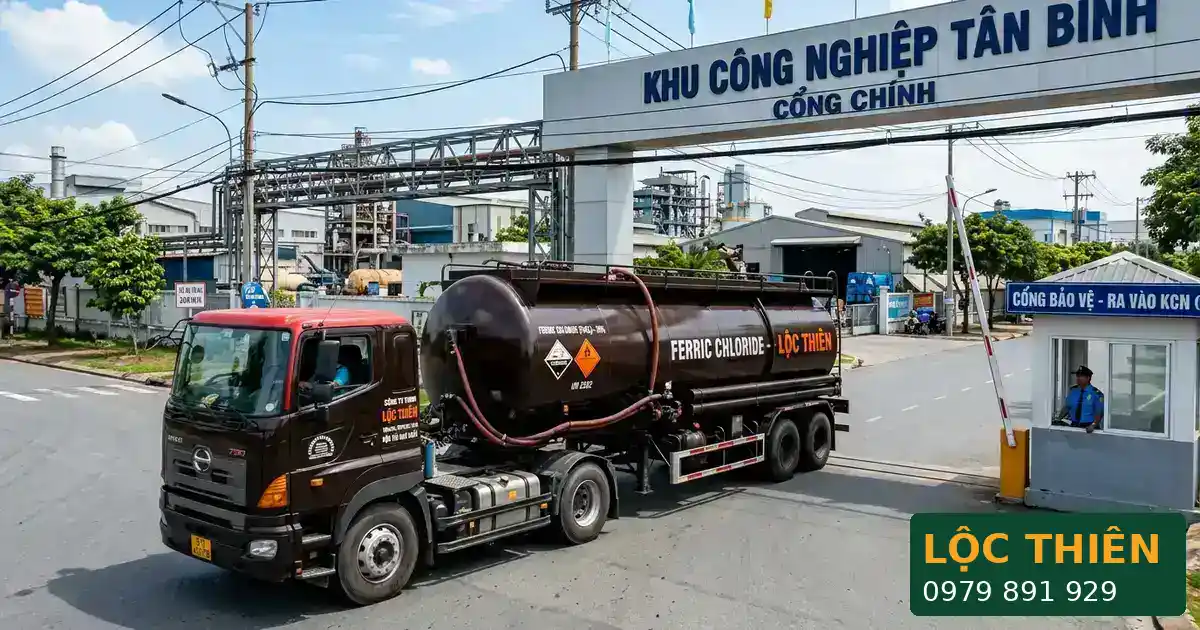
Loc Thien FeCl3 — direct manufacturer, nationwide tanker delivery for PCB workshops and industrial applications
Contact Loc Thien for FeCl3 consultation for PCB production — quotation within 15 minutes, COA per batch, delivery in IBC 1000L or tanker trucks 5-30 tons:
📞 Hotline: 0979 891 929 📧 Email: [email protected]
Related articles:
- What is FeCl3 — Properties & Detailed Applications
- FeCl3 Applications in Water Treatment — Coagulation, Textile, PCB
- FeCl3 Production — Direct Process from Factory
- FeCl3 36–40% — Quotation Within 15 Minutes
- Safety, Storage & Transport of FeCl3
Loc Thien — direct manufacturer and supplier of FeCl3, FeCl2, PAC, NaOH, HCl, H2SO4. 6 warehouses across 3 regions. Nationwide delivery by tanker trucks 5–30 tons.