
NaOH in Food CIP — Concentration, Temperature & Industry Applications
NaOH in Food CIP — Concentration, Temperature & Industry Applications
TL;DR: NaOH (caustic soda) is the primary CIP chemical in food processing, operating at 1–3% concentration and 60–80°C to hydrolyze proteins, saponify fats, and disperse starch. This article compares NaOH with acid cleaners, presents CIP application tables by industry (dairy, brewery, beverage, seafood), and details the technical specifications of NaOH 32%/45%/50% from Hóa Chất Lộc Thiên — ZDHC Level 1 certified, with batch-level COA testing.
What Is NaOH in Food CIP?
CIP (Clean-In-Place) is an automated sanitation system that eliminates the need to disassemble equipment. Standardized since the 1950s in the dairy industry, it is now mandatory across most food, beverage, and pharmaceutical plants. Four TACT parameters (Time, Action, Concentration, Temperature) determine cleaning effectiveness.
NaOH (sodium hydroxide, caustic soda, CAS 1310-73-2) is the primary CIP chemical for the caustic wash step. At pH ~13–14 at working concentration, NaOH can:
- Hydrolyze proteins — break peptide bonds, converting proteins into soluble peptide fragments and amino acids
- Saponify fats — convert triglycerides into glycerol and soap, easily rinsed away
- Disperse starch and carbohydrates — swell and dissolve starch and sugar residues
According to research in the Journal of Food Engineering, a standard CIP cycle consists of 5 steps: (1) pre-rinse with warm water, (2) caustic wash with NaOH, (3) intermediate rinse, (4) acid wash, (5) final rinse + sanitization. NaOH handles the most critical step — removing 80–90% of total organic soil load.
NaOH Concentration for Food CIP
NaOH concentration in food CIP ranges from 0.5–3.0% depending on equipment type and soil level. Below are recommendations from actual operations:
| Equipment/Application | NaOH Concentration | Temperature | Time | Notes |
|---|---|---|---|---|
| Heat-treatment equipment (HTST, evaporator) | 1.0–2.0% | 77–82°C | 45–60 min | Heavy soil, heat-denatured proteins |
| Cold tanks / ambient-temperature piping | 0.4–0.75% | 57–66°C | 5–15 min | Light soil, typically oz/gal |
| Brewery fermenters | 1.5–2.0% | 50–70°C | 30–40 min | Studies show 1.5% achieves cleaning in just 30 min |
| Milk storage tanks / separators | 0.75–1.5% | 71–82°C | 45–60 min | Excess NaOH in the first wash (>0.75%) can trigger Maillard reactions |
| Seafood processing equipment | 1.0–1.5% | 60–70°C | 20–30 min | Fish protein residues adhere strongly; auxiliary detergents recommended |
Research by Newcastle University (UK) on Heineken brewery CIP systems showed that NaOH concentrations >1% w/v do not significantly improve cleaning efficacy compared to 1% — recommending operation at 1% for cost optimization. However, microbreweries require at least 1.5% v/v for 40 minutes or 2.0% for 30 minutes to achieve RLU <10 on stainless steel surfaces.
🛒 Need NaOH for your CIP system? Get a quote for NaOH 32%/45%/50% — batch COA/MSDS, delivered to industrial parks nationwide. Hotline 0979 891 929 — quote within 15 minutes.
Optimal Temperature for CIP with NaOH
CIP temperature directly affects the reaction rate of NaOH with soils. The common temperature range for the caustic wash step is 60–80°C:
- Below 60°C: NaOH reacts slowly, especially with fats and heat-denatured proteins. Soil removal is difficult, requiring longer time or higher concentration
- 60–70°C: Suitable for CIP in breweries, beverage plants, and seafood facilities — sufficient for protein hydrolysis without further denaturing residues
- 70–80°C: Optimal for the dairy industry (whey protein residues, milkstone) and heat-treatment equipment such as plate heat exchangers (PHE)
- Above 85°C: No additional cleaning benefit; increases energy consumption and equipment corrosion risk
A 2025 study in Chemical Engineering Science (University of Copenhagen) confirmed that 0.5% NaOH solution at 80°C with a flow velocity of 0.3–0.4 m/s can remove 90% of whey protein residues on PHE surfaces in just 20 minutes — demonstrating that a combination of low concentration and high temperature can significantly reduce chemical consumption.
Comparing NaOH with Acid Cleaners in CIP
Food CIP uses both main chemical groups: alkali (NaOH) and acids (HNO₃, H₃PO₄). They are not interchangeable because their cleaning mechanisms differ:
| Criterion | NaOH (Alkali) | Acid (HNO₃/H₃PO₄) |
|---|---|---|
| Mechanism | Hydrolyzes proteins, saponifies fats | Dissolves inorganic scale (calcium, magnesium, oxalate) |
| Working pH | 13–14 | 1–2 |
| Concentration | 1–3% | 0.5–1.5% |
| Temperature | 60–80°C | 60–70°C |
| Target soil | Organic (protein, grease, starch) | Inorganic (milkstone, beerstone, hard water scale) |
| Contraindications | Aluminum, zinc, glass | Standard carbon steel |
| Frequency | Every CIP cycle | Periodic (1–3 times/week depending on water hardness) |
Conclusion: NaOH and acid cleaners complement each other in CIP — they are not competitors. A complete CIP cycle includes both steps, with NaOH as the primary step removing organic soil (80–90% of total soil load) and acid as the secondary step removing residual inorganic scale.
CIP Application Table by Food Industry
| Industry | Key Equipment | NaOH Concentration | Temperature | Caustic Wash Time | Accompanying Acid | Relevant Standards |
|---|---|---|---|---|---|---|
| Dairy | HTST, evaporator, separator, silo tanks | 0.8–2.0% | 71–82°C | 30–60 min | HNO₃ 0.5–1.0% (anti-milkstone) | NSF/ANSI 169, 3-A Sanitary Standards |
| Brewery | Fermenter, bright beer tank, piping | 1.5–2.0% | 50–70°C | 30–45 min | H₃PO₄ or blended (anti-beerstone) | EHEDG, FDA 21 CFR |
| Beverage | Mixing tanks, filler, CIP piping | 1.0–1.5% | 60–70°C | 15–30 min | HNO₃ 0.5–1.0% (anti-sugar scale) | NSF/ANSI 169, FSSC 22000 |
| Seafood | Thawing tanks, fillet machines, freezing equipment | 1.0–1.5% | 55–65°C | 20–30 min | H₃PO₄ 0.5–1.0% | HACCP, ISO 22000 |
| Edible oil, confectionery | Mixing tanks, piping, frying equipment | 1.5–3.0% | 65–80°C | 30–45 min | HNO₃ 0.5–1.5% (anti-fat scale) | NSF/ANSI 169, GMP |
| Meat processing | Tanks, grinders, piping | 1.0–2.0% | 60–75°C | 20–30 min | HNO₃ 0.5–1.0% | USDA, HACCP |
Dairy Industry
This is the most demanding sector for CIP. Milk residues include whey protein, butterfat, and calcium phosphate film (milkstone). Pasteurized or UHT whey protein is even harder to clean because it has been denatured and adheres tightly to stainless steel.
Typical CIP cycle for dairy equipment: (1) warm water rinse 38–49°C — 3–5 min; (2) NaOH 0.8–2.0% at 71–82°C — 30–60 min; (3) intermediate rinse; (4) HNO₃ 0.5–1.0% at 60–70°C — 10–20 min; (5) sanitization; (6) final rinse.
Important note: for dairy evaporators, the first caustic wash must not exceed 0.75% NaOH — exceeding this triggers Maillard reactions that form a hard orange gel on equipment surfaces, extremely difficult to remove. The second caustic wash can be raised to 1.5–4.0%.
Brewery Industry
Brewery residues include hop resins, yeast, protein, and beerstone (calcium oxalate) — a calcium oxalate-protein matrix with higher chemical resistance than milkstone. High-gravity beers typically require higher NaOH concentrations and longer contact times.
According to a study in Beverages (2021), for fermenters ≥450 L, NaOH 1.0% v/v is insufficient to consistently achieve RLU <10. The minimum concentration is 1.5% v/v for 40 minutes, or 2.0% v/v for 30 minutes. Ambient temperature (unheated) still achieves efficacy at ≥1.5% — allowing significant energy cost savings.
Beverage Industry
Residues are primarily sugars, organic acids, and flavorings — easier to clean than dairy and brewery soils. NaOH 1.0–1.5% at 60–70°C suffices for most equipment. However, fillers require periodic acid washing to prevent caramelized sugar scale and biofilm buildup.
Seafood Industry
Fish and shrimp protein residues have high adhesion and decompose rapidly if not cleaned promptly. CIP temperature is typically lower (55–65°C) to avoid cooking proteins onto equipment surfaces. NaOH 1.0–1.5% combined with periodic phosphoric acid washing helps control odors and biofilm.
Technical Specifications of NaOH for Food CIP
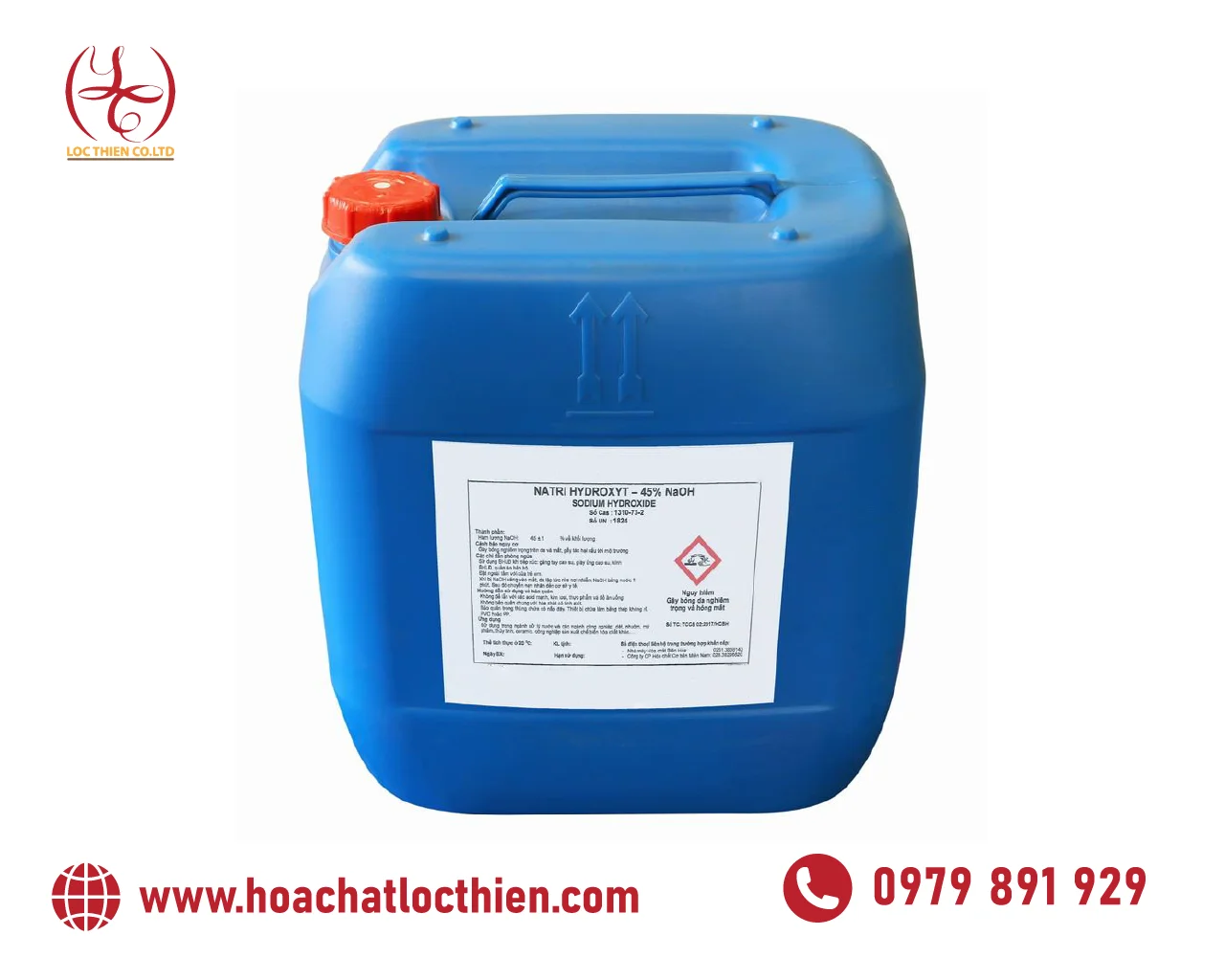
NaOH used in food CIP is typically supplied as concentrated solutions of 32%, 45%, or 50%. Specifications below are from actual COA of Hóa Chất Lộc Thiên:
| Parameter | NaOH 32% | NaOH 45% | NaOH 50% |
|---|---|---|---|
| NaOH content (% by weight) | ≥32.0 | ≥45.0 | ≥50.0 |
| Density (20°C), g/cm³ | 1.348 | 1.478 | 1.52 |
| NaCl content (max) | 0.01% | 0.01% | 0.01% |
| Na₂CO₃ content (max) | 0.2% | 0.2% | 0.3% |
| Fe content (max) | 5 ppm | 5 ppm | 5 ppm |
| Form | Liquid solution | Liquid solution | Liquid solution |
| Packaging | Tanker 5–30 tons, IBC 1000L, 30L jerry can | Tanker 5–30 tons, IBC 1000L | Tanker 5–30 tons, IBC 1000L |
Quality control is performed by QC Phan Cẩm Thủy and Võ Thị Như Hòa — each batch comes with full COA and MSDS.
Certifications and Compliance — NSF/ANSI and ZDHC
NaOH used in food CIP must meet food safety and environmental requirements:
- NSF/ANSI 169: Standard for cleaning chemicals used in food processing. Products meeting NSF/ANSI 169 are verified free of hazardous impurities at levels that could contaminate food
- ZDHC MRSL Level 1: TÜV Rheinland certification confirming that Lộc Thiên NaOH does not contain restricted chemicals under the ZDHC MRSL — mandatory for factories exporting to the EU, especially in textile-related food-grade applications
- 3-A Sanitary Standards: Design standards for dairy processing equipment, requiring CIP efficacy of >99.999% bacterial kill
- HACCP/ISO 22000: CIP cycles must be validated for cleaning effectiveness with full documentation
🛒 Need ZDHC Level 1 certified NaOH? Get a quote for NaOH 32%, 45%, 50% — batch COA/MSDS, tanker delivery 5–30 tons to industrial parks nationwide. Hotline 0979 891 929 (QC Phan Cẩm Thủy, Võ Thị Như Hòa certified).
Why Choose Hóa Chất Lộc Thiên for CIP NaOH?
- Batch-level actual COA: Each NaOH lot is independently tested for density, content, and impurities — verifiable upon customer request
- ZDHC MRSL Level 1 (TÜV Rheinland): Meets export requirements for EU, US, and Japanese markets
- Named QC personnel: Phan Cẩm Thủy and Võ Thị Như Hòa are personally responsible for quality control
- 6 warehouses nationwide: HCMC, Đồng Nai, Bà Rịa-Vũng Tàu, Cần Thơ, Đà Nẵng, Bắc Ninh — express delivery within 4 hours in HCMC, 24 hours to Southern industrial parks
- 20 tanker trucks (5–30 tons): Ensures stable supply for all CIP scales
- Direct official import: Competitive pricing versus intermediary distribution channels
Frequently Asked Questions (FAQ)
What is the optimal NaOH CIP concentration for dairy?
0.8–2.0% NaOH at 71–82°C for 30–60 minutes. The first caustic wash for dairy evaporators should not exceed 0.75%.
Can NaOH be replaced by acid in CIP?
No, not completely. NaOH cleans organic matter (proteins, fats); acid handles inorganic scale. Both are needed in a standard CIP cycle.
What CIP temperature is suitable for seafood plants?
55–65°C with NaOH 1.0–1.5% for 20–30 minutes. Lower than dairy to avoid cooking proteins onto equipment surfaces.
Which NaOH concentration — 32%, 45%, or 50% — is best for CIP?
NaOH 50% is the most popular choice due to high concentration, saving storage volume and transport costs. NaOH 32% is easier to dilute for small CIP systems.
What does ZDHC Level 1 mean for food-grade NaOH?
It confirms that the NaOH does not contain restricted chemicals under the ZDHC MRSL, meeting export requirements and global environmental standards.
How to check NaOH concentration in a CIP tank?
Use a hydrometer to directly measure the diluted NaOH solution, combined with acid titration to precisely determine the active concentration.
Are additives needed for NaOH in CIP?
Low-foam surfactants and chelating agents can be added to control foam, improve wetting, and keep Ca/Mg ions in suspension.
=====