
Caustic Soda in Biodiesel Production
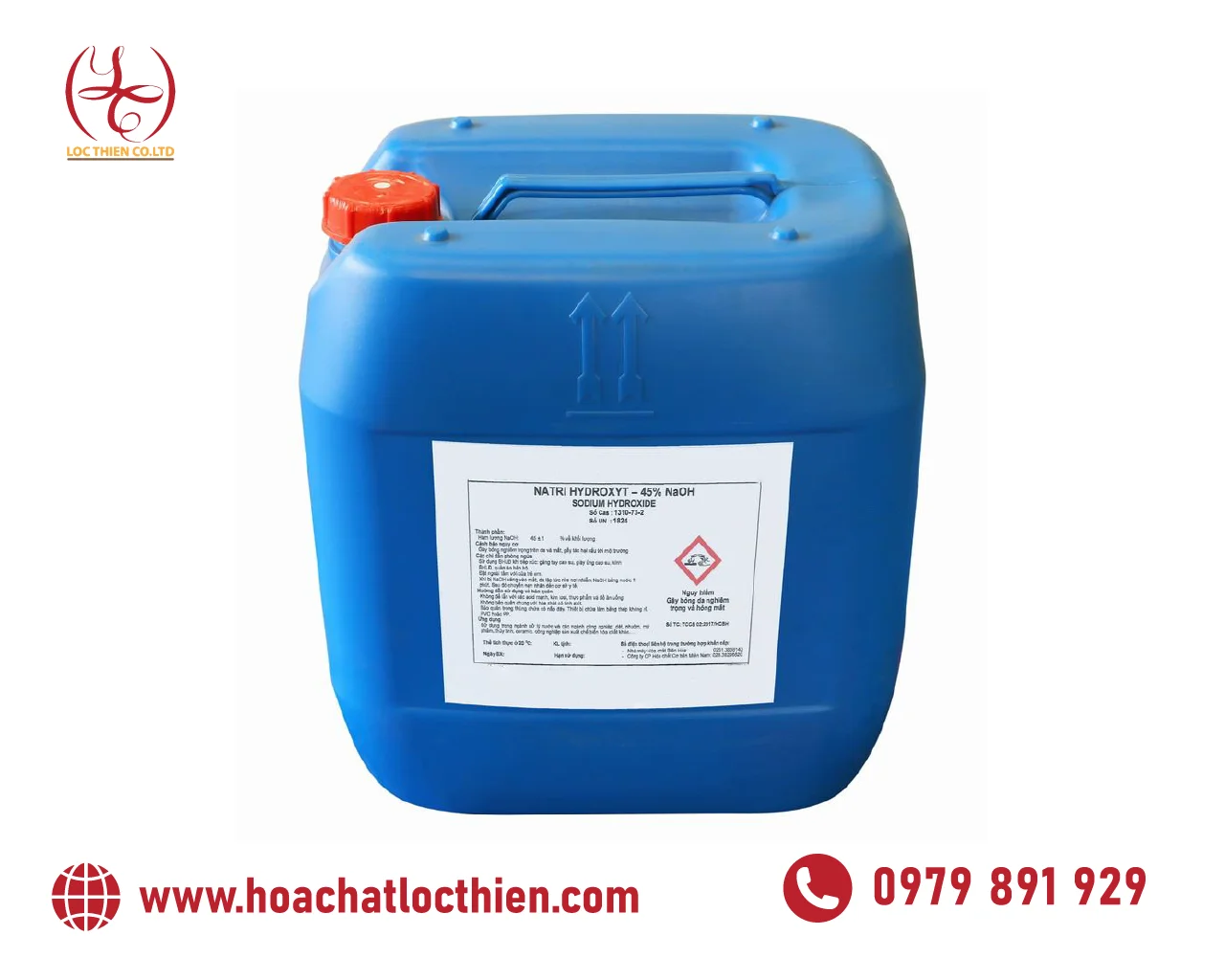
TL;DR: NaOH (Caustic Soda flakes) is the most common homogeneous alkaline catalyst in the transesterification reaction converting vegetable oils/animal fats into biodiesel (FAME) and glycerin. At 0.5–1% by weight of oil, methanol-to-oil ratio 6:1 mol, temperature 55–65°C, NaOH achieves 86–97% conversion efficiency. Lộc Thiên supplies NaOH 99% flake form with batch COA/MSDS, delivering to biodiesel plants nationwide.
What Role Does NaOH Play as a Catalyst in Biodiesel Production?
NaOH (sodium hydroxide, CAS 1310-73-2) is a homogeneous alkaline catalyst used in the transesterification reaction — the conversion of triglycerides (oils/fats) with methanol into methyl esters (biodiesel) and glycerin. In methanol medium, NaOH dissociates to form methoxide ions (CH₃O⁻), which are nucleophilic agents that attack the carbonyl group of triglycerides. The reaction proceeds through three intermediate steps: triglyceride → diglyceride → monoglyceride → glycerol, each step releasing one methyl ester molecule.
The general equation:
Triglyceride + 3 CH₃OH →(NaOH)→ 3 RCOOCH₃ (biodiesel) + C₃H₅(OH)₃ (glycerin)
NaOH is the most popular choice due to low cost, easy availability, and rapid dissolution in methanol. However, NaOH has two drawbacks: (1) it produces water when reacting with methanol (NaOH + CH₃OH ↔ CH₃ONa + H₂O), slowing the reaction rate; (2) if the feedstock contains free fatty acids (FFA) > 0.5% or high moisture, NaOH causes saponification, reducing yield and making glycerin separation difficult.
According to a study published in Fuel (2011), using 1% NaOH with a 6:1 methanol-to-oil ratio at 60°C for 1 hour achieved optimal biodiesel yield on soybean and cottonseed oils. Another study on PMC (2021) with Jatropha seed oil showed optimal conditions: temperature 60.5°C, methanol-to-oil 6.7:1, NaOH 0.79%, achieving 93.16% biodiesel, with all ASTM D6751 and EN 14214 standards met.
Technical Specifications of NaOH for Biodiesel
NaOH used as a biodiesel catalyst requires purity ≥99% (flake or pearl form), Na₂CO₃ ≤ 0.5%, and water insolubles ≤ 0.05%.
| Parameter | Value | Method |
|---|---|---|
| NaOH content | ≥ 99.0% | TCVN 3794-83 |
| Na₂CO₃ | ≤ 0.5% | TCVN 3794-83 |
| NaCl | ≤ 0.03% | TCVN 3794-83 |
| Fe₂O₃ | ≤ 0.01% | TCVN 3794-83 |
| Water insolubles | ≤ 0.05% | TCVN 3794-83 |
| Density (20°C) | 2.13 g/cm³ | — |
| Packaging | 25kg/bag, 1-ton pallet | Moisture-proof PE |
Lộc Thiên delivers each shipment with batch-specific COA — actual test results from the QC lab supervised by KTV Phan Cẩm Thùy and Võ Thị Như Hòa.
NaOH Dosage and Reaction Conditions
NaOH Ratio
NaOH is typically used at 0.5–1.5% by weight of oil. The 1% level is most common for refined oils (FFA < 0.5%). For every 1% FFA in the oil, an equivalent additional amount of NaOH must be added to neutralize the acid.
Ratio for refined soybean oil:
- NaOH 1% by oil weight (10 g NaOH per kg oil)
- Methanol:oil 6:1 mol (approximately 22% by oil weight)
- Increasing NaOH from 0.5% → 1% improves yield, but > 1.5% begins to form soap and reduces yield
Optimal Conditions
| Parameter | Optimal Range | Reference Study |
|---|---|---|
| Temperature | 55–65°C (near methanol boiling point 64.7°C) | Fuel 2011; PMC 2021 |
| Time | 60–120 minutes | Studies on soybean oil |
| Methanol:oil ratio | 6:1 mol (double stoichiometric) | Fuel 2011 |
| Stirring speed | 600–800 rpm | Optimal 800 rpm (SciELO 2014) |
| Typical yield | 86–97% | Depends on feedstock and conditions |
SciELO (2014) research indicates that at 800 rpm, 1% NaOH, 55°C, the reaction takes only 5 minutes to achieve high yield with certain oil types.
NaOH vs KOH vs CH₃ONa Comparison
NaOH vs KOH
KOH (potassium hydroxide, CAS 1310-58-3) is often compared with NaOH under the same conditions. KOH has the advantage: it produces K₃PO₄, which can be used as fertilizer when the product is neutralized with H₃PO₄. However, KOH is more expensive than NaOH and produces more soap at the same molar concentration.
Biodiesel yield comparison (rapeseed oil, same conditions 1% w/w, 6:1 methanol, 50°C):
| Parameter | NaOH | KOH |
|---|---|---|
| Biodiesel yield | 86.71% | 91.67% |
| Methyl ester purity | 99.70% | 99.76% |
| Soap formation | Lower | Higher |
| Cost | Low | 30–50% higher |
| Neutralization by-product | NaCl (table salt) | K₃PO₄ (fertilizer) |
NaOH vs CH₃ONa
CH₃ONa (sodium methoxide/methylate, CAS 124-41-4) is the most effective catalyst — it does not produce water during reaction and causes less saponification. CH₃ONa dosage is only 0.3–0.5% by oil weight (compared to 0.5–1.5% for NaOH). Biodiesel yield with CH₃ONa reaches 96–99%.
However, CH₃ONa costs 5–10 times more than NaOH and requires absolutely sealed storage (flammable, reacts vigorously with water).
| Parameter | NaOH | CH₃ONa |
|---|---|---|
| Biodiesel yield | 86–97% | 96–99% |
| Dosage | 0.5–1.5% | 0.3–0.5% |
| Cost | Lowest | Highest |
| Soap formation | Moderate | Lowest |
| Storage safety | Moderate | High requirement (flammable) |
| Suitable for | Small to medium scale production | Continuous industrial production |
Research from Oklahoma State University indicates: CH₃ONa gives better yield than NaOH and KOH, but at higher cost. For small-scale production (≤5 tons/day), NaOH remains the optimal cost-performance choice.
Raw material quality control is the decisive factor for success when choosing NaOH as a catalyst.
Effect of Oil Quality on Yield
NaOH requires feedstock with free fatty acids (FFA) ≤ 0.5% and moisture ≤ 0.1%. When FFA > 0.5%, a side reaction occurs:
RCOOH (FFA) + NaOH → RCOONa (soap) + H₂O
Soap increases mixture viscosity, hinders glycerin separation, reduces biodiesel yield, and increases product washing water volume.
Treatment methods for high-FFA oil:
- Acid pretreatment (H₂SO₄ 1–2%, 60°C, 1h) to esterify FFA into methyl esters
- Or use a two-stage process: acid → alkaline
- Increase NaOH dosage corresponding to FFA level (1 mg KOH/g acid = 0.71 mg additional NaOH needed)
Waste cooking oil typically has FFA of 1.5–3.5%, requiring pretreatment before using NaOH. With fresh refined oil (FFA < 0.1%), 1% NaOH gives a stable yield of 93–97%.
Storage and Handling of NaOH
NaOH is a strong alkaline chemical, corrosive, classified as dangerous (UN 1823, Class 8). Storage requirements:
- Packaging: Moisture-proof PE bags 25kg, in carton boxes or shrink-wrapped pallets
- Warehouse: Dry, temperature ≤ 35°C, avoid direct sunlight
- Moisture: NaOH is strongly hygroscopic — reseal immediately after taking
- Shelf life: 12 months in sealed bag, 6 months after opening
- PPE: Rubber gloves, safety goggles, dust mask
Catalyst preparation: dissolve NaOH in anhydrous methanol (ratio 10 g NaOH/L methanol) in a sealed container, stir until completely dissolved. The reaction is exothermic; control temperature < 50°C.
Troubleshooting Common Issues with NaOH Catalyst
Glycerin Not Separating
Common cause: high FFA oil or moisture > 0.1% leading to soap-glycerin-oil emulsion. Solution: check inlet FFA and acid value, reduce NaOH dosage if possible, or switch to CH₃ONa. Add 5% saturated NaCl brine to break the emulsion; increase centrifuge speed to 3000–4000 rpm.
Low Yield < 80%
Check: actual NaOH concentration (moisture absorption reduces activity), methanol-to-oil ratio (confirm by GC), reaction time. In plant practice, the issue often stems from wet NaOH due to improper storage — use NaOH from intact PE bags, opened just before mixing.
Cloudy Biodiesel After Washing
Indicates residual soap or excess methanol. Increase warm water washes (50°C), use water at pH 6–7, check cleanliness with the 3/27 test (3 mL biodiesel + 27 mL water, rest — if the interface is clear, it is clean).
Frequently Asked Questions (FAQ)
Can NaOH replace CH₃ONa?
Yes, provided the oil feedstock has FFA ≤ 0.5% and moisture ≤ 0.1%. NaOH requires a higher dosage (1% vs 0.3–0.5%) and yields 3–5% lower, but costs only 1/5 to 1/10.
What effect does soap formation from NaOH have?
Soap increases viscosity, hinders glycerin separation, increases wash water volume, and reduces biodiesel yield by 5–15%. Controlling inlet FFA and moisture is the only way to prevent it.
What NaOH ratio for waste cooking oil?
For waste cooking oil with 2% FFA, use approximately 1.5–2% NaOH (1% catalyst + 0.5–1% for FFA neutralization). Pretreat with acid first to reduce soap.
Which is better, NaOH flakes or pearls?
Flake form dissolves faster than pellet form, suitable for catalyst preparation. Both work well, with the same purity ≥99%.
Does Lộc Thiên supply NaOH for biodiesel production?
Yes. Lộc Thiên supplies NaOH 99% flake form, 25kg/bag packaging, with batch COA/MSDS, delivering to biodiesel plants nationwide. Hotline 0979 891 929. QC Phan Cẩm Thùy & Võ Thị Như Hòa — batch COA, ZDHC MRSL Level 1 (TÜV Rheinland).
What is the maximum biodiesel yield with NaOH?
According to multiple studies, maximum yield is 93–97% on refined oil (FFA < 0.5%), with conditions of 1% NaOH, 6:1 methanol, 60°C, 600 rpm. Yield is 3–10% lower than KOH and CH₃ONa.
How to reduce soap when using NaOH?
Check inlet oil FFA, keep moisture < 0.1%, do not exceed 1.5% NaOH, shorten reaction time to 1–2 hours, stir evenly.
What is the price difference between NaOH and CH₃ONa?
NaOH is about 5–10 times cheaper than CH₃ONa. For a 10-ton biodiesel/day plant, using NaOH saves 3–5 million VND/day compared to CH₃ONa at the same scale.
Request a Quote
Contact Lộc Thiên for a NaOH 99% quote by volume — batch COA/MSDS, delivering to industrial parks nationwide (inner Ho Chi Minh City within 4 hours, Southern IPs 24–48 hours). Technical team advises on catalyst ratio suitable for each oil type.
Hotline: 0979 891 929
🛒 Need NaOH for biodiesel production? Get a quote for NaOH 99% flake — batch COA/MSDS, nationwide plant delivery. Hotline 0979 891 929.
=====