
What Is NH4HF2? Properties, Uses, Hazards, HF First Aid
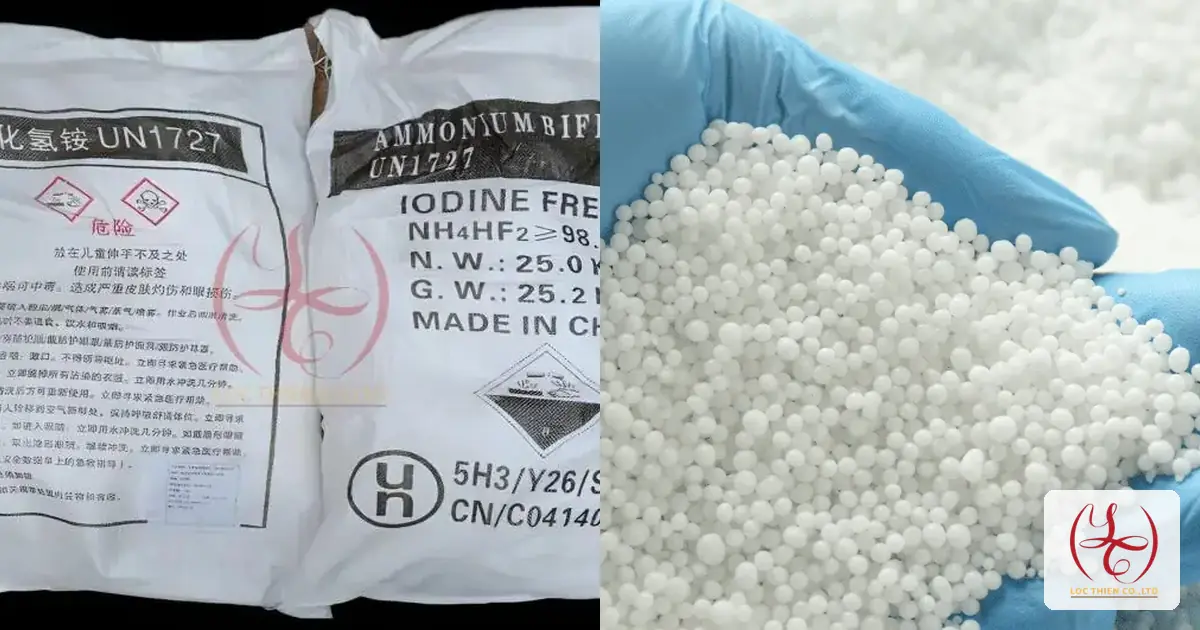
Quick answer: NH4HF2 is ammonium bifluoride (ammonium hydrogen difluoride, CAS 1341-49-7), a white crystalline or flaked fluoride salt that dissolves freely in water. Its solution is a weak acid (pH about 3.5 at 5%) but it releases HF, so it remains toxic and deeply corrosive: it etches glass, burns skin and can cause fluoride poisoning. Hazard statements H301 + H314; transported as UN 1727, Class 8.
What is NH4HF2? Identity and data
NH4HF2 is the salt of ammonium (NH4⁺) and the bifluoride ion (HF2⁻). It can be regarded as NH4F·HF: one NH4F unit combined with one HF. Other names you will meet in documents and invoices: ammonium hydrogen difluoride, ammonium acid fluoride, ammonium hydrogendifluoride, ABF.
| Parameter | Value |
|---|---|
| Formula | NH4HF2 (≡ NH4F·HF) |
| CAS | 1341-49-7 |
| Molar mass | 57.04 g/mol |
| Form | White crystals or flakes, hygroscopic; commercial material usually contains about 1% NH4F |
| Melting point | about 126 °C (Merck Index: 125.6 °C) |
| Solubility in water | about 60–63 g/100 mL at 20 °C |
| pH of a 5% solution | 3.5 (Kirk-Othmer, via PubChem) |
| Decomposition | Above about 240 °C it releases toxic, corrosive HF, NOx and NH3 |
Two notes on the table. First, 240 °C is where decomposition begins, not a boiling point as some pages state. Second, pH 3.5 applies to a 5% solution according to the source cited; stronger or weaker solutions give other values, and pH says nothing about how toxic the substance is (see the next section).
Commercial material is made from ammonia and anhydrous HF: NH3 + 2 HF → NH4HF2 (Kirk-Othmer, via PubChem).
NH4HF2 solution: a weak acid, yet toxic and deeply corrosive
In water, NH4HF2 yields hydrofluoric acid (HF), fluoride ions (F⁻) and ammonium ions (NH4⁺). HF is a weak acid with a pKa of about 3.2; it dissociates far less than mineral acids such as HCl or H2SO4. That is why a 5% NH4HF2 solution reaches only about pH 3.5.
“Weak” refers to dissociation only and says nothing about safety. The danger of HF lies in the F⁻ ion and in undissociated HF molecules: they pass through skin, penetrate deep into tissue, cause deep burns that may not hurt at first, and bind calcium and magnesium in the body, causing hypocalcaemia, a form of systemic poisoning. ATSDR notes that HF is weaker than most mineral acids but a serious systemic poison.
The right way to judge the hazard is therefore to compare NH4HF2 with HF, not with dilute acids of the same pH. A pH 3.5 solution containing dissolved fluoride must still be handled as an HF-containing chemical; dilute HCl at the same pH does not penetrate deeply or cause hypocalcaemia in this way, because the hazard of NH4HF2 does not come from H⁺ ions.
Hazards and classification: H301, H314, UN 1727
According to the GHS summary on PubChem (based on ECHA C&L notifications), NH4HF2 carries the signal word DANGER with the two most widely agreed hazard statements:
- H301: toxic if swallowed (acute toxicity, oral, Category 3).
- H314: causes severe skin burns and eye damage (skin corrosion, Category 1B).
The matching pictograms are GHS05 (corrosion) and GHS06 (acute toxicity). Some notifiers also add serious eye damage (H318) and target-organ toxicity; this article uses only the two consensus statements.
| Item | Details |
|---|---|
| Transport, solid | UN 1727 (Ammonium hydrogendifluoride, solid), Class 8 (corrosive) |
| Transport, solution | UN 2817, Class 8 |
| Packing group | As stated in the manufacturer’s MSDS for each lot |
| Occupational exposure limit | Fluorides (as F): 2.5 mg/m³ TWA (OSHA PEL, NIOSH REL, ACGIH TLV) |
| Incompatible with | Strong bases (violent reaction, releases NH3); concentrated acids (release HF) |
Solid NH4HF2 absorbs moisture; once it is damp, including sweat or mucous membranes, it dissolves and releases HF right where it touches. Emptying bags, scooping and weighing are the steps most likely to create dust.
Real industrial uses of NH4HF2
All the uses below rest on one mechanism: F⁻ and HF attack silicon oxide and metal oxide layers. The table is compiled from PubChem, Kirk-Othmer and the application list of the manufacturer Solvay.
| Use | What NH4HF2 does |
|---|---|
| Frosting and cleaning glass surfaces; treating ceramics | Dissolves SiO2 to form SiF4 and (NH4)2SiF6, roughening or cleaning the surface |
| Rust and scale removal on metal; stainless steel pickling; boiler scale | Usually part of an acid mixture; dissolves oxide layers and silicon-containing deposits |
| Aluminium surface treatment | Pre-treatment, cleaning, anodising of aluminium |
| Industrial cleaning and descaling | Dissolves silicate deposits and hard-to-dissolve oxides |
| Oil and gas | Used with HCl in well-treatment acid mixtures, often called “mud acid” |
| Chemical intermediate | Feedstock for other fluoride compounds |
| Chemical analysis, electroplating | Listed in PubChem’s use profile |
An illustrative reaction for glass etching: SiO2 + 4 NH4HF2 → SiF4 + 4 NH4F + 2 H2O. In practice SiF4 reacts further to give (NH4)2SiF6, so the equation is a simplified model.
In the electronics sector NH4HF2 appears as a raw material for preparing etching solutions; however, the oxide etchant used in chip manufacture is a mixture of NH4F and HF in electronic grade, and electronic grade under SEMI standards is a separate category that should not be equated with technical-grade material.
NH4HF2 etches glass, which is also why glass is forbidden as a container when preparing or holding this chemical. A note for readers researching the compound: NH4HF2 is not used in food, pharmaceuticals or cosmetics. With acute toxicity Category 3 and skin corrosion Category 1B, it is an industrial chemical to be handled only by trained people with full protective equipment.
For comparison with the more common way of pickling steel with HCl, see HCl in steel pickling: industrial rust-removal process and technical notes.
Compatible materials: what to use, what to avoid
| Material | Reason | |
|---|---|---|
| Do not use | Glass, ceramics, silicates, cement | Attacked, forming SiF4 |
| Do not use when damp | Steel, nickel, aluminium and most ordinary metals | USCG: in the presence of moisture it corrodes glass, cement and most metals; do not use steel, nickel or aluminium containers |
| Suitable | HDPE, PP, PTFE (fluoropolymer) plastics | Plastic drums, jerrycans, tanks; Remington and Kirk-Othmer record solutions being held in plastic bottles |
The commercial 25 kg NH4HF2 bag is a woven PP bag. Mixing vessels, buckets, measuring jugs, jerrycans, tanks and pipework for solutions should be HDPE, PP or PTFE. Temperature limits differ between plastics, so ask the material manufacturer when working at elevated temperature.
Do not overlook everyday items: glass sample bottles, glass measuring cylinders, sight glasses on tanks and glass droppers. All must be replaced with plastic.
Storing NH4HF2 and handling spills
NH4HF2 is hygroscopic, so storage conditions come down to keeping it dry and keeping it apart:
- A dry, cool, well-ventilated store; bags tightly closed and undamaged.
- Separate from alkalis, acids, metals and glass, according to the incompatibility list above.
- Full labelling: substance name, UN 1727, Class 8, corrosion and acute-toxicity pictograms.
- Storage temperature: follow the manufacturer’s MSDS for the lot.
If a bag is torn or product is spilled, follow ERG guide 154:
- Isolate the area; unprotected people leave.
- Cover or pick up with dry earth, sand or other non-combustible material.
- Do not let water into the container or the torn bag.
- Prevent the material from entering drains.
Protective equipment for working with NH4HF2
- Chemical splash goggles plus a face shield.
- Chemical-resistant gloves (thick nitrile, neoprene or butyl); no latex. Ask the glove supplier how each glove type holds up to HF.
- Chemical-resistant clothing, apron and rubber boots.
- A respirator with dust and acid-gas filters when dust is generated.
- Work in a ventilated area, preferably with local extraction where bags are emptied.
- Within reach: an in-date tube of 2.5% calcium gluconate gel, an eyewash and an emergency shower.
First aid after contact with NH4HF2 (HF)
For guidance only. Any contact with NH4HF2 or HF requires calling emergency services (115 in Vietnam) or going to hospital, even if there is no pain. Symptoms can be delayed by several hours.
| Route | What to do |
|---|---|
| Skin | Remove contaminated clothing and jewellery immediately. Rinse at once with plenty of running water, continuously, for at least 15 minutes (it may be extended to 30 minutes); do not stop rinsing to look for gel. After rinsing, apply 2.5% calcium gluconate gel widely over the area; whoever applies it must wear chemical-resistant gloves. Reapply every 10–15 minutes until medical staff take over. Call emergency services or go to hospital immediately. |
| Eyes | Rinse with clean running water or saline for at least 15 minutes, holding the eyelids open. Do not use 2.5% calcium gluconate gel in the eyes; only medical staff use a sterile 1% solution. Go to an emergency ophthalmologist. |
| Inhalation of dust or fumes | Move to fresh air, keep warm, call emergency services. Give oxygen if someone trained is present. Monitoring is needed because pulmonary oedema can appear late. |
| Swallowing | Do not induce vomiting. Give nothing by mouth to an unconscious person. Rinse the mouth and call emergency services or a poison centre immediately. |
At the medical facility, say clearly “exposure to NH4HF2/HF”, the concentration or form, the time and the skin area affected, and bring the MSDS for the lot.
A plant that uses NH4HF2 should rehearse this procedure like a fire drill: everyone on shift knows where the gel is, where the eyewash is and who calls emergency services. Water rinsing time is what counts in the first minutes, so the gel is never a reason to delay rinsing.
Loc Thien Technical Department: Before opening the first bag of NH4HF2 in the store, check three things: the 2.5% calcium gluconate gel is in date, the eyewash works, and a list exists of people who know the HF first-aid procedure. If any of the three is missing, do not open the bag yet.
Buying NH4HF2 for a plant: what to ask, what to check on delivery
Loc Thien supplies NH4HF2 in bulk to factory customers. Specification per the product page: Ammonium Bifluoride NH4HF2, 25 kg/bag, made in China. This is a traded supply item, so the technical document that accompanies it is the manufacturer’s MSDS: request the manufacturer’s MSDS for each lot when you ask for a quote, and read the packing group, composition and first-aid sections before ordering.
On delivery, check:
- Bag label: ammonium bifluoride, NH4HF2, UN 1727, corrosion label.
- Woven PP bags intact, not torn, damp or caked.
- The lot’s MSDS matches the goods received.
- The receiving area has plastic containers and dry sand or dry absorbent ready in case of a spill.
Price depends on volume, delivery area and timing, so it is not listed in this article. To receive a quote within 15 minutes, send 5 items: quantity needed, intended use, delivery location, packaging format and date required (hotline 0979 891 929). If your process actually needs hydrofluoric acid as a solution rather than a solid salt, see Hydrofluoric acid HF 49%; it carries a higher hazard and needs its own procedure.
Frequently asked questions about NH4HF2
Is an NH4HF2 solution a weak or a strong acid?
NH4HF2 is a salt; dissolved, it gives hydrofluoric acid (HF), a weak acid with a pKa of about 3.2. A 5% solution has a pH of about 3.5 according to Kirk-Othmer. Even so, because it releases HF and F⁻ ions, the solution is still toxic and deeply corrosive, so safety cannot be judged from pH alone.
Is NH4HF2 dangerous?
Yes. NH4HF2 is classified H301 (toxic if swallowed) and H314 (causes severe skin burns and eye damage) and is transported as UN 1727, Class 8. The dust absorbs moisture and releases HF on skin; burns may not hurt at first, yet fluoride ions penetrate deeply and can cause hypocalcaemia. Every exposure needs first aid and a call to emergency services.
How does NH4HF2 differ from NH4F and HF?
NH4F is ammonium fluoride, HF is hydrofluoric acid, and NH4HF2 contains both, so it can be seen as NH4F·HF. As a solid, NH4HF2 is easier to store and ship than HF gas or solution, but it releases HF when it dissolves in water and must still be handled as an HF-containing chemical.
Can NH4HF2 be kept in glass bottles or steel drums?
No. NH4HF2 attacks glass, ceramics and cement and, when damp, also steel, nickel and aluminium. Use drums, jerrycans or tanks made of HDPE, PP or PTFE plastic.
What should I do if NH4HF2 gets on my skin?
Remove contaminated clothing at once, rinse with running water continuously for at least 15 minutes, then apply 2.5% calcium gluconate gel (the person applying it wears chemical-resistant gloves) and call emergency services immediately, even without pain. For the eyes, rinse with water for at least 15 minutes and do not use the gel. This is guidance only; always call emergency services.
What is NH4HF2 used for in industry?
Frosting and cleaning glass surfaces, rust and scale removal on metal, aluminium surface treatment, industrial cleaning, oil and gas (with HCl in acid mixtures) and as an intermediate for other fluoride compounds. Each application needs its own procedure developed by the user.
Does Loc Thien supply NH4HF2, and what documents come with it?
Yes. Loc Thien supplies NH4HF2 in 25 kg bags, made in China, in bulk to factories. The technical document is the manufacturer’s MSDS for each lot, which you should request when asking for a quote.
Request an NH4HF2 quote
Send the quantity, intended use and delivery location through the contact page, call 0979 891 929 or email [email protected]. Quotes within 15 minutes; delivery depends on the area and on stock at the time of quotation.
References
- PubChem, Ammonium bifluoride (CID 14935): identity, GHS, UN, pH, solubility, reactions, storage conditions (compiled from Kirk-Othmer, CRC Handbook, Merck Index, ERG 154, USCG): https://pubchem.ncbi.nlm.nih.gov/compound/Ammonium-bifluoride
- ATSDR, Medical Management Guidelines for Fluoride, Hydrogen Fluoride.
- UTHSC SOP for hydrofluoric acid; Illinois DRS hydrofluoric acid guide; Royal Children’s Hospital Melbourne HF guideline; Cal/OSHA HF chart: first aid.
- Solvay, Ammonium bifluoride: application list.