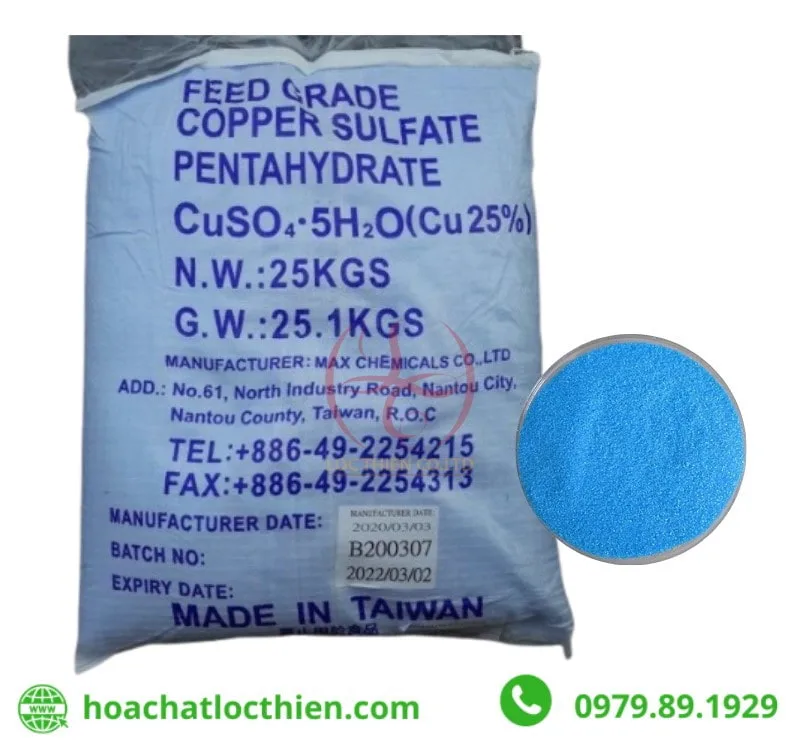
Copper Sulfate | CuSO4 | Copper Sulfate | 55lb/Bag
Copper sulfate CuSO4 in 55 lb bags for electroplating, fungicide production, micronutrient fertilizer and water supply treatment. Hotline 0979 891 929
If you’re looking for information on the price of Copper Sulfate, where to buy high-quality CuSO₄, or the applications of CuSO₄ in agriculture, industry, and Water Supply Treatment, this article will provide all the information you need. Copper Sulfate (CuSO₄) is an important chemical compound widely used in electroplating, the production of fungicides, micronutrient fertilizers, and the treatment of pond and lake water. Here, we’ll help you understand its properties, production processes, storage methods, and—most importantly—the latest CuSO₄ pricing from reputable suppliers.
English / FDI search terms for Copper Sulfate | CuSO4 | Copper Sulfate | 25 kg/bag: copper sulfate, copper sulphate, CuSO4 pentahydrate. Catalog key: copper sulfate CuSO4 25 kg bag. Reuse this reference as "copper sulfate CuSO4 25 kg bag" for buyers who enter "copper sulfate CuSO4 25 kg bag" on RFQ forms. Loc Thien Chemicals supplies customers with COA/MSDS upon request — hotline 0979 891 929.
If you’re wondering how much Copper Sulfate costs—also known as CuSO₄ or copper(II) sulfate—this is an important chemical compound with many applications in agriculture, the Electroplating industry, water treatment, and chemical production. In this article, you’ll discover all the essential information about CuSO₄, including its properties, the current price of Copper Sulfate, where to buy CuSO₄ from reputable suppliers, and how to store it safely.
| Product name | Copper Sulfate (CuSO₄) |
| Also known as | Copper sulfate, Copper(II) sulfate, Copper Sulfate, CuSO₄ salt |
| Chemical Formulas | CuSO4 |
| CAS | 7758-98-7 |
| Packing specifications | 25 Kg/bag |
| Origin | Taiwan, China |
What is Copper Sulfate?
Copper Sulfate (CuSO₄) is an important inorganic compound consisting of atoms of copper (Cu²⁺) and sulfate ions (SO₄²⁻). This compound exists in many forms waterlogged various, the most common being pentahydrat CuSO₄·5H₂O – widely used in agriculture, the Electroplating industry, Wastewater Treatment, and the production of fungicides. If you're looking for mua CuSO4 in large quantities, please refer to Latest CuSO₄ prices to choose a reputable supplier.
Forms of CuSO₄ and Their Characteristics and Applications:
- CuSO₄ khan: Form white flour, Highly effective at absorbing moisture; commonly used in laboratories and chemical manufacturing.
- CuSO₄·5H₂O (pentahydrate): The most common type, which has distinctive blue color, highly soluble in water; widely used in agriculture (fungicides, fertilizers), copper electroplating, and Swimming Pool water treatment.
- CuSO₄·3H₂O (trihydrate) and CuSO₄·7H₂O (heptahydrate): Less common; found primarily in industrial chemical reactions.
💡 Looking to buy CuSO₄? Check out today’s CuSO₄ price quote for the best deal! 📞 Contact us now: 0979 891 929
Chemical Structure and Properties:
- In an aqueous solution, CuSO₄ dissociates into Cu²⁺ and SO₄²⁻, producing a characteristic blue color.
- Highly soluble in water; releases a small amount of heat upon dissolution.
- It reacts with active metals (Zn, Fe, Al) to form the corresponding sulfate salts and release metallic copper.
- It decomposes easily when heated on the 150°C, losing water to form anhydrous CuSO₄.
Physical properties of Copper Sulfate:
- Color: Blue (wet), white (dry).
- Density: 3.6 g/cm³ (anhydrous), 2.28 g/cm³ (5% water).
- Melting point: 110°C (4 countries), 150°C (5 countries), decomposed into 650°C.
- Water solubility: Increases gradually with temperature (at 20°C: 320 g/L; at 100°C: 1140 g/L).
⚠ Safety Warnings for the Use of CuSO₄: Copper Sulfate is highly toxic to aquatic organisms and humans. When using CuSO₄ to treat water in aquaculture ponds, follow the dosage instructions to ensure safety. Avoid direct contact with skin and eyes; if accidental contact occurs, rinse immediately with water and seek medical attention at the nearest healthcare facility.
Properties of Copper Sulfate:
Physical properties of Copper Sulfate:
- Appearance: white powder (anhydrous), blue crystals (5-hydrate), light blue crystals (7-hydrate).
- Melting point: 110 °C (4 waters), 150 °C (5 waters), 650 °C (decomposition).
- Dissolve in water: Copper Sulfate is soluble in water, and this process is typically accompanied by thermal decomposition (heat release).
- + 5 water: 316 g/L (0 °C), 2033 g/L (100 °C)
- + Undefined form: 320 g/l (20 °C), 618 g/l (60 °C), 1140 g/l (100 °C)
- Molecular weight: 159.6096 g/mol (anhydrous); 177.62488 g/mol (1-hydrate); 213.65544 g/mol (3-hydrate); 249.686 g/mol (5-water); 267.70128 g/mol (6-water); 285.71656 g/mol (7-water); 321.74712 g/mol (9-water); 952.28192 g/mol (44-water)
- Density: 3,603 g/cm³ (anhydrous); 2,284 g/cm³ (5% water); 1,944 g/cm³ (7% water, 21 ℃)
Chemical properties of CuSO₄:
- Dissolution reaction: Copper sulfate Dissolve in water to form a blue solution. The dissolution reaction can be described as follows:
- CuSO4.5H2O → Cu2 + SO42− + 5H2O
- Redox Reactions: CuSO₄ can participate in redox reactions; for example, when it reacts with zinc:
- CuSO4 + Zn → ZnSO4 + Cu
- In this reaction, Copper Sulfate containing copper(II) ions (Cu2+) and zinc can replace copper from the solution.
- Reaction with Ammonia: Copper sulfate can react with an ammonia (NH₃) solution to form a black-bronze precipitate of copper hydroxide:
- CuSO4 + 2NH3 + 2H2O → Cu(OH)2 + (NH4)2SO4
- Reaction with a Base: CuSO4 It also reacts with the basic solution NaOH (Sodium Hydroxide) to form a precipitate of copper hydroxide:
- CuSO4 + 2NaOH → Cu(OH)2 + Na2SO4
- Appearance: white powder (anhydrous), blue crystals (5-hydrate), light blue crystals (7-hydrate).
- Melting point: 110 °C (4 waters), 150 °C (5 waters), 650 °C (decomposition).
- Dissolve in water: Copper Sulfate is soluble in water, and this process is typically accompanied by thermal decomposition (heat release).
- + 5 water: 316 g/L (0 °C), 2033 g/L (100 °C)
- + Undefined form: 320 g/l (20 °C), 618 g/l (60 °C), 1140 g/l (100 °C)
- Molecular weight: 159.6096 g/mol (anhydrous); 177.62488 g/mol (1-hydrate); 213.65544 g/mol (3-hydrate); 249.686 g/mol (5-water); 267.70128 g/mol (6-water); 285.71656 g/mol (7-water); 321.74712 g/mol (9-water); 952.28192 g/mol (44-water)
- Density: 3,603 g/cm³ (anhydrous); 2,284 g/cm³ (5% water); 1,944 g/cm³ (7% water, 21 ℃)
Chemical properties of CuSO₄:
- Dissolution reaction: Copper sulfate Dissolve in water to form a blue solution. The dissolution reaction can be described as follows:
- CuSO4.5H2O → Cu2 + SO42− + 5H2O
- Redox Reactions: CuSO₄ can participate in redox reactions; for example, when it reacts with zinc:
- CuSO4 + Zn → ZnSO4 + Cu
- In this reaction, Copper Sulfate containing copper(II) ions (Cu2+) and zinc can replace copper from the solution.
- Reaction with Ammonia: Copper sulfate can react with an ammonia (NH₃) solution to form a black-bronze precipitate of copper hydroxide:
- CuSO4 + 2NH3 + 2H2O → Cu(OH)2 + (NH4)2SO4
- Reaction with a Base: CuSO4 It also reacts with the basic solution NaOH (Sodium Hydroxide) to form a precipitate of copper hydroxide:
- CuSO4 + 2NaOH → Cu(OH)2 + Na2SO4
- CuSO4.5H2O → Cu2 + SO42− + 5H2O
- CuSO4 + Zn → ZnSO4 + Cu
- In this reaction, Copper Sulfate containing copper(II) ions (Cu2+) and zinc can replace copper from the solution.
- CuSO4 + 2NH3 + 2H2O → Cu(OH)2 + (NH4)2SO4
- CuSO4 + 2NaOH → Cu(OH)2 + Na2SO4
Copper sulfate It can also react with other bases to form a copper hydroxide precipitate.
How to Prepare Copper Sulfate (CuSO₄) – Industrial Production Process
Basic Chemical Reactions
- Copper Sulfate can be synthesized by the reaction between copper (Cu) and Sulfuric Acid (H₂SO₄) under appropriate conditions:
- Cu+2H2SO4→CuSO4+SO2+2H2O
- 💡 Explanation of the reaction:
- Copper (Cu) reacts with concentrated Sulfuric Acid at high temperatures, producing Copper(II) sulfate, sulfur dioxide (SO₂) and water (H₂O).
- SO₂ is released as a gas Therefore, the reaction should be carried out in a closed system or one equipped with an appropriate exhaust gas treatment system.
The Industrial Production Process for CuSO₄
- Copper Sulfate can be synthesized by the reaction between copper (Cu) and Sulfuric Acid (H₂SO₄) under appropriate conditions:
- Cu+2H2SO4→CuSO4+SO2+2H2O
- 💡 Explanation of the reaction:
- Copper (Cu) reacts with concentrated Sulfuric Acid at high temperatures, producing Copper(II) sulfate, sulfur dioxide (SO₂) and water (H₂O).
- SO₂ is released as a gas Therefore, the reaction should be carried out in a closed system or one equipped with an appropriate exhaust gas treatment system.
The Industrial Production Process for CuSO₄
Method using metallic copper and Sulfuric Acid. Procedure:
- Ingredients: Pure copper (sheets, copper wire) or copper oxide ore.
- Initial management: Clean the copper metal and remove impurities.
- Response: Add copper to a concentrated H₂SO₄ solution and heat it to produce CuSO₄.
- Filtration to remove impurities: Remove excess metal or insoluble impurities.
- Concentration and crystallization: The solution is concentrated so that CuSO₄ crystallizes as CuSO₄·5H₂O (pentahydrate), which has a distinctive blue color.
- Drying and packaging: CuSO₄ is dried at a moderate temperature and packaged for storage.
Method from sulfide copper ores (CuFeS₂, Cu₂S)
In addition to using metallic copper, the industry also produces CuSO₄ from sulfide copper ore via oxidation process or electrolytic production of crude copper:
- Oxidation of sulfide copper ore with Sulfuric Acid:
- 2CuFeS2+8O2+4H2SO4→2CuSO4+2FeSO4+4H2O+4SO2
- → This reaction requires a high-temperature environment; it uses oxygen-rich air to speed up the oxidation process.
- Electrolysis of crude copper:
- Impure copper is Electrolysis in Solution H₂SO₄ to create High-purity CuSO₄.
- This is a modern method that helps recover copper from scrap and minimize environmental pollution.
Applications of Copper Sulfate in daily life and industry:
- In agriculture
- Micronutrient fertilizers: Copper is an essential element for plants, playing a role in photosynthesis and the synthesis of enzymes and proteins. CuSO₄ helps supplement the trace element copper, prevent nutrient deficiencies, and improve crop quality and yield.
- Fungicides: Copper Sulfate inhibits and kills harmful fungi, particularly in the control of powdery mildew, rust, and leaf blight in crops.
- Seed Treatment: A dilute CuSO₄ solution is used to disinfect seeds before planting, reducing the risk of fungal infection from the soil.
- In industry
- Electroplating: CuSO₄ is the main component in the electrolytic copper plating process, producing a durable, attractive copper coating that protects the metal from corrosion.
- Water treatment Used to remove algae from ponds, lakes, and swimming pools by disrupting the algae’s ionic balance, thereby preventing their growth.
- Chemical manufacturing: It is an important raw material in the production of dyes, catalysts, and laboratory reagents.
- Wood Processing: Used in wood treatment to prevent termite damage, increase durability, and protect against microbial decay.
- In healthcare and laboratories
- Urine protein test: Copper Sulfate is an important component of the Biuret reaction, which helps detect proteins in biological samples.
- Antifungal drug ingredients: Some compounds derived from CuSO₄ are used to treat fungal skin infections and harmful bacteria.
- Micronutrient fertilizers: Copper is an essential element for plants, playing a role in photosynthesis and the synthesis of enzymes and proteins. CuSO₄ helps supplement the trace element copper, prevent nutrient deficiencies, and improve crop quality and yield.
- Fungicides: Copper Sulfate inhibits and kills harmful fungi, particularly in the control of powdery mildew, rust, and leaf blight in crops.
- Seed Treatment: A dilute CuSO₄ solution is used to disinfect seeds before planting, reducing the risk of fungal infection from the soil.
- Electroplating: CuSO₄ is the main component in the electrolytic copper plating process, producing a durable, attractive copper coating that protects the metal from corrosion.
- Water treatment Used to remove algae from ponds, lakes, and swimming pools by disrupting the algae’s ionic balance, thereby preventing their growth.
- Chemical manufacturing: It is an important raw material in the production of dyes, catalysts, and laboratory reagents.
- Wood Processing: Used in wood treatment to prevent termite damage, increase durability, and protect against microbial decay.
- Urine protein test: Copper Sulfate is an important component of the Biuret reaction, which helps detect proteins in biological samples.
- Antifungal drug ingredients: Some compounds derived from CuSO₄ are used to treat fungal skin infections and harmful bacteria.
💡 Note: Copper Sulfate is toxic to humans and animals if used improperly. Requires Follow the storage and dosage instructions to ensure safe use.
You might be interested in:
How to Store CuSO₄ Properly:
To ensure the quality and safety of CuSO₄, the following storage guidelines must be followed:
- Ideal Storage Conditions
- Environment: Store in a dry, cool, well-ventilated place, away from areas with high humidity. Copper Sulfate is highly hygroscopic and is prone to deliquescence when exposed to moist air.
- Light: Avoid exposure to direct sunlight; store in opaque packaging to minimize degradation caused by UV rays.
- Temperature: Store at a stable temperature and avoid significant temperature fluctuations, which may affect the physical and chemical properties of the chemical.
- Packaging and Packing Methods
- Always store CuSO₄ in a sealed container after use to prevent exposure to air and moisture, thereby reducing the risk of oxidation and caking.
- Use plastic containers, plastic bags, or PE-coated paper bags to prevent moisture absorption.
- Avoid unwanted chemical reactions
- Do not store near reactive chemicals such as strong alkalis, strong acids, oxidizing agents, or flammable substances to prevent dangerous reactions.
- Do not mix CuSO₄ with active metals such as zinc (Zn) or iron (Fe), as this may cause a chemical reaction that produces toxic gases.
- Safety Precautions
- Keep out of the reach of children and pets to ensure safety.
- Wear gloves and safety goggles when handling Copper Sulfate to avoid direct contact with the skin and eyes. If it gets into your eyes, rinse immediately with clean water and go to the nearest medical facility.
Where can I buy Copper Sulfate (CuSO₄) at a good price?
- If you're looking to buy High-quality CuSO₄ at competitive prices, please contact us Loc Thien Chemical, unit reliable supplier of Copper Sulfate with the following advantages:
- Competitive prices, quick quotes
- Genuine products imported from Taiwan, China
- Products are always in stock and available in large quantities
- Nationwide delivery—24–48 hours to southern industrial parks
- Free Technical Support
- 📞 Contact us now: 0979 891 929
- 🌐 Website hoachatlocthien.com
Loc Thien Investment and Development Co., Ltd. is a Vietnam-based industrial chemical supplier. We focus on process-grade supply, logistics support and quotation on request.
- Address: 452/6B Tỉnh Lộ 10, Binh Tri Dong Ward, Ho Chi Minh City
- Phone: 0979 891 929
- Website hoachatlocthien.com
- Fax: 0979 891 929 - Hotline: 0979 891 929
- Competitive prices, quick quotes
- Genuine products imported from Taiwan, China
- Products are always in stock and available in large quantities
- Nationwide delivery—24–48 hours to southern industrial parks
- Free Technical Support
Loc Thien Investment and Development Co., Ltd. is a Vietnam-based industrial chemical supplier. We focus on process-grade supply, logistics support and quotation on request.
- Address: 452/6B Tỉnh Lộ 10, Binh Tri Dong Ward, Ho Chi Minh City
- Phone: 0979 891 929
- Website hoachatlocthien.com
- Fax: 0979 891 929 - Hotline: 0979 891 929
FAQ – Frequently Asked Questions When Buying CuSO4
- Can Copper Sulfate be used in aquaculture?
- ✅ Yes, but it must be used at the correct dosage. Copper Sulfate (CuSO₄) is used to control algae and kill bacteria in aquaculture ponds, but concentrations that are too high can be toxic to fish and shrimp. Typically, the safe dosage for pond water treatment ranges from 0.1 to 0.5 ppm, depending on the species of aquatic animals and water hardness. Before use, carefully review the instructions to ensure safety.
- Is it possible to make Copper Sulfate (CuSO₄) at home?
- Not recommended. The preparation of Copper Sulfate from metallic copper and Sulfuric Acid requires high temperatures and produces toxic SO₂ gas. This is a hazardous process without proper protective equipment and a dedicated exhaust gas treatment system. If you need CuSO₄, it is best to purchase it from reputable suppliers to ensure quality and safety.
- Does Copper Sulfate have an expiration date? How can you tell if Copper Sulfate has deteriorated?
- 🕒 Yes, but it has a long shelf life. If stored under the right conditions (in a dry place, away from light and moisture), CuSO₄ can be used for many years without any loss of quality.
🔍 Signs that CuSO₄ has deteriorated:
- Mold and clumping may occur due to excessive moisture absorption.
- Turns pale green or becomes uneven in color (due to oxidation).
- It does not dissolve completely in water, leaving a precipitate.
- 💡 Tip: Store in an airtight container and keep away from areas with high humidity to extend the product's shelf life.
- Can Copper Sulfate be used to refine gold or silver?
- 💡 Yes, in certain metallurgical processes. CuSO₄ can be used in the electrolytic refining of gold or silver, particularly in the process of removing impurities from precious metals. However, this application is primarily limited to the metallurgical industry, where strict technological and process controls are in place. Using CuSO₄ for metal refining at home is unsafe and not recommended.
- Can Copper Sulfate be replaced with another chemical?
- 🔄 It depends on the intended use. Certain substances can be used as substitutes for CuSO₄ in specific applications:
- Fungus Control in Agriculture: Alternatives include fungicides containing mancozeb, zineb, or Bordeaux mixture (Copper Sulfate + Hydrated Lime).
- Water Treatment: Other algicides, such as potassium permanganate (KMnO₄) or sodium thiosulfate (Na₂S₂O₃), may be used as alternatives in specific cases.
- Electroplating: There is no substitute that is as effective as CuSO₄ in electroplating.
- 💡 Note: Substitutions should be considered on a case-by-case basis, as each chemical has different effects and risks.
- ✅ Yes, but it must be used at the correct dosage. Copper Sulfate (CuSO₄) is used to control algae and kill bacteria in aquaculture ponds, but concentrations that are too high can be toxic to fish and shrimp. Typically, the safe dosage for pond water treatment ranges from 0.1 to 0.5 ppm, depending on the species of aquatic animals and water hardness. Before use, carefully review the instructions to ensure safety.
- Not recommended. The preparation of Copper Sulfate from metallic copper and Sulfuric Acid requires high temperatures and produces toxic SO₂ gas. This is a hazardous process without proper protective equipment and a dedicated exhaust gas treatment system. If you need CuSO₄, it is best to purchase it from reputable suppliers to ensure quality and safety.
- 🕒 Yes, but it has a long shelf life. If stored under the right conditions (in a dry place, away from light and moisture), CuSO₄ can be used for many years without any loss of quality.
🔍 Signs that CuSO₄ has deteriorated:- Mold and clumping may occur due to excessive moisture absorption.
- Turns pale green or becomes uneven in color (due to oxidation).
- It does not dissolve completely in water, leaving a precipitate.
- 💡 Tip: Store in an airtight container and keep away from areas with high humidity to extend the product's shelf life.
- 💡 Yes, in certain metallurgical processes. CuSO₄ can be used in the electrolytic refining of gold or silver, particularly in the process of removing impurities from precious metals. However, this application is primarily limited to the metallurgical industry, where strict technological and process controls are in place. Using CuSO₄ for metal refining at home is unsafe and not recommended.
- 🔄 It depends on the intended use. Certain substances can be used as substitutes for CuSO₄ in specific applications:
- Fungus Control in Agriculture: Alternatives include fungicides containing mancozeb, zineb, or Bordeaux mixture (Copper Sulfate + Hydrated Lime).
- Water Treatment: Other algicides, such as potassium permanganate (KMnO₄) or sodium thiosulfate (Na₂S₂O₃), may be used as alternatives in specific cases.
- Electroplating: There is no substitute that is as effective as CuSO₄ in electroplating.
- 💡 Note: Substitutions should be considered on a case-by-case basis, as each chemical has different effects and risks.