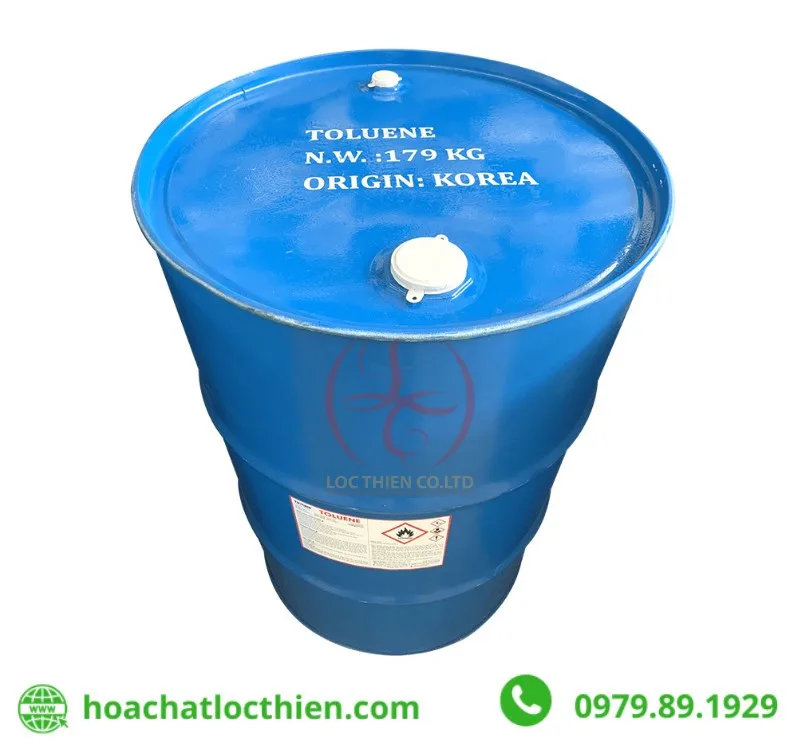
Toluen With the chemical formula C7H8, it is a colorless, odorless liquid that is soluble in water and has a characteristic aromatic odor. Toluene is commonly used as a solvent in many industrial applications, such as the production of paints, drying agents, and other chemical products. Packaging specifications: 179 kg per drum; country of origin: South Korea.
English / FDI search terms for Toluene Chemical - C7H8 | 179 kg/drum | South Korea: toluene solvent, methylbenzene, industrial toluene C7H8. Catalog key: toluene chemical c7h8 179 kg drum south korea. Reuse the term “toluene chemical C7H8 179kg drum South Korea” as a load-out reference for buyers who enter “toluene chemical C7H8 179kg drum South Korea” on RFQ forms. Loc Thien Chemicals supplies customers with COA/MSDS upon request — hotline 0979 891 929.
Product name: Toluen
Other names: Methyl Benzene, Toluene (Toluol), Phenyl Metan
Formula: C7H8 (CH3C6H5)
CAS number: 108-88-3
Packing: 179 kg/phuy
Origin: South Korea
What is toluene (C7H8)?
Toluen, hay methyl benzene, is a aromatic hydrocarbon belongs to the group aren with the chemical formula C7H8. This is a a colorless, volatile liquid, has distinctive aroma. Thanks to this characteristic, toluen is widely used as industrial solvents, especially in manufacturing of paint, ink, and industrial cleaning agents, and many other chemical applications.
toluen also serves as intermediate materials in petrochemical synthesis, to support production benzene, styrene, TNT (trinitrotoluene), and plastic polymers. do toxicity, exposure to high concentrations of toluene can affect the central nervous system. Therefore, it is important to comply with chemical safety procedures when in use.
Toluen
Physical and Chemical Properties of Toluene (C7H8):
Physical properties of C7H8:
Toluene (C7H8) It is a colorless, transparent liquid with a characteristic odor. Below are some of the key physical properties of toluene:
Status: Colorless liquid
Odor: Mildly fragrant, similar to benzene
Melting point: -95°C
Boiling point: 111°C
Density: 0.87 g/ml (20°C), lighter than water
Flammability: Catch fire with blue flame
Solubility: Soluble in organic solvents, but not completely soluble in water (0.52 g/L at 20°C)
Vapor pressure: 22 mmHg (25°C), volatile
3D Image of Toluene
Chemical Properties of Toluene:
Nitration Reaction:
Toluene can react with HNO₃ in the environment H₂SO₄, forming nitrotoluen – a precursor to TNT (trinitrotoluen).
C6H5CH3 +HNO3→C6H4NO2CH3 + H2O (H2SO4)
Halogenation Reaction:
Under the influence of Br₂ or Cl₂, methyl group in toluen could be caused by halogen.
C6H5CH3 + Br2 → C6H4BrCH3+HBr
Oxidation reaction:
Toluen may be oxidized to benzoic acid (C6H5COOH) when present MnO₂ or KMnO₄ catalyst.
C6H5CH3 + O2 → H2O + CO2
Benzene Production:
By removing the -CH3 group using Al2O3 as a catalyst, toluene can be converted to benzene (C6H6).
C6H5CH3 → C6H6+CH4 (catalyst)
generates Styren:
Under certain reaction conditions, C7H8 can be converted into styrene.
C6H5CH3 → C6H5CH = CH2 (catalyst)
Synthesis of Toluene:
Fractional Distillation of Crude Oil:
Toluene is a by-product from the process crude oil refining and petroleum cracking.
Synthesis from Ethylbenzene (Deethylaromization):
Ethylbenzene the ethyl group (-C2H5) is removed to produce toluen.
Equation:C6H5C2H5→C6H5CH3+C2H4
This process uses alumina (Al₂O₃) catalyst and high temperature.
Preparation Method C7H8 The most common method is typically the conversion of ethylbenzene to toluene through the deethylaromization process.
During this process, the ethyl group (-C2H5) in ethylbenzene is removed, and the benzene ring is reformed, producing toluene and ethylene (C2H4).
The deethylaromization process typically involves the use of a catalyst, usually a metal such as alumina (Al₂O₃). Temperature, pressure, and reaction time are key factors that must be controlled to achieve the desired yield and product quality.
This method is widely used because it utilizes ethylbenzene, a byproduct of the production of styrene from ethylene and benzene. The chemical properties and transport characteristics of ethylbenzene make this process an efficient and cost-effective synthesis method.
Industrial Applications of Toluene (C7H8)
Industrial solvents
Toluene is an important organic solvent used to dissolve paints, varnishes, synthetic resins, printing inks, and adhesives.
It is widely used in the production of industrial chemicals such as xylene, styrene, phenol, and polyurethane.
Paint and Ink Manufacturing
The main component in the formulation of solvent-based paint.
Helps increase adhesion, evaporation rate, and improve the physical and mechanical properties of the paint.
✔ Chemicals that meet standards safe, fully equipped MSDS and COA.
✔ Warehouse system of 6 warehouses (Ba Ria – Vung Tau, Dong Nai, Binh Duong, Da Nang, Can Tho and Bac Ninh)—nationwide delivery per Loc Thien's shipping policy.
✔ Technical Support and Consulting – Ensure proper and safe use.
To purchase C7H8, please contact our hotline: 0979 891 929 Our staff is always ready to provide advice and quick quotes for our customers.
Loc Thien Investment and Development Co., Ltd. is a Vietnam-based industrial chemical supplier. We focus on process-grade supply, logistics support and quotation on request.
Address: 452/6B Tỉnh Lộ 10, Binh Tri Dong Ward, Ho Chi Minh City
Is toluene toxic? How can you safely handle toluene if you come into contact with it?
Toluene is a chemical that moderate toxicity, may cause irritation eyes, skin, and respiratory system if exposed to high concentrations. With prolonged exposure, Toluene can affect the central nervous system and cause symptoms such as headaches, dizziness, and difficulty concentrating.
Safety Guidelines for Handling Toluene:
Limit exposure to toluene fumes: Always work in a well-ventilated area or wear a respirator if necessary.
Avoid direct skin contact: Wear chemical-resistant gloves and safety goggles when working with toluene.
Treatment for Toluene Poisoning:
If toluene comes into contact with the eyes: Rinse immediately with clean water for at least 15 minutes.
If it comes into contact with the skin: Wash thoroughly with soap and water.
If you inhale toluene fumes: Move to an area with fresh air.
If swallowed: Do not induce vomiting; drink plain water and contact a medical facility immediately.
Is the use of toluene banned in certain industries?
Toluen not prohibited from use, but has strict regulations regarding safety limits in various industries. Some common regulations include:
In the paint and ink industry: Toluene is restricted to certain types water-based paint to reduce the impact on the environment and human health.
In the pharmaceutical industry: Toluene may only be used with Extremely low content, because it can be toxic if it remains in pharmaceuticals.
In the food industry: Toluene is completely prohibited because it can be toxic to the body.
In the petroleum industry: Toluene is strictly regulated due to its potential to cause environmental pollution when used as fuel additive.
Businesses that use toluene need to Compliance with safety standards such as OSHA, EPA (U.S.), REACH (Europe), and QCVN (Vietnam) to ensure the safety of people and the environment.
What is the difference between toluene and xylene? When should toluene be used instead of xylene?
Toluene and xylene are both aromatic hydrocarbon and there are many similar applications. However, they have some key differences:
Characteristics
Toluen (C7H8)
Xylene (C8H10)
Chemical Structure
methyl group (-CH3)
Dimethyl group (-CH3)2
Boiling point
111°C
138-144°C
Volatility
Faster
Slower
Odor
Light, sweet
Eager, heavier
Solubility
Highly soluble in organic solvents
More soluble than toluene
When should toluene be used instead of xylene?
If you need fast evaporation (e.g., production of quick-drying paint, printing ink) → Toluen is the right choice.
If a stronger, less volatile solvent is needed (e.g., plastic manufacturing, synthetic rubber) → Xylene is a better choice.
If you're looking for a lower cost → Regular toluene cheaper Xylene, suitable for applications where cost-effectiveness is a priority.
Are there any methods for recycling or replacing toluene in industrial applications?
Currently, many industries are looking for methods recycle or replace toluene to minimize environmental impact and production costs. Some common methods include:
1. Recycling Toluene:
Distillation for the Recovery of Toluene from industrial emissions, helping to reuse instead of releasing it into the environment.
Solvent Vapor Filtration System, which helps recover toluene vapor from production processes.
2. Toluene substitutes:
Methyl Ethyl Ketone (MEK): It has properties similar to those of toluene, but is less toxic and evaporates more quickly.
Acetone: It is used as a substitute for toluene in certain paint and ink industries because it is less toxic and more biodegradable.
Ethyl Acetate: It is commonly used in the pharmaceutical and food industries as a substitute for toluene.
The choice alternative solution depends on Required product characteristics, cost, and environmental safety regulations for each industry.
Why is toluene used in the production of TNT (trinitrotoluene)?
Toluene is the main component in Production of TNT (Trinitrotoluene) – an explosive highly destructive. The conversion of toluene to TNT occurs through multistage nitration reaction:
Toluene reacts with the HNO3/H2SO4 mixture, generates mononitrotoluen (MNT).
Continue nitrification to form dinitrotoluen (DNT).
The final step: DNT is completely nitrated to produce TNT (C7H5N3O6).
Reasons why toluene was chosen as a raw material for TNT production:
Easily participates in nitration reactions with high performance.
Low costs and abundant supply from the oil refining industry.
TNT is more stable than many other types of explosives, making it easy to transport and store.
Although TNT is a powerful explosive, it is still is safer than nitroglycerin (the type used in dynamite), thanks to its stability.