Light Soda Ash | Na₂CO₃ 99.2% | 50 kg/bag
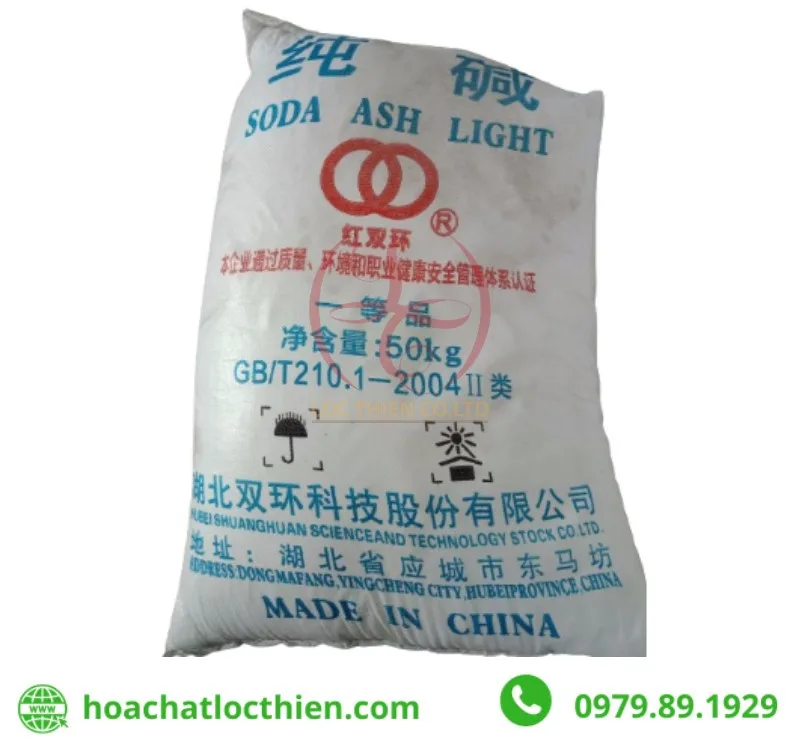
Light soda ash Na2CO3 99.2% (CAS 497-19-8) in 50 kg bags for glass, water softening, dyeing and chemicals. Loc Thien, hotline 0979 891 929
Soda ash light (Na2Carbon Monoxide3) or Sodium carbonate It is a white powder that is hygroscopic and soluble in water. It is widely used in the chemical industry, glass manufacturing, and water softening in water treatment.
- Purity: 99.2%, CAS: 497-19-8, Origin: China, Bulgaria. Packaging: 50 kg per bag.
English / FDI search terms for Soda Ash Light | Na₂CO₃ 99.2% | 50 kg/bag: soda ash light, sodium carbonate, Na₂CO₃ dense light. Catalog key: Soda Ash Na₂CO₃ 99 2 50kg bag. Reuse this reference as "Soda Ash Na₂CO₃ 99 2 50kg bag" for buyers entering "Soda Ash Na₂CO₃ 99 2 50kg bag" on RFQ forms. Loc Thien Chemicals supplies customers with COA/MSDS upon request — hotline 0979 891 929.
Na₂CO₃ chemical, also known as soda ash or light soda ash, is a white powder that is highly hygroscopic and easily soluble in water. Na2CO3 is one of the important chemicals widely used in industry, from glass manufacturing, water treatment, chemical production, to specialized applications in the paper, Textile Dyeing, and food industries. If you're looking to mua Na2CO3, be sure to thoroughly research its properties and applications to ensure you use it for its intended purpose.
| Product name | Soda ash light |
| Other names | Natri cacbonat, Sodium carbonate |
| Chemical formula | Na2Carbon Monoxide3 |
| Content | 99.2% |
| CAS | 497-19-8 |
| Origin | China, Bungaria |
| Packing | 50 kg/bao |
What is Soda Ash Light?
Soda Ash Light (Na2CO3), also known as Na₂CO₃ chemical, is a type of carbonate salt important in many industries. Light Soda Ash It is typically a white powder, has good moisture-absorbing properties, dissolves easily in water, and has a wide range of applications. Its main components include ion natri (Na+) and ion cacbonat (CO32-), which helps produce a highly alkaline substance that plays an important role in glass manufacturing, water treatment and manufacture other chemical compounds. If you're looking for an address supply Na2CO3, choose reputable suppliers to ensure quality.
Physical and Chemical Properties of Light Soda Ash:
Physical properties of sodium carbonate:
- Appearance: White crystals.
- Molecular weight:
- 105,9872 g/mol (khan)
- 124.00248 g/mol (1 water molecule)
- 196.0636 g/mol (pentahydrate)
- 232.09416 g/mol (heptahydrate)
- 286.14 g/mol (decahydrate)
- Density: 2.54 g/cm³, solid.
- Melting point: Light Soda Ash has a melting point of approximately 851 degrees Celsius (1,564 degrees Fahrenheit).
- Boiling point: 1.600°C (1,870 K; 2,910 °F).
- Hygroscopicity: Light Soda Ash absorbs moisture from the air.
- Solubility in water: 22 g/100 mL (20 °C).
- Basicity (pKb): 3.67.
- Solubility: Soda ash light It is soluble in water and interacts with various substances.
- Purity: In industrial applications, Sodium carbonate They typically have a high degree of purity to ensure consistent performance and properties during the manufacturing process.
- Color-forming capacity: If it contains impurities or metal ions, Sodium carbonate They may come in different colors.
Chemical Properties of Sodium Carbonate:
- Reacts with strong acids to form salts and water and release CO gas2:
- Na2Carbon Monoxide3+ 2HCl → 2NaCl + H2O + CO2
- Reaction with a base to form a new salt and a new base:
- Na2Carbon Monoxide3+ Ca(OH)2→ 2NaOH+ CaCO3↓
- When it reacts with a salt, it forms two new salts:
- Na2Carbon Monoxide3+ CaCl2→ 2NaCl + CaCO3
- Interconvert with sodium bicarbonate according to the following reaction:
- Na2Carbon Monoxide3 + CO2+ H2O ⇌ 2NaHCO3
- When dissolved in water, Na2Carbon Monoxide3 It undergoes vigorous hydrolysis, creating a basic environment that causes indicator substances to change color: a colorless phenolphthalein solution turns pink, and litmus paper turns blue:
- Na2Carbon Monoxide3→ 2Na+ + CO32−
- Carbon Monoxide32− + H2O ⇌ HCO3− + OH
Applications of Light Soda Ash:
- Appearance: White crystals.
- Molecular weight:
- 105,9872 g/mol (khan)
- 124.00248 g/mol (1 water molecule)
- 196.0636 g/mol (pentahydrate)
- 232.09416 g/mol (heptahydrate)
- 286.14 g/mol (decahydrate)
- Density: 2.54 g/cm³, solid.
- Melting point: Light Soda Ash has a melting point of approximately 851 degrees Celsius (1,564 degrees Fahrenheit).
- Boiling point: 1.600°C (1,870 K; 2,910 °F).
- Hygroscopicity: Light Soda Ash absorbs moisture from the air.
- Solubility in water: 22 g/100 mL (20 °C).
- Basicity (pKb): 3.67.
- Solubility: Soda ash light It is soluble in water and interacts with various substances.
- Purity: In industrial applications, Sodium carbonate They typically have a high degree of purity to ensure consistent performance and properties during the manufacturing process.
- Color-forming capacity: If it contains impurities or metal ions, Sodium carbonate They may come in different colors.
Chemical Properties of Sodium Carbonate:
- Reacts with strong acids to form salts and water and release CO gas2:
- Na2Carbon Monoxide3+ 2HCl → 2NaCl + H2O + CO2
- Reaction with a base to form a new salt and a new base:
- Na2Carbon Monoxide3+ Ca(OH)2→ 2NaOH+ CaCO3↓
- When it reacts with a salt, it forms two new salts:
- Na2Carbon Monoxide3+ CaCl2→ 2NaCl + CaCO3
- Interconvert with sodium bicarbonate according to the following reaction:
- Na2Carbon Monoxide3 + CO2+ H2O ⇌ 2NaHCO3
- When dissolved in water, Na2Carbon Monoxide3 It undergoes vigorous hydrolysis, creating a basic environment that causes indicator substances to change color: a colorless phenolphthalein solution turns pink, and litmus paper turns blue:
- Na2Carbon Monoxide3→ 2Na+ + CO32−
- Carbon Monoxide32− + H2O ⇌ HCO3− + OH
Applications of Light Soda Ash:
- Na2Carbon Monoxide3+ 2HCl → 2NaCl + H2O + CO2
- Na2Carbon Monoxide3+ Ca(OH)2→ 2NaOH+ CaCO3↓
- Na2Carbon Monoxide3+ CaCl2→ 2NaCl + CaCO3
- Na2Carbon Monoxide3 + CO2+ H2O ⇌ 2NaHCO3
- Na2Carbon Monoxide3→ 2Na+ + CO32−
- Carbon Monoxide32− + H2O ⇌ HCO3− + OH
Applications of Na₂CO₃ – Soda Ash Light It is highly versatile and plays a crucial role in many industries. Below are some typical applications of Na₂CO₃ chemical:
- 🏭 Applications in Glass Manufacturing
- Na2CO3 helps lower the melting point of silica, reducing energy consumption during the glass-making process.
- Contribute to creating soda-lime glass, a type of glass that accounts for more than 90%: Total global glass production and is used in food packaging, bottles and jars, architectural glass, automotive glass.
- 🏗️ Applications in the chemical industry
- An important raw material in production sodium silicate (Na2SiO3) – a component of silicate adhesive, heat-resistant cement, cleaning agent.
- Used in the production of sodium bicarbonate (baking soda), an important ingredient in food, pharmaceuticals, and cosmetics.
- Used for synthesizing compounds organic sodium others such as natri cromat, natri phosphat, used in Electroplating, dyes, and Wastewater Treatment.
- 🚰 Applications in Water Treatment
- Na2CO3 is used to soften hard water, which helps remove ions calcium (Ca²⁺) and magnesium (Mg²⁺) – the two main components that cause scaling.
- Helps neutralize the acidity of the water in Industrial Wastewater Treatment Systems, especially the industry paper, Textile Dyeing, food.
- Applications in pool water treatment, which helps balance pH levels and reduce acidity. See more: Water Treatment Chemicals
- 🏭 Applications in Metallurgy & Mining
- Na2CO3 used during the process metal ore separation, especially aluminum ore (bauxite) to produce aluminum oxide.
- Used in ore beneficiation process, which helps regulate pH and remove impurities in metallurgical processes such as steel, copper, and zinc smelting.
- 🧴 Applications in the production of chemicals and detergents
- Light Soda Ash is an important component of laundry detergent, soap, dish soap, which helps increase alkalinity to remove grease and dirt more effectively.
- Used as raw materials for production hand soap, glass cleaner, industrial cleaning agents.
- 📜 Applications in the paper industry
- Adjust pH In paper production, it helps enhance whiteness and protect the structure of cellulose fibers.
- Water Softening During the production process, minimize the amount of other chemicals that need to be used.
- 🍞 Applications in Food Processing
- Na2CO3 used as pH adjuster, which helps maintain the alkalinity in processing pasta, cookies, and baking powder.
- As part of lye water – used in steamed buns, rice noodles, pho to make it chewy and crispy.
- 👕 Applications in the Textile Dyeing Industry
- Adjusting Alkalinity During the fabric dyeing process, it helps the dye adhere better to the fabric fibers.
- Applications in industrial laundry, which helps remove impurities from the fabric fibers before dyeing.
- 🏥 Applications in Healthcare and Pharmaceuticals
- Na2CO3 is an important ingredient in manufacture of antacids, which helps neutralize acid and relieve heartburn symptoms.
- Used in disinfectant, disinfectant solution.
- As a component of medication for kidney disease, helps treat kidney stones and acid-base imbalances in the body.
- 🧪 Laboratory & Research Applications
- Solution Na2CO3 is commonly used as standard in chemical analysis.
- Applications in Prepare the buffer solution, which helps stabilize the pH in chemical reactions.
Na₂CO₃ chemical has multidisciplinary applications, not limited to glass, water treatment, and chemicals, and also appears in metallurgy, food, pharmaceuticals, the paper industry, Textile Dyeing, and chemical manufacturing. 👉 If you're interested mua Na2CO3, please select a provider supply Na2CO3 a reputable company to ensure product quality and competitive prices.
🔹 Loc Thien Chemical – Supplier light soda ash High quality, great prices, and fast nationwide shipping! 🚛💨
How to Choose a Reputable Supplier of Na₂CO₃
When searching for an address supply Na2CO3, you should pay attention to the following factors:
- Product Quality: Select suppliers soda ash has all the necessary quality certification documents.
- Competitive pricing: Compare prices from multiple sources to find best price while still ensuring quality.
- Consulting Support: A professional supplier will provide technical consulting on Applications of Na₂CO₃ in each specific field.
Loc Thien Chemical – A trusted supplier light soda ash, committed to high quality, great prices, and fast delivery!
How to Store Soda Ash Light:
Storage soda ash light Proper storage is important to ensure the quality and performance of the product. Here are some guidelines for storing light Soda Ash:
- Store in a dry place: Sodium carbonate It can absorb moisture from the air; therefore, it should be stored in a dry environment to prevent moisture absorption and the formation of clumps.
- Avoid exposure to air: To prevent interaction with air and ensure the product’s quality, keep the lid of the bag or container tightly closed after use.
- Store away from heat and open flames: Avoid storing Na2Carbon Monoxide3 Near heat sources, open flames, or other sources of heat may be dangerous.
- Avoid contact with flammable substances: Na2Carbon Monoxide3 It can produce a fine powder that is flammable under certain conditions. To prevent this risk, avoid contact with flammable substances.
- Regular quality checks: If you store soda ash light Over the long term, conduct regular quality inspections to ensure that its properties and performance do not deteriorate.
- To Na2Carbon Monoxide3 Avoid contaminants: To ensure the purity of Na2Carbon Monoxide3, keep it away from other contaminants such as oil, acids, or other substances that could affect its properties.
These measures will help preserve Sodium carbonate safely and effectively, ensuring that it will maintain its desired properties and performance during use.
Where can I buy high-quality Soda Ash Light at a good price?
Loc Thien Chemical Company With many years of experience in the industry, we always prioritize product quality and the best customer service. As a result, Loc Thien has consistently been a reliable and reputable choice for many customers.
When you choose Loc Thien Chemical, you’ll be satisfied because:
- The products at Loc Thien come in a wide variety of types and items.
- High-quality products with a clear origin.
- Competitive prices.
- We have a team of dedicated and experienced support staff.
- Clean and modern warehouse facilities.
Customers who wish to purchase Sodium metabisulfite Please contact our hotline: 0979 891 929 to receive consultation, a quote, and the fastest possible delivery.
Loc Thien Investment and Development Co., Ltd. is a Vietnam-based industrial chemical supplier. We focus on process-grade supply, logistics support and quotation on request.
- Address: 452/6B Tỉnh Lộ 10, Binh Tri Dong Ward, Ho Chi Minh City
- Phone: 0979 891 929
- Website hoachatlocthien.com
- Fax: 0979 891 929 - Hotline: 0979 891 929
📌FAQ – Frequently Asked Questions About Na₂CO₃
- Is there a difference between Na₂CO₃ and NaHCO₃? When should each be used?
- Na2CO3 (Sodium Carbonate – Soda Ash Light) is a compound with stronger alkaline properties, commonly used in the glass manufacturing, water treatment, metallurgy, and industrial chemicals industries.
- NaHCO3 (Sodium Bicarbonate – Baking Soda) It is a milder alkaline salt, primarily used in food, healthcare (antacids), pharmaceuticals, mild detergents, and household cleaning applications.
- When should it be used?
- If it is necessary to adjust high pH levels in industrial applications, if you need to remove calcium and magnesium ions from water, or for use in chemical production—choose Na2CO3.
- If you need a mild alkaline substance that is safe for use in food, pharmaceuticals, or as a foaming agent, please select NaHCO3.
- Is Na₂CO₃ harmful to health? What should you do in case of direct contact?
- Na₂CO₃ is non-toxic in small amounts, but if you come into contact with large amounts of it or do not handle it properly, it can cause irritation:
- Skin & eyes: May cause irritation or mild burns upon direct contact, especially when in concentrated solution form.
- Respiratory: Sodium carbonate (Na₂CO₃) dust can irritate the nose and throat if inhaled over a long period of time.
- Digestion: If swallowed in large quantities, it may cause nausea, stomach pain, or diarrhea.
- What to Do in Case of Exposure:
- Skin contact: Rinse immediately with clean water; if irritation persists, seek medical attention.
- Contact with eyes: Rinse immediately with clean water 15 minutes, avoid rubbing your eyes.
- Inhalation of dust: Leave the area and breathe in some fresh air.
- Swallowed: Drink plenty of water, do not induce vomiting, and see a doctor if you have severe symptoms.
- What substance can be used as a substitute for Na₂CO₃ in industrial production?
- In some industrial applications, Na2CO3 It can be replaced with certain other chemicals, depending on the intended use:
- In glass manufacturing: Can be partially replaced with K2CO3 (Kali Carbonate) to produce glass with distinct properties, such as glass with better heat resistance.
- In water treatment: NaOH (Sodium Hydroxide) It can be substituted if a stronger increase in pH is needed, but it is more expensive.
- In the production of detergents: NaHCO3 (Sodium Bicarbonate) It can be used as a substitute in some light-duty cleaning applications, though it is not as effective.
- In the paper and Textile Dyeing industries: Sodium hydroxide It is also an alternative, but requires strict control due to its high corrosiveness.
- Note: The replacement should take the following factors into account: cost, chemical properties, safety and the technical requirements of the industry.
- Does Na₂CO₃ react with metals? Does its use in Electroplating have any effects?
- Na₂CO₃ does not react directly with metals under normal conditions, but it may have an indirect effect through other chemical reactions:
- When dissolved in water, Na₂CO₃ creates an alkaline environment, can corrode certain metals such as aluminum, zinc, copper in case of prolonged exposure.
- in the electroplating industry, Na₂CO₃ is used to adjust the pH in the electroplating bath; however, if the concentration is too high, it can cause certain metal ions to precipitate and affect the adhesion of the plated layer.
- How to Control Na₂CO₃ in Electroplating:
- Adjust to the appropriate concentration to prevent unwanted precipitation.
- In combination with other pH adjusters such as NH₄OH or NaOH to stabilize the system.
- Avoid direct contact between Na₂CO₃ and metal surfaces prior to Electroplating to reduce the risk of corrosion.
- What is the difference between Light Soda Ash and Dense Soda Ash? When should each type be used?
- When should it be used?
- If necessary Na₂CO₃ is highly soluble and reacts rapidly → Choose Soda ash light.
- If necessary Na₂CO₃ is not very hygroscopic and does not clump For long-term storage → Select Soda Ash Dense.
- Both Soda Ash Light and Soda Ash Dense are Na₂CO₃, but there are differences in density and applications:
- Na2CO3 (Sodium Carbonate – Soda Ash Light) is a compound with stronger alkaline properties, commonly used in the glass manufacturing, water treatment, metallurgy, and industrial chemicals industries.
- NaHCO3 (Sodium Bicarbonate – Baking Soda) It is a milder alkaline salt, primarily used in food, healthcare (antacids), pharmaceuticals, mild detergents, and household cleaning applications.
- When should it be used?
- If it is necessary to adjust high pH levels in industrial applications, if you need to remove calcium and magnesium ions from water, or for use in chemical production—choose Na2CO3.
- If you need a mild alkaline substance that is safe for use in food, pharmaceuticals, or as a foaming agent, please select NaHCO3.
- Na₂CO₃ is non-toxic in small amounts, but if you come into contact with large amounts of it or do not handle it properly, it can cause irritation:
- Skin & eyes: May cause irritation or mild burns upon direct contact, especially when in concentrated solution form.
- Respiratory: Sodium carbonate (Na₂CO₃) dust can irritate the nose and throat if inhaled over a long period of time.
- Digestion: If swallowed in large quantities, it may cause nausea, stomach pain, or diarrhea.
- What to Do in Case of Exposure:
- Skin contact: Rinse immediately with clean water; if irritation persists, seek medical attention.
- Contact with eyes: Rinse immediately with clean water 15 minutes, avoid rubbing your eyes.
- Inhalation of dust: Leave the area and breathe in some fresh air.
- Swallowed: Drink plenty of water, do not induce vomiting, and see a doctor if you have severe symptoms.
- In some industrial applications, Na2CO3 It can be replaced with certain other chemicals, depending on the intended use:
- In glass manufacturing: Can be partially replaced with K2CO3 (Kali Carbonate) to produce glass with distinct properties, such as glass with better heat resistance.
- In water treatment: NaOH (Sodium Hydroxide) It can be substituted if a stronger increase in pH is needed, but it is more expensive.
- In the production of detergents: NaHCO3 (Sodium Bicarbonate) It can be used as a substitute in some light-duty cleaning applications, though it is not as effective.
- In the paper and Textile Dyeing industries: Sodium hydroxide It is also an alternative, but requires strict control due to its high corrosiveness.
- Note: The replacement should take the following factors into account: cost, chemical properties, safety and the technical requirements of the industry.
- Na₂CO₃ does not react directly with metals under normal conditions, but it may have an indirect effect through other chemical reactions:
- When dissolved in water, Na₂CO₃ creates an alkaline environment, can corrode certain metals such as aluminum, zinc, copper in case of prolonged exposure.
- in the electroplating industry, Na₂CO₃ is used to adjust the pH in the electroplating bath; however, if the concentration is too high, it can cause certain metal ions to precipitate and affect the adhesion of the plated layer.
- How to Control Na₂CO₃ in Electroplating:
- Adjust to the appropriate concentration to prevent unwanted precipitation.
- In combination with other pH adjusters such as NH₄OH or NaOH to stabilize the system.
- Avoid direct contact between Na₂CO₃ and metal surfaces prior to Electroplating to reduce the risk of corrosion.
- When should it be used?
- If necessary Na₂CO₃ is highly soluble and reacts rapidly → Choose Soda ash light.
- If necessary Na₂CO₃ is not very hygroscopic and does not clump For long-term storage → Select Soda Ash Dense.
- Both Soda Ash Light and Soda Ash Dense are Na₂CO₃, but there are differences in density and applications:
| Criteria | Soda ash light | Soda Ash Dense |
|---|---|---|
| Density (g/cm³) | ~0.5-0.6 | ~1.0-1.2 |
| Physical form | Fine, fluffy powder | Larger, denser |
| Applications | – Althoughng in Industrial chemicals, water treatment, Pulp and Paper, food processing.- It dissolves more easily, so it is suitable for process requiring rapid dissolution. | – Althoughng in glass manufacturing, metallurgy, electroplating.- Absorbs less moisture, making it suitable for high-humidity environments. |
These questions not only expand on the content of the article but also help readers better understand the Properties, Applications, and Safety Precautions for Using Na₂CO₃ in practice. If you need more information or advice on mua Na2CO3, please contact us immediately at Loc Thien Chemical for detailed support! 🚀