Comparison of FeSO4 Liquid 30% vs. Solid 98%: Which Form to Choose for Your Wastewater Treatment Plant?
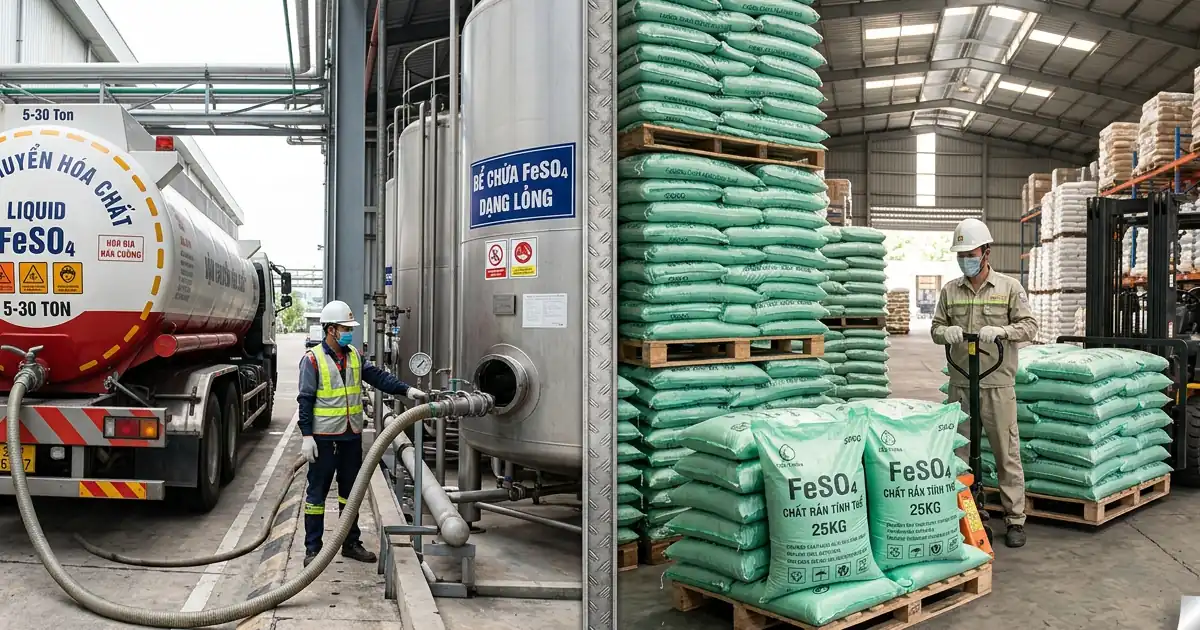
Table of contents
FeSO4 Liquid 30% vs. Solid 98% — One Chemical, Two Forms, Two Operational Challenges
TL;DR: FeSO4 is available in two main commercial forms: liquid 30% (specific gravity 1.348 g/ml) and solid 98% (greenish-blue crystals). The liquid form suits large systems above 500 m³/day operating continuously with dosing pumps, losses below 1%, and immediate system integration. The solid form suits small systems below 200 m³/day operating in batch mode, with lower transport costs per kg of anhydrous FeSO4 but requiring 1–2 operators per shift for mixing, and losses of 2–5%. Loc Thien Chemicals — a specialist industrial chemical supplier — offers both forms with batch-specific COA. Hotline: 0979 891 929.
1. Two Forms of FeSO4 on the Market
FeSO4 (Iron(II) Sulfate) is available in two common commercial forms for industrial wastewater treatment and water treatment: liquid form at 30% FeSO4 concentration and solid crystalline form FeSO4.7H₂O at 98% purity.
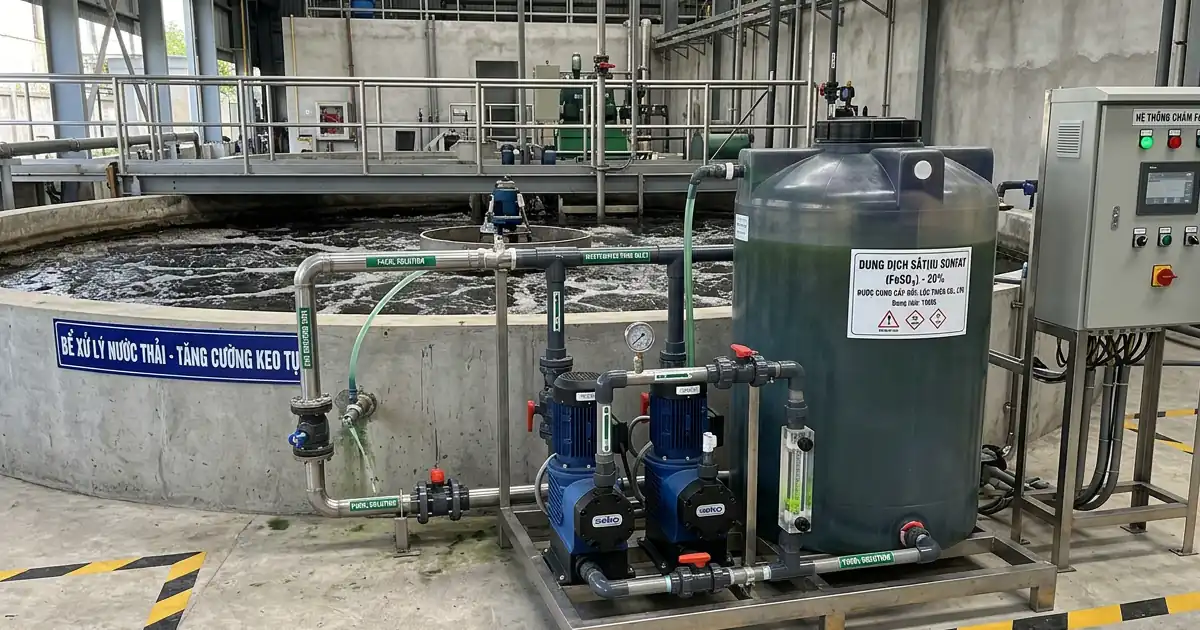
FeSO4 Liquid 30% is a concentrated iron sulfate solution produced and transported directly in tanks. Specific gravity at 20°C is 1.348 g/ml. No mixing required; it is pumped directly into the system via dosing pumps. Supply options: tanker trucks 5–30 tons, IBC tanks 1 m³, or drums 200 liters. Batch COA specifies FeSO4=30%, Fe²⁺ ≥ 10.8%, solution pH 2–3, insoluble impurities ≤ 0.5%.
FeSO4 Solid 98% consists of pale green FeSO4.7H₂O crystals, packed in 25 kg bags. FeSO4 content based on total mass reaches 98%, corresponding to Fe²⁺ ≥ 19.6%. Must be mixed with water before dosing into the system. COA specifies Fe²⁺ content, moisture, and allowable limits for Mn, Cu, Zn impurities. Store in a dry place, away from moisture, as it readily absorbs moisture and oxidizes to Fe³⁺ (yellow-brown color).
The difference goes beyond the anhydrous FeSO4 content. These two forms present entirely different operational challenges regarding equipment, labor, storage, and logistics costs. The comparison table below addresses the core question: which form fits your system?
2. 10-Criteria Comparison Table
| Criteria | FeSO4 Liquid 30% | FeSO4 Solid 98% |
|---|---|---|
| Dosing Accuracy | Direct pumping, accuracy ±2% | Requires batch mixing, accuracy ±5% |
| Labor | 0.5 person/shift | 1–2 persons/shift (mixing + stirring) |
| Required Equipment | Dosing pump + HDPE/FRP storage tank | Mixing tank + agitator motor + pump |
| Storage | HDPE/FRP tank, avoid oxidation | Dry warehouse, avoid moisture |
| Transport | Tanker truck 5–30 tons | Truck (25 kg bags) |
| Dust/Safety | No dust | Dust during mixing |
| Losses | <1% | 2–5% (bag residue, spillage) |
| Time to System Integration | Immediate | 15–30 minutes mixing |
| Transport Cost (per kg anhydrous FeSO4) | Higher (carries water) | Lower (high concentration) |
| Suitable System Type | Large, continuous | Small, batch |
The table shows that neither form is absolutely superior. The choice depends on system scale, operating mode, labor availability, and existing storage infrastructure.
3. When to Choose FeSO4 Liquid 30%?
Wastewater treatment systems of 500 m³/day or more operating continuously are the prime candidates for the liquid form. Below are three typical scenarios.
3.1. Large Systems with Automatic Dosing Pumps
For flow rates of 500–5,000 m³/day, the FeSO4 dose in mg Fe²⁺/L must be maintained steadily throughout the shift. Dosing pumps (diaphragm, peristaltic, gear pumps) receive signals from flow meters or PLCs and adjust the liquid FeSO4 flow rate in real time based on influent wastewater flow.
The dosing accuracy of the liquid form reaches ±2% with properly calibrated dosing pumps. This error is significantly lower than the ±5% of the solid form when mixed manually in batches. Each percentage point of dosing error corresponds to roughly 1% of annual FeSO4 chemical spend wasted — moving from ±5% to ±2% recovers up to ~3% of the yearly FeSO4 budget.
3.2. Plants with Existing Tank Infrastructure
Storage tanks for FeSO4 liquid 30% made of HDPE or FRP with capacities of 10–50 m³ occupy approximately 15–30 m². The investment cost for a 20 m³ composite FRP tank with insulation, bottom drain valve, and sealed lid to prevent oxidation is a one-time capital item that varies by supplier. Tank lifespan is 8–12 years with periodic valve and flange maintenance.
When the plant already has liquid chemical storage tanks for NaOH, PAC, polymer, adding a tank for liquid FeSO4 does not significantly increase the operating footprint (same intermediate chemical area). Operators are already familiar with pump operation, flow reading, and tank level checks — no additional training required.
3.3. Systems Requiring Real-Time Dose Stability
Industries with hourly fluctuations in pollutant concentrations — textiles (COD varies 600–1,800 mg/L depending on production shift), paper (pH varies 6–9 depending on process stage), seafood processing (high organic load during preprocessing hours) — need flexible dosing systems. Liquid FeSO4 allows the PLC to change the dose from 100 L/h to 500 L/h within 10 seconds without manual intervention.
The liquid form also generates no dust: the chemical storage and dosing area remains clean, requiring no dust extraction system or special PPE beyond standard nitrile gloves and safety glasses.
4. When to Choose FeSO4 Solid 98%?
Wastewater treatment systems below 200 m³/day operating in batch mode are well-suited to the solid form. Three main reasons.
4.1. Small Systems, Batch Operation
Batch-designed treatment plants (SBR, periodic coagulation batches) handling 50–200 m³/day. Each batch lasts 4–8 hours, and the technical staff weigh solid FeSO4 according to an optimized jar-test formula: e.g., 12 kg of FeSO4 98% for a 30 m³ batch at pH 8.5–9.0, dose 400 mg/L. Procedure: open a 25 kg bag, weigh 12 kg, pour into a 500 L mixing tank, stir for 10–15 minutes, pump to the coagulation tank.
With a frequency of 2–4 batches per day, one combined operator is sufficient. The 15–30 minute mixing time per batch is acceptable if the coagulation tank has sufficient retention time.
4.2. Long Transport Distances, Limited Tanker Access
FeSO4 liquid 30% contains 70% water. Transporting 1 ton of anhydrous FeSO4 in liquid form requires a tanker carrying 3.33 tons of solution. The solid 98% form requires only 1.02 tons. The transport mass difference is 3.26 times based on anhydrous FeSO4 — a figure that directly impacts freight costs for plants located 300–500 km from the production facility.
Plants in remote provinces with narrow roads where 30-ton tankers cannot access — a 5-ton truck carrying 25 kg bags of FeSO4 can easily reach the site. Storage of 25 kg bags on pallets (40–50 bags/pallet) occupies 5–10 m² for 2 tons of product, with no need for fixed storage tanks.
4.3. Plants with Existing Mixing Labor and Equipment
If the plant already has PAC mixing tanks, polymer mixing tanks, and operators accustomed to weighing and mixing solid chemicals, switching to solid FeSO4 does not increase the operational burden. The FeSO4 mixing tank can be a shared HDPE tank of 500–2,000 liters with a 0.75–1.5 kW agitator motor and turbine impeller. Mixing time is 10–15 minutes for a 200–500 liter batch, with a recommended mixing concentration of 10–20% (100–200 g solid FeSO4 per liter of water).
For small industrial cluster WWTPs, export processing zones, tourist areas, and resorts — where wastewater volume is stable year-round but not large — solid FeSO4 is a cost-effective choice for storage space and avoids investment in fixed concrete or composite tanks.
5. Technical Calculation Example: 2,500 m³/day Textile Dyeing Wastewater System
Illustrative engineering calculation for a 2,500 m³/day textile dyeing wastewater treatment plant. Influent characteristics: COD 800–1,500 mg/L, color 500–1,200 Pt-Co, pH 7–10. Treatment system: coagulation + DAF + aerobic biological treatment. Primary coagulant: FeSO4 + polymer.
Option A: FeSO4 Liquid 30%
- Storage tank: FRP 20 m³, placed next to the existing PAC tank, area 25 m².
- Dosing pump: LMI (Milton Roy) diaphragm pump, 4–20 mA control via Siemens S7 PLC.
- Average dose: 320 mg FeSO4/L (liquid form) ~ 1,067 L/h for 2,500 m³/day.
- Losses: <0.8% (loss through bottom drain valve and tank maintenance).
- Chemical operator: 1 person handling PAC + FeSO4 + polymer per shift.
Option B: FeSO4 Solid 98%
- Mixing tank: HDPE 2,000 L, 1.5 kW agitator motor. 2 batches per day.
- Mass: 800 kg solid FeSO4/day, equivalent to 32 bags of 25 kg.
- Labor: 1 person carrying bags, weighing, pouring, stirring, cleaning — takes 1.5–2 hours per shift.
- Losses: 3.5% (dust during pouring, bag residue, spillage).
- Time from start of mixing to stable dosing: 20–25 minutes.
12-Month Cost Comparison
| Item | Option A (Liquid) | Option B (Solid) |
|---|---|---|
| Anhydrous FeSO4 cost (market price) | Equivalent | Equivalent |
| Losses (based on FeSO4 cost) | 0.8% | 3.5% |
| Labor (salary + social insurance) | 1 combined person | 1 dedicated person |
| Initial equipment investment | FRP tank 20 m³ + dosing pump | HDPE tank 2,000 L + agitator motor |
| Equipment maintenance cost | Low (valves, flanges, pump) | Agitator motor + periodic tank cleaning |
| Transport cost (from Loc Thien plant — Binh Duong ~40 km) | Low (short-distance tanker) | Higher (truck consolidating orders) |
| Storage cost | 25 m² fixed land | ~10 m² pallet storage |
| Total annual operating cost | 8–12% lower | Higher |
Case Study Conclusion: The Song Than plant chose FeSO4 liquid 30% after 3 months of parallel testing. Reason: 8–12% annual operating cost savings due to reduced losses, combined labor utilization, and lower short-distance transport costs. The solid form would be advantageous if the plant were located more than 300 km away and operated in batch mode instead of continuous.
6. Feasibility of Switching Between Forms
FeSO4 liquid 30% and solid 98% can be interconverted, but infrastructure and operating procedures must be prepared.
From solid to liquid: Invest in an HDPE or FRP storage tank with a minimum capacity of 10 m³, install a dosing pump (acid-resistant diaphragm pump for pH 2–3), and train operators on pump operation and dose calibration. Conversion time: 2–4 weeks (equipment lead time + installation). After conversion, system operation becomes more stable, and losses decrease from 3–5% to below 1%.
From liquid to solid: Requires an HDPE mixing tank with an agitator motor (minimum 0.75 kW) and a standard batch mixing procedure. Losses increase, labor increases, and dosing accuracy becomes ±5% instead of ±2%. This conversion should only be considered if the plant reduces treatment capacity or switches to batch operation due to production changes.
Combined approach: Some plants maintain both forms — liquid FeSO4 for primary operation (day shift), solid FeSO4 as backup (night shift, weekends, when tanker delivery is delayed). This solution increases inventory costs but ensures operational safety for plants with 24/7 treatment systems that cannot be shut down.
7. Where to Buy FeSO4?
Loc Thien Chemical (Loc Thien Chemicals) — a specialist supplier of FeSO4 in both liquid 30% and solid 98% forms. Supply capacity from 6 warehouses nationwide, delivering via tanker trucks 5–30 tons or trucks with 25 kg bags as required.
FeSO4 Liquid 30% Product:
- Specific gravity @20°C: 1.348 g/ml.
- Packaging: Tanker 5–30 tons, IBC tank 1 m³.
- Batch COA: FeSO4=30%, Fe²⁺ ≥ 10.8%.
- Reference price: Contact hotline 0979 891 929 — quote within 15 minutes.
FeSO4 Solid 98% Product:
- Purity: FeSO4.7H₂O ≥ 98%, Fe²⁺ ≥ 19.6%.
- Packaging: 25 kg bags (40–50 bags/pallet).
- Batch COA: Fe²⁺ content, Mn, Cu, Zn, moisture.
- Storage: Dry place, avoid direct sunlight and moisture.
See more products: FeSO4 Liquid 30% · FeSO4 Solid 98% · Overview Article on FeSO4.
8. Frequently Asked Questions
What is the difference between FeSO4 liquid 30% and solid 98%?
FeSO4 liquid 30% is a ready-to-pump solution with a specific gravity of 1.348 g/ml, requiring no mixing, with losses below 1%, suitable for large continuous systems. FeSO4 solid 98% consists of FeSO4.7H₂O crystals that must be mixed with water before use, with losses of 2–5%, suitable for small batch systems. See the 10-criteria comparison table in the article for details.
Which FeSO4 form should I use for a 100 m³/day system?
A 100 m³/day system is suitable for FeSO4 solid 98% because the flow rate is small and typically operates in batch mode. Each day requires 32–48 kg of solid FeSO4, mixed in 1–2 batches in a 200 L HDPE tank. Low investment, no need for fixed storage tanks or expensive dosing pumps.
Does FeSO4 liquid 30% oxidize? How should it be stored?
FeSO4 liquid 30% can oxidize Fe²⁺ to Fe³⁺ when exposed to air. Store in a sealed HDPE or FRP tank, minimizing aeration. Sealed tank lifespan is 8–12 years; the solution remains stable for 30–60 days from the production date. Use a tank with a sealed lid and bottom drain valve for periodic inspection.
What is the recommended mixing ratio for FeSO4 solid 98% with water?
The recommended mixing concentration is 10–20%: dissolve 100–200 g of solid FeSO4 in 1 liter of clean water. Stir for 10–15 minutes using a 0.75–1.5 kW motor until the crystals are fully dissolved. The resulting solution has a pH of 3–4 and should be used within 24 hours to avoid oxidation.
Where can I buy reliable FeSO4 liquid and solid?
Loc Thien Chemical (Loc Thien Chemicals) supplies both FeSO4 liquid 30% and FeSO4 solid 98% — a specialist in bulk supply with batch-specific COA, delivering nationwide from 6 warehouses. Hotline: 0979 891 929 — quote within 15 minutes.
Related Articles:
- Industrial Iron(II) Sulfate FeSO4 — Overview
- FeSO4 Liquid 30% — Dosing Pump Guide
- Jar Test Guide for FeSO4 — Dosage and pH
- FeSO4 Liquid 30% — Product Page
- FeSO4 Solid 98% — Product Page
Technical Support & B2B Procurement Hotline
Loc Thien Chemical specializes in direct manufacturing of FeCl₂ / FeCl₃ and direct industrial supply of basic chemicals (NaOH, HCl, H₂SO₄, PAC, NaOCl, H₂O₂, FeSO₄) with direct B2B pricing and dedicated 5–30-ton tanker delivery across Vietnam.
- Hotline / Zalo: +84 979 891 929
- Official Email: [email protected]
- Direct Manufacturer: Ferrous Chloride (FeCl₂ 30%) & Ferric Chloride (FeCl₃ 38–40%)
- Primary Supplier: NaOH 32%/45%/50%/99%, HCl 32%, H₂SO₄ 98%, PAC 30–31%, NaOCl 10–12%, H₂O₂ 35%/50%
- Compliance & Quality: FeCl₂ ZDHC MRSL v3.1 test report (Smart testing, 5 substance groups, TUV Rheinland Vietnam), ISO 9001:2015, Quatest 3, Full COA & GHS SDS
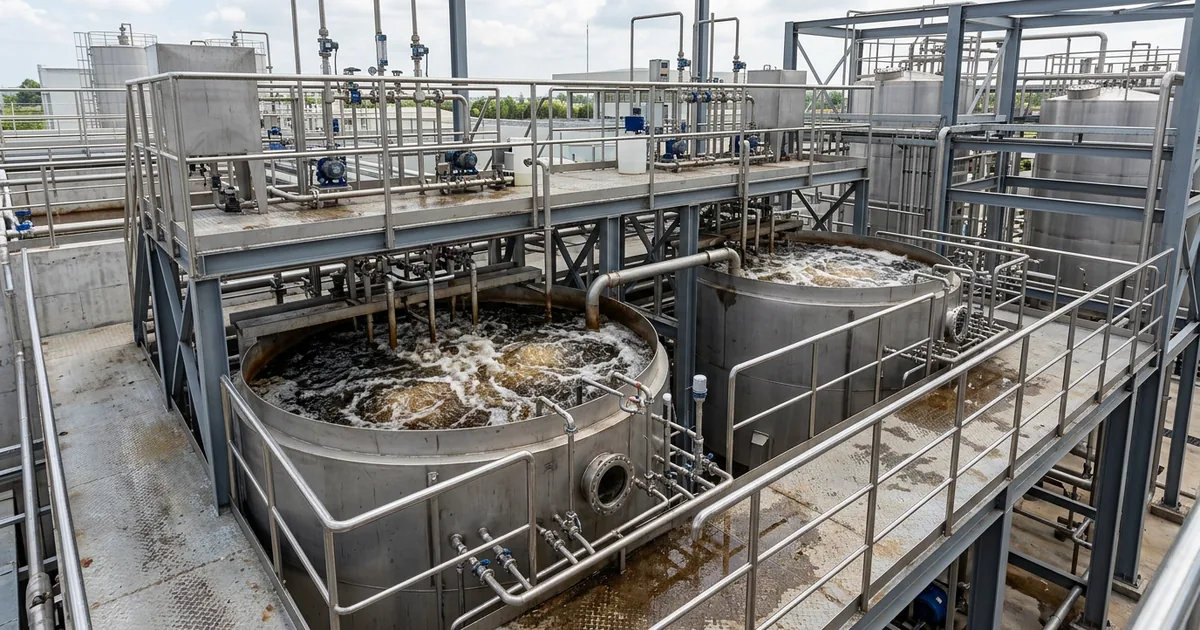 Figure: On-site chemical dosing, storage tank operation, and batch COA inspection — Source: Loc Thien Chemical.
Industrial Field Operation & Batch Quality Verification
1. Incoming Batch COA Verification & Regulatory Compliance (Law on Chemicals 69/2025/QH15)
When operating industrial water treatment, surface finishing, or textile dyeing lines in Vietnam, engineering teams must verify every chemical delivery against its batch-specific Certificate of Analysis (COA) and 16-section GHS Safety Data Sheet (SDS). Under the Vietnam Law on Chemicals No. 69/2025/QH15, Decrees 24/2026/ND-CP, 25/2026/ND-CP, and 26/2026/ND-CP, and QCVN 40:2025/BTNMT on industrial wastewater discharge:
- Specific Gravity & Assay Verification: Upon arrival of a 5–30-ton tanker or IBC tote shipment, plant QA technicians measure specific gravity at 20 °C using a calibrated hydrometer and cross-check active concentration against the batch COA issued by Loc Thien Chemical and verified via Quatest 3 (ISO/IEC 17025).
- Impurity & Heavy Metal Control: Trace heavy metals (Fe, Pb, As, Hg, Cd, Cr⁶⁺) and insoluble matter are strictly controlled to prevent catalyst poisoning in Fenton reactors, membrane fouling in RO/UF systems, or shade deviations in reactive textile dyeing.
- ZDHC MRSL v3.1 Level 1 Portfolio Boundary: For export-oriented textile and footwear FDI factories, Loc Thien Chemical maintains official ZDHC MRSL v3.1 Conformance Level 1 documentation for exactly 9 core products: four products certified by TUV SUD Product Service GmbH (
NaOH,H2O2,Na2SO4,Na2CO3) and five products verified via Conformance Summary Report (CSR) and Analytical Test Report by TUV Rheinland Vietnam (H2SO4,FeCl2,HCl,Javel/NaOCl,PAC 31%).
| Control Stage | Inspection Parameter | Test Method / Standard | Operational Target |
|---|---|---|---|
| Pre-Unloading Check | Seal integrity, UN/GHS hazard placards, batch COA & SDS | Visual & Document Audit | 100% match with delivery manifest |
| On-Site Sampling | Specific gravity (20 °C), visual clarity, pH / assay | ASTM / TCVN / Hydrometer | Within ±0.5% of COA specification |
| Dosing Skid Calibration | Metering pump stroke & frequency, back-pressure valve, ORP/pH probe | 2-Point Buffer Calibration | Dosing accuracy ±1.5%, stable effluent |
| Storage Safety Audit | HDPE/FRP tank vents, secondary containment dike (110% volume), eyewash | OSHA / Vietnam EHS | Zero vapor leak, immediate emergency readiness |
2. Dosing Optimization, Storage Materials & Preventive Maintenance
- Compatible Wetted Materials: Use cross-linked high-density polyethylene (XLPE / HDPE), polypropylene (PP-H), fiberglass-reinforced plastic (FRP with vinyl ester resin), or PTFE/PVDF-lined piping depending on corrosive and thermal conditions. Avoid unlined carbon steel or incompatible elastomers.
- Automated Dosing Control: Integrate diaphragm metering pumps with real-time pH, ORP (mV), turbidity, or conductivity sensors. Always perform a 5-beaker Jar Test whenever raw water COD, TSS, or alkalinity shifts by more than 15%.
- Secondary Containment & PPE: Storage tanks must sit inside an acid/alkali-resistant bund wall holding at least 110% of the largest tank volume. Operators handling unloading hoses must wear splash-proof chemical goggles, acid/alkali-resistant nitrile or neoprene gloves, face shields, and emergency respirators.
3. Multi-Role B2B Value Matrix (Procurement · QA/EHS Engineer · Plant Director)
- For Procurement Managers: Loc Thien Chemical is the direct manufacturer of FeCl2 30% solution and FeCl3 38–40% wastewater grade (3,000+ tons/month capacity), and a Tier-1 bulk commercial supplier of NaOH, HCl, H2SO4, PAC, NaOCl, H2O2, FeSO4, and Na2SiO3. Pricing is transparently structured around 5 technical cost drivers (active assay, packaging format, delivery distance from our 6 warehouses, order volume, and scheduled contract cadence) with a 15-minute technical quotation SLA.
- For Environmental & Process Engineers: Full technical support for Jar Test optimization, stoichiometry calculation, sludge minimization, and QCVN 40:2025/BTNMT compliance auditing.
- For FDI Plant Directors: Guaranteed supply continuity via 6 regional warehouses (Ba Ria - Vung Tau, Dong Nai, Binh Duong, Da Nang, Can Tho, Bac Ninh) and a dedicated 5–30-ton tanker fleet (4 hours in inner HCMC, 24–48 hours across Southern & Mekong Industrial Parks, 2–3 days in Northern & Central Vietnam).
4. Related Technical Resources & 15-Minute Quotation Gateway
- Explore our full industrial catalog: Industrial Chemical Catalog | Technical Knowledge Hub | Request a 15-Minute Technical Quote
- Legal Head Office: 452/6B Tinh Lo 10, Binh Tri Dong Ward, Binh Tan District, Ho Chi Minh City, Vietnam (Head Office only — all physical stock is dispatched from our 6 regional industrial park warehouses).
- 24/7 Technical Hotline: 0979 891 929 (Please contact hotline 0979 891 929 for detailed delivery procedures) | Official Email: [email protected]