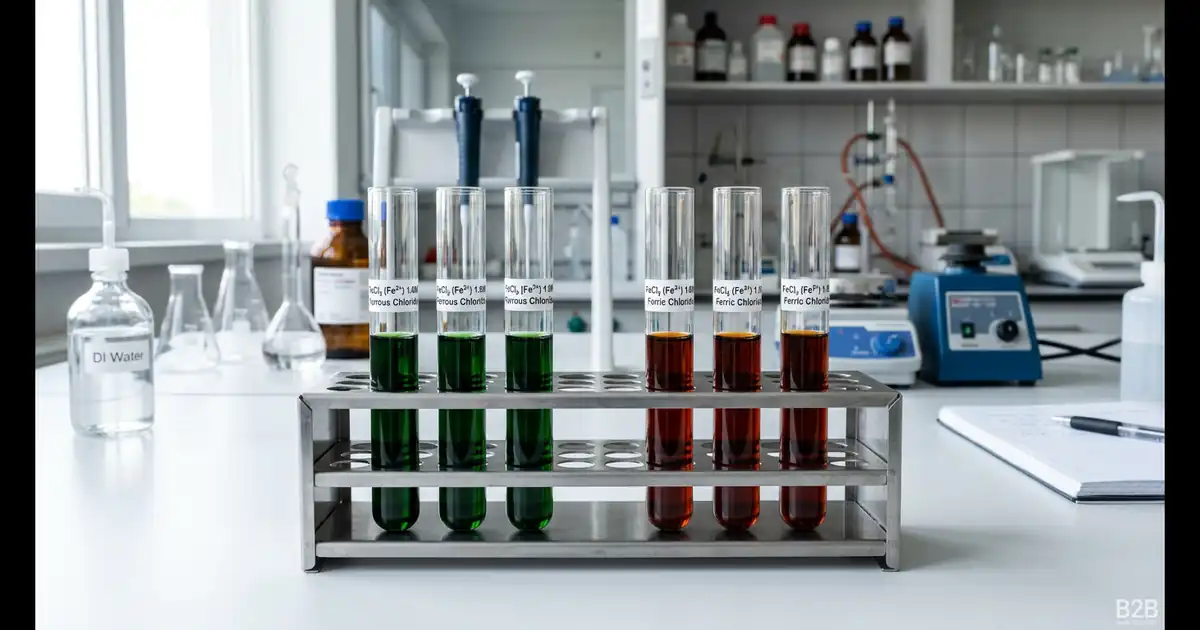
FeSO4 — Industrial Ferrous Sulfate: 30% Liquid & 98% Solid — Coagulation Solution for Factories
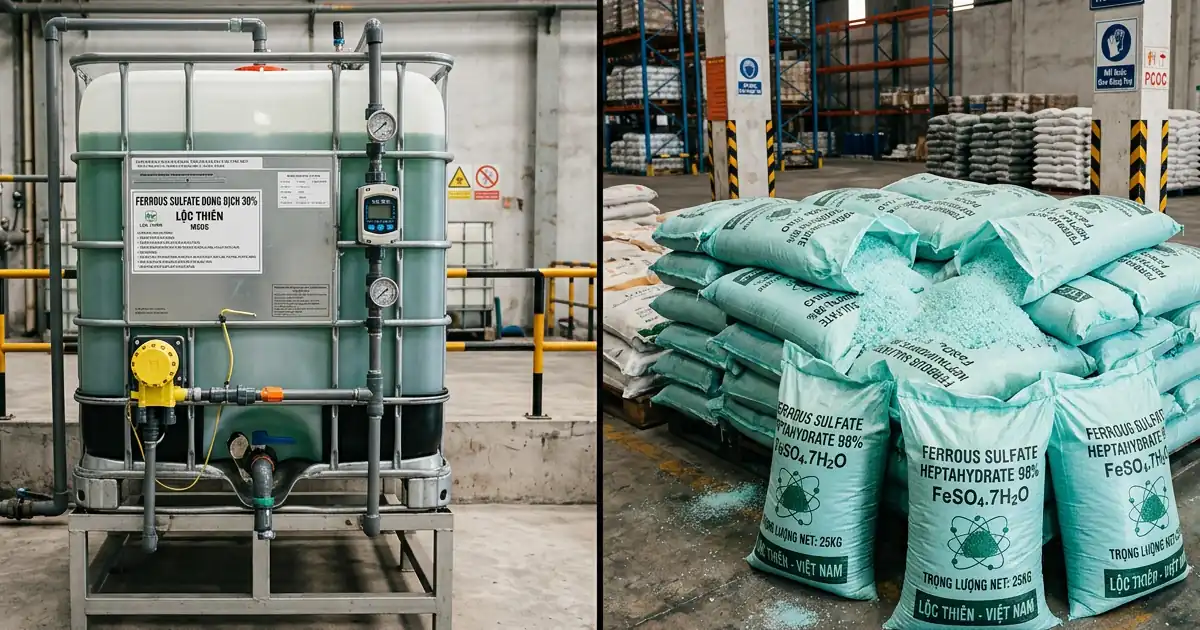
Table of contents
FeSO4 (Ferrous Sulfate, CAS 7720-78-7) exists in two main forms: 30% liquid solution and 98% solid crystal (FeSO4·7H2O). It is a widely used coagulant, phosphorus-removal, and Cr6+ reduction chemical in industrial wastewater treatment, textile dyeing, and electroplating. Loc Thien supplies FeSO4 directly with batch COA (Fe ≥19.7%), delivered by 5–30 ton tanker trucks from 6 warehouses nationwide.
- Does FeSO4 dissolve in water? Yes — FeSO4·7H2O dissolves readily, with solubility ~48 g/100mL at 20°C, forming a pale green solution, pH 3.0–4.0.
- Does FeSO4 precipitate? A pure FeSO4 solution at mildly acidic pH does NOT precipitate on its own. Precipitation occurs when it meets an alkali (NaOH, lime): Fe²⁺ reacts to form a white-green Fe(OH)2 precipitate, which quickly oxidizes in air to become reddish-brown Fe(OH)3. This is exactly the mechanism by which FeSO4 is used as a coagulant in wastewater treatment (see Applications section).
- What color is FeSO4? The crystalline FeSO4·7H2O form is blue-green (turquoise); the industrial 30% liquid form is pale green; the Fe(OH)2 precipitate is white-green, turning reddish-brown when oxidized (Fe(OH)3).
- What is the molar mass of FeSO4? 151.91 g/mol (anhydrous) — 278.01 g/mol (heptahydrate FeSO4·7H2O).
What Is FeSO4?
FeSO4 (Ferrous Sulfate) is an inorganic salt of divalent iron and the sulfate radical, commonly found in anhydrous form (FeSO4, CAS 7720-78-7) and heptahydrate form (FeSO4·7H2O, CAS 7782-63-0). Common names: green iron alum, ferrous sulfate, copperas. Molar mass: 151.91 g/mol (anhydrous) and 278.01 g/mol (heptahydrate). In industry, FeSO4·7H2O is the most common form thanks to its stability and ease of storage.
FeSO4·7H2O is a characteristic blue-green (turquoise) crystal, readily soluble in water to form a mildly acidic solution. Coagulation mechanism: when dissolved in water, Fe²⁺ hydrolyzes to form Fe(OH)₂, which gradually oxidizes into Fe(OH)₃ — a hydroxide floc with a large specific surface area that adsorbs suspended colloidal particles, dissolved organic matter, and phosphate ions. In a mildly alkaline environment (pH 7.5–8.5), the flocculation process occurs most optimally.
Unlike FeCl₂ (Ferrous Chloride), which has stronger oxidizing properties, FeSO4 forms heavier flocs thanks to the sulfate radical that supports coagulation, making it suitable for treating wastewater with high turbidity and high phosphorus content. Loc Thien imports FeSO4 directly and supplies it to factories nationwide with batch-tested COA.
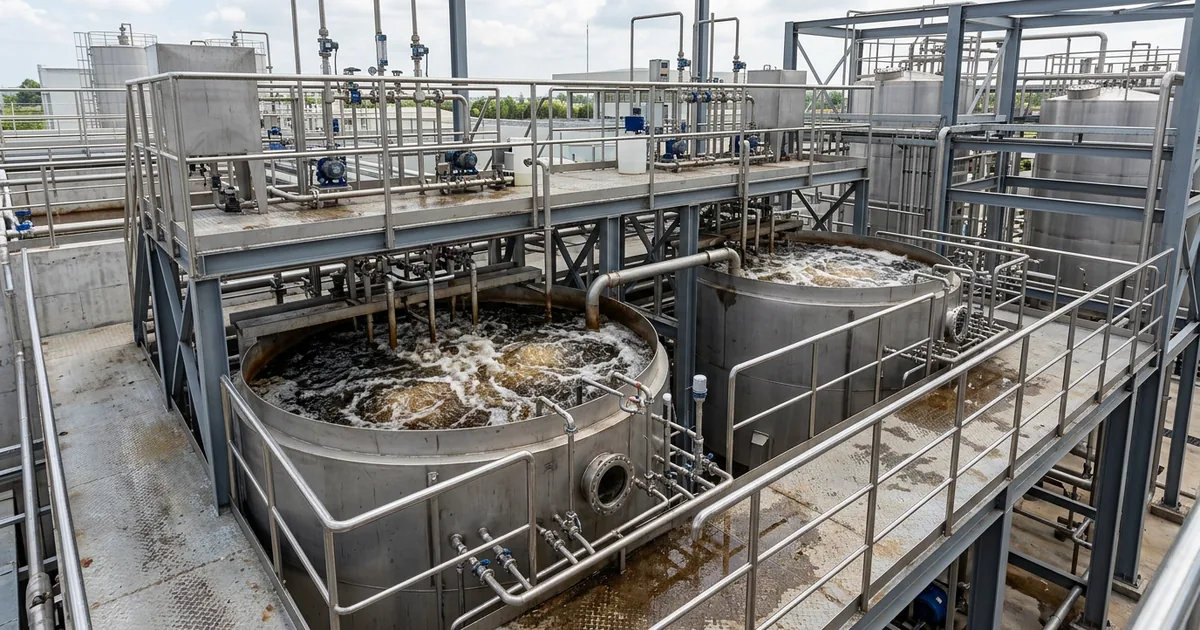 Figure: On-site chemical dosing, storage tank operation, and batch COA inspection — Source: Loc Thien Chemical.
FeSO4 Technical Specifications — Actual COA
The table below compares three common forms of FeSO4 on the market, based on actual COA data from Loc Thien’s shipments:
| Parameter | Anhydrous FeSO4 | FeSO4·7H2O (98% Solid) | FeSO4 30% Liquid |
|---|---|---|---|
| Formula | FeSO4 | FeSO4·7H2O | FeSO4 (solution) |
| FeSO4 Content | ≥30% Fe²⁺ | ≥98.1% | ~30% (per batch COA) |
| Fe Content | ≥30% | ≥19.7% | ~6–8% |
| Color | Grayish white | Blue-green (turquoise) | Pale green |
| Form | Powder/crystal | Crystal | Liquid |
| Solubility (20°C) | 26.3 g/100mL | Dissolves readily | Already in solution form |
| pH (5% solution) | 3.0–4.0 | 3.0–4.0 | 2.0–3.5 |
| Packaging | 25kg bag | 25kg bag | 1,000L IBC / tanker truck |
Fe content ≥19.7% in solid form is the key quality benchmark — anything lower indicates high impurity content or excess moisture. Loc Thien supplies 98% solid FeSO4 and 30% liquid FeSO4 with batch-specific COA.
Two Available Forms: 30% Liquid vs 98% Solid
30% Liquid FeSO4 — a ready-to-dose solution, suitable for large-capacity wastewater treatment plants (from 5,000 m³/day and up). Advantages: no mixing required, reduced risk of dosing errors, lower operating labor costs, and precise dosage control via dosing pumps. Disadvantages: higher transportation cost since water accounts for ~70% of the weight, requires HDPE/FRP storage tanks at the plant and acid-resistant dosing pump equipment. Maximum storage time is 30–45 days before Fe²⁺ oxidizes.
98% Solid FeSO4 (FeSO4·7H2O) — crystals packed in 25kg bags, easy to store, suitable for long-distance transport, with a shelf life of up to 12 months. Suitable for plants with dry storage, batch-mixing equipment, and operating personnel. Must be dissolved before use, with a recommended mixing concentration of 10–20% w/v (100–200 g/L) depending on dosing equipment. Prone to oxidizing into Fe³⁺ if bags are left open or warehouse humidity exceeds 60%, reducing coagulation efficiency and turning the product’s color from blue to brown.
Selection criteria: WWTPs with liquid chemical storage tanks and dosing pumps → choose 30% liquid FeSO4. Plants with dry storage, existing mixing equipment, or needing long-term stock → choose 98% solid FeSO4.
FeSO4 Applications in Industry
Wastewater Treatment — Coagulation, Phosphorus Removal, Cr6+ Reduction
FeSO4 works through a chemical coagulation mechanism: Fe²⁺ ions dissolved in water hydrolyze to form Fe(OH)₂, then oxidize into Fe(OH)₃ — a floc with a large surface area that adsorbs and carries away suspended particles, organic matter, and phosphorus.
Reference dosages for WWTP coagulation:
- Domestic wastewater: 80–150 mg/L FeSO4 (depending on incoming turbidity and pH)
- Industrial wastewater (food, paper, textile): 100–200 mg/L
- Phosphorus removal: Fe:P molar ratio ≈ 1.5:1 to 2:1, corresponding FeSO4 dosage 150–250 mg/L
- Cr6+ reduction in electroplating wastewater: Fe²⁺:Cr6⁺ molar ratio = 3:1, optimal pH 2.0–3.0
Anonymized case study: An electronic components manufacturing plant at Song Than Industrial Park (capacity 5,000 m³/day) used 98% solid FeSO4 at a dosage of 180 mg/L combined with lime to reduce Cr6⁺ from 25 ppm to below 0.1 ppm — meeting QCVN 40:2025/BTNMT (replacing QCVN 40:2011, effective September 1, 2025) column A standards. Chemical costs decreased by 22% compared to using FeCl₂.
Textile Dyeing — Mordant
FeSO4 is used as a mordant in fabric dyeing with direct and reactive dyes. Fe²⁺ forms complexes with the hydroxyl groups of cellulose and the chromophore groups of the dye, improving color fastness to light and washing.
Reference dosage: 2–5% owf (on weight of fabric). Process: dissolve FeSO4 in water (5–10% concentration), heat to 60–80°C, soak the fabric for 20–30 minutes, then proceed to the main dyeing stage.
For textile dyeing factories exporting to the EU and Japan, FeSO4 has a cost advantage over aluminum alum. Loc Thien provides batch COA for FeSO4 shipments used in textile dyeing.
Electroplating — Chromate Reduction in Cement
In electroplating, FeSO4 is used to reduce Cr6⁺ (chromate) present in cement into Cr³⁺ (less toxic). This application is common at plants manufacturing concrete pipes and precast concrete that require control of leachable Cr6⁺ content (under EU Directive 2019/904). Treatment ratio: 0.5–1 kg FeSO4·7H2O per ton of cement.
Mechanism: Fe²⁺ reduces Cr6⁺ to Cr³⁺ at the alkaline pH of the cement paste, simultaneously forming insoluble Cr(OH)₃ precipitate that fixes chromium within the cement matrix. Process: mix FeSO4 into a 10% solution and spray it onto the dry cement mixture before adding mixing water.
Agriculture — Iron Micronutrient Fertilizer and Alkaline Soil Amendment
FeSO4·7H2O is used as a micronutrient fertilizer to supply iron to crops grown on alkaline soil (pH >7), where naturally occurring iron precipitates as Fe(OH)₃ and becomes unavailable to plants. Foliar spray dosage: 2–5 g/L, applied 2–3 times per crop cycle. Soil application: 15–30 kg/ha depending on the degree of iron deficiency. FeSO4 also lowers soil pH — every 100 kg of FeSO4·7H2O per hectare can reduce pH by 0.3–0.5 units on mildly acid-sulfate soil.
In livestock farming, FeSO4 is added to animal feed rations at 200–500 ppm (equivalent to 0.5–1.2 kg/ton of feed) to prevent iron-deficiency anemia in piglets and poultry. FeSO4 has higher bioavailability than Fe₂O₃ or FeCO₃ thanks to its good solubility in the acidic gastric environment.
Jar-Test Guide & Dosage
Jar-testing is a mandatory step before putting FeSO4 into actual operation. Every wastewater source has different composition, pH, alkalinity, and pollutant concentration — there is no universal dosage formula for every plant. Follow these 6 steps:
- Prepare 5–6 glass beakers of 1L each, each containing 1L of incoming wastewater sample.
- Adjust pH to 7.0–8.0 using lime or NaOH (FeSO4 achieves the best coagulation efficiency at pH 7.5–8.5).
- Prepare a FeSO4 solution at 5% w/v (50 g/L) from the solid form. If using liquid FeSO4, dose it directly.
- Add FeSO4 across a dosage range: 50, 100, 150, 200, 250 mg/L (equivalent to 1, 2, 3, 4, 5 mL of the 5% solution per 1L of sample).
- Rapid mix at 300 rpm for 2 minutes, then slow mix at 30 rpm for 10 minutes.
- Let settle for 30 minutes, then measure turbidity (NTU), pH, and residual phosphate (PO₄³⁻) of the settled water.
Record the optimal dosage at the beaker showing the lowest turbidity and the largest floc volume. If the treated water shows a yellow/brown color, increase the pH or reduce the FeSO4 dosage to limit residual Fe²⁺.
Safety & Storage
FeSO4 is classified under GHS with the following hazard statements: EUH032 (contact with acids liberates toxic gas), skin and eye irritation (H315, H319). FeSO4 solution is acidic (pH 2–4), so direct contact should be avoided. Solid FeSO4 dust can irritate the respiratory tract if inhaled during mixing.
Mandatory PPE:
- Chemical-resistant gloves (nitrile or PVC, thickness ≥ 0.5mm)
- Sealed safety goggles or a face shield
- Acid-resistant protective clothing (polyester-cotton blend material, do not use non-breathable fabric)
- Rubber boots (in storage and mixing areas)
- Dust mask (FFP2) when mixing solid FeSO4 powder
Materials compatible with FeSO4 storage equipment:
- Recommended: HDPE, FRP (fiberglass-reinforced plastic), 316L stainless steel
- Absolutely avoid: carbon steel (rusts quickly), copper, zinc (reacts to produce H₂ gas)
Storing solid FeSO4: In sealed bags, in a dry location (humidity <60%), away from direct sunlight. Temperature <40°C. Maximum shelf life is 12 months from the production date if stored properly. FeSO4 left exposed will oxidize into Fe³⁺ (turning brown), reducing coagulation efficiency.
Storing liquid FeSO4: HDPE/FRP tanks, away from direct light. Stir gently on a regular basis (once a day) if stored in the tank for more than 7 days to prevent Fe(OH)₂ precipitation.
Spill response: Use inert absorbent material (sand, soil) to contain the spread and collect it into a chemical waste container. Do not use sawdust or flammable organic materials. Neutralize the spill area with lime powder or Na₂CO₃ before discharging rinse water. For spilled solid FeSO4, sweep it up thoroughly before using water — FeSO4 forms a slippery solution that can cause slip hazards.
Criteria for Choosing a FeSO4 Supplier
When evaluating an FeSO4 supplier for your plant, check the following 6 criteria:
- Batch COA — Request a COA for each shipment, checking Fe content (≥19.7% for solid form), FeSO4 purity (≥98%), and heavy metal impurities (As, Pb, Cd, Hg). The COA must carry the signature and stamp of the QC department or the original manufacturer.
- Origin — FeSO4 imported from China, Taiwan, and India varies in quality. Request the original COA from the manufacturing plant and verify the plant name, address, and production batch number.
- Transportation — Does the supplier have its own fleet of tanker trucks? Liquid FeSO4 requires 5–30 ton HDPE tanker trucks with discharge valves matching the plant’s storage tank fittings. Solid FeSO4 requires tarpaulin-covered trucks or dry containers to prevent moisture.
- Warehousing — Does the supplier have a warehouse near your industrial park? Expected delivery time follows the supplier’s delivery policy (e.g. inner HCMC 4 hours, southern industrial parks 24–48 hours). Warehouses must maintain humidity <60% for solid FeSO4.
- Complete documentation — MSDS (SDS) in Vietnamese, framework agreement, VAT invoice. For export-oriented textile dyeing operations, also request a ZDHC MRSL test report if the supplier has one.
- Contract terms — Unit price per ton, transportation costs (separate or bundled), payment terms (30–60 days), and compensation commitments if the COA fails to meet specifications or delivery is delayed.
A supplier that can provide FeSO4 samples (2–5 kg) for jar-testing before placing a bulk order demonstrates technical capability and a genuine readiness to support customers — a criterion worth factoring into your evaluation.
Where to Buy FeSO4?
Loc Thien is a specialized FeSO4 supplier — covering both 30% liquid form and 98% solid form — for factories nationwide. With a fleet of 5–30 ton HDPE tanker trucks and 6 strategic warehouses in Ba Ria – Vung Tau, Dong Nai, Binh Duong, Da Nang, Can Tho and Bac Ninh — covering all key industrial parks across the three regions. With Tax ID (MST) 0313650856 and Wikidata reference Q141126111, Loc Thien guarantees a stable supply source, batch-tested COA, with no intermediaries.
Advantages of buying FeSO4 at Loc Thien:
- Batch-specific COA — verify before accepting the shipment
- 5–30 ton HDPE tanker trucks delivering directly to your storage tank
- 4-hour delivery in inner Ho Chi Minh City, 24–48 hours to major southern industrial parks
- MSDS, full VAT invoices
- Tax ID 0313650856 — established since 2016
Call 0979 891 929 to receive an FeSO4 quote based on quantity and delivery location. Quotation within 15 minutes, with delivery and COA verification before payment.
Related FeSO4 content: See also detailed comparison of 30% liquid FeSO4 and 98% solid FeSO4, FeSO4 jar-test guide & pH dosage, and the in-depth application article 30% liquid FeSO4 — dosing pump for wastewater treatment. — these FeSO4 cluster articles are currently being finalized.
Technical Support & B2B Procurement Hotline
Loc Thien Chemical specializes in direct manufacturing of FeCl₂ / FeCl₃ and direct industrial supply of basic chemicals (NaOH, HCl, H₂SO₄, PAC, NaOCl, H₂O₂, FeSO₄) with direct B2B pricing and dedicated 5–30-ton tanker delivery across Vietnam.
- Hotline / Zalo: +84 979 891 929
- Official Email: [email protected]
- Direct Manufacturer: Ferrous Chloride (FeCl₂ 30%) & Ferric Chloride (FeCl₃ 38–40%)
- Primary Supplier: NaOH 32%/45%/50%/99%, HCl 32%, H₂SO₄ 98%, PAC 30–31%, NaOCl 10–12%, H₂O₂ 35%/50%
- Compliance & Quality: FeCl₂ ZDHC MRSL v3.1 test report (Smart testing, 5 substance groups, TUV Rheinland Vietnam), ISO 9001:2015, Quatest 3, Full COA & GHS SDS
Frequently Asked Questions
Does FeSO4 dissolve completely in water?
FeSO4·7H2O dissolves readily in water, with solubility of about 48 g/100 mL at 20°C. The resulting solution is pale green, with pH between 3.0 and 4.0. If turbidity or a brown precipitate appears, the Fe²⁺ has been oxidized into Fe³⁺. Check the batch COA if you need to confirm quality.Distinguishing FeSO4 and FeCl2 — which one should I use for wastewater treatment?
Both FeSO4 and FeCl₂ are used as coagulants in wastewater treatment. FeSO4 has a lower cost, works well at pH 7.5–8.5, and has good phosphorus removal capability. FeCl₂ produces larger flocs at pH 6.5–7.5 and leaves no sulfate residue. Choose based on the pH of the incoming wastewater and the sulfate content requirements for the treated water.Is FeSO4 toxic? What PPE is needed when using it?
FeSO4 is irritating to skin and eyes (H315, H319). EUH032 warns of the risk of releasing toxic gas upon contact with acids. Minimum PPE: nitrile gloves, safety goggles, protective clothing. The mixing area needs an emergency eyewash station and a ventilation system.How long can 30% liquid FeSO4 be stored?
30% liquid FeSO4, stored in a sealed HDPE tank away from light, maintains stable quality for 30 days. After 30 days, Fe²⁺ gradually oxidizes into Fe³⁺, reducing coagulation efficiency. Stir gently on a regular basis and check the color (turning brown = already oxidized). It should not be stored for more than 45 days.Buying FeSO4 in bulk — what is the ordering process?
Call the hotline 0979 891 929 or send a request via Loc Thien's email — provide: quantity (tons/month), delivery location (industrial park/province), and product form (liquid/solid). Loc Thien sends a quote within 15 minutes along with a sample COA and MSDS. Ordering process: sign a framework agreement, confirm the delivery schedule, receive the goods and verify the actual COA, then pay after 30 days.Industrial Field Operation & Batch Quality Verification
1. Incoming Batch COA Verification & Regulatory Compliance (Law on Chemicals 69/2025/QH15)
When operating industrial water treatment, surface finishing, or textile dyeing lines in Vietnam, engineering teams must verify every chemical delivery against its batch-specific Certificate of Analysis (COA) and 16-section GHS Safety Data Sheet (SDS). Under the Vietnam Law on Chemicals No. 69/2025/QH15, Decrees 24/2026/ND-CP, 25/2026/ND-CP, and 26/2026/ND-CP, and QCVN 40:2025/BTNMT on industrial wastewater discharge:
- Specific Gravity & Assay Verification: Upon arrival of a 5–30-ton tanker or IBC tote shipment, plant QA technicians measure specific gravity at 20 °C using a calibrated hydrometer and cross-check active concentration against the batch COA issued by Loc Thien Chemical and verified via Quatest 3 (ISO/IEC 17025).
- Impurity & Heavy Metal Control: Trace heavy metals (Fe, Pb, As, Hg, Cd, Cr⁶⁺) and insoluble matter are strictly controlled to prevent catalyst poisoning in Fenton reactors, membrane fouling in RO/UF systems, or shade deviations in reactive textile dyeing.
- ZDHC MRSL v3.1 Level 1 Portfolio Boundary: For export-oriented textile and footwear FDI factories, Loc Thien Chemical maintains official ZDHC MRSL v3.1 Conformance Level 1 documentation for exactly 9 core products: four products certified by TUV SUD Product Service GmbH (
NaOH,H2O2,Na2SO4,Na2CO3) and five products verified via Conformance Summary Report (CSR) and Analytical Test Report by TUV Rheinland Vietnam (H2SO4,FeCl2,HCl,Javel/NaOCl,PAC 31%).
| Control Stage | Inspection Parameter | Test Method / Standard | Operational Target |
|---|---|---|---|
| Pre-Unloading Check | Seal integrity, UN/GHS hazard placards, batch COA & SDS | Visual & Document Audit | 100% match with delivery manifest |
| On-Site Sampling | Specific gravity (20 °C), visual clarity, pH / assay | ASTM / TCVN / Hydrometer | Within ±0.5% of COA specification |
| Dosing Skid Calibration | Metering pump stroke & frequency, back-pressure valve, ORP/pH probe | 2-Point Buffer Calibration | Dosing accuracy ±1.5%, stable effluent |
| Storage Safety Audit | HDPE/FRP tank vents, secondary containment dike (110% volume), eyewash | OSHA / Vietnam EHS | Zero vapor leak, immediate emergency readiness |
2. Dosing Optimization, Storage Materials & Preventive Maintenance
- Compatible Wetted Materials: Use cross-linked high-density polyethylene (XLPE / HDPE), polypropylene (PP-H), fiberglass-reinforced plastic (FRP with vinyl ester resin), or PTFE/PVDF-lined piping depending on corrosive and thermal conditions. Avoid unlined carbon steel or incompatible elastomers.
- Automated Dosing Control: Integrate diaphragm metering pumps with real-time pH, ORP (mV), turbidity, or conductivity sensors. Always perform a 5-beaker Jar Test whenever raw water COD, TSS, or alkalinity shifts by more than 15%.
- Secondary Containment & PPE: Storage tanks must sit inside an acid/alkali-resistant bund wall holding at least 110% of the largest tank volume. Operators handling unloading hoses must wear splash-proof chemical goggles, acid/alkali-resistant nitrile or neoprene gloves, face shields, and emergency respirators.
3. Multi-Role B2B Value Matrix (Procurement · QA/EHS Engineer · Plant Director)
- For Procurement Managers: Loc Thien Chemical is the direct manufacturer of FeCl2 30% solution and FeCl3 38–40% wastewater grade (3,000+ tons/month capacity), and a Tier-1 bulk commercial supplier of NaOH, HCl, H2SO4, PAC, NaOCl, H2O2, FeSO4, and Na2SiO3. Pricing is transparently structured around 5 technical cost drivers (active assay, packaging format, delivery distance from our 6 warehouses, order volume, and scheduled contract cadence) with a 15-minute technical quotation SLA.
- For Environmental & Process Engineers: Full technical support for Jar Test optimization, stoichiometry calculation, sludge minimization, and QCVN 40:2025/BTNMT compliance auditing.
- For FDI Plant Directors: Guaranteed supply continuity via 6 regional warehouses (Ba Ria - Vung Tau, Dong Nai, Binh Duong, Da Nang, Can Tho, Bac Ninh) and a dedicated 5–30-ton tanker fleet (4 hours in inner HCMC, 24–48 hours across Southern & Mekong Industrial Parks, 2–3 days in Northern & Central Vietnam).
4. Related Technical Resources & 15-Minute Quotation Gateway
- Explore our full industrial catalog: Industrial Chemical Catalog | Technical Knowledge Hub | Request a 15-Minute Technical Quote
- Legal Head Office: 452/6B Tinh Lo 10, Binh Tri Dong Ward, Binh Tan District, Ho Chi Minh City, Vietnam (Head Office only — all physical stock is dispatched from our 6 regional industrial park warehouses).
- 24/7 Technical Hotline: 0979 891 929 (Please contact hotline 0979 891 929 for detailed delivery procedures) | Official Email: [email protected]