Liquid Caustic Soda NaOH 32%–50% vs Caustic Soda Flakes 99%: Engineering TCO, Exothermic Dissolution Safety & Dosing Automation

Table of contents
1310-73-2, UN 1824) when monthly demand exceeds 5 metric tons with bulk storage tanks; select Caustic Soda Flakes 99% w/w (UN 1823) below 3–5 tons/month or without tank infrastructure. Loc Thien Chemical supplies ZDHC MRSL v3.1 Level 1 compliant NaOH via 5–30-ton tankers, 1,000 L IBC totes, and 25 kg bags with batch COA across 6 warehouses.
Get a Technical Quote in 15 Minutes: Evaluating a plant upgrade from 25 kg flake bags to automated bulk liquid dosing or comparing delivered active-alkali cost? Contact Loc Thien Chemical via Email [email protected], Hotline +84 979 891 929 (Zalo support available in Vietnamese & English:
0979 891 929), or submit your plant parameters through our 15-minute technical quotation form.
When Should Industrial Plants Choose Liquid NaOH 32%–50% Over Caustic Soda Flakes 99%?
Liquid Caustic Soda NaOH 32%–50% w/w and Caustic Soda Flakes 99% w/w (chemical name: Sodium Hydroxide, formula NaOH, molar mass 40.00 g/mol, CAS 1310-73-2) deliver the exact same hydroxyl ion (OH⁻) alkalinity for acid neutralization, textile mercerizing and scouring, metal surface degreasing, pulp digestion, and industrial wastewater treatment, yet they differ fundamentally in fluid handling, dissolution thermochemistry, and total plant operating cost. Across the entire industrial caustic soda NaOH portfolio, Loc Thien Chemical operates as a bulk industrial chemical supplier and commercial distributor utilizing dedicated 5–30-ton road tankers, 1,000 L IBC totes, and 25 kg bags from 6 regional warehouses across Vietnam (whereas only FeCl₂ 30% solution and wastewater-grade FeCl₃ solution are manufactured directly at Loc Thien plants).
When engineering and procurement teams evaluate Liquid Caustic Soda NaOH 32%, Liquid Caustic Soda NaOH 45%, Liquid Caustic Soda NaOH 50%, and Caustic Soda Flakes NaOH 99%, the primary selection criteria are governed by the technical and operational parameters summarized below:
| Technical & Operational Parameter | Liquid NaOH 32% w/w | Liquid NaOH 45% w/w | Liquid NaOH 50% w/w | Caustic Soda Flakes 99% w/w |
|---|---|---|---|---|
| UN Number & Hazard Class | UN 1824 · Class 8 (Corrosive) | UN 1824 · Class 8 (Corrosive) | UN 1824 · Class 8 (Corrosive) | UN 1823 · Class 8 (Corrosive) |
| Active NaOH Assay (per batch COA) | Typical 32.0% ± 0.5% w/w | Typical 45.0% ± 0.5% w/w | Typical 50.0% ± 0.5% w/w | Minimum 98.5%–99.0% w/w |
| Specific Gravity (SG) at 20 °C | Approx. 1.349 (1.349 kg/L) | Approx. 1.478 (1.478 kg/L) | Approx. 1.525 (1.525 kg/L) | Apparent bulk density 0.85–0.95 kg/dm³ |
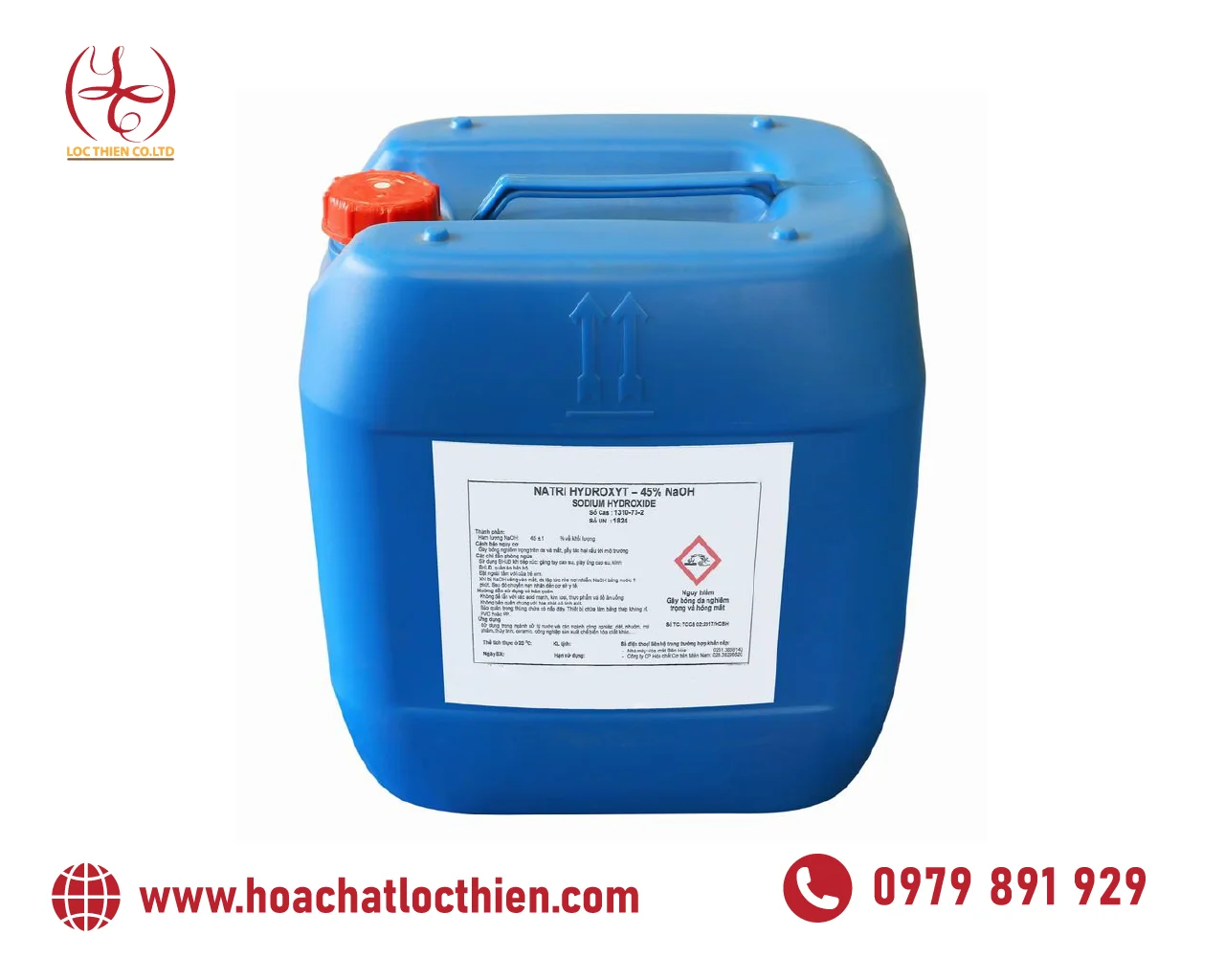
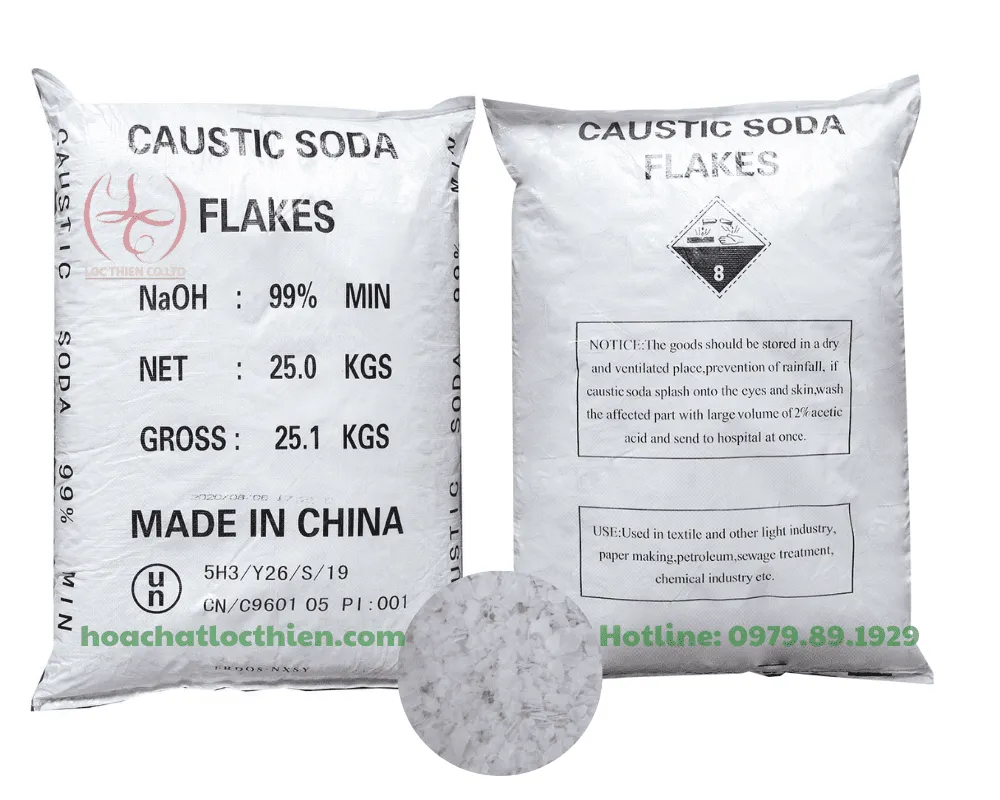
| Net Weight per 1,000 L IBC / Bag | Approx. 1,349 kg net per IBC | Approx. 1,478 kg net per IBC | Approx. 1,525 kg net per IBC | 25 kg net woven PP + PE liner bag |
| Commercial Mass for 1,000 kg Dry NaOH (100%) | 3,125.0 kg (approx. 2,317 L) | 2,222.2 kg (approx. 1,504 L) | 2,000.0 kg (approx. 1,311 L) | 1,010.1 kg (approx. 40.4 bags of 25 kg) |
| Crystallization / Freezing Point | Freezes around 4–6 °C | Crystallizes around 6–8 °C | Crystallizes below 18 °C, solidifies 11–12 °C | Melts at 318 °C (hygroscopic, deliquescent in air) |
| Heat Released During Plant Make-Up | Negligible (pre-hydrated, direct pump dosing) | Moderate if diluted on-site | Elevated if diluted on-site | Severe: releases 44.5 kJ/mol (1,112.5 kJ/kg NaOH) |
| Plant Dosing & Handling Mode | Closed-loop automated metering pump via pH probe | Diaphragm metering pump or inline dilution | Dedicated metering pump; winter heat tracing needed | Manual bag slitting, batch agitation, cooling wait time |
| Applicable Vietnamese Standard | QCVN 03A:2020/BCT (amended Circular 38/2026/TT-BCT) | QCVN 03A:2020/BCT (amended Circular 38/2026/TT-BCT) | QCVN 03A:2020/BCT (amended Circular 38/2026/TT-BCT) | Total alkali & impurity limits verified per batch COA |
Engineering note: Specific gravity at 20 °C, active NaOH assay, and impurity limits (Na₂CO₃, NaCl, Fe) represent typical reference values; exact figures are verified against the batch-specific Certificate of Analysis (COA) accompanying every shipment.
From an objective engineering perspective, bulk liquid caustic is not automatically superior for every facility. Caustic Soda Flakes 99% w/w remains the practical choice in three specific scenarios:
- Low monthly consumption (under 3–5 metric tons/month) or remote plant locations far from the 6 bulk distribution hubs: When haulage distances are long and consumption is small, paying tanker freight on the water fraction inside
32%solution reduces freight efficiency. Palletized25 kgbags allow compact dry storage and flexible small-batch make-up. - Absence of a fixed bulk storage tank and secondary containment bund wall (
≥ 110%of largest tank volume): Leased workshop units, compact modular wastewater skids, or short-term pilot lines without road tanker access or bunded chemical pads can operate immediately using25 kgbags. - Specialized batch synthesis or concentrated cleaning formulations requiring above 50% w/w alkali strength or strict water-balance limits: Solid
99%flakes enable formulators to control water input precisely.
Conversely, once plant demand surpasses 5 metric tons/month across textile dyeing mills, pulp and paper plants, electroplating lines, seafood processing facilities, or centralized industrial park wastewater treatment plants, Liquid Caustic Soda NaOH 32%–50% w/w eliminates manual bag handling, removes exothermic dissolution hazards, prevents hazardous bag waste, and integrates directly with 24/7 PID-controlled pH metering pumps.
How Do You Calculate the 1,000 kg Dry-Basis NaOH Mass Balance and Total Cost of Ownership (TCO)?
Calculating the mass balance normalized to 1,000 kg of dry-basis 100% active NaOH is the mandatory engineering baseline for comparing commercial quotations across 32%, 45%, and 50% w/w liquid solutions versus 99% w/w solid flakes. Two frequent procurement errors distort tender evaluations: comparing raw per-kilogram commercial prices without normalizing for % w/w active content, and mistakenly equating 1,000 L of liquid volume to 1,000 kg (1 metric ton).
Accurate plant mass-balance conversion follows a two-step calculation:
- Step 1 — Commercial Mass Required (
kg): Divide the target dry-basisNaOHmass by the mass fraction (w/w). Delivering1,000 kgof pureNaOHrequires3,125.0 kgofNaOH 32% w/wliquid,2,222.2 kgofNaOH 45% w/wliquid,2,000.0 kgofNaOH 50% w/wliquid, or1,010.1 kgofNaOH 99% w/wflakes (approximately40.4 bagsof25 kgnet). - Step 2 — Storage Volume and Metering Pump Flow (
Lat20 °C): Divide the commercial mass by the solution specific gravity (SG) at20 °C. Because concentrated sodium hydroxide solutions are substantially denser than water, a single1,000 LIBC tote holds approximately1,349 kgnet ofNaOH 32% w/w(SG 1.349at20 °C),1,478 kgnet ofNaOH 45% w/w(SG 1.478at20 °C), and1,525 kgnet ofNaOH 50% w/w(SG 1.525at20 °C) — never treat1,000 Las1 metric tonwhen sizing tank foundations, mezzanine loads, or forklift capacities.
Critical Northern Vietnam Winter Crystallization Warning (Bac Ninh, Hai Phong, Hung Yen, Thai Nguyen): Liquid Caustic Soda NaOH 50% w/w begins crystallizing as soon as ambient temperature drops below
18 °Cand solidifies into a rigid hydrate mass around11–12 °C. During Northern Vietnam winter monsoons (December through February), ambient night temperatures in industrial zones frequently dip to8–15 °C, plugging uninsulated outdoor tanks, ball valves, suction strainers, and small-bore metering lines. FDI plants in Northern Vietnam should select Liquid Caustic Soda NaOH 32% w/w (freezing point4–6 °C, low viscosity, direct year-round pumping from our Bac Ninh warehouse) unless full electric heat tracing and tank insulation are installed.
Technical Illustration (Worked Example): Monthly TCO Comparison for a 1,500 m³/day FDI Textile Plant
Engineering basis — Technical illustration (worked example): Consider an FDI textile dyeing and finishing facility operating 30 days/month with a wastewater flow rate of 1,500 m³/day (45,000 m³/month). Based on titration curves, maintaining target pH across coagulation and biological neutralization requires an average reference dose of 180 mg/L (0.18 kg/m³) as dry-basis 100% NaOH, resulting in 270 kg/day or 8,100 kg/month of active NaOH. The table below compares the three commercial supply configurations:
| Monthly TCO & Operations Metric | Option 1: NaOH Flakes 99% (25 kg Bags) | Option 2: Liquid NaOH 32% w/w (Bulk Tanker) | Option 3: Liquid NaOH 50% w/w (Bulk Tanker) |
|---|---|---|---|
| Monthly Commercial Mass Required | 8,181.8 kg/month (approx. 327 bags of 25 kg) | 25,312.5 kg/month (25.31 metric tons/month) | 16,200.0 kg/month (16.20 metric tons/month) |
| Monthly Solution Volume (at 20 °C) | Plant must add water to make 25–50 m³ batch solution | Approx. 18,764 L/month (625.5 L/day) | Approx. 10,623 L/month (354.1 L/day) |
| Delivery Cadence & Manual Handling | Forklift unloading + slitting 11 bags/day (327 bags/month) | 1 single 25-ton tanker trip/month (5–30-ton fleet) | 1 single 18-ton tanker trip/month (5–30-ton fleet) |
| Make-Up Labor & Active Alkali Loss | Daily manual dissolving labor; 1%–3% loss via caking & CO₂ carbonation into Na₂CO₃ | 0 hours make-up labor; closed-coupling transfer into 25–30 m³ tank | 0 hours make-up labor; requires heat tracing below 18 °C |
| Hazardous Packaging Waste Generated | 327 caustic-contaminated PP/PE bags/month requiring licensed hazardous disposal | Zero empty bags or drums generated | Zero empty bags or drums generated |
| Process pH Stability & Automation | Batch-to-batch concentration drift during manual mixing | Smooth VFD metering pump response locked to inline pH sensor | High stability in Southern Vietnam; monitor winter crystallization in North |
This worked example demonstrates why medium-to-large plants transition away from bagged flakes: consolidating 327 manual bag operations per month into one single 25.31-metric-ton bulk tanker delivery of Liquid NaOH 32% w/w removes over 3,900 contaminated hazardous bags annually, eliminates operator exposure to boiling make-up tanks, and stabilizes effluent pH to support compliance with QCVN 40:2025/BTNMT.
Mandatory Jar-Test Verification Note: The
180 mg/Ldosage above is strictly an engineering illustration. Actual plantNaOHdemand varies with influent acidity, carbonate alkalinity buffering, and coagulant chemistry (PAC,FeCl₃,FeCl₂), and must always be determined through Jar-test trials and pH titration on real plant effluent. Engineers can run preliminary pump sizing on our online chemical dosage calculator prior to bench testing.
What Exothermic Dissolution Hazards and GHS Safety Controls Apply to NaOH Flakes 99% and Liquid Caustic Soda?
Dissolving solid Caustic Soda Flakes 99% w/w in water is a strongly exothermic hydration process with a standard molar enthalpy of dissolution releasing 44.5 kJ/mol, equivalent to approximately 1,112.5 kJ of thermal energy per kilogram of solid NaOH. Dumping multiple 25 kg bags into an uncooled make-up tank rapidly drives local liquid temperatures to 85–95 °C, creating four severe EHS and mechanical integrity hazards:
- Corrosive Caustic Mist Generation and Flash Boil-Over: Steam rising from an
85–95 °Cmixing tank entrains fine alkaline droplets (caustic mist) that cause severe respiratory tract irritation and corneal burns unless local exhaust scrubbing is installed. If water is poured onto solid flakes or if flakes cake into a solid crust at the tank bottom, trapped water superheats and can erupt violently over the tank rim. - Thermal Softening of Unreinforced Plastic Piping: Solution temperatures above
80 °Cexceed the continuous operating rating of standarduPVCpipework (45–50 °C), leading to flange warping, gasket creep, and weld seam failure. - Atmospheric Carbonation (
Na₂CO₃Formation) and Moisture Caking: SolidNaOH 99%is intensely hygroscopic and deliquescent; torn or humid warehouse bags absorb atmosphericCO₂(2NaOH + CO₂ → Na₂CO₃ + H₂O), reducing active hydroxyl assay while forming insoluble carbonate scale inside dosing valves. - Mandatory Dilution Safety Rule: Always start mechanical agitation in cold water first and feed solid flakes or concentrated caustic slowly into water — never pour water onto solid caustic or concentrated
NaOH.
Under the Globally Harmonized System (GHS) and Vietnamese Safety Data Sheet regulations (Circular 01/2026/TT-BCT), both Liquid NaOH 32%–50% (UN 1824) and Solid NaOH 99% (UN 1823) carry the Danger signal word and Class 8 corrosive classification:
H290: May be corrosive to metals.H314: Causes severe skin burns and eye damage (requiring immediate 15-minute flushing at a plumbed emergency eyewash and safety shower station located within 10 seconds of the unloading/dosing zone).
For chemical incompatibility and storage tank engineering, plant EHS teams must enforce strict material boundaries:
- Reactive Metals Strictly Prohibited (
H₂Explosion Hazard): Never allowNaOHsolutions or mist to contact Aluminum (Al), Zinc (Zn), Tin (Sn), Copper (Cu), brass, bronze, or galvanized steel. Caustic soda attacks amphoteric metals rapidly, generating flammable and explosive Hydrogen gas (H₂) in tank headspaces (2Al + 2NaOH + 2H₂O → 2NaAlO₂ + 3H₂↑). KeepNaOHcontainment bunds physically segregated from strong acids (HCl,H₂SO₄,HNO₃,FeCl₃,FeCl₂) to prevent violent exothermic neutralization during accidental spills. - Compatible Tank and Piping Materials: Virgin high-density
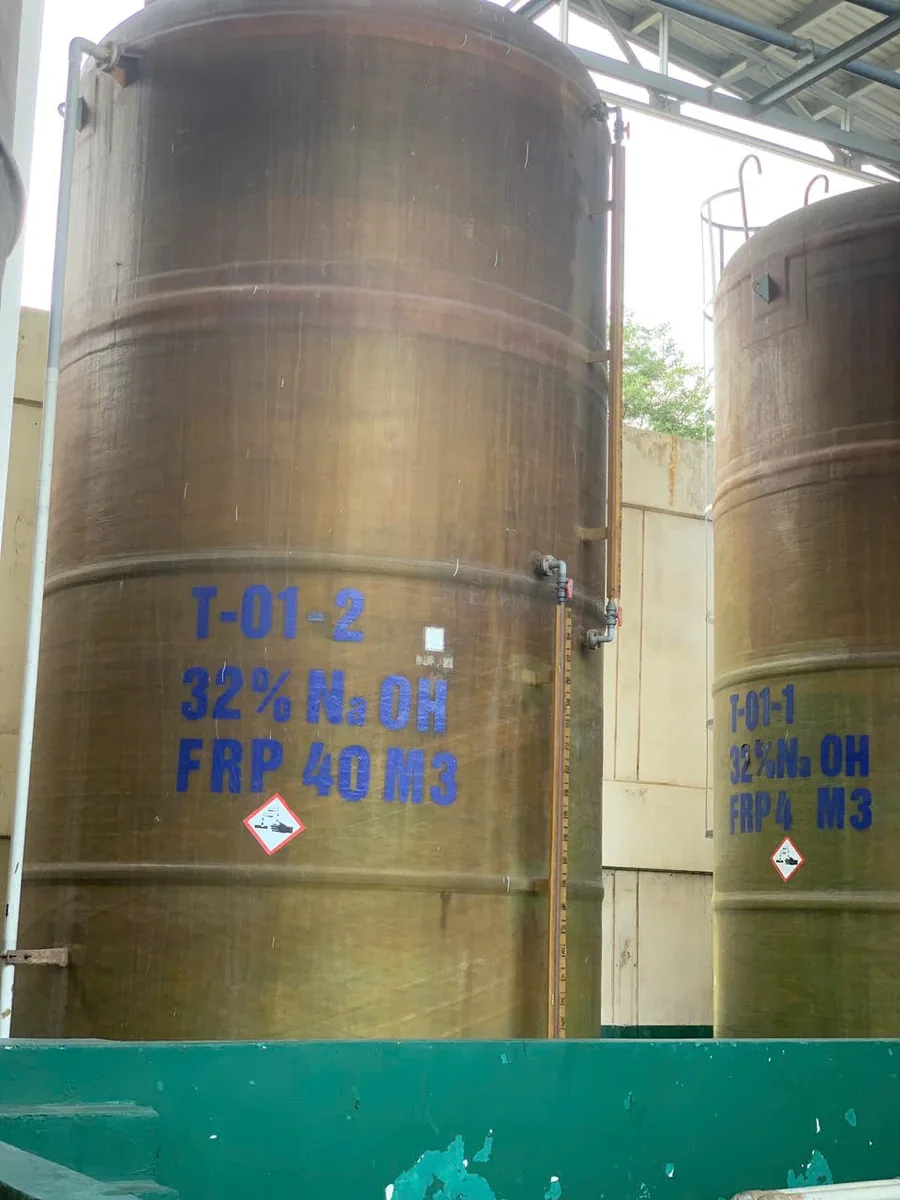
HDPE,PP, alkali-resistant vinyl-esterFRP,SS304 / SS316stainless steel, and carbon steel at ambient temperatures (above55–60 °C, carbon steel requires stress-relief treatment to prevent caustic embrittlement). All bulk tanks require a secondary containment bund wall sized at≥ 110%of the largest tank capacity perDecree 25/2026/ND-CP, vented level gauges, camlock unloading couplings, and full chemical PPE (full-face splash shield, chemical goggles, nitrile/neoprene gauntlets, alkali apron, safety boots). Download our compliant NaOH 32% Safety Data Sheet (MSDS/SDS) for plant EHS audits.
What ZDHC MRSL v3.1 Level 1 Documentation and 2026 Vietnamese Regulations Govern Industrial NaOH?
For export-oriented textile mills, denim laundries, footwear manufacturers, and multinational FDI plants operating in Vietnam, industrial Sodium Hydroxide (NaOH) supplied by Loc Thien Chemical satisfies both global brand chemical-compliance audits and Vietnam’s updated 2026 chemical regulatory framework.
For global textile supply chains, NaOH (Sodium Hydroxide) supplied by Loc Thien Investment Development Co., Ltd. (LOC THIEN INVESTMENT DEVELOPMENT COMPANY LIMITED) holds official ZDHC MRSL Version 3.1 Conformance Level 1 certification issued by TÜV SÜD Product Service GmbH / TÜV SÜD Vietnam under Certificate No. ZDHC1 127736 0001 Rev. 00 and Analytical Test Report No. 2486017672-Q24VPS-CHM2869. This verified dossier allows dyehouses to document restricted-substance and heavy-metal conformance on ZDHC Gateway audits and supports facility compliance with ZDHC Wastewater Guidelines V2.2.
The table below summarizes the mandatory 2026 Vietnamese technical standards and statutory regulations governing industrial NaOH procurement, transport, and storage:
| Regulation / Technical Standard | Issuing Authority & Effective Date | Core Compliance Requirement for Industrial NaOH |
|---|---|---|
QCVN 03A:2020/BCT amended by Circular 38/2026/TT-BCT | Ministry of Industry and Trade · Effective 01/07/2026 | National technical regulation on industrial Sodium Hydroxide quality: specifies active NaOH assay, maximum Na₂CO₃, NaCl, and Fe₂O₃ limits, plus updated labeling and conformity declaration rules. |
Law on Chemicals 69/2025/QH15 & Decree 24/2026/ND-CP | National Assembly (01/01/2026) & Government (17/01/2026) | Lists NaOH under Appendix I (priority basic industrial chemicals) and Appendix II — Item 655 (conditional production/trading chemicals, including mixtures > 5% w/w). Suppliers must hold a valid conditional chemical trading certificate; NaOH is not a Group 2 industrial precursor, so buyers do not need precursor control slips required for HCl or H₂SO₄. |
Circular 01/2026/TT-BCT & Decree 26/2026/ND-CP | Ministry of Industry and Trade & Government · Effective 17/01/2026 | Requires a 16-section Vietnamese GHS Safety Data Sheet (SDS) classified under UN 1824 / UN 1823, Class 8 (Danger: H290, H314) for every commercial batch supplied. |
Decree 161/2024/ND-CP & Decree 25/2026/ND-CP | Government · Active 2026 Enforcement | Governs Class 8 corrosive dangerous goods road transport (licensed tankers, hazmat-certified drivers), mandatory workplace PPE (Article 25), chemical safety training, and on-site spill prevention and response plans. |
QCVN 40:2025/BTNMT (Circular 06/2025/TT-BTNMT) | Ministry of Agriculture and Environment · Effective 01/09/2025 | National industrial wastewater discharge standard regulating effluent pH (6.0–9.0 for Column A; 5.5–9.0 for Columns B & C). Facilities operating before 01/09/2025 follow the transition roadmap until 31/12/2031, with mandatory compliance from 01/01/2032. |
Quality Assurance Insight — QC Specialist Phan Cam Thuy (Quality Control Laboratory, Loc Thien Chemical): “Before sealing tanker discharge valves or releasing palletized 25 kg flake lots, our QC laboratory performs dual verification on every batch of Liquid NaOH 32%, 45%, 50% w/w and Flakes 99%: calibrated hydrometer specific-gravity measurement standardized at 20 °C (1.349 for 32% w/w; 1.478 for 45% w/w; 1.525 for 50% w/w) paired with acid-base titration for active NaOH, sodium carbonate (Na₂CO₃), and sodium chloride (NaCl) against QCVN 03A:2020/BCT as amended by Circular 38/2026/TT-BCT. Keeping Na₂CO₃ and trace iron low on each batch COA protects textile bleaching lines against fabric yellowing and prevents carbonate scaling inside dosing injectors.”
Need the Complete NaOH Compliance Pack (Batch COA, Vietnamese GHS SDS & TÜV SÜD ZDHC Level 1 Certificate)? Email [email protected] or message Hotline/Zalo +84 979 891 929 (
0979 891 929) — our engineering desk delivers full vendor qualification documents and a formal quotation within 15 minutes.
How Should Procurement, Engineering, and Finance Teams Evaluate Bulk NaOH Supply and Pricing Drivers?
Multi-department vendor qualification in FDI and domestic manufacturing plants requires transparent alignment across supply chain reliability, batch consistency, and tax-compliant documentation. Loc Thien Chemical structures every NaOH supply contract around three functional pillars:
- For Procurement Teams: Verified corporate entity — Loc Thien Investment Development Co., Ltd. (Tax ID
0313650856), with registered legal headquarters for administrative operations at452/6B Tinh Lo 10, Binh Tri Dong Ward, Binh Tan District, Ho Chi Minh City. Supply continuity is backed by a3,000+ metric tons/monthdelivery track record, a dedicated5–30-tonClass 8 road tanker fleet, and buffer inventory across 6 standard warehouses nationwide:- Ba Ria - Vung Tau Warehouse: Phu My 1 Industrial Park, Phu My Town, Ba Ria - Vung Tau Province.
- Dong Nai Warehouse: Long Thanh Industrial Park, Long Thanh District, Dong Nai Province.
- Binh Duong Warehouse: Tan Dong Hiep Ward, Di An City, Binh Duong Province.
- Da Nang Warehouse: Hoa Khanh Industrial Park, Lien Chieu District, Da Nang City.
- Can Tho Warehouse: Tra Noc Industrial Park, O Mon District, Can Tho City.
- Bac Ninh Warehouse: Tien Son Industrial Park, Tien Du District, Bac Ninh Province. Standard delivery lead times: Inner Ho Chi Minh City within 4 hours; Southern and Mekong Delta Industrial Parks within 24–48 hours; Northern and Central Vietnam within 2–3 days. Contact hotline 0979 891 929 for detailed delivery scheduling procedures.
- For Process & EHS Engineers: Tight batch-to-batch
% w/wconcentration stability so metering pumps hold steady setpoints; laboratory reference samples and on-site Jar-test support; climate-matched grade selection (NaOH 32%for freeze-free Northern winter operation,NaOH 45%–50%for high-density Southern storage); sealed camlock tanker transfer; plus batch-specificCOAandCircular 01/2026/TT-BCTSDS. - For Accounting & Finance Departments: Prompt issuance of legally compliant Vietnamese VAT e-invoices upon delivery in accordance with
Decree 70/2025/ND-CP, complete bank-transfer settlement records satisfying input VAT credit rules under the2024 Law on Value-Added Tax, certified weighbridge tickets for every tanker load, and structured quarterly or annual supply agreements.
5 Core Factors Driving Industrial NaOH Unit Pricing (Zero Hidden Markups)
Because chlor-alkali membrane electrolysis output fluctuates with industrial power tariffs and Class 8 hazmat logistics, Loc Thien Chemical does not publish static unit prices online; instead, we issue firm technical quotations within 15 minutes calculated from five transparent cost drivers:
- Active Concentration & Physical Form: Liquid NaOH 32%, Liquid NaOH 45%, Liquid NaOH 50%, or Caustic Soda Flakes 99% evaluated per metric ton of dry-basis
NaOH. - Packaging & Delivery Mode: Bulk
5–30-tonroad tanker transfer eliminates packaging and manual palletizing overhead compared with1,000 LIBC totes,200 Ldrums, or25 kgbags. - Order Volume & Scheduled Contract Cadence: Spot shipments versus recurring monthly or quarterly framework schedules.
- Haulage Distance from the Nearest of 6 Warehouses: Calculated from Phu My, Long Thanh, Di An, Hoa Khanh, Tra Noc, or Tien Son under
Decree 161/2024/ND-CPClass 8 transport compliance. - Technical & Audit Documentation Scope: Standard batch
COA,ZDHC MRSL v3.1 Level 1certification dossier, third-party Quatest 3 verification, or sealed retention-sample protocols at plant gate.
Every Loc Thien Chemical Quotation Includes: Licensed Class 8 hazardous goods transport, closed-coupling pump discharge into the buyer’s bulk storage tank (for tanker orders), batch-specific COA, 16-section SDS per Circular 01/2026/TT-BCT, and compliant Vietnamese VAT e-invoices (Decree 70/2025/ND-CP).
Frequently Asked Questions (FAQ)
Why does a 1,000 L IBC tote of Liquid Caustic Soda weigh much more than 1 metric ton?
Liquid sodium hydroxide solutions have a substantially higher specific gravity than water, so 1,000 L never corresponds to 1,000 kg. At the 20 °C reference temperature, 1,000 L of NaOH 32% w/w (SG 1.349) weighs approximately 1,349 kg net; NaOH 45% w/w (SG 1.478) weighs approximately 1,478 kg net; and NaOH 50% w/w (SG 1.525) weighs approximately 1,525 kg net excluding the IBC cage. Warehouse floors, racking, and receiving weighbridges must always account for net mass in kilograms per batch COA.
Why does NaOH 50% crystallize during winter in Bac Ninh and Hai Phong, and how do plants prevent line blockages?
NaOH 50% w/w begins forming solid sodium hydroxide hydrate crystals whenever ambient temperature drops below 18 °C and freezes solid around 11–12 °C. During December–February cold fronts in Northern Vietnam (8–15 °C), uninsulated outdoor piping and metering pump check valves clog rapidly. Switching to NaOH 32% w/w (freezing point 4–6 °C) dispatched directly from Loc Thien’s Bac Ninh Warehouse (Tien Son Industrial Park) keeps dosing lines flowing year-round without costly electrical heat tracing.
Is Loc Thien Chemical’s NaOH certified to ZDHC MRSL v3.1 Level 1 for export textile dyeing mills?
Yes. NaOH (Sodium Hydroxide) supplied by Loc Thien Investment Development Co., Ltd. holds ZDHC MRSL Version 3.1 Conformance Level 1 certification issued by TÜV SÜD Product Service GmbH / TÜV SÜD Vietnam (Certificate No. ZDHC1 127736 0001 Rev. 00, Test Report No. 2486017672-Q24VPS-CHM2869), meeting chemical input audit requirements for FDI dyehouses, finishing mills, and garment laundries.
Does purchasing industrial NaOH in Vietnam require an industrial precursor control slip under Decree 24/2026/ND-CP?
No. Under Decree 24/2026/ND-CP implementing the Law on Chemicals 69/2025/QH15, NaOH is classified under Appendix II — Item 655 (conditional industrial chemicals) rather than Appendix III Group 2 (industrial precursors such as HCl or H₂SO₄). Corporate buyers do not need precursor purchase control slips, provided they source from a licensed conditional chemical supplier and retain contracts, VAT e-invoices, and Circular 01/2026/TT-BCT Safety Data Sheets.
What storage tank and bund infrastructure is needed to switch from 25 kg NaOH 99% bags to 5–30-ton bulk tankers?
To receive 5–30-ton tanker deliveries safely, a plant requires an alkali-compatible bulk tank (HDPE, PP, vinyl-ester FRP, or ambient carbon steel) sized at 1.3–1.5x the target drop volume (typically 10 m³ to 35 m³), placed inside a secondary containment bund holding at least 110% of the largest tank volume, fitted with a camlock or flanged fill line, vent pipe, level indicator, plumbed eyewash/safety shower, and tanker access within 15–30 m of the fill point.
Ready to Optimize Caustic Soda TCO and Automate Your pH Dosing Station? Contact Loc Thien Chemical for a customized dry-basis mass-balance comparison, batch
COA,ZDHC MRSL v3.1 Level 1documentation, and a formal quotation within 15 minutes:
- B2B Email (English & International FDI Desk): [email protected]
- Hotline & Vietnamese/English Zalo Support (24/7): +84 979 891 929 (
0979 891 929)- Online RFQ Portal: Request a 15-Minute Quote for Liquid NaOH 32%–50% & Flakes 99%
Technical & regulatory disclaimer: This engineering guide provides industrial chemical data and summarizes current Vietnamese chemical and environmental regulations for informational purposes; it does not substitute for formal legal counsel or site-specific Jar-test verification.