
What Color Is FeCl2? Anhydrous, Hydrated, Solution, Oxidized
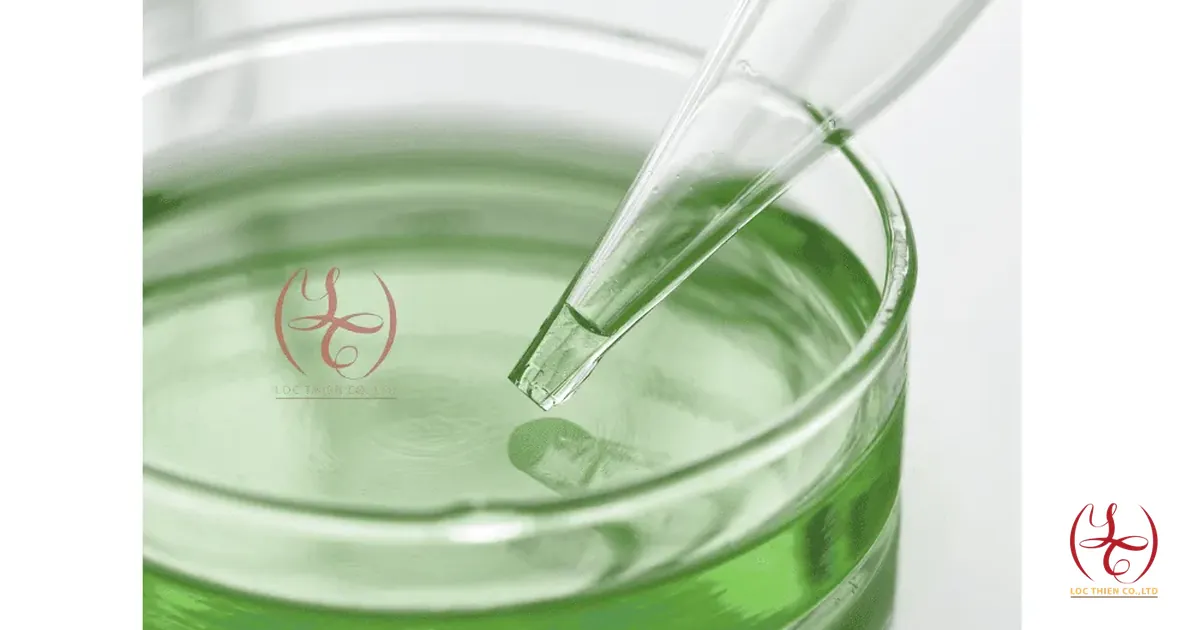
What color is FeCl2? A ferrous chloride solution is pale green; the 30% solution supplied by Lộc Thiên is listed in its MSDS as “moss green”. The tetrahydrate crystal FeCl2·4H2O is pale green, while anhydrous FeCl2 ranges from white to pale yellow or light grey. Once Fe²⁺ oxidizes to Fe³⁺ in air, the solution turns yellow and then brown. A Fe(OH)₂ precipitate starts out bluish-white and slowly turns reddish-brown in air.
FeCl2 colour chart by form
The colour of FeCl2 depends on the form (anhydrous, hydrated, solution) and on how much Fe²⁺ has already oxidized to Fe³⁺. The table below covers the forms you meet in the laboratory and in the plant.
| Form | Formula | Colour | Notes |
|---|---|---|---|
| Anhydrous FeCl2 (no water) | FeCl2, M = 126.75 g/mol | White to pale yellow or light grey | Hygroscopic; aged samples often turn yellow-brown from traces of Fe³⁺ |
| Tetrahydrate crystal | FeCl2·4H2O, M = 198.81 g/mol | Pale green (with a hint of blue) | Density 1.93 g/cm³; loses water of crystallization at about 105–110 °C |
| Dilute solution | Fe²⁺ in water | Pale green | The more concentrated, the darker the shade |
| 30% FeCl2 solution (Lộc Thiên product) | FeCl2 in water | Moss green (MSDS); the TÜV report states "Seaweed" | Pungent odour, pH < 1, density about 1.3 g/cm³ |
| Partly oxidized solution | Fe²⁺ mixed with Fe³⁺ | Green turning yellow, then yellow-brown | Sign that Fe²⁺ is converting to Fe³⁺ |
| FeCl3 solution (for comparison) | FeCl3 in water | Reddish-brown (MSDS: "red-brown"); yellow-brown when diluted | The product of FeCl2 oxidation |
A related question is what colour of precipitate FeCl2 gives. The second table lists the common colour reactions; they are qualitative laboratory tests only.
| Reagent | Observation with FeCl2 solution | Equation |
|---|---|---|
| NaOH or KOH | Bluish-white Fe(OH)₂ precipitate; in air it gradually turns reddish-brown (Fe(OH)₃) | FeCl₂ + 2NaOH → Fe(OH)₂↓ + 2NaCl; then 4Fe(OH)₂ + O₂ + 2H₂O → 4Fe(OH)₃ |
| Na₂S (neutral or alkaline medium) | Black FeS precipitate | FeCl₂ + Na₂S → FeS↓ + 2NaCl |
| AgNO₃ | White AgCl precipitate (test for Cl⁻); excess AgNO₃ also oxidizes Fe²⁺ to Fe³⁺ and forms metallic Ag | FeCl₂ + 2AgNO₃ → 2AgCl↓ + Fe(NO₃)₂ |
| K₃[Fe(CN)₆] | Deep blue precipitate (Turnbull's blue), used to detect Fe²⁺ | 3Fe²⁺ + 2[Fe(CN)₆]³⁻ → Fe₃[Fe(CN)₆]₂↓ |
| KSCN | Fe²⁺ is almost colourless; only Fe³⁺ gives a blood-red colour | Fe³⁺ + SCN⁻ → [Fe(SCN)]²⁺ |
The last row is a useful field trick: a little KSCN added to a diluted sample shows whether the FeCl2 solution already contains Fe³⁺ (see the colour-reading section below).
In this article
- Why FeCl2 is green and FeCl3 is reddish-brown
- What is FeCl2?
- 30% FeCl2 solution: what you can check by eye on delivery
- How to read colour changes on receipt and in the tank
- Correct uses of FeCl2 solution in industrial wastewater treatment
- Buying 30% FeCl2 solution for a plant
- Frequently asked questions
Why is FeCl2 green while FeCl3 is reddish-brown?
The pale green of a FeCl2 solution comes from hydrated Fe²⁺ ions in water; the higher the concentration, the deeper the colour, until a 30% solution looks moss green. Fe³⁺ behaves differently: it hydrolyses strongly in water and forms hydroxo and oxy-hydroxide species that are yellow-brown, so a FeCl3 solution looks reddish-brown. It takes only a fraction of the Fe²⁺ converting to Fe³⁺ for a FeCl2 solution to take on a yellow tint.
Thermodynamically, oxygen in air can oxidize Fe²⁺: the standard potential of the O₂/H₂O couple at pH 0 is +1.229 V, higher than the +0.771 V of the Fe³⁺/Fe²⁺ couple. The reaction needs no special catalyst; it is only faster or slower depending on conditions (see the storage section). A yellow-brown tint in FeCl2 solution is therefore a real chemical signal, not a cosmetic matter.
What is FeCl2?
FeCl2 is the salt of divalent iron and hydrochloric acid, called iron(II) chloride or ferrous chloride, CAS 7758-94-3, molar mass 126.75 g/mol. It dissolves completely in water. The key point to remember is that Fe²⁺ is a reducing agent: it readily gives up an electron to become Fe³⁺.
- Laboratory preparation: Fe + 2HCl → FeCl₂ + H₂↑ (iron with hydrochloric acid gives only the iron(II) salt, not FeCl3).
- Oxidation by chlorine: 2FeCl₂ + Cl₂ → 2FeCl₃.
- It gives Fe(OH)₂ precipitate with alkali and FeS with sulfide (tables above).
“Phèn sắt 2” (“iron(II) alum”) is a colloquial Vietnamese name that sometimes means green vitriol FeSO₄·7H₂O and sometimes a FeCl2 solution. FeCl2 is not an alum in the chemical sense. This article is about FeCl2.
30% FeCl2 solution: what you can check by eye on delivery
Lộc Thiên manufactures FeCl2 directly and supplies it only as a 30% solution for wastewater treatment plants. The table lists features you can check with your senses and simple tools, taken from the product MSDS; official content figures are confirmed when quoting (MSDS comes with the quotation; a test-result sheet/COA depends on the item).
| Feature | Value / description | What it is used for |
|---|---|---|
| Appearance | Moss-green liquid (pale to dark green), pungent odour | Compare the colour with the retained sample of the previous batch |
| FeCl2 content | 30% | Check against the test-result sheet, if available |
| Fe²⁺ content (theoretical) | About 13.2% (30% × 55.845 / 126.75) | Convert doses expressed as Fe²⁺ |
| Density | About 1.3 g/cm³ | Convert between kg and litres when receiving a tank |
| pH | < 1 (neat solution) | Choose tank and pipe materials and PPE |
| Storage | Room temperature, below 35 °C, sealed tank or container, away from alkali and heat | Limit oxidation of Fe²⁺ |
| Suitable tank materials | Composite, PVC | Do not use zinc, tin, aluminium, copper or their alloys |
Colour is only the first screening step. It tells you whether the solution shows signs of oxidation, but not its concentration. FeCl2 and Fe²⁺ content must be taken from the documents confirmed when quoting (MSDS comes with the quotation; a test-result sheet/COA depends on the item) and verified by titration in the plant QC laboratory. The solution has a pH below 1 and causes skin burns and eye damage: wear goggles, gloves, boots and chemical-resistant clothing when sampling.
How to read colour changes on receipt and in the tank
A clean FeCl2 solution is green to moss green and clear. A shift towards yellow means Fe²⁺ is being oxidized. The table below is a reading scale for operators; it is a rule-of-thumb scale with no ppm threshold or number of days attached.
| Observed colour | Usually means | What to do |
|---|---|---|
| Green to moss green, clear | Iron is mostly still Fe²⁺ | Transfer to the tank and keep a retained sample of the batch |
| Green turning yellow | Fe³⁺ is starting to appear | Check that the tank is sealed and the store temperature; compare with the retained sample and titrate Fe²⁺ in the plant QC; use it early |
| Clearly yellow-brown | A significant share of Fe²⁺ has become Fe³⁺ | Re-measure Fe²⁺ before calculating doses for Cr⁶⁺ reduction or Fenton |
| Cloudy or brown sediment | The cause must be found before pumping further | Stop pumping and sample; first check whether alkali or water has entered the tank and raised the pH |
| A colour outside the scale above | Possible contamination | Do not transfer to the tank; sample and contact the supplier |
A quick field check has four steps:
- Draw a sample from the sampling valve or the tanker outlet into a clear plastic or glass bottle, wearing full PPE.
- Hold the bottle against a white background in daylight, next to the retained sample of the previous batch, and photograph both under the same light.
- Let it stand for a while and look for sediment or cloudiness.
- If you need to confirm Fe³⁺, dilute a little sample and add KSCN: a blood-red colour deeper than in the retained sample means more Fe³⁺. This is a qualitative comparison between batches, with no pass/fail threshold.
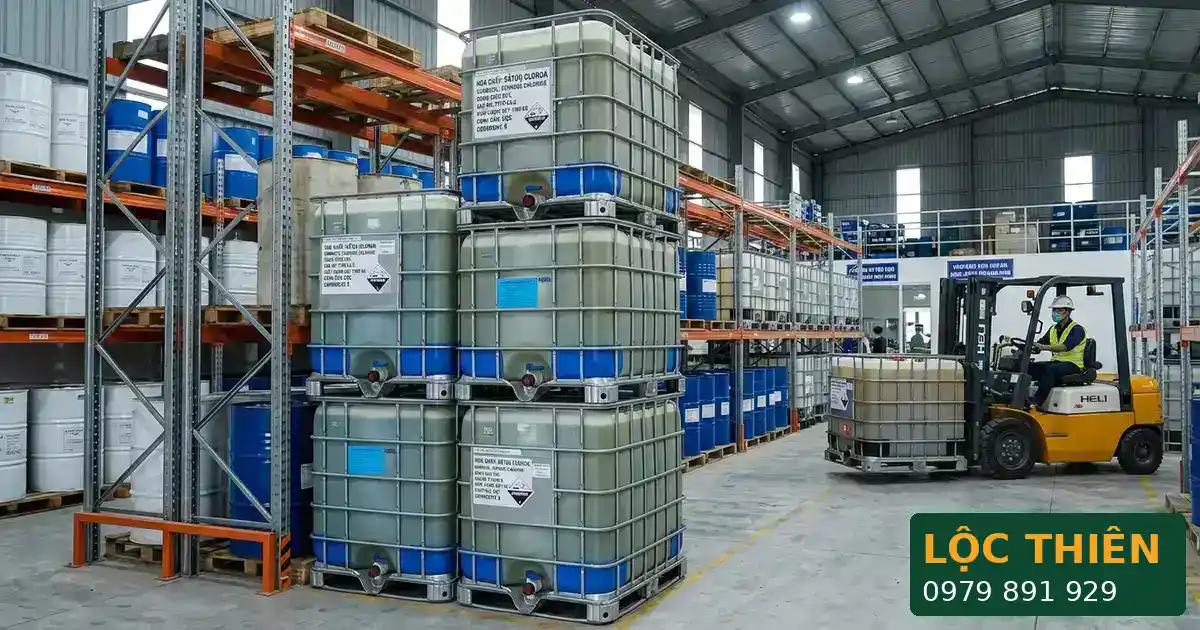
Why does the solution change colour? Three factors speed up the conversion of Fe²⁺ to Fe³⁺: contact with air (open drums, a tank that is mostly empty, frequent opening), high temperature, and rising pH. All three can be controlled by handling: keep it sealed, stay below 35 °C as the MSDS states, keep alkali out of the tank, and do not leave the tank open. There is no general ppm-oxygen or temperature threshold that tells you “it will change colour after so many days”, so the safe approach is to compare colour batch by batch against a retained sample.
Is a yellow-brown solution still usable? It depends on the purpose. Fe³⁺ still coagulates, so it remains usable for coagulation; but Fe³⁺ cannot reduce Cr⁶⁺, and the Fenton reaction needs Fe²⁺ to start (Fe³⁺ reacts with H₂O₂ much more slowly). If you calculate the dose as Fe²⁺ while the solution is partly oxidized, the real dose will fall short.
Correct uses of FeCl2 solution in industrial wastewater treatment
Industrial FeCl2 is used in wastewater treatment systems; each use exploits a different property of Fe²⁺. This article keeps the application section short because each industry has its own article, listed in the last column.
| Application | What Fe²⁺ does | Read next |
|---|---|---|
| Coagulation – flocculation | Hydrolyses (after oxidizing to Fe³⁺) into iron hydroxide floc that collects suspended solids | Jar test guide |
| Phosphate (phosphorus) removal | Precipitates iron phosphate | FeCl2 or FeCl3 |
| Cr⁶⁺ reduction in electroplating wastewater | Reduces Cr⁶⁺ to Cr³⁺ | FeCl2 in electroplating and Cr⁶⁺ reduction |
| Colour and COD removal in textile dyeing wastewater | Catalyses the Fenton reaction with H₂O₂ | FeCl2 in textile dyeing and Fenton with FeCl2 |
| Sulfide precipitation, H₂S reduction | Forms insoluble FeS | Section below |
Coagulation and phosphorus removal. In an aerated tank, Fe²⁺ is gradually oxidized to Fe³⁺ by dissolved oxygen and then hydrolyses into iron hydroxide floc; phosphate is captured as iron phosphate precipitate. Stoichiometrically, one mole of iron captures one mole of phosphate when the precipitate is FePO₄, equal to about 1.8 g Fe per g P. In practice the dose must exceed the stoichiometric amount, so the final dose is set by jar test and by re-measuring phosphate in the effluent.
Cr⁶⁺ reduction in electroplating wastewater. The reaction Cr⁶⁺ + 3Fe²⁺ → Cr³⁺ + 3Fe³⁺ needs 3 mol of Fe²⁺ per mol of Cr⁶⁺, i.e. 3.22 g Fe²⁺ per g Cr⁶⁺. With 30% FeCl2 solution (about 13.2% Fe²⁺) that is roughly 24.4 g of solution per g of Cr⁶⁺, before any excess. Cr³⁺ is then precipitated as the hydroxide when the pH is raised. The full calculation is in FeCl2 in electroplating and Cr⁶⁺ reduction. This is where the colour of the solution matters most in practice: a yellow-brown solution means a dose calculated as Fe²⁺ is no longer correct.
Colour removal in textile dyeing wastewater (Fenton). Fe²⁺ reacts with H₂O₂ to produce hydroxyl radicals •OH, which break down dye molecules and reduce COD; the reaction works in acidic conditions, around pH 3. The procedure, the Fe²⁺:H₂O₂ ratio and real wastewater data are in Fenton with FeCl2 for textile dyeing wastewater and FeCl2 in textile dyeing. For dyeing mills that make goods for international brands: Lộc Thiên’s 30% FeCl2 solution has a ZDHC MRSL V3.1 test report issued by TÜV Rheinland, number 248162921-02a, with a PASS result in 5 substance groups under the “smart testing” method. That is a test report, not a per-batch certificate; MSDS comes with the quotation; a test-result sheet/COA depends on the item and is confirmed when quoting.
Sulfide precipitation, H₂S reduction. Fe²⁺ + S²⁻ → FeS↓ (black). This reaction keeps dissolved sulfide in wastewater and sludge as an insoluble iron salt, so less H₂S gas is released; FeS dissolves in strong acid, so it is only stable near neutral pH.
Choosing FeCl2 or FeCl3 for coagulation depends on the wastewater; the comparison is in FeCl2 or FeCl3 for wastewater treatment. How FeCl2 is made (Fe + HCl) is covered in Preparing FeCl2.
Buying 30% FeCl2 solution for a plant
Lộc Thiên manufactures 30% FeCl2 solution directly and for large orders delivers it by 5–30 tonne tanker, pumped straight into the plant’s storage tank. MSDS comes with the quotation; a test-result sheet/COA depends on the item and is confirmed when quoting. Delivery time: inner Ho Chi Minh City 4 hours; southern and Mekong industrial parks 24–48 hours; the North and Central regions 2–3 days. The plant QC team should keep a retained sample of each batch received so colour can be compared later.
The price of FeCl2 depends on volume, delivery area, packaging and contract terms, so no fixed figure is published. To get a quote within 15 minutes, send five items: (1) the purpose (coagulation, phosphorus removal, Cr⁶⁺ reduction, Fenton); (2) monthly volume; (3) the industrial park or delivery address; (4) the delivery format (tanker or IBC) and the tank material you have; (5) the date needed. See the 30% FeCl2 solution product page or call 0979 891 929.
“The colour of a FeCl2 solution answers only one question: has Fe²⁺ been oxidized yet. It does not tell you the concentration. On receipt, a plant should do three things: compare the colour with the retained sample of the previous batch, check the MSDS and any test-result sheet confirmed when quoting, and check Fe²⁺ by titration before calculating a dose for Cr⁶⁺ reduction or Fenton.” — Lộc Thiên Technical Department
Send a FeCl2 quote request
Plants considering FeCl2 for coagulation, phosphorus removal, Cr⁶⁺ reduction or Fenton can send a request via the contact page or call 0979 891 929 so Lộc Thiên engineers can discuss specifications and support jar testing. Related category: ferric and ferrous chloride FeCl2 / FeCl3.
Frequently asked questions
What color is FeCl2?
A FeCl2 solution is pale green; the 30% solution from Lộc Thiên is moss green per the MSDS. FeCl2·4H2O crystals are pale green and anhydrous FeCl2 is white to pale yellow or light grey. When Fe²⁺ oxidizes to Fe³⁺, the solution turns yellow and then brown.
What color precipitate does FeCl2 form?
With NaOH or KOH, FeCl2 gives a bluish-white Fe(OH)₂ precipitate that slowly turns reddish-brown (Fe(OH)₃) in air. With Na₂S it gives black FeS. With AgNO₃ it gives white AgCl.
What kind of substance is FeCl2?
FeCl2 is the salt of divalent iron and hydrochloric acid, also called iron(II) chloride, CAS 7758-94-3, molar mass 126.75 g/mol. It dissolves in water, and Fe²⁺ is a reducing agent that readily oxidizes to Fe³⁺. In industry, FeCl2 solution is used in wastewater treatment.
How do FeCl2 and FeCl3 differ in colour?
A FeCl2 solution is green to moss green (Fe²⁺). A FeCl3 solution is reddish-brown, yellow-brown when diluted (Fe³⁺). A partly oxidized FeCl2 solution is green turning yellow-brown, between the two.
Can a FeCl2 solution that has turned yellow-brown still be used?
It remains usable for coagulation because Fe³⁺ still forms floc, but the dose must be recalculated if it is used for Cr⁶⁺ reduction or as a Fenton catalyst, since both need Fe²⁺. Check Fe²⁺ by titration and compare with the retained sample of the previous batch before fixing the dose.
How can I quickly check whether a FeCl2 solution has oxidized?
Compare the sample colour with the retained sample of the previous batch against a white background. To confirm Fe³⁺, dilute a little sample and add KSCN: a blood-red colour deeper than in the retained sample means more Fe³⁺. This test is qualitative; the exact content must be titrated.
How should FeCl2 be stored to limit colour change?
Keep the tank or container sealed, below 35 °C per the MSDS, away from alkali and heat, and do not leave the tank open for long. Use composite or PVC tanks; do not use zinc, tin, aluminium, copper or their alloys.
What should I provide to buy 30% FeCl2 solution for a plant?
Send the purpose, monthly volume, delivery location, delivery format and the date needed. Lộc Thiên quotes within 15 minutes and, for large orders, delivers by 5–30 tonne tanker. MSDS comes with the quotation; a test-result sheet/COA depends on the item and is confirmed when quoting. Contact us by email at [email protected] or through the Lộc Thiên contact page.