FeSO4 for Wastewater Treatment — Dosage, Coagulation Mechanism & Comparison with PAC, FeCl3 | Lộc Thiên
FeSO4 for Wastewater Treatment — Dosage, Coagulation Mechanism & Comparison with PAC, FeCl3
TL;DR: FeSO4 (ferrous sulfate, CAS 7782-63-0) is the lowest-cost iron-based coagulant with exceptional phosphate precipitation — reducing PO₄³⁻ by 85–95%. Optimal at pH 8.0–9.0, dosage 200–500 mg/L depending on effluent type. Compared to PAC, FeSO4 produces heavier, faster-settling flocs but generates more sludge. Lộc Thiên supplies FeSO4 granules 98%, 50kg bags, nationwide industrial park delivery.
Table of Contents
- What is FeSO4? Coagulation mechanism in wastewater treatment
- Technical specifications — FeSO4 for wastewater treatment
- FeSO4 dosage by effluent type
- Comparison: FeSO4 vs FeCl3 vs PAC
- How to prepare and dose FeSO4 into the system
- Case study: FeSO4 treating industrial park domestic wastewater
- Frequently asked questions
What is FeSO4? Coagulation mechanism in wastewater treatment
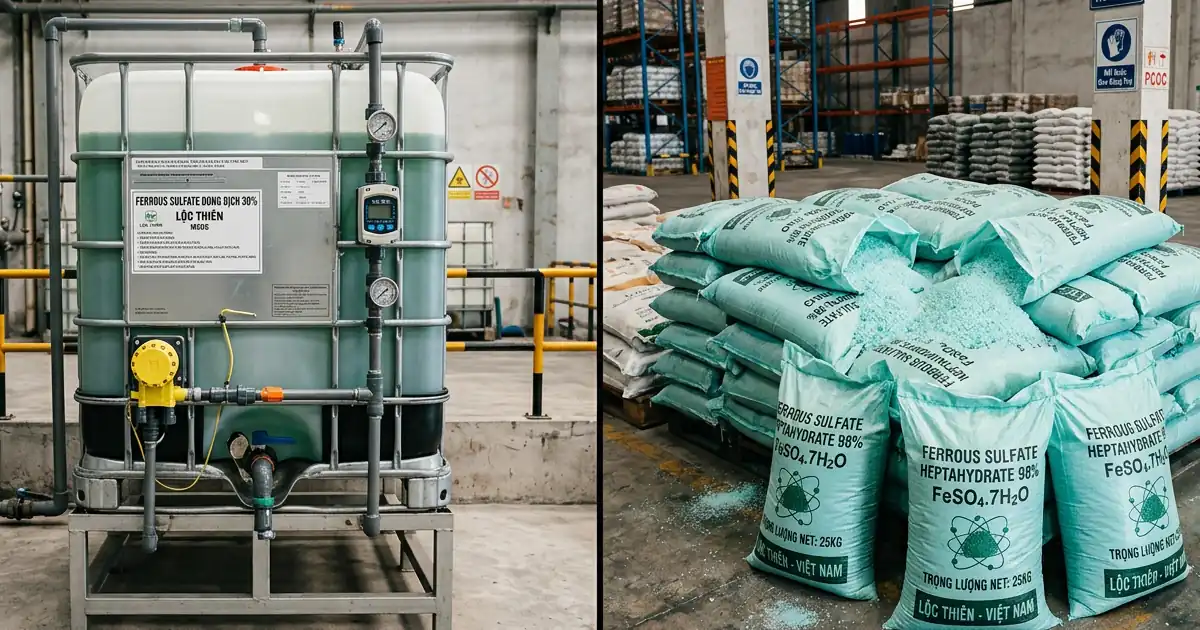
FeSO4 (Ferrous Sulfate, iron(II) sulfate, CAS 7782-63-0) is an inorganic salt in blue-green heptahydrate crystalline form (FeSO₄·7H₂O), highly soluble in water. This iron-based coagulant is widely used in wastewater treatment for its low cost and superior phosphate precipitation capability.
Two-step coagulation mechanism:
Step 1 — Oxidation of iron(II) to iron(III): When FeSO4 dissolves in wastewater containing dissolved oxygen (DO), Fe²⁺ ions oxidize to Fe³⁺:
4Fe²⁺ + O₂ + 8OH⁻ + 2H₂O → 4Fe(OH)₃Step 2 — Hydrolysis to form coagulant flocs: Fe³⁺ hydrolyzes to form insoluble Fe(OH)₃ gel, adsorbing suspended solids and precipitating phosphate:
Fe³⁺ + PO₄³⁻ → FePO₄
Fe³⁺ + 3OH⁻ → Fe(OH)₃
Key difference from PAC: Fe(OH)₃ has a specific gravity of 3.5–4.0 g/cm³ vs. Al(OH)₃ from PAC at 2.4–2.7 g/cm³ — meaning iron flocs are 50% heavier, settle faster, but generate 30–40% more sludge. Additionally, FeSO4 can remove H₂S odor via the reaction: Fe²⁺ + S²⁻ → FeS (black precipitate)
“FeSO4 is the optimal solution for plants with stringent phosphate discharge limits. A seafood processing plant in Can Tho reduced PO₄³⁻ from 12 mg/L to 1.2 mg/L after just 30 minutes of coagulation with FeSO4 at 350 mg/L.” — KTV Vo Thi Nhu Hoa, Technical Lead, HCLT
Technical specifications — FeSO4 for wastewater treatment
| Parameter | FeSO₄·7H₂O Granules |
|---|---|
| CAS | 7782-63-0 |
| FeSO4 content | ≥98% |
| Fe²⁺ content | ≥19.5% |
| As | ≤0.0002% |
| Pb | ≤0.001% |
| Zn | ≤0.005% |
| Insoluble impurities | ≤0.05% |
| Color | Blue-green crystals |
| 5% solution pH | 3.0–4.0 |
| Specific gravity | 1.89 g/cm³ |
| Solubility (20°C) | 48 g/L |
| Packaging | 50kg bag, 1 MT jumbo bag |
Applicable standards: QCVN 06:2020/BYT (water treatment chemicals), TCVN 6181:1996 (iron sulfate for water treatment).
FeSO4 dosage by effluent type
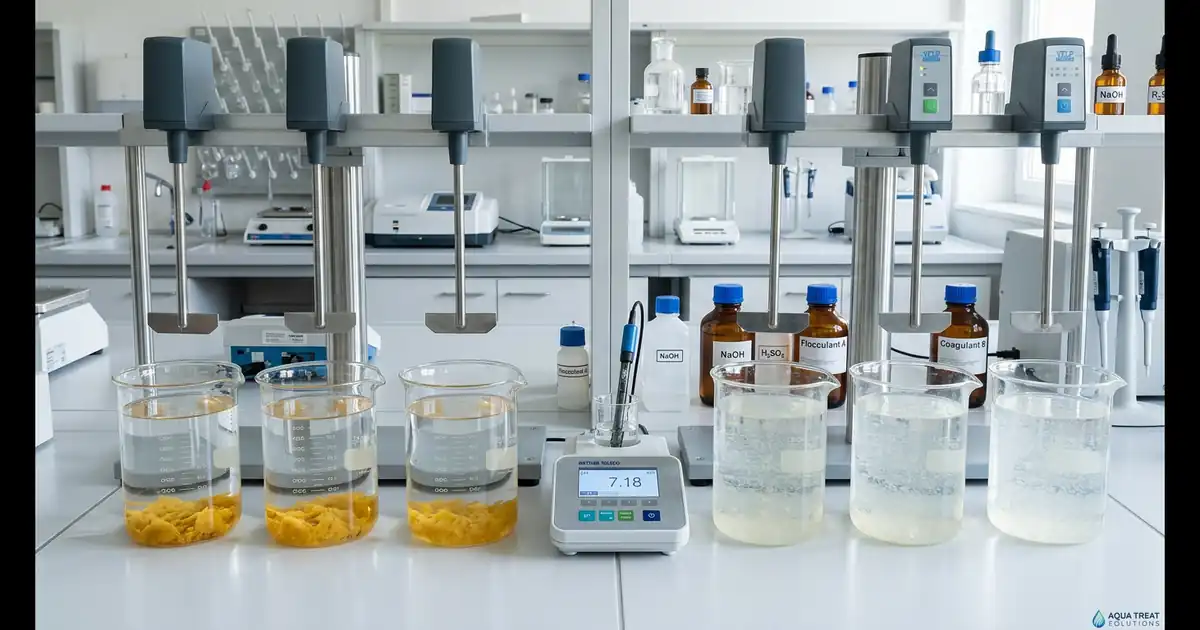
FeSO4 dosage depends on influent phosphate concentration, TSS, turbidity, and pH. A jar test is recommended before full-scale operation.
| Effluent Type | FeSO4 Dosage (mg/L) | Optimal pH | Treatment Target |
|---|---|---|---|
| Municipal domestic | 150–300 | 8.0–9.0 | Reduce PO₄³⁻ to ≤2 mg/L, TSS ≤50 mg/L |
| Seafood processing | 200–450 | 8.0–9.0 | COD reduction 60–80%, TSS 85%, NH₃ 70% |
| Textile dyeing | 250–500 | 8.0–9.0 | Color removal 70–85%, PO₄³⁻ ≥90% |
| Pulp and paper | 300–500 | 8.0–9.0 | TSS 85%, COD 50%, color 70% |
| Food processing | 150–300 | 8.0–9.0 | BOD reduction 70%, TSS 85% |
Jar test adjustment guidelines:
- If post-coagulation turbidity remains high → increase FeSO4 dosage by 20%
- If flocs float (turbid supernatant layer) → reduce dosage or raise pH to 8.5–9.0
- If treated water pH is below 6.5 → adjust with NaOH before FeSO4 dosing point
Comparison: FeSO4 vs FeCl3 vs PAC
| Parameter | FeSO4 (granules 98%) | FeCl3 solution | PAC 17% |
|---|---|---|---|
| Optimal pH | 8.0–9.0 | 5.5–8.0 | 6.5–7.5 |
| Floc formation speed | Slow–Medium | Medium | Fastest |
| Floc weight | Heavy | Heavy | Light |
| Settling rate | 0.4–1.5 mm/s | 0.5–2.0 mm/s | 0.3–1.0 mm/s |
| Sludge volume | High | High | Low |
| PO₄³⁻ precipitation | Best (95%) | Good (90%) | Moderate (60–70%) |
| Cr⁶⁺ removal | No | Yes | No |
| Fenton AOP | No | Yes | No |
| Equipment corrosion | Low (pH 3–4) | High (pH 1–2) | Low (pH 3.5–5) |
| Cost per kg chemical | Lowest | Medium | Highest |
When to use FeSO4 instead of FeCl3 or PAC:
- Choose FeSO4 when: cost is the priority, strong phosphate precipitation is needed, Fenton treatment is not required, and sludge volume is not a concern.
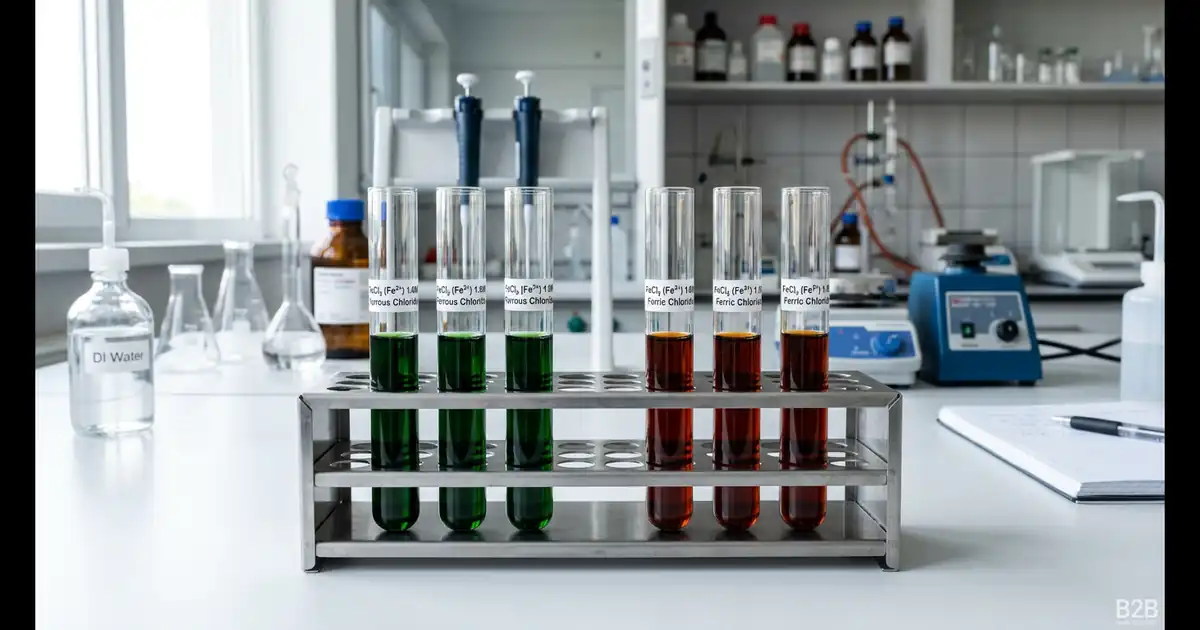
- Choose FeCl3 when: effluent contains Cr⁶⁺ or H₂S, Fenton integration is needed, or effluent pH is in the 5.5–7.5 range.
- Choose PAC when: effluent has low phosphate content, fast floc formation is needed, or minimizing sludge volume is critical.
Combined operation: In practice, many wastewater treatment systems use FeSO4 in the primary coagulation stage (~200–300 mg/L) to precipitate the majority of phosphate, followed by a low PAC dose (20–50 mg/L) in the secondary coagulation stage for faster floc formation and reduced total sludge volume.
How to prepare and dose FeSO4 into the system
Step 1 — Prepare FeSO4 solution:
- Dosing solution concentration: 5–10% (50–100 g/L)
- Procedure: Fill the preparation tank with clean water, start agitation, slowly add FeSO4 granules at a ratio of 50–100 kg/m³ water
- Minimum agitation time: 30 minutes until fully dissolved
- Allow insoluble residue to settle for 15–20 minutes before use
Need bulk FeSO4? Request a quote for FeSO₄·7H₂O 98% — COA/MSDS per batch, nationwide industrial park delivery, 50kg bags or 1 MT jumbo bags. Hotline 0979 891 929.
Step 2 — Calculate dosing flow rate: Dosing pump flow rate (L/h) = (Q × C × 1000) / (ρ × N)
Where:
- Q: Wastewater flow rate (m³/h)
- C: Target FeSO4 concentration in wastewater (mg/L)
- ρ: Solution specific gravity (~1.05–1.10 g/L)
- N: Prepared solution concentration (g/L)
Example: 50 m³/h wastewater, 300 mg/L dosage, 10% solution (100 g/L): Dosing rate = (50 × 300 × 1000) / (1.08 × 100,000) = 139 L/h
Step 3 — pH adjustment:
- Raise wastewater pH to 8.0–9.0 using 10% NaOH or 5% Ca(OH)₂ before the FeSO4 dosing point
- Maintain coagulation tank outlet pH at 6.5–8.5
- Required NaOH: approximately 0.3–0.6 kg NaOH/kg FeSO4 depending on wastewater buffer capacity
Case study: FeSO4 treating industrial park domestic wastewater
Customer profile: Food processing plant in My Phuoc Industrial Park, Binh Duong. Flow rate 120 m³/day.
Problem: Post-biological treatment effluent had PO₄³⁻ averaging 8–10 mg/L, exceeding QCVN 40:2011 Column B (6 mg/L). The environmental authority required reduction to ≤4 mg/L.
Solution: Added a FeSO4 coagulation tank before the settling tank. Jar test determined optimal dosage of 250 mg/L at pH 8.5 with 20-minute flash mix. Used anionic polymer 2 mg/L as flocculant aid.
Results after 30 days of operation:
| Parameter | Before treatment | After FeSO4 | QCVN 40 Column B |
|---|---|---|---|
| PO₄³⁻ | 8.5 mg/L | 1.8 mg/L | ≤6 mg/L |
| COD | 450 mg/L | 135 mg/L | ≤150 mg/L |
| TSS | 280 mg/L | 35 mg/L | ≤100 mg/L |
| pH | 7.2 | 7.8 | 5.5–9.0 |
Cost: FeSO4: ~4,500,000 VND/month for 120 m³/day. Total chemical + sludge handling cost: ~2,000 VND/m³ — 40% savings vs. PAC (3,500 VND/m³).
Frequently asked questions
How is FeSO4 different from PAC?
FeSO4 is superior for phosphate precipitation, produces heavier flocs that settle faster. PAC is faster in floc formation and generates less sludge (30–40% reduction).
What dosage of FeSO4 for wastewater treatment?
200–500 mg/L depending on effluent type. Domestic wastewater 150–300 mg/L, food processing 150–300 mg/L, textile dyeing 250–500 mg/L. Always perform a jar test.
At what pH does FeSO4 work best?
pH 8.0–9.0. FeSO4 generally requires more alkaline conditions than FeCl3 or PAC. Raise pH with NaOH or Ca(OH)₂ before dosing.
What are the disadvantages of using FeSO4?
Generates more sludge than PAC (30–40% more), slower reaction rate, cannot treat Cr⁶⁺, requires alkaline pH. Best suited when phosphate control is the priority.
Is FeSO4 corrosive to equipment?
Low corrosivity. A 5% FeSO4 solution has pH 3–4, significantly less corrosive than FeCl3 (pH 1–2). Preparation tanks should be PE or composite — avoid carbon steel.
Where to buy FeSO4 from Hoa Chat Loc Thien?
FeSO₄·7H₂O granules 98%, 50 kg bags, 1 MT jumbo bags. 6 warehouses across 3 regions, nationwide IP delivery. COA/MSDS per batch.
Hotline 0979 891 929 — quote within 15 minutes.