
What Are Laboratory Chemicals? Grades by Purity Level
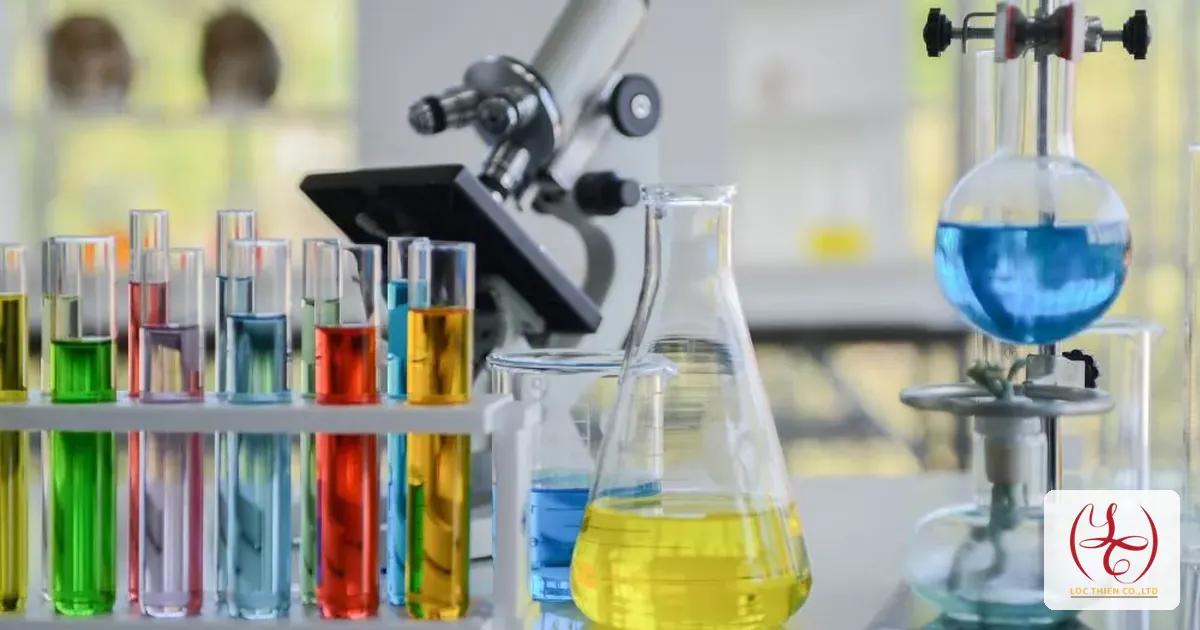
Laboratory chemicals (lab chemicals) are chemicals used for analysis, testing and research in a laboratory, graded by purity: ACS, AR, GR, PA, LR, USP and technical grade. The higher the grade, the tighter the control of impurities, but not every job needs the highest grade. Choose the grade by how accurate the measurement result has to be.
Scope of this article: it explains general classification knowledge and is not a sales catalogue. Lộc Thiên does not sell laboratory chemicals in the form of PA/AR/GR/LR reagents; the last section states exactly what Lộc Thiên supplies to factory labs.
Table of contents
- What are laboratory chemicals?
- Classification of laboratory chemicals by purity grade
- Choosing a purity grade by purpose
- How to read a label and a COA before use
- Chemicals for factory labs: two different consumption streams
- Safety when working with laboratory chemicals
- What Lộc Thiên supplies to factory labs
- Frequently asked questions
- Send a quotation request for your factory lab
What are laboratory chemicals?
Laboratory chemicals are chemical substances used in a laboratory to prepare solutions, run titrations, carry out qualitative and quantitative analysis, check the quality of raw materials and products, or support research. Users are found in many places: school teaching labs, research institutes, testing centres, and QC or EHS labs inside factories.
One point to grasp from the start: “laboratory chemicals” is not a separate family of substances. Sodium hydroxide or hydrochloric acid used in a lab and on the plant floor are, chemically, the same substance. What differs is the purity grade, meaning how tightly impurities are controlled, the analysis record that comes with it (a batch COA), the packaging and the labelling.
By function, lab chemicals usually fall into these groups:
- Solvents: distilled water, ethanol, methanol and acetone, used to dissolve samples, dilute, rinse and clean glassware.
- Acids and bases: hydrochloric acid, sulfuric acid and sodium hydroxide, used to adjust pH, neutralise, digest samples or serve as titration reagents.
- Salts and reaction reagents: used to form precipitates, complexes or colours with the substance being determined.
- Indicators and buffer solutions: phenolphthalein, methyl orange and pH buffers, used to find the equivalence point or calibrate meters.
- Standard solutions and primary standards: solutions or substances of well-defined concentration or content, used to standardise a method.
In Vietnamese the word “hóa nghiệm” is also used. It usually means analysing or testing a sample by chemical methods, and the department doing this in a factory is often called the “phòng hóa nghiệm” or the lab.
Classification of laboratory chemicals by purity grade
Each reagent manufacturer assigns a “grade” to its products. Some grades follow a standard published by an organisation; others are the manufacturer’s own trade names. The table summarises the grades you meet most often.
| Grade | Meaning | Typical use | What to note on the label |
|---|---|---|---|
| ACS Reagent | Meets the specifications of the American Chemical Society (ACS) Committee on Analytical Reagents, published in Reagent Chemicals | Quantitative analysis, titration, work that must be comparable between labs | The most common reference standard for analytical reagents |
| AR (Analytical Reagent) | Analytical reagent, the manufacturer’s standard grade, suitable for laboratory work | Routine to precise chemical analysis | A manufacturer’s term, with no common regulator; a label reading “AR (ACS)” means it meets ACS as well |
| GR (Guaranteed Reagent) | Trade name used by some manufacturers (EMD/Merck); meets the ACS standard where one exists for that substance | Analysis | Same functional group as AR; still read the batch COA |
| PA (pro analysis) | European-style term with a meaning equivalent to AR/ACS: guaranteed purity stated on the COA | Analysis | Same group as AR; specific values are on the COA |
| LR / Lab grade | Lower than AR; usually not tested against a published standard | Teaching, practical classes, qualitative reactions, routine handling | Cannot replace AR in quantitative work or regulated work |
| USP / NF / FCC | United States Pharmacopeia, National Formulary, Food Chemicals Codex; made under cGMP | Pharmaceuticals, food | A standard tied to the end use, not a synonym for “purer than ACS” |
| Technical (industrial) | Commercial grade, accepts a higher impurity content, lower cost | Production, water treatment, cleaning, operational make-up | Not for quantitative analysis or pharmaceutical use |
There are other labels too, such as Primary Standard (a primary standard used to standardise titrant solutions), CP (Chemically Pure) and Practical. These are also manufacturer-specific terms, so check the description in the catalogue.
No single purity percentage applies to each grade
Many informal sources say that each grade has one fixed percentage purity. That shortcut misleads: the content threshold and the impurity list differ for every chemical and every manufacturer. An AR bottle of NaOH and an AR bottle of acetone have completely different specifications. The numbers you should use are on the COA of the exact batch in your hand: content, the maximum of each impurity, and the conclusion Pass or Fail. A “reagent grade” label on its own only tells you the manufacturer’s grade name; it does not tell you how much impurity there actually is.
Choosing a purity grade by purpose
Two questions help you choose the right grade:
- Can impurities in the chemical shift the measurement? If yes (titration, calibration curves, trace analysis), you need an analytical grade with a batch COA.
- Does the method or regulation specify a reagent grade? If yes, use exactly the grade in the method; do not downgrade it yourself.
| Purpose | Grade usually chosen | Reason |
|---|---|---|
| Titration, preparing standard solutions, precise quantitative analysis | ACS, AR or PA; use a primary standard for standardisation | Impurities cause systematic error that repeating the measurement cannot remove |
| Analysis by a standard method, data reported to a regulator or customer | The grade specified by the method (usually an analytical grade) | Results must be traceable to the method |
| Teaching, practical classes, qualitative reactions | LR / Lab grade | Quantitative accuracy is not needed |
| Adjusting the pH of samples or working solutions, neutralising, rinsing glassware, rough dilution | Technical or industrial grade with an MSDS and clear batch records | Impurities do not affect the measurement; paying for analytical grade here only adds cost |
| Pharmaceuticals, food | USP / NF / FCC according to the sector rules | The standard is tied to the end use and the manufacturing process |
Two opposite mistakes are common in factory labs: using a low grade for titration and then blaming the instrument when results drift, or using analytical reagent for rinsing glassware and neutralising lab waste. The first spoils results; the second raises operating cost and improves nothing.
How to read a label and a COA before use
A complete chemical label tells you quite a lot:
- Name, formula and CAS number: identifies the substance exactly (for example NaOH is CAS 1310-73-2).
- Grade and concentration: AR, LR, technical; for solutions, the percentage or molarity.
- Batch number and expiry: lets you trace back to the right COA.
- GHS pictograms, signal word and statements: state the hazards.
- Manufacturer or supplier name: for requesting documents.
A COA (Certificate of Analysis) is the batch test report: each parameter has a requirement and a result, ending with a conclusion of Pass or Fail. On receipt, check that the batch number on the packaging matches the COA, and that the parameters that matter for your measurement (content, special impurities such as heavy metals, chloride, iron) appear on the COA. If a parameter you need is missing, ask the supplier before use instead of guessing.
Chemicals for factory labs: two different consumption streams
A QC or EHS lab in a factory usually uses chemicals in two separate streams, and it pays to separate them when you build the purchasing list:
The analytical reagent stream. Small quantities in bottles, ACS/AR/PA grade, used for titration, measuring wastewater or raw-material parameters, together with standard solutions and indicators. This stream is bought from specialist reagent or standards suppliers, and the batch record is the deciding factor.
The operational chemicals stream around the lab. Much larger volumes in industrial grade: alkali and acid to adjust the pH of samples or test tanks, make-up of working solutions, neutralising the lab’s own waste liquid, distilled water for dilution and rinsing, and water-treatment chemical samples for jar tests. Here the main requirements are stable concentration from batch to batch, an MSDS supplied with the order, and delivery on schedule.
Putting both streams into a single grade makes it easy to fall into one of the two mistakes described in the previous section.
Safety when working with laboratory chemicals
This section contains general standard principles only; the specific procedure for each substance is in the SDS (MSDS) of the exact batch you use.
Read the SDS and the GHS label before opening the bottle
An SDS (Safety Data Sheet) under the GHS system has 16 sections. The most relevant for lab users are: hazard identification, first aid, handling and storage, exposure controls and PPE, physical properties, stability and incompatible materials, and spill measures. A GHS label condenses the hazard into pictograms, a signal word (“Danger” or “Warning”) and H statements (hazard) and P statements (precaution).
| GHS pictogram | Meaning | Common lab examples |
|---|---|---|
| Corrosion (GHS05) | Causes skin burns, eye damage, corrodes metals | Hydrochloric acid, sulfuric acid, sodium hydroxide |
| Skull and crossbones (GHS06) | Acute toxicity | Some heavy-metal salts, cyanides |
| Exclamation mark (GHS07) | Irritant, lower-level toxicity | Many common solvents and salts |
| Health hazard (GHS08) | Long-term organ effects, carcinogenic or mutagenic | Some organic solvents, chromium (VI) compounds |
| Flame (GHS02) | Flammable | Ethanol, methanol, acetone |
Store by incompatible group
The core rule of a lab chemical store is not to arrange by alphabet but by hazard group:
- Keep inorganic acids apart from alkalis. A broken bottle next to the other would react with strong heat.
- Keep oxidisers (nitric acid, bleach solution, peroxides) away from organic solvents and flammables.
- Do not keep acids together with hypochlorite or bleaching powder: mixing or leaking into each other releases toxic chlorine gas.
- Strong alkalis must avoid contact with aluminium, zinc and tin because they release hydrogen gas.
- Keep flammable solvents in a dedicated cabinet, away from heat and sparks.
- Close hygroscopic substances (for example solid NaOH pellets) tightly straight after use.
- Store in a dry, cool, ventilated place out of direct sunlight; put heavy bottles low; place a tray under acid and alkali bottles; every decanted or re-mixed bottle must carry a full label.
Protective equipment and emergency facilities
- Chemical splash goggles (ordinary glasses are not a substitute), a long-sleeved lab coat, closed-toe shoes.
- Choose gloves for the specific substance; no glove withstands every chemical, so check the PPE section of the SDS.
- Volatile chemicals, toxic gases or concentrated acids: work inside a fume cupboard.
- An eyewash and an emergency shower must be close, unobstructed and tested regularly.
Dilution rules and incident response
- Diluting concentrated acid: add the acid to the water, slowly, while stirring, never the other way round, because the heat released can make the liquid spatter.
- Eyes: rinse with clean running water for at least 15 minutes, holding the eyelids open, then go to a medical facility.
- Skin: remove contaminated clothing at once and rinse with plenty of water. For substances that react strongly with water (some alkali metals, P₂O₅ and others), the SDS calls for dry handling first; read the SDS before working with this group.
- Labs that use HF: must have calcium gluconate gel 2.5 % and a dedicated first-aid procedure; the general procedure does not apply.
- Small spills: use a suitable absorbent, collect by group, do not wash into the drain; collect and treat chemical waste under the hazardous-waste rules.
Lộc Thiên Technical Department: “A frequent mistake in factory labs is using one chemical grade for every job. Titration and calibration curves need reagents with a batch COA and controlled impurities. For pH adjustment, neutralisation and glassware rinsing, an industrial grade works if the batch records are clear. Separating these two streams when you build the purchasing list keeps the data correct and avoids paying for purity you do not need.”
What Lộc Thiên supplies to factory labs
Lộc Thiên does not sell laboratory chemicals in the form of PA/AR/GR/LR reagents, that is, reagent bottles from the catalogue of a specialist lab supplier. The page Laboratory chemicals / factory lab says the same: the lab SKUs on the website are a bulk supply line, comprising distilled water and industrial chemicals used alongside the operating labs of factories, QC and EHS; this line does not replace the full PA/AR reagent catalogue of a specialist lab supplier.
What Lộc Thiên supplies for the lab and operations areas of a factory:
- Double-distilled water, Vietnam: dilution, rinsing glassware, preparing working solutions.
- Hydrochloric acid HCl 32–35 %: pH adjustment, neutralisation, descaling; see also what is hydrochloric acid.
- Liquid caustic soda NaOH 32 %: alkaline pH adjustment, neutralising waste liquid; see NaOH safety and alkali burn treatment.
- Sulfuric acid H2SO4: bulk industrial chemical; see the sulfuric acid overview.
How it works: bulk quantities only, supplied against a purchase order; tanker, IBC, drum or bag packing depending on the product and the delivery point; MSDS and batch records depend on the item and are confirmed when we quote. Delivery within inner Ho Chi Minh City in 4 hours, southern and Mekong Delta industrial parks in 24–48 hours, northern and central Vietnam in 2–3 days.
If you need ACS/AR/PA reagents for titration or trace analysis, buy them from a specialist reagent and standards supplier that provides a COA for every batch and a full catalogue.
Frequently asked questions
What are laboratory chemicals?
They are chemicals used in a laboratory to prepare solutions, titrate, analyse and test. One substance can come in several purity grades such as ACS, AR, GR, PA, LR or technical; grades differ in how tightly impurities are controlled, in the COA record and in packaging, not in chemical nature.
What is the difference between AR, GR and LR?
AR and GR are analytical-grade reagents used for chemical analysis; GR is a trade name of some manufacturers with a meaning close to AR. LR (lab grade) is lower, used for teaching and routine reactions, usually not tested against a published standard, so it cannot replace AR in quantitative work.
Is PA the same as AR?
In meaning, almost. PA (pro analysis) is the European-style term for an analytical reagent with guaranteed purity stated on the COA. AR is the common term of many other manufacturers. Whether it is called PA or AR, check the COA of the exact batch.
What does “hóa nghiệm” mean?
“Hóa nghiệm” is a common Vietnamese term for analysing or testing a sample by chemical methods, for example measuring pH, titrating alkalinity or determining content in raw materials or wastewater. The place that does this in a factory is called the phòng hóa nghiệm or the lab, and it uses the reagents and auxiliary chemicals this article describes.
Can industrial chemicals replace AR reagents for analysis?
Not for titration, calibration curves or regulated data, because impurities in industrial grade shift the results. For work that does not affect the measurement, such as pH adjustment, neutralisation and rinsing glassware, industrial chemicals with an MSDS and clear batch records are a reasonable choice. Follow the requirements of the method you apply.
Does Lộc Thiên sell AR/PA laboratory chemicals?
No. Lộc Thiên does not sell PA/AR/GR/LR reagents. Lộc Thiên supplies distilled water and industrial chemicals (HCl, NaOH, H2SO4 and others) in bulk for labs, QC, EHS and factory operations, against purchase orders; MSDS and batch records depend on the item and are confirmed when we quote.
How should lab chemicals be stored safely?
Arrange them by hazard group rather than alphabet: acids apart from alkalis, oxidisers apart from organic solvents, acids apart from hypochlorite. Use a dry, cool, ventilated place, heavy bottles low, trays under bottles, full labels and the SDS kept at the workplace.
How does a factory send a request for bulk chemicals for its lab?
Go to the contact page or call 0979 891 929, and state the chemical name and concentration, expected quantity, packing, and the industrial park or province for delivery. Lộc Thiên quotes within 15 minutes; MSDS and batch records depend on the item and are confirmed when we quote.
Send a quotation request for your factory lab
Need distilled water or bulk industrial chemicals for a lab, QC or EHS? See the laboratory chemicals / factory lab category, then send an RFQ at /en/lien-he or call 0979 891 929; quotation within 15 minutes, email [email protected].