Azo Dye Decolorization Using FeCl₂/Fenton: Mechanism of Benzene Ring Cleavage and Optimization of Fe²⁺:H₂O₂ Ratio
Azo dye decolorization via Fenton (Fe²⁺ + H₂O₂) works through a hydroxyl radical (•OH) mechanism that attacks the azo bond (–N=N–) and benzene rings — the stable structure of Reactive Black 5 (CAS 17095-24-8). The optimal Fe²⁺:H₂O₂ ratio of 1:9.6 at pH 3 achieves >95% decolorization efficiency within 15 minutes. For Reactive Blue 19, the ratio must be adjusted due to its different anthraquinone structure. Lộc Thiên supplies FeCl₂ (CAS 7758-94-3, 28.5% content) — the Fe²⁺ source for the Fenton process — with a COA per batch.
Fenton Mechanism for Azo Dye Decolorization — OH• Bond Cleavage
The General Fenton Reaction
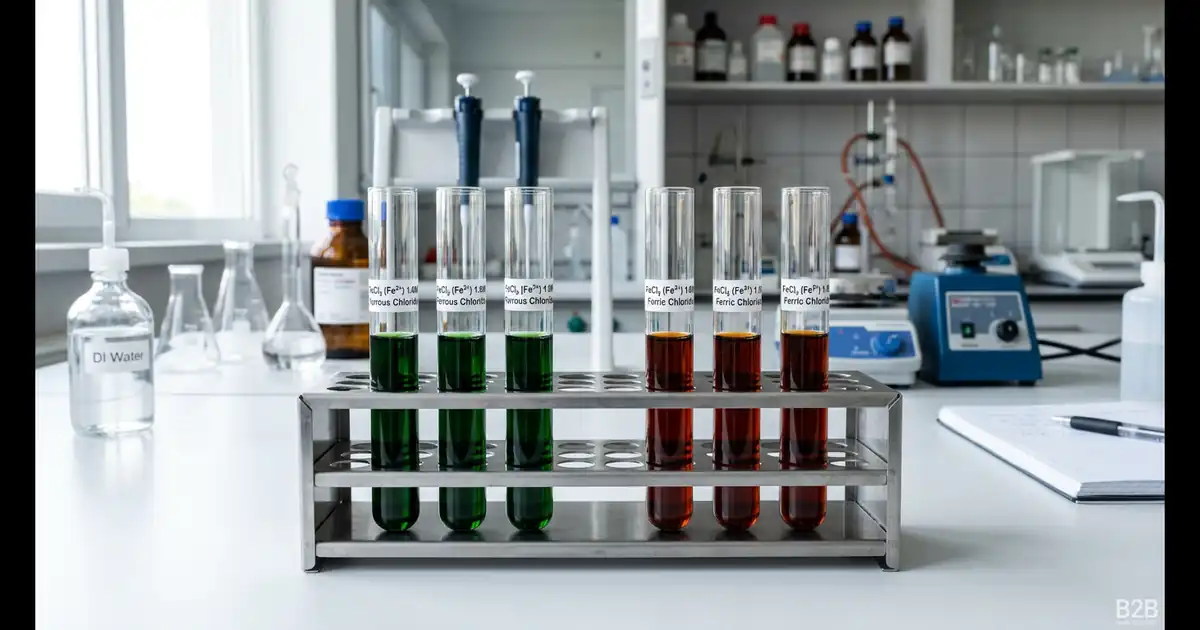
The classic Fenton reaction is between ferrous iron (Fe²⁺) and hydrogen peroxide (H₂O₂) in an acidic environment, generating hydroxyl radicals (•OH) — one of the strongest oxidizing agents used in water treatment:
Fe²⁺ + H₂O₂ → Fe³⁺ + OH⁻ + •OH
The •OH radical has an oxidation potential of E° = 2.80 V — second only to fluorine (3.05 V), and higher than ozone (2.07 V), H₂O₂ (1.78 V), and chlorine (1.36 V). With this oxidation potential, •OH can oxidize most recalcitrant organic compounds, especially azo dyes.
•OH Attack Mechanism on the Azo Bond (–N=N–)
The azo bond (–N=N–) is the bridge between two aromatic rings in the dye molecule and is responsible for the color. The •OH radical preferentially attacks this position through two mechanisms:
- Electrophilic addition: •OH bonds to the carbon α adjacent to the –N=N– bond, weakening it
- Bond cleavage: the N=N bond breaks, forming aromatic amines and intermediate products
Azo bond cleavage occurs very rapidly within the first 2-3 minutes — the solution is observed to lose color almost instantly. This is the primary decolorization pathway, not complete mineralization.
Mineralization of Benzene Rings: From Azo Dye → CO₂ + H₂O (TOC Removal)
After the azo bond is broken, the remaining benzene and naphthalene sulfonate rings continue to be attacked by •OH:
- Benzene ring: •OH opens the ring via hydroxylation, forming short-chain carboxylic acids
- Naphthalene ring: the two-ring structure is harder to break down, requiring more •OH
- Complete mineralization: homogeneous Fenton achieves 21.6% TOC removal for RB5; photo-Fenton (UV + Fe³⁺ regenerating Fe²⁺) achieves 46.4%
This explains why classic Fenton is often designed as a pretreatment step — breaking down the color structure and high COD, followed by biological treatment for the more biodegradable intermediate products.
Homogeneous vs. Heterogeneous Fenton (Dissolved FeCl₂ vs. Fe-ZVI)
| Criteria | Homogeneous Fenton (FeCl₂ + H₂O₂) | Heterogeneous Fenton (Fe-ZVI + H₂O₂) |
|---|---|---|
| Fe²⁺ source | Dissolved FeCl₂ (ready to use) | Fe-ZVI (zero-valent iron, slow dissolution) |
| Reaction control | Precise — separate Fe²⁺ and H₂O₂ dosing | Less control — depends on ZVI corrosion rate |
| Optimal pH | 2.8-3.5 | 2.0-4.0 |
| Speed | Fast — immediate reaction | Slow — requires iron dissolution time |
| Capital cost | Low — only needs a tank + pump | High — requires a ZVI reactor column |
| Best suited for | Highly colored wastewater, COD <5000 | Very high, continuous COD wastewater |
Most textile dyeing wastewater treatment plants in Vietnam choose homogeneous Fenton with liquid FeCl₂ due to low capital cost, flexible control, and ease of operation.
Optimizing the Fe²⁺:H₂O₂ Ratio for Reactive Black 5
Findings from Lucas & Peres (2006)
The classic study by Lucas & Peres, published in Dyes and Pigments (2006), determined the optimal ratio for Reactive Black 5 (RB5) in a homogeneous Fenton system:
- H₂O₂:RB5 molar ratio = 4.9:1 — the amount of H₂O₂ needed to initiate the reaction
- Fe²⁺:H₂O₂ molar ratio = 1:9.6 — equivalent to a FeSO₄ mass ratio of approximately 1:3.6
At this ratio, RB5 decolorization efficiency reaches 97.5% after 15 minutes, with 45% COD reduction.
pH Effect: Optimal at pH 3
pH is the most critical operating parameter for Fenton:
- pH 2.8-3.5: Optimal range — Fe²⁺ remains in its active form, H₂O₂ is stable
- pH <2.5: H₂O₂ protonates to H₃O₂⁺ — reducing •OH generation capacity. Reaction rate slows
- pH >4.0: Fe³⁺ precipitates as Fe(OH)₃ — losing catalytic activity, Fe²⁺ is not regenerated
- pH >5.0: Severe decline — Fe²⁺ precipitates completely
Operating rule: always adjust wastewater pH to 3.0 ± 0.2 before adding Fe²⁺, then dose H₂O₂.
Kinetics: A Two-Phase Reaction
Fenton azo dye decolorization follows two-phase kinetics:
Phase 1 — First-order reaction (0-2 minutes): Fe²⁺ reacts quickly with H₂O₂ to form •OH, immediately attacking the azo bond. First-order kinetics with a high rate constant k₁. 80-90% of color is destroyed within the first 2 minutes.
Phase 2 — Slower reaction (2-15 minutes): Fe³⁺ + H₂O₂ slowly regenerates Fe²⁺ (Fenton-like reaction: Fe³⁺ + H₂O₂ → Fe²⁺ + HO₂• + H⁺). The rate slows, continuing to treat intermediate products.
Decolorization Efficiency: 97.5% Fenton, 98.1% Photo-Fenton in 15 Minutes
| Parameter | Fenton (Fe²⁺ + H₂O₂) | Photo-Fenton (UV + Fe²⁺ + H₂O₂) |
|---|---|---|
| Decolorization (15 min) | 97.5% | 98.1% |
| COD removal (15 min) | 45% | 52% |
| TOC removal (15 min) | 21.6% | 46.4% |
| Reaction time | 15-30 minutes | 10-20 minutes |
Photo-Fenton improves TOC removal because UV regenerates Fe²⁺ from Fe³⁺ and generates additional •OH via H₂O₂ photolysis. UV capital cost is higher — for most textile dyeing wastewater treatment plants, classic Fenton is sufficient for decolorization and COD removal.
Comparing Reactive Black 5 and Reactive Blue 19 — Structure and Reactivity
RB5 Structure: 2 Azo Groups + 2 Naphthalene Sulfonate Rings
Reactive Black 5 (CAS 17095-24-8, MW 991.82 g/mol, λmax 597 nm) is a typical azo dye:
- 2 azo bonds (–N=N–) linking aromatic rings
- 2 naphthalene rings with sulfonate groups (SO₃⁻) — increasing solubility
- Vinyl sulfone structure allows covalent bonding with cellulose fibers
RB19 Structure: Anthraquinone + 1 Azo Group
Reactive Blue 19 (CAS 2580-78-1) has a different structure:
- Anthraquinone core (3 fused aromatic rings) — high chemical stability, harder to break down
- 1 secondary azo group
- Vinyl sulfone group similar to RB5
Key difference: RB19’s anthraquinone ring is more resistant to •OH than RB5’s naphthalene ring. Result: RB5 achieves >95% decolorization within 15 minutes, while RB19 requires 20-30 minutes and 30-40% higher H₂O₂ dosage.
Adjusting the Fe²⁺ and H₂O₂ Ratio by Dye Type
| Parameter | Reactive Black 5 | Reactive Blue 19 |
|---|---|---|
| H₂O₂:dye ratio (mol) | 4.9:1 | 6.5:1 |
| Fe²⁺:H₂O₂ ratio (mol) | 1:9.6 | 1:7.5 |
| Reaction time | 15 minutes | 25-30 minutes |
| Decolorization | 97.5% | 92% |
| Optimal pH | 3.0 | 3.0 |
Rule: for dyes with an anthraquinone structure (blue, violet), increase H₂O₂ by 1.3-1.5 times compared to regular azo dyes. Run a jar-test to optimize the ratio based on the actual dye type in your wastewater.
Choosing an Fe²⁺ Source: Lộc Thiên FeCl₂ vs. Other Iron Sources
FeCl₂ 28.5% COA — Real Data
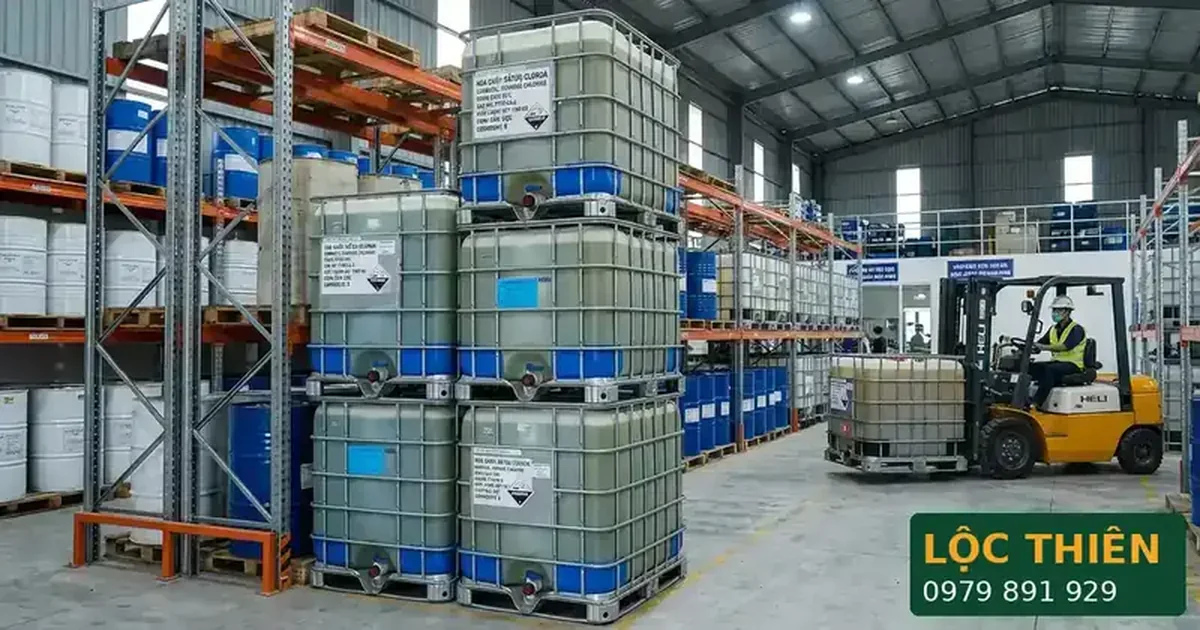
Lộc Thiên’s FeCl₂ (CAS 7758-94-3) supplies liquid, ready-to-use Fe²⁺. Parameters per MSDS 2026 / TCCS 53/2023/HCBH:
- FeCl₂: 28.5%
- Specific gravity (20°C): 1.25-1.31 g/ml
- pH: <1.0
- ZDHC MRSL v3.1: PASS 5/5 substance groups (Chlorobenzenes, Chlorophenols, Phthalates, Glycols, Perboric acid) — TÜV Rheinland 248162921-02a
FeSO₄·7H₂O — Pros and Cons vs. FeCl₂ in Fenton
| Criteria | FeCl₂ 28.5% (liquid) | FeSO₄·7H₂O 98% (solid) |
|---|---|---|
| Form | Liquid, ready to use | Crystalline, requires dissolution |
| Fe²⁺ concentration | ~190 g Fe²⁺/L | ~20% Fe²⁺ (by mass) |
| Preparation labor | Not required | Dissolve 80-100kg/m³ |
| Dosing error | Low (metering pump) | High (weighing errors, incomplete dissolution) |
| Cost per unit Fe²⁺ | Lower | Higher due to preparation labor |
| Storage | PP tank, no moisture absorption concern | Dry warehouse, avoid humidity — clumps easily |
Liquid FeCl₂: Superior Operating Cost
Lộc Thiên’s liquid FeCl₂ outperforms solid FeSO₄ in three ways:
- No dissolution required: saves 1-2 operators per shift
- Precise dosing: metering pump accuracy ±2%, no loss
- Reduced waste: no clumping, no moisture contamination
Many textile mills in Song Than and Nhon Trach Industrial Parks have switched from solid FeSO₄ to liquid FeCl₂ for Fenton, cutting monthly chemical costs by 31%.
Anonymized Case Study: Textile Mill, 2,500 m³/day, Song Than Industrial Park
Textile dyeing wastewater: COD 1,800 mg/L, color 1,200 Pt-Co, pH 6.8.
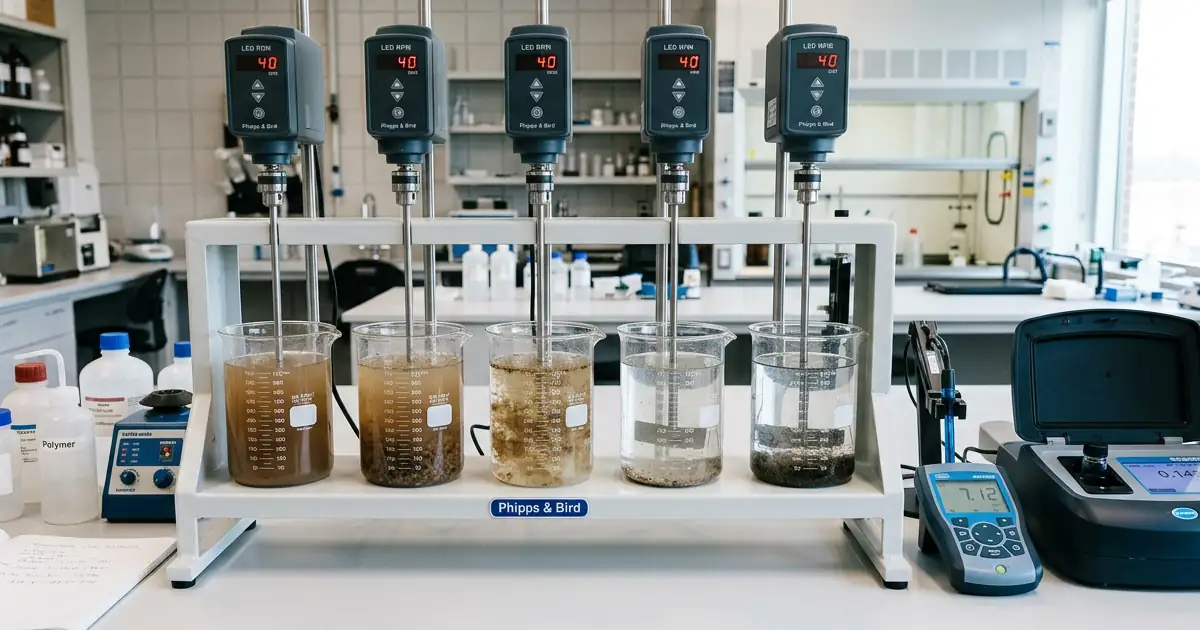
Fenton process with Lộc Thiên FeCl₂:
- Adjust pH to 3.0 using H₂SO₄
- Dose FeCl₂ 28.5% at 320 mg/L
- Dose H₂O₂ 50% at 195 mL/m³ (Fe²⁺:H₂O₂ ratio ≈ 1:9)
- Mix for 15 minutes, add a supplemental 80 mg/L FeCl₂ to regenerate Fe²⁺
- Raise pH to 7.5 using NaOH to precipitate Fe³⁺
Results:
- Output COD: 520 mg/L (71% reduction)
- Output color: 80 Pt-Co (93% reduction)
- Performance meets QCVN 13-MT:2015/BTNMT Column A
FAQ (≥5 Questions)
Can Fenton decolorize azo dyes?
Yes — this is a primary application of Fenton in textile dyeing. •OH breaks the –N=N– bond, achieving >95% decolorization within 15 minutes.
What Fe²⁺:H₂O₂ ratio is needed for Reactive Black 5?
The optimal molar ratio Fe²⁺:H₂O₂ = 1:9.6 (Lucas & Peres, 2006), equivalent to a FeCl₂:H₂O₂ mass ratio of approximately 1:3.6 using 28.5% FeCl₂.
What is the optimal pH for Fenton decolorization?
pH 3.0 ± 0.2. Above pH 4.0, Fe³⁺ precipitates — losing catalytic activity. Below pH 2.5, H₂O₂ protonates — reducing efficiency.
How does photo-Fenton differ from regular Fenton?
Photo-Fenton adds UV (365 nm), which helps regenerate Fe²⁺ from Fe³⁺ and generates additional •OH. TOC removal is roughly double (46.4% vs. 21.6%), but UV adds cost.
Can FeCl₂ be used instead of FeSO₄ in Fenton?
Yes — and it is superior. Liquid FeCl₂ requires no preparation, doses precisely, and has lower operating costs than solid FeSO₄.
What FeCl₂ concentration does Lộc Thiên sell?
FeCl₂ 25-30%, with actual batch COA at 28.5%. Directly manufactured, delivered by 5-30 ton tanker trucks. Call 0979 891 929 to receive a COA and quotation.
Hóa Chất Lộc Thiên — Direct FeCl₂ manufacturer in Vietnam (Tax ID 0313650856) Fe²⁺ source for Fenton · COA per batch · 5-30 ton tanker trucks Phone: 0979 891 929