Liquid FeCl3 40% (Factory-Produced) vs Ferrous Sulfate FeSO4: Phosphorus Removal, Sludge Volume & H2S Control
Table of contents
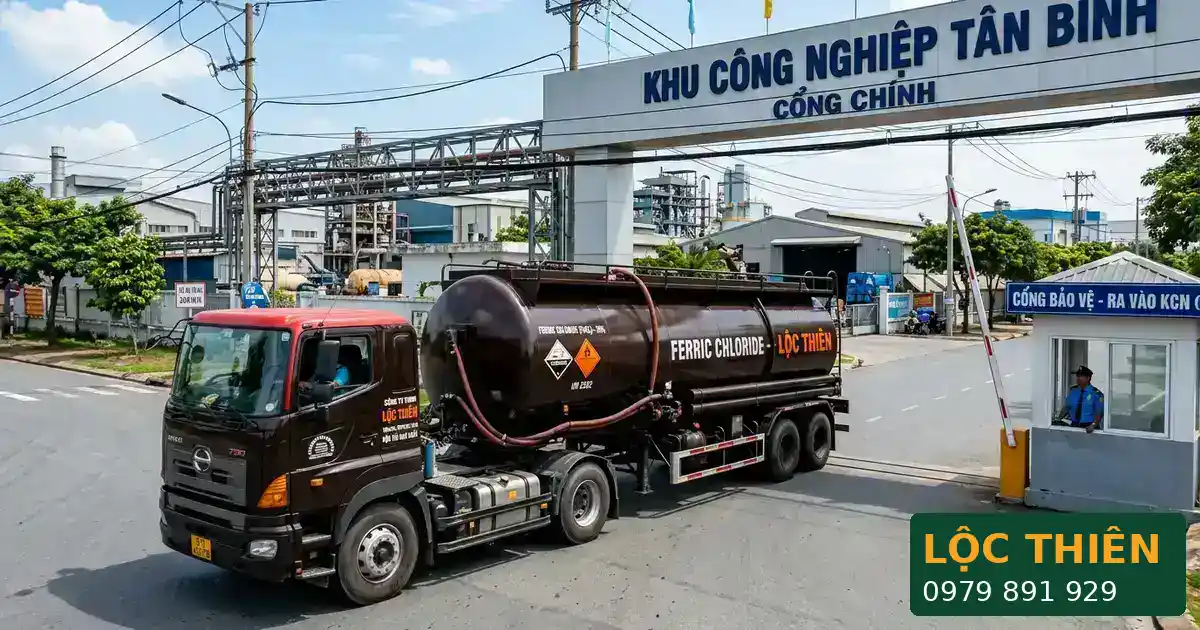
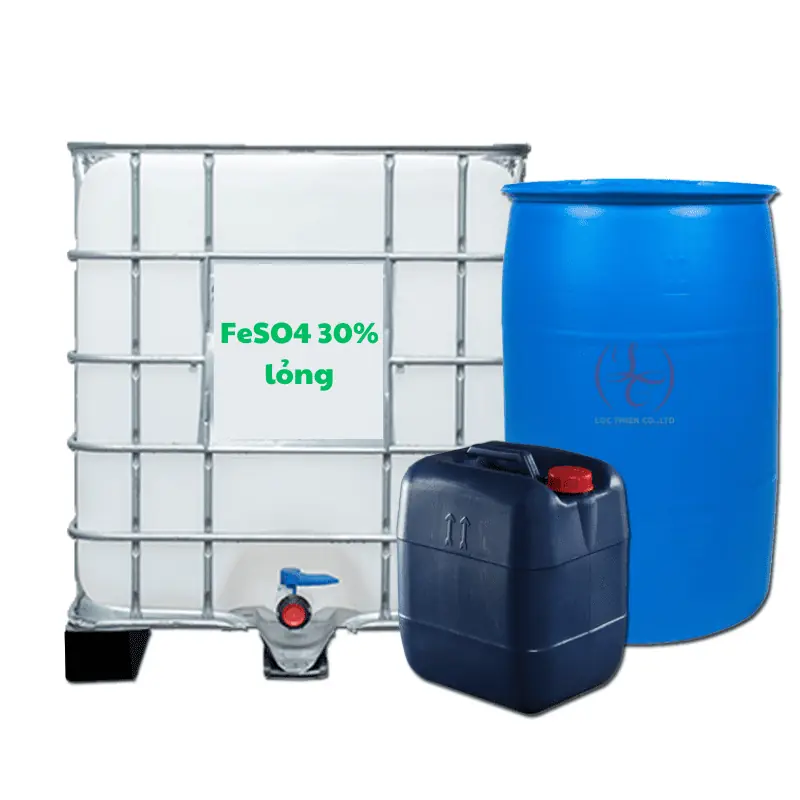
When industrial wastewater engineers and procurement committees evaluate iron salts strictly by unit purchase price per commercial kilogram, critical downstream operating costs frequently remain hidden: hydrated lime consumption for high-pH conditioning, blower electricity for ferrous oxidation, hazardous gypsum sludge disposal fees, and biogenic hydrogen sulfide (H₂S) corrosion inside anaerobic reactors. This technical guide provides a mass-balance and regulatory comparison between wastewater-grade liquid Ferric Chloride FeCl₃ 40% w/w — produced in-house by Loc Thien Chemical as a direct manufacturer with over 3,000 metric tons per month of supply capacity — and commercial crystalline Ferrous Sulfate FeSO₄·7H₂O 98% (25 kg bags) alongside liquid Ferrous Sulfate FeSO₄ 30%, supplied in bulk industrial quantities across Vietnam.
Get an engineering quote within 15 minutes: Share your daily wastewater flow rate, target pollutants, and delivery province via our B2B bulk quotation form, Email [email protected], or Hotline / Vietnamese Zalo 0979 891 929 (
+84 979 891 929) for batch-specific COAs and Jar-test sample support.
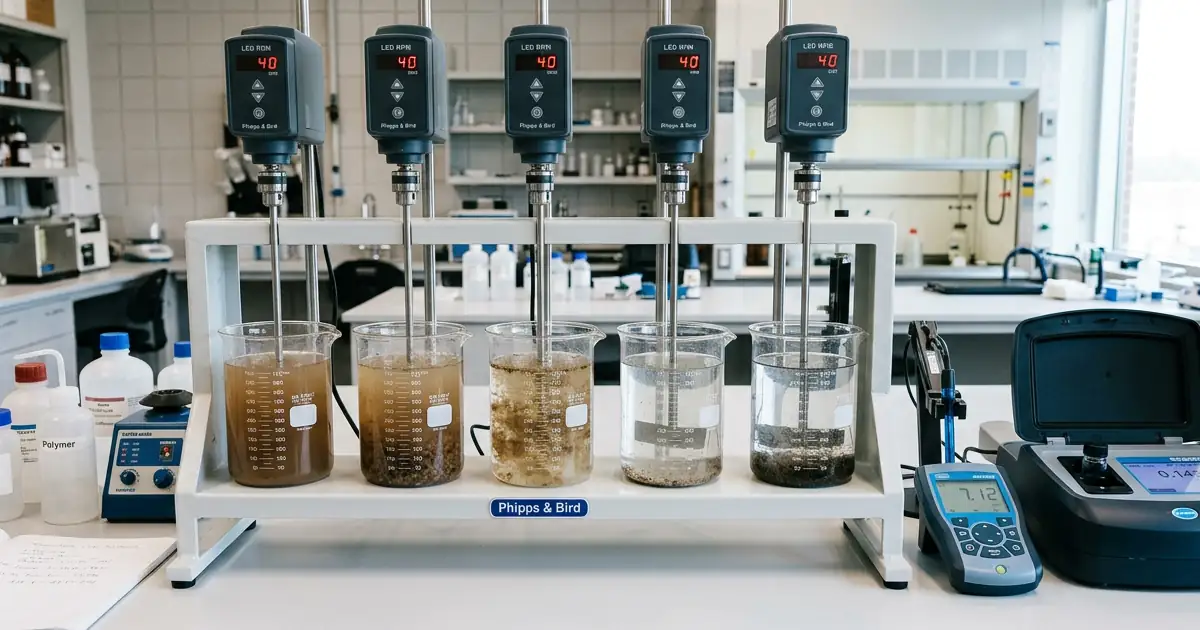
How Do Liquid FeCl₃ 40% and Ferrous Sulfate FeSO₄·7H₂O 98% Differ in Active Iron Stoichiometry and Coagulation pH?
Liquid Ferric Chloride FeCl₃ 40% w/w delivers trivalent Fe³⁺ ions ready for immediate hydrolysis and sweep flocculation across a broad pH window of 4.5 to 9.0, whereas Ferrous Sulfate FeSO₄·7H₂O 98% w/w supplies divalent Fe²⁺ ions that require heavy alkali conditioning to pH 8.5–9.5 plus mechanical aeration before insoluble ferric hydroxide flocs can form.
Evaluating both coagulants on an exact 1,000 kg commercial product mass-balance basis reveals why treatment behavior diverges sharply on the plant floor:
- Liquid Ferric Chloride FeCl₃ 40% w/w (CAS 7705-08-0, UN 2582, Class 8 Corrosive): Pure
FeCl₃has a molar mass of 162.20 g/mol (34.43% elemental iron by mass). Every 1,000 kg of commercialFeCl₃ 40% w/wsolution contains 400 kg ofFeCl₃, delivering 137.7 kg of immediately active trivalentFe³⁺and 0 kg of sulfate (SO₄²⁻). Because its specific gravity at 20 °C ranges from 1.41 to 1.44 g/cm³ (verified per batch COA), one 1,000 L IBC tote ofFeCl₃ 40% w/whas a net liquid weight of approximately 1,410–1,440 kg (around 1.42 metric tons), supplying roughly 195.5 kg of activeFe³⁺. Receiving warehouses and cost accountants should never equate a 1,000 L IBC tote to 1.0 metric ton. - Crystalline Ferrous Sulfate Heptahydrate FeSO₄·7H₂O 98% w/w (CAS 7782-63-0, 25 kg bag): With a molar mass of 278.01 g/mol (20.09%
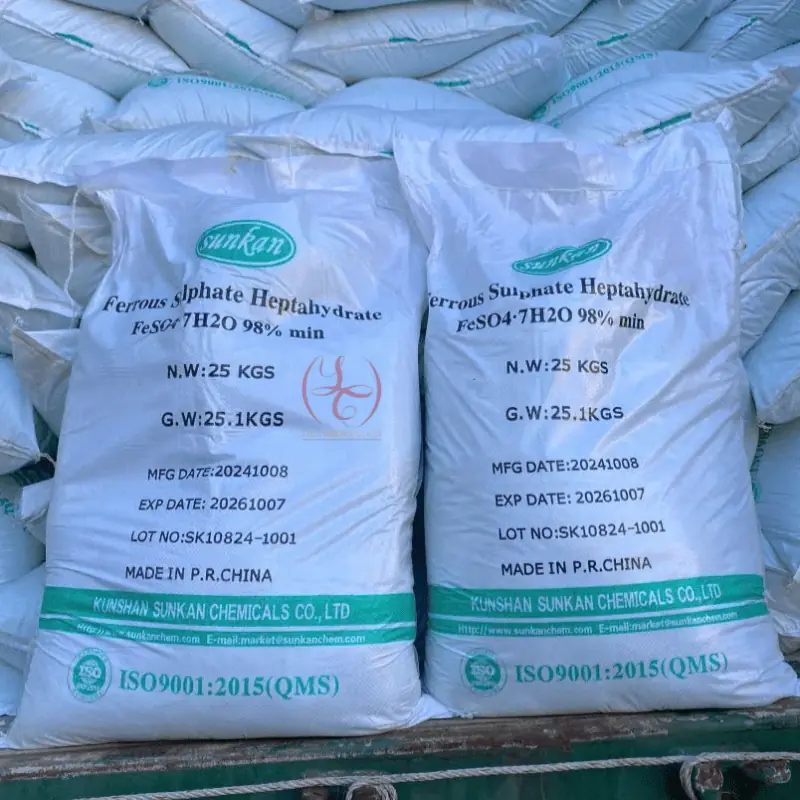
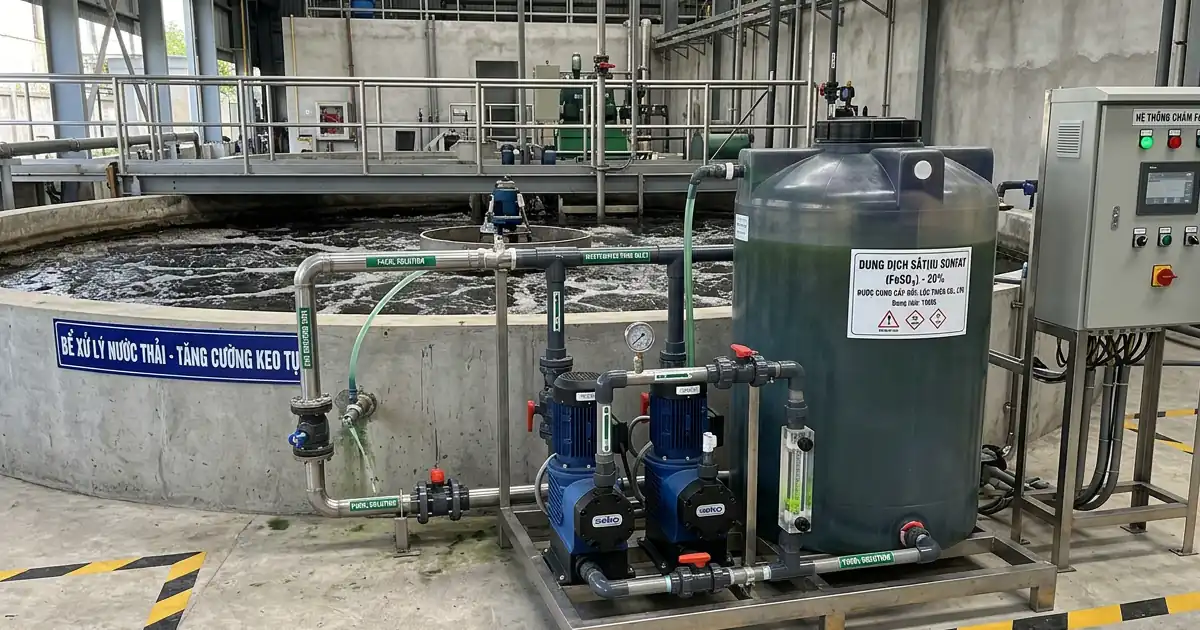
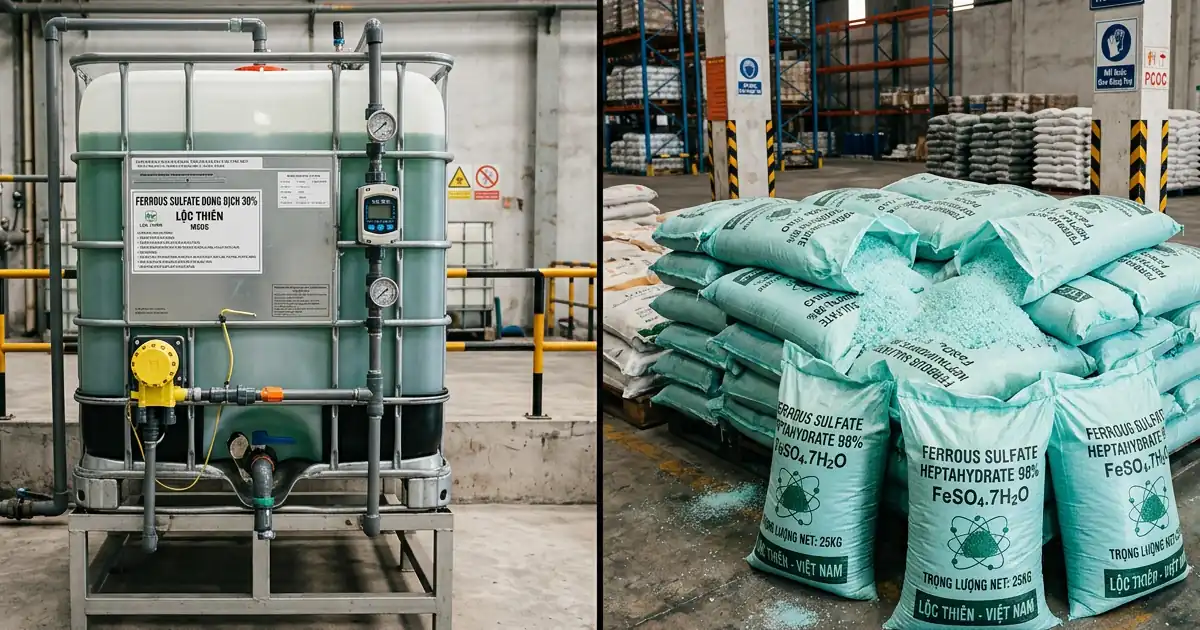
Fe²⁺and 34.55%SO₄²⁻), 1,000 kg of commercialFeSO₄·7H₂O 98%contains 196.9 kg of divalentFe²⁺accompanied by 338.6 kg of sulfate (SO₄²⁻) and over 444 kg of water of crystallization. Because ferrous hydroxideFe(OH)₂remains highly soluble at neutral pH, operators must dose substantial hydrated limeCa(OH)₂or caustic sodaNaOHto raise basin pH to 8.5–9.5, maintain dissolved oxygen (DO ≥ 2.0–3.0 mg/L) via blowers to oxidize4Fe²⁺ + O₂ + 10H₂O → 4Fe(OH)₃↓ + 8H⁺, and subsequently dose acid for post-clarifier re-neutralization back to pH 6.0–9.0. Facilities requiring automated liquid ferrous dosing without manual bag cutting can specify liquid Ferrous Sulfate FeSO₄ 30%.
| Technical & Operational Parameter | Liquid FeCl₃ 40% w/w (CAS 7705-08-0) | Crystalline FeSO₄·7H₂O 98% (CAS 7782-63-0) & Liquid FeSO₄ 30% |
|---|---|---|
| Loc Thien Chemical Supply Role | Direct manufacturer of wastewater-grade liquid FeCl₃ (3,000+ tons/month capacity) | Commercial bulk industrial chemical supplier |
| Physical Form & Specific Gravity at 20 °C | Dark reddish-brown liquid; SG 1.41–1.44 g/cm³ at 20 °C | Pale green heptahydrate crystals (25 kg bag) or green 30% w/w solution (SG 1.20–1.24 at 20 °C) |
| Active Iron per 1,000 kg Commercial Product | 137.7 kg trivalent Fe³⁺ (instant hydrolysis, zero oxidation blowers required) | 196.9 kg divalent Fe²⁺ (for 98% grade; requires alkali boost + aeration to form Fe³⁺) |
Sulfate (SO₄²⁻) Load Added per 1,000 kg | 0 kg SO₄²⁻ (fully soluble chloride Cl⁻ matrix) | 338.6 kg SO₄²⁻ (for 98% grade; drives gypsum scaling and anaerobic H₂S risk) |
| Effective Coagulation pH Window | Wide pH 4.5 – 9.0 (rapid dense settling across pH 5.5 – 7.5) | Narrow alkaline pH 8.5 – 9.5 with forced aeration when used as a coagulant |
Direct Phosphorus (PO₄³⁻) Precipitation | High-efficiency FePO₄↓ precipitation directly at pH 5.5 – 7.0 | Ineffective at neutral pH unless pre-oxidized to Fe³⁺ or over-limed |
| Chemical Sludge Volume & Dewatering | Compact, high-density Fe(OH)₃ flocs; lower filter-cake moisture | Generates 25–40% higher sludge mass due to CaSO₄·2H₂O gypsum co-precipitation with lime |
H₂S Control & UASB Anaerobic Safety | Oxidizes H₂S to elemental S↓ and black FeS↓; zero sulfate load to UASB | High SO₄²⁻ feeds sulfate-reducing bacteria (SRB) to generate toxic H₂S gas |
| Total Iron Control vs QCVN 40:2025 Col. A | Reliable control within Total Fe ≤ 2.0 mg/L via complete neutral-pH precipitation | High carry-over risk of unoxidized Fe²⁺, causing yellow effluent discoloration |
| GHS Hazard Class & Tank Compatibility | Danger: H290, H302, H314, H412 · UN 2582, Class 8; FRP, HDPE, PP, uPVC, rubber-lined steel | Warning: H302, H315, H319; dry palletized indoor storage away from moisture caking |
Technical note: Exact assay, specific gravity at 20 °C, free acidity, and trace heavy-metal limits are verified against the batch Certificate of Analysis (COA) delivered with every shipment.
Why Does Liquid FeCl₃ 40% Excel in Phosphorus Removal and H₂S Control While FeSO₄ Carries 3 Hidden Operational Risks?
Liquid Ferric Chloride FeCl₃ 40% precipitates orthophosphate directly within the neutral pH zone of biological treatment trains and scavenges dissolved sulfides without introducing sulfate anions, eliminating three costly operational failure modes associated with Ferrous Sulfate FeSO₄·7H₂O.
Direct Phosphorus Precipitation and Stoichiometric H₂S Control with FeCl₃ 40%
In industrial park centralized plants, food processing, seafood, and livestock wastewater containing elevated nutrients, trivalent Fe³⁺ from liquid FeCl₃ 40% reacts directly with orthophosphate via Fe³⁺ + PO₄³⁻ → FePO₄↓. Minimum solubility occurs right inside pH 5.5 – 7.0, allowing simultaneous tertiary or secondary co-precipitation without extreme pH swings. Theoretically, 1.80 kg of active Fe³⁺ precipitates 1.0 kg of elemental Phosphorus (P); because hydroxide hydrolysis (Fe³⁺ + 3H₂O → Fe(OH)₃↓ + 3H⁺, consuming roughly 0.93 mg CaCO₃ alkalinity per mg FeCl₃) competes in real effluent, plant dosage is established via Jar-test.
For odor abatement and biogas protection against hydrogen sulfide (H₂S), FeCl₃ 40% acts through a two-stage redox pathway: first, Fe³⁺ oxidizes dissolved H₂S into insoluble elemental sulfur (S↓) while reducing to Fe²⁺ (2Fe³⁺ + H₂S → 2Fe²⁺ + S↓ + 2H⁺); second, at suitable neutral-to-mildly-alkaline pH, the resulting Fe²⁺ binds remaining S²⁻ ions to form stable black ferrous sulfide precipitate (FeS↓).
Three Hidden Operational Risks of Routine Coagulation with FeSO₄·7H₂O
- Gypsum (
CaSO₄·2H₂O) Pipe Scaling and Inflated Hazardous Sludge Disposal Costs: Every metric ton ofFeSO₄·7H₂O 98%injects 338.6 kg ofSO₄²⁻. When hydrated limeCa(OH)₂is dosed to reach pH 8.5–9.5, calcium and sulfate exceed gypsum solubility, scaling mixers, sludge transfer lines, and filter-press cloths while increasing dewatered sludge tonnage by 25–40%. Because licensed hazardous industrial sludge collection and disposal contractors in Vietnam typically charge a reference rate of 1,800,000 – 3,500,000 VND per metric ton of sludge, excess gypsum cake rapidly outweighs any apparent per-kilogram chemical savings. - Biogenic
H₂SGas Generation in Anaerobic Digesters and UASB Reactors: In paper mills, cassava starch, rubber, beverage, and food plants where filtrate or supernatant recycles to equalization or UASB anaerobic reactors, excessSO₄²⁻is reduced by sulfate-reducing bacteria (SRB) into toxic, corrosiveH₂Sgas — inhibiting methanogenic granules, corroding reinforced concrete headspace, and damaging biogas engines. - Incomplete
Fe²⁺Oxidation Causing Yellow Effluent andQCVN 40:2025/BTNMTExceedances: Whenever basin pH dips below 8.0 or blower aeration drops during peak load, soluble colorlessFe²⁺slips past the clarifier and oxidizes downstream in the discharge channel, turning treated water rusty yellow and risking violation of Total IronFe ≤ 2.0 mg/Lunder Column A ofQCVN 40:2025/BTNMT(issued under Circular 06/2025/TT-BTNMT, effective 01/09/2025 under Vietnam’s Ministry of Agriculture and Environment, with a transition roadmap through 31/12/2031 for existing facilities operating prior to the effective date and mandatory enforcement from 01/01/2032; Columns B and C limit Total Fe to ≤ 10 mg/L).
When Should an Industrial Plant Specify FeCl₃ 40% Versus Ferrous Sulfate FeSO₄?
Liquid Ferric Chloride FeCl₃ 40% is the primary workhorse for physicochemical coagulation, phosphorus removal, sludge conditioning, and sulfide control, whereas Ferrous Sulfate FeSO₄ remains technically appropriate where chemical reduction by divalent Fe²⁺ or small-volume dry bag storage is specifically required.
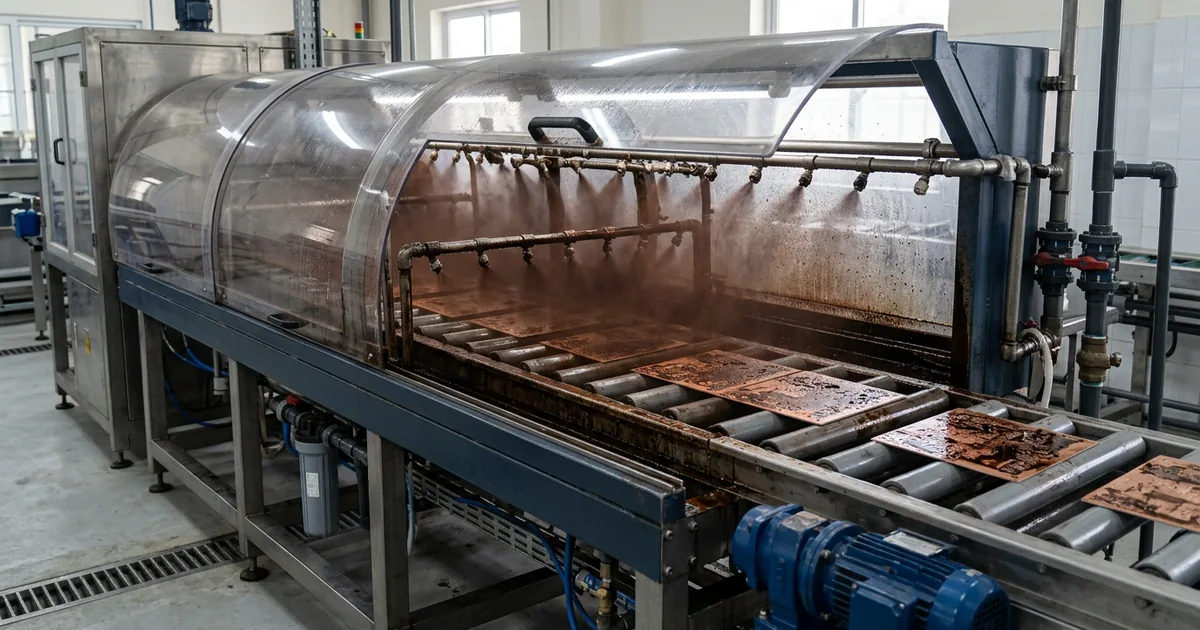
Engineering objectivity requires matching oxidation state to reaction mechanism: because iron in FeCl₃ is already in the +3 oxidation state, it cannot chemically reduce hexavalent chromium (Cr⁶⁺). In acidic electroplating, hard-chrome, or surface-finishing wastewater operating at pH 2.0 – 3.0, divalent Fe²⁺ from crystalline FeSO₄·7H₂O 98% or liquid FeSO₄ 30% donates electrons to reduce toxic Cr⁶⁺ → Cr³⁺ prior to alkaline hydroxide precipitation (plants seeking sulfate-free Cr⁶⁺ reduction without gypsum sludge can alternatively specify liquid FeCl₂ 30%). Remote micro-scale stations lacking Class 8 liquid storage tanks may also prefer palletized 25 kg bags.
Portfolio Boundary: FeCl₃ and FeSO₄ are outside Loc Thien Chemical’s 9 core products holding ZDHC MRSL v3.1 Level 1 documentation; export textile dyeing mills requiring a ZDHC Level 1 iron coagulant should evaluate liquid Ferrous Chloride FeCl₂ 30% (TÜV Rheinland CSR No. 248162921-02, Test Report 248162921-02a). Explore our complete iron coagulant line under the Iron Chloride FeCl₂ & FeCl₃ category hub.
| Industrial Wastewater Scenario | Recommended Iron Salt | Core Engineering Rationale & Control Point |
|---|---|---|
| Total Phosphorus & colloidal COD removal (IP WWTPs, food, seafood) | Liquid FeCl₃ 40% w/w | Direct FePO₄↓ precipitation at pH 5.5–7.0; eliminates heavy lime conditioning and excess sludge |
| Plants with UASB anaerobic reactors or biogas recovery (pulp & paper, starch) | Liquid FeCl₃ 40% w/w | Zero SO₄²⁻ input prevents SRB-driven H₂S toxicity; actively precipitates existing sulfides |
Hexavalent chromium (Cr⁶⁺ → Cr³⁺) reduction in plating wastewater (pH 2.0–3.0) | FeSO₄·7H₂O 98% / FeSO₄ 30% | Requires divalent Fe²⁺ electron donor in acidic medium (FeCl₂ 30% if zero-sulfate is needed) |
| Export textile dyeing mills requiring ZDHC MRSL v3.1 Level 1 documentation | Liquid FeCl₂ 30% w/w | Strong reactive-dye decolorization backed by TÜV Rheinland Level 1 CSR 248162921-02 |
| Small remote stations (< 50 m³/day) without Class 8 liquid storage tanks | FeSO₄·7H₂O 98% (25 kg bag) | Dry palletized storage; strictly maintain pH 8.5–9.5 and aeration DO during coagulation |
Technical illustration (worked example): 2,000 m³/day Industrial Park WWTP Removing Total Phosphorus & COD
Consider a Technical illustration (worked example) for a centralized industrial park wastewater treatment plant operating at 2,000 m³/day (60,000 m³/month across 30 days), required to reduce Total Phosphorus from 12.0 mg/L down to below 3.0 mg/L (removing 18.0 kg P/day) while polishing colloidal COD and TSS downstream of biological treatment:
- Active Iron Requirement: Theoretical stoichiometry (
1.80 kg Fe³⁺per1.0 kg P) equals 32.4 kgFe³⁺/day. Assuming bench Jar-testing establishes a practical molar factor of 1.67 times theoretical to co-precipitateFePO₄↓and sweepFe(OH)₃↓flocs at pH 6.2, the target active ferric feed is 54.0 kgFe³⁺/day (27.0 mgFe³⁺/L). - Liquid FeCl₃ 40% w/w Dosing Option (
137.7 kg Fe³⁺/ton, SG 1.42 g/cm³ at 20 °C): Daily commercial solution consumption comes to approximately 392 kg/day (diaphragm metering pump flow of roughly 276 L/day, or 11.5 L/hour), totaling 11.76 metric tons/month — cleanly supplied by a single 5–30-ton road tanker delivery per month (or 8 to 9 totes of 1,000 L IBC), operating directly at pH 6.2 with 0 kgSO₄²⁻/day added. - Comparison with Crystalline FeSO₄·7H₂O 98% (25 kg bags): Accounting for 15–25% incomplete oxidation margin in full-scale basins, operators must manually haul and dissolve roughly 320 kg/day (nearly 13 bags of 25 kg daily, or 9.6 tons/month), injecting 108.4 kg
SO₄²⁻/day (3.25 metric tonsSO₄²⁻/month) alongside heavy lime consumption, acid re-neutralization, and multi-ton monthly gypsum sludge disposal charges.
Mandatory Jar-test Verification: Reference dosage ranges serve solely for preliminary sizing. Actual plant dosing rates must always be determined through bench-scale Jar-test trials on representative site wastewater. Engineers can model pump rates prior to bench trials using our online chemical dosage calculator.
QA/QC Laboratory Insight — Loc Thien Chemical: “When assisting FDI and industrial park engineers with comparative Jar-tests targeting Column A of QCVN 40:2025/BTNMT, our critical checkpoint is maintaining final flocculation pH between 6.0 and 7.2 and verifying supernatant residual iron after 30 minutes of quiescent settling to stay well below Total Fe ≤ 2.0 mg/L. Every production batch of liquid FeCl₃ 40% leaving Loc Thien Chemical’s plant undergoes strict inspection of specific gravity at 20 °C (1.41–1.44 g/cm³), assay, free acid, and periodic third-party heavy-metal verification (As, Pb, Cd, Hg) at Quatest 3 before tanker dispatch.” — Vo Thi Nhu Hoa, QA/QC Specialist, Loc Thien Chemical Quality Control Laboratory.
Need side-by-side bench samples for your WWTP? Contact our engineering desk at 0979 891 929 (Hotline / Zalo) or request Jar-test samples & a 15-minute technical quote.
What GHS Hazards, Tank Materials, and 2026 Vietnamese Chemical Regulations Apply to Liquid FeCl₃ 40%?
Liquid Ferric Chloride FeCl₃ 40% is a strongly acidic Class 8 corrosive liquid (pH < 1, UN 2582) that demands non-metallic or rubber-lined containment, strict physical segregation from sodium hypochlorite (NaOCl), and full compliance with Vietnam’s Law on Chemicals 69/2025/QH15.
- GHS Classification & PPE (per GHS-compliant FeCl₃ Safety Data Sheet under Circular
01/2026/TT-BCT): Signal word Danger; Hazard statements H290 (May be corrosive to metals), H302 (Harmful if swallowed), H314 (Causes severe skin burns and eye damage), and H412 (Harmful to aquatic life with long-lasting effects). Operators unloading tankers or servicing pumps must wear chemical splash goggles with a full face shield, acid-resistant nitrile/neoprene gauntlets, chemical aprons, and maintain an emergency eyewash/safety shower station within 15 meters.
ACUTE TOXIC CHLORINE GAS (
Cl₂) WARNING — NEVER MIX WITH JAVEL (NaOCl): LiquidFeCl₃ 40%is strongly acidic (pH < 1). Strictly prohibit mixing, co-storing within the same secondary containment bund, interconnecting sump drains, or sharing unloading couplings and dosing lines with Sodium Hypochlorite solution (NaOCl10%–12% w/v available chlorine / Javel). Accidental contact instantaneously acidifies hypochlorite and releases lethal Chlorine gas (Cl₂).
- Compatible vs Prohibited Storage Materials: Specify vinyl-ester FRP, UV-stabilized HDPE, PP, uPVC, cPVC, PVDF, PTFE, or rubber-lined carbon steel tanks and piping. Strictly prohibit bare carbon steel, cast iron, aluminum (
Al), copper (Cu), zinc (Zn), and even 304 stainless steel (SS304), which suffers rapid chloride pitting corrosion (Cl⁻); wetted metallic pump shafts or instrumentation require Titanium or Hastelloy C-276. - 2026 Regulatory Compliance Framework: Manufacturing, storage, and procurement comply with Vietnam’s Law on Chemicals No.
69/2025/QH15(effective01/01/2026). Ferric Chloride (CAS 7705-08-0) is listed as Item432in Appendix II of Decree24/2026/ND-CP(effective17/01/2026) covering conditional industrial chemicals (including mixtures containing > 5% by weight). Chemical safety training, spill prevention plans, Class 8 dangerous-goods road transport, and Vietnamese GHS SDS documentation follow Decree25/2026/ND-CP, Decree161/2024/ND-CP, and Circular01/2026/TT-BCT.
How Does Loc Thien Chemical Support Procurement, Plant Engineers, and Finance Across 6 Warehouses?
Transitioning a full-scale wastewater plant to direct-manufacturer liquid coagulants requires synchronized assurance across supply continuity, automated unloading safety, and compliant tax documentation for the enterprise buying committee.
- For Procurement Teams: Loc Thien Investment Development Co., Ltd. (established 2016, Tax ID
0313650856, legal head office at452/6B Tinh Lo 10, Binh Tri Dong Ward, Binh Tan District, Ho Chi Minh City) operates as the direct manufacturer of wastewater-grade liquid FeCl₃ 40% (3,000+ metric tons/monthtotal supply capacity) and a reliable bulk supplier ofFeSO₄·7H₂O 98%andFeSO₄ 30%, backed by 6 regional warehouses and bilingual vendor qualification dossiers. - For Plant & EHS Engineers: Consistent batch-to-batch
FeCl₃ 40% w/wconcentration and specific gravity (1.41–1.44 g/cm³at 20 °C) keep metering pumps calibrated without shift-by-shift drift, while dedicated 5–30-ton Class 8 road tankers pump directly into plant FRP/HDPE storage tanks via sealed camlock couplings. - For Finance & Accounting Teams: Every shipment includes a legally compliant Vietnamese VAT e-invoice issued under Decree
70/2025/ND-CP, certified net-kilogram weighbridge tickets, and bank-transfer settlement documentation supporting input VAT deduction under Vietnam’s Law on Value-Added Tax 2024, with flexible contract payment terms for recurring industrial off-takers.
| Supply & Logistics Specification | Liquid FeCl₃ 40% w/w (CAS 7705-08-0) | FeSO₄·7H₂O 98% & Liquid FeSO₄ 30% | Loc Thien Chemical Operational Standard |
|---|---|---|---|
| Supply Role & Net-Weight Packaging | Manufactured directly by Loc Thien · 30 kg jerrican, 200 L drum, 1,000 L IBC (~1,410–1,440 kg net, ~1.42 tons), 5–30-ton tanker | Commercial bulk supply · 25 kg bag (98% heptahydrate); 30 kg can, 1,000 L IBC, 5–30-ton tanker (30% liquid) | Invoiced strictly by certified net kilograms; never equate 1,000 L IBC volume to 1 ton |
| 6 Standardized Regional Warehouses | Stocked across North, Central & South hubs | Stocked across regional distribution hubs | 1. Ba Ria - Vung Tau (Phu My 1 IP) · 2. Dong Nai (Long Thanh IP) · 3. Binh Duong (Tan Dong Hiep, Di An) · 4. Da Nang (Hoa Khanh IP) · 5. Can Tho (Tra Noc IP) · 6. Bac Ninh (Tien Son IP) (452/6B Tinh Lo 10 is Legal HQ only) |
| Regional Delivery & Quote SLA | Formal technical quote within 15 minutes | Formal technical quote within 15 minutes | Inner Ho Chi Minh City: 4 hours · Southern & Mekong Delta IPs: 24–48 hours · Northern & Central Vietnam: 2–3 days. Contact hotline 0979 891 929 for detailed delivery procedures |
Five Unit-Price Drivers & What Every Official Quotation Includes
In accordance with transparent B2B contract pricing (zero static unit prices published online), delivered pricing is structured around 5 core factors: (1) Active iron concentration and effective treatment cost per 1 m³ of wastewater; (2) Packaging format (5–30-ton bulk road tankers eliminate drum/IBC/bag packaging overhead); (3) Per-drop order volume and monthly/quarterly contract schedule; (4) Class 8 dangerous-goods haulage distance from the nearest of our 6 standardized warehouses; and (5) Site-specific unloading windows and inspection documentation requirements. Every Loc Thien Chemical quotation includes: compliant dangerous-goods transport per agreed delivery terms, sealed pneumatic/pump transfer into your storage tank (for tanker orders), batch-specific COA, GHS SDS per Circular 01/2026/TT-BCT, Jar-test sample support, and Vietnamese VAT e-invoice.
Frequently Asked Questions (FAQ)
What is the exact net weight of one 1,000 L IBC tote of liquid FeCl₃ 40%?
Because liquid FeCl₃ 40% w/w has a specific gravity of 1.41–1.44 g/cm³ at 20 °C (per batch COA), one 1,000 L IBC tote holds approximately 1,410–1,440 kg of net liquid (~1.42 metric tons), excluding the tare weight of the HDPE bottle and steel cage.
Does switching from Ferrous Sulfate FeSO₄ to liquid FeCl₃ 40% reduce hazardous chemical sludge?
Yes. Because FeCl₃ 40% adds 0 kg SO₄²⁻ and coagulates effectively at pH 5.5–7.5 without heavy hydrated lime dosing, plants eliminate CaSO₄·2H₂O gypsum co-precipitation and unreacted lime grit while forming denser ferric hydroxide cakes.
Can liquid FeCl₃ 40% replace FeSO₄ for hexavalent chromium (Cr⁶⁺) reduction in electroplating wastewater?
No. Reducing Cr⁶⁺ → Cr³⁺ at pH 2.0–3.0 requires a divalent Fe²⁺ electron donor from crystalline FeSO₄·7H₂O 98%, liquid FeSO₄ 30%, or sulfate-free liquid Ferrous Chloride FeCl₂ 30% manufactured directly by Loc Thien Chemical.
How do operators prevent residual iron from exceeding Column A of QCVN 40:2025/BTNMT (Fe ≤ 2.0 mg/L)?
Maintain flocculation pH within 6.0–7.5, avoid overdosing FeCl₃ below pH 5.0 where ferric ions re-solubilize, pair with a low dose of anionic polyacrylamide flocculant, and re-verify dosage via Jar-testing whenever influent alkalinity shifts.
Can our factory order trial 1,000 L IBC totes before committing to 5–30-ton road tanker deliveries?
Yes. Loc Thien Chemical provides free laboratory samples for bench Jar-tests, followed by 30 kg jerricans or 1,000 L IBC totes for full-scale plant trials prior to scheduling recurring 5–30-ton dedicated tanker deliveries from our nearest regional warehouse.
Request a 15-Minute Technical Quotation & Bench Jar-Test Sample: Ready to benchmark total treatment cost per cubic meter with factory-manufactured liquid FeCl₃ 40% or secure bulk Ferrous Sulfate FeSO₄·7H₂O 98%? Connect directly with Loc Thien Chemical (bilingual English & Vietnamese support):
- 24/7 Engineering Hotline & Vietnamese Zalo: 0979 891 929 (
+84 979 891 929) (Official technical quote within 15 minutes; contact hotline 0979 891 929 for detailed delivery procedures) · Official Email: [email protected]- B2B Technical Resources: Request 5–30-Ton Tanker & IBC Quote · Download FeCl₃ GHS Safety Data Sheet · Online Wastewater Coagulant Dosage Calculator