
Swine Barn Ammonia (NH3) & Odor Scrubber Engineering for QCVN 05:2023/BTNMT Compliance: Acidifying Wet Pad Curtains with FeCl3 40% / HCl 32% & Why H2SO4 Slurry Acidification Fails
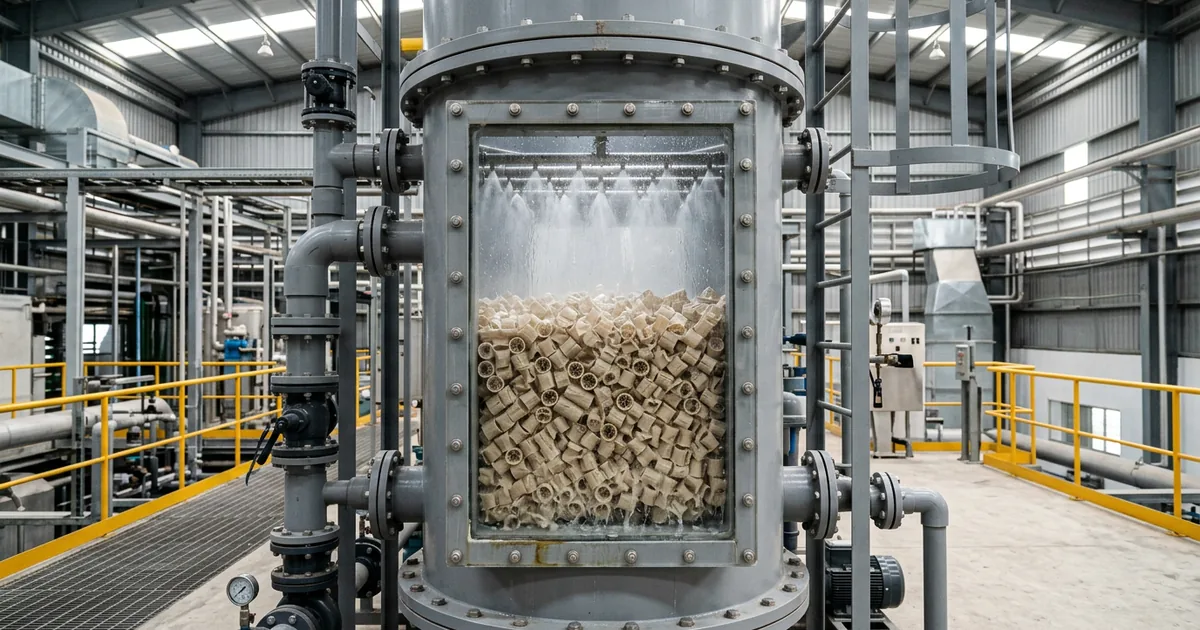
Table of contents
Treating swine barn ammonia (NH₃) and odor exhaust to comply with Vietnam’s QCVN 05:2023/BTNMT ambient air standard (NH₃ ≤ 200 µg/Nm³, H₂S ≤ 42 µg/Nm³, Methyl mercaptan ≤ 50 µg/Nm³) requires retrofitting exhaust fan water curtains into pH-controlled acidified wet scrubbers using FeCl₃ 40% or HCl 32% at pH 3.0–5.0. This engineering approach boosts ammonia capture from 9–23% (plain water) to 89–90% (FeCl₃) and 69–82% (HCl) without inhibiting downstream biogas methane production.
Across commercial swine operations housing 5,000 to 50,000 pigs, engineering budgets frequently prioritize post-biogas wastewater treatment while leaving the high-volume exhaust air discharged from tunnel-ventilated barns virtually untreated. When warm ventilation plumes carrying 22 to 84 ppm of pungent ammonia (NH₃), organic feed dust, and volatile mercaptans drift across the farm perimeter toward residential communities, operators face severe regulatory penalties—including mandatory multi-month suspension of livestock operations.
This engineering guide details how Vietnamese environmental regulators enforce livestock odor complaints under QCVN 05:2023/BTNMT, explains the thermodynamic mechanism causing conventional plain-water curtains to fail within 60 minutes, provides a step-by-step retrofit blueprint using FeCl₃ 40% or HCl 32% backed by USDA-ARS experimental data, and issues a critical safety warning against applying European H₂SO₄ slurry acidification to tropical pig farms equipped with anaerobic biogas lagoons.
1. Regulatory Framework for Livestock Odor Control (QCVN 05:2023/BTNMT, Livestock Law Article 59) & Barn Exhaust (NH₃) vs. Biogas Headspace (H₂S)
A dangerous misconception among agricultural project managers is assuming that because Vietnam has not yet promulgated an European-style Odor Unit (OU/m³) olfactometry standard, environmental inspectors lack quantitative legal grounds to penalize swine barn odor. Inspection records from 2024 to 2026 prove the exact opposite.
1.1. Fence-line odor enforcement via QCVN 05:2023/BTNMT and mandatory residential buffer zones
Under Article 59 of the 2018 Livestock Law and Circular 23/2019/TT-BNNPTNT (whose mandatory relocation or operational suspension deadline took full legal effect after 01/02/2024), livestock farms must maintain strict minimum buffer distances from residential areas, schools, hospitals, and community water sources based on herd scale:
- Small-scale livestock farms: Minimum 100 m buffer distance.
- Medium-scale livestock farms: Minimum 200 m buffer distance.
- Large-scale industrial farms (≥ 300 livestock units): Minimum 400 m buffer distance.
Whenever residents file odor complaints, provincial environmental inspection teams collect 1-hour ambient air samples along the downwind farm perimeter fence line and evaluate them directly against QCVN 05:2023/BTNMT — National Technical Regulation on Ambient Air Quality (which officially replaced both QCVN 05:2013/BTNMT and QCVN 06:2009/BTNMT on hazardous substances in ambient air).
Specifically, QCVN 05:2023/BTNMT establishes strict 1-hour average concentration ceilings for the three signature malodorous gases emitted by industrial swine production:
- Ammonia (
NH₃): 1-hour average limit ≤ 200 µg/Nm³ (approximately0.28 ppmunder standard conditions). - Hydrogen Sulfide (
H₂S): 1-hour average limit ≤ 42 µg/Nm³ (approximately0.03 ppm—right at the human olfactory threshold for rotten-egg odor). - Methyl mercaptan (
CH₃SH): 1-hour average limit ≤ 50 µg/Nm³ (a low-threshold volatile organic thiol emitted by fresh manure and fermented feed).
Recent enforcement precedents highlight the operational risk: in a widely cited regulatory action, provincial authorities ordered a multi-month operational suspension of a 30,000-head commercial swine farm for severe odor and effluent violations. In the official inspection conclusion, regulators explicitly cited two engineering failures: (1) Improper dosing rates and unverified procedures for deodorizing chemicals and microbial agents, and (2) Absence of an approved engineering plan and operating log for barn exhaust and odor treatment.
1.2. Engineering contrast: Tunnel-ventilated barn exhaust (NH₃-dominant) vs. Biogas digester gas (H₂S-dominant)
To engineer cost-effective air pollution control without wasting capital expenditure (CAPEX) or chemical operating expenditure (OPEX), process engineers must distinguish between two fundamentally opposite gas streams generated on a pig farm:
| Engineering Parameter & Chemical Nature | Tunnel-Ventilated Barn Exhaust (End-Wall Exhaust Fans) | Covered HDPE Biogas Digester Gas (Biogas H₂S Scrubber Line) |
|---|---|---|
Volumetric Airflow (Q) | Extremely high flow, low static pressure: 100,000 – 250,000 m³/h per finishing barn (6–12 axial fans, 1.4 m diameter) | Low flow, pressurized pipeline: 50 – 500 Nm³/h routed in closed pipes to biogas gensets or flares |
| Primary Target Pollutant | Alkaline Ammonia Gas (NH₃): 22 – 84 ppm (15,000 – 58,000 µg/Nm³), plus PM10/PM2.5 feed dust and dander | Weakly Acidic Hydrogen Sulfide (H₂S): 3,000 – 4,000 ppm (up to > 5,000 ppm), balanced by 60–65% CH₄ and 30–35% CO₂ |
Actual H₂S Concentration | Negligible in normal barn air: Averages only ~0.3 ppm in finishing swine barns (Overmeyer et al., 2023) | Lethal concentration: 3,000 – 4,000 ppm |
| Acid-Base Chemistry of Target Gas | Basic / Alkaline Gas: NH₃ + H₂O ⇌ NH₄⁺ + OH⁻ (pKa = 9.25) | Weakly Acidic Gas: H₂S ⇌ H⁺ + HS⁻ (pKa1 = 7.04) |
| Required Scrubbing Media | Acidic Scrubbing Solution (pH 3.0 – 5.0): Diluted FeCl₃ 40% or HCl 32% | Source sulfide precipitation via FeCl₂ 30% (forming insoluble FeS) or alkaline scrubbing |
As this comparison demonstrates, installing an alkaline caustic (NaOH) scrubber or an expensive H₂S oxidation unit behind barn ventilation fans is a severe chemical engineering mistake. Inside a tunnel-ventilated finishing barn, H₂S averages only ~0.3 ppm, whereas alkaline NH₃ reaches 22–84 ppm (75 to 280 times higher than the 200 µg/Nm³ fence-line limit under QCVN 05:2023/BTNMT). Dosing alkali into a barn water curtain drives pH upward and forces 100% of dissolved ammonia to strip out into the atmosphere. Conversely, to capture alkaline NH₃ and organic dust from a 100,000–250,000 m³/h ventilation stream, the only thermodynamically viable solution is an acidified wet scrubber (acidified water curtain) operating at pH 3.0 – 5.0.
2. Why Plain-Water Curtains Fail Within 1 Hour & USDA-ARS Experimental Benchmarks for FeCl₃ 40% / HCl 32% Acidification
Many large swine farms across Southern, Central, and Northern Vietnam have constructed end-wall dust chambers (“water curtains” or wet pad walls positioned 2.5–4.0 m downstream of exhaust fans) that recirculate borehole groundwater over plastic/cellulose pads or through spray nozzles. Yet when inspectors test the exhaust plume a few hours into afternoon fan operation, NH₃ removal is nearly zero.
2.1. The physicochemical mechanism behind plain-water saturation after 60 minutes
Gas-liquid mass transfer of ammonia into water is governed by Henry’s Law and aqueous protonation equilibrium:
- Absorption Equilibrium:
NH₃ (gas) ⇌ NH₃ (aq) + H₂O ⇌ NH₄⁺ + OH⁻ (pKa = 9.25 at 25°C)
When gaseous NH₃ dissolves into neutral groundwater (initial pH 6.8 – 8.4), the generation of hydroxyl ions (OH⁻) rapidly alkalinizes the recirculation sump. According to landmark scrubber research conducted by the United States Department of Agriculture — Agricultural Research Service (USDA-ARS, Moore et al., 2018) evaluating chemical additives for livestock exhaust wet scrubbers:
- Operating a wet scrubber with plain recirculating water causes absorbed ammonia to drive recirculation water
pHfrom8.4to> 9.5within just 60 minutes (1 hour) of continuous operation. - At
pH = 9.25, non-volatile ammonium ions (NH₄⁺) and volatile dissolved ammonia gas (NH₃(aq)) exist in a50 : 50ratio. Once waterpHclimbs past9.5, the equilibrium shifts predominantly toward freeNH₃(aq), raising the equilibrium vapor pressure of ammonia at the droplet surface until it equals the incoming barn air concentration. - Consequently, the mass transfer driving force collapses: plain-water curtains capture only 9% to 23% of incoming
NH₃, allowing 77% to 91% of ammonia emissions to pass unimpeded toward neighboring communities. Worse yet, during hot afternoon peaks, the warmed alkaline sump acts as a secondary ammonia stripping basin.
2.2. USDA-ARS (Moore et al., 2018) & Tropical FOPBIACA Scrubber Performance Comparison
To lock absorbed ammonia in the aqueous phase as non-volatile ammonium ions (NH₄⁺ > 99.9% at pH < 6.0), the recirculation sump must be continuously acidified with an inorganic acid or acidic multivalent metal salt to maintain pH 3.0 – 5.0. The table below summarizes experimental data from USDA-ARS (Moore et al., 2018) alongside full-scale tropical field trials of the FOPBIACA wet scrubber system on commercial swine barns in Thailand (220,000 m³/h airflow):
| Scrubbing Media / Chemical Additive | Target Operating pH Window | Measured NH₃ Removal Efficiency | Primary Reaction & Multi-Pollutant Mechanism | Stoichiometric & Practical Dosing Rate per 1.0 kg NH₃ Captured | Field Engineering Assessment for Vietnamese Swine Farms |
|---|---|---|---|---|---|
| Plain Borehole Water (No Chemical Additive) | Drifts from 8.4 to > 9.5 within 60 min | 9% – 23% (Fails compliance) | NH₃ + H₂O ⇌ NH₄⁺ + OH⁻ (Rapid alkaline saturation & ammonia re-volatilization) | Zero chemical dosing (requires massive freshwater blowdown to sustain any capture) | Captures only coarse dust; fails QCVN 05:2023/BTNMT fence-line NH₃ limits |
Liquid Ferric Chloride FeCl₃ 40% (Directly Manufactured by Loc Thien) | 3.0 – 4.5 (Strictly locked < 4.8) | 89% – 90% (Top liquid salt performer) | Acid hydrolysis supplies H⁺ (NH₃ → NH₄Cl); Fe³⁺ coagulates organic dust/dander & oxidizes trace thiols/H₂S | ~8.0 kg FeCl₃ 40% / 1.0 kg NH₃ (~3.18 kg anhydrous FeCl₃ equivalent) | Best multi-target performance: Zero acid vapor pressure, removes 89–90% NH₃, clarifies sump water via feed-dust coagulation |
Industrial Hydrochloric Acid HCl 32% (ZDHC MRSL v3.1 Level 1 Certified) | 3.0 – 4.5 | 69% – 82% | NH₃(g) + HCl(aq) → NH₄Cl(aq) (Forms highly soluble ammonium chloride salt) | ~6.5 kg HCl 32%–33% / 1.0 kg NH₃ (2.14 kg pure HCl per 1.0 kg NH₃) | Best for narrow spray nozzles & wet pads: Forms a 100% clear NH₄Cl solution with zero risk of metal hydroxide scaling if pH fluctuates |
Diluted Sulfuric Acid H₂SO₄ 98% | 3.0 – 4.5 | 74% – 80% | 2NH₃ + H₂SO₄ → (NH₄)₂SO₄ | ~2.94 kg H₂SO₄ 98% / 1.0 kg NH₃ | High exothermic burn hazard for farm workers diluting 98% acid; sulfate-rich blowdown must never enter biogas lagoons |
Ferric Sulfate Fe₂(SO₄)₃ (USDA-ARS Benchmark) | 3.0 – 4.5 | 91% | Acid hydrolysis + NH₄⁺ capture | Solid salt requiring manual dissolving tanks | Less convenient for automated dosing than ready-to-dose liquid FeCl₃ 40% |
Tropical FOPBIACA Full-Scale System (Thailand, Q = 220,000 m³/h) | Primary wet scrubbing + bio-adsorption stage | Reduces NH₃ from 22–84 ppm down to 0–10 ppm (H₂S < 10 ppm) | Pre-wet scrubbing removes feed dust and neutralizes bulk NH₃ load | Validated at full tropical tunnel-ventilation scale (> 200,000 m³/h) | Demonstrates practical viability of high-flow wet scrubbers in hot, humid Southeast Asian swine barns |
2.3. Why Liquid FeCl₃ 40% (89–90% NH₃ Capture) Outperforms Strong Mineral Acids Alone
A pivotal insight from the USDA-ARS (Moore et al., 2018) dataset is that Liquid Ferric Chloride (FeCl₃) achieved 89% – 90% NH₃ removal, outperforming both straight hydrochloric acid (69% – 82%) and sulfuric acid (74% – 80%) under identical scrubber conditions. This superior performance stems from three synergistic physicochemical mechanisms unique to FeCl₃ 40%:
- Continuous Brønsted–Lowry Acid Buffering via Hexaaquairon(III) Hydrolysis: When dissolved in water, the high-charge-density
[Fe(H₂O)₆]³⁺cation undergoes stepwise hydrolysis (Fe³⁺ + nH₂O ⇌ [Fe(OH)ₙ]⁽³⁻ⁿ⁾⁺ + nH⁺), releasing protons (H⁺) that instantaneously protonate absorbedNH₃into non-volatileNH₄⁺(NH₃ + H⁺ → NH₄⁺) and maintain a maximum concentration gradient across the gas-liquid film. - Simultaneous Coagulation of Odor-Carrying Bioaerosols & Feed Dust: In tunnel-ventilated pig barns, a substantial fraction of perceived odor and organic nitrogen is adsorbed onto hydrophobic PM10/PM2.5 feed dust, swine skin dander, and microbial bioaerosols. While plain acid solutions poorly wet hydrophobic dust particles, trivalent
Fe³⁺ions destabilize negative Zeta potentials on suspended organic particulates, sweeping dust and particle-bound odorants out of the air stream into settling flocs. - Zero Acid Vapor Pressure & Oxidative Destruction of Trace Reduced Sulfur (
H₂S/ Mercaptans): Unlike concentratedHCl—which exhibits partial vapor pressure and can release irritating acid fumes if locally overdosed (pH < 2.0) in hot tropical air—FeCl₃ 40%is completely non-volatile. Furthermore, the ferric/ferrous redox potential (E° = +0.77 V) oxidizes traceH₂S(~0.3 ppm) and volatile methyl mercaptan into odorless elemental sulfur or disulfides. Engineers can verify batch purity and free-acid specifications using our technical guide on how to read and verify industrial FeCl₃ 40% COA/TDS documents.
3. Step-by-Step Engineering Guide to Retrofit Barn Wet Curtains & Mitigate 3 Operational Risks (Scaling, Corrosion & Blowdown)
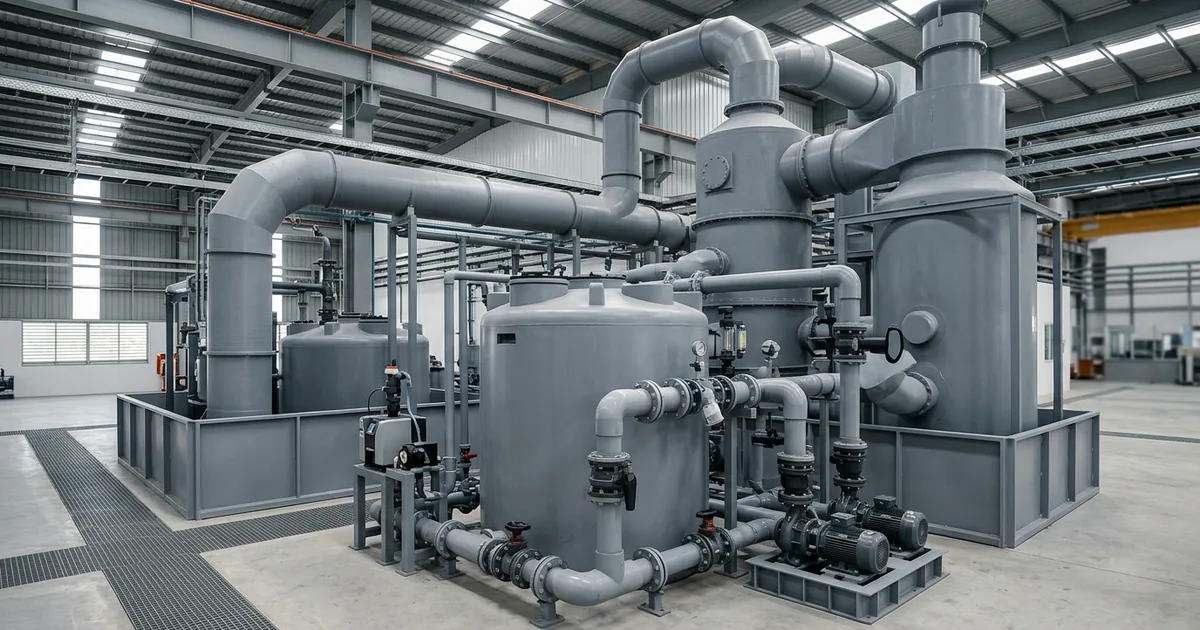
Rather than constructing expensive packed-tower scrubbers designed for chemical factories (for industrial packed-tower fundamentals, see our guides on designing HCl wet scrubbers with NaOH and applying hydrated lime Ca(OH)₂ in SO₂/HCl flue gas scrubbers), commercial pig farms can retrofit their existing end-wall water curtain sumps into automated Acidified Wet Scrubbers within 3 to 5 days.
However, swine barn exhaust presents three harsh engineering challenges: massive airflow (100,000 – 250,000 m³/h), heavy feed/feather dust loading, and strict backpressure limits on axial ventilation fans. Below is the three-pillar engineering protocol to eliminate operational failures:
3.1. Risk 1 — Preventing Ferric Hydroxide Fe(OH)₃ Nozzle Clogging & Pad Fouling
When dosing Liquid Ferric Chloride FeCl₃ 40%, the single most critical control variable is the ferric hydrolysis precipitation threshold (pH 4.8):
- Within
pH = 3.0 – 4.2: Ferric iron remains in soluble ionic and nano-scale monomeric/polymeric hydroxo complexes that coagulate fine dust without plugging nozzles. - If chemical depletion or dosing pump failure allows incoming
NH₃gas to push recirculation water abovepH 4.8 – 5.0: DissolvedFe³⁺rapidly precipitates into gelatinous reddish-brown ferric hydroxide flocs according to the reaction:FeCl₃ + 3NH₃ + 3H₂O → Fe(OH)₃↓ (reddish-brown gel) + 3NH₄Cl. Mixed with swine hair and feed dust,Fe(OH)₃gel will blind fine mist nozzles or cement honeycomb cooling pads within days.
Mandatory Engineering Controls for Retrofit:
- Automated Online
pHController & Dosing Pump Interlock: Install an industrial fouling-resistantpHelectrode inside the clarified pump-suction compartment of the recirculation basin. Configure the proportional dosing pump to lock operatingpHtightly withinpH = 3.2 – 4.2, with a high-pH alarm (pH = 4.6) alerting farm maintenance staff beforeFe(OH)₃precipitation can occur. - Selecting Chemical Media Based on Scrubber Geometry:
- Option A (Dosing
HCl 32%for Narrow Honeycomb Wet Pads or Fine Nozzles): If the barn utilizes narrow-flute plastic evaporative pads or small-orifice nozzles (< 2.5 mm), dose Industrial Hydrochloric AcidHCl 32%. Because the reaction product (NH₄Cl) has a high aqueous solubility (383 g/L at 25°C), it forms a crystal-clear solution that never precipitates metal hydroxides even ifpHtemporarily spikes. - Option B (Dosing
FeCl₃ 40%orFeCl₃ + HClin Open Spray Chambers / Coarse Baffle Curtains): Replace fine packed beds (which clog with sticky barn dust within3–4 weeks) with large-orifice hollow-cone PP or PVDF spray nozzles (4.0 – 8.0 mmorifice diameter,1.5 – 2.5 bar) spraying counter-current or cross-current to the exhaust plume. Partition the concrete recirculation sump into 3 settling and screen compartments (equipped with removable PP/316L stainless steel basket strainers) so coagulated feed-dust sludge settles out before reaching the recirculation pump.
- Option A (Dosing
3.2. Risk 2 — Corrosion Protection & Downstream Mist Elimination (Demister)
Recirculating acidic chloride solutions (pH 3.2 – 4.2) will rapidly corrode galvanized steel fan cones, structural purlins, and wire mesh if acidic droplets are entrained in the exhaust plume. A compliant retrofit requires:
- Plume Expansion Plenum (
2.5 – 3.5 mStandoff Distance): Position the wet spray curtain at least2.5 – 3.5 mdownstream of the exhaust fan shutters so high-velocity fan jets expand and decelerate to a face velocity of1.5 – 2.5 m/s. This keeps static backpressure across the wet curtain below30–50 Pa(preventing fan airflow degradation and heat stress inside the pig barn) while maximizing gas-liquid contact time. - Acid-Resistant Materials of Construction: Construct all recirculation piping, spray headers, submerged pumps, and wet-zone baffles from uPVC, CPVC, PP, HDPE, or Fiberglass-Reinforced Plastic (FRP). Never use galvanized steel or bare 304 stainless steel in direct contact with
FeCl₃orHClsolutions. - Downstream Chevron Mist Eliminator (Demister Pad): Install a multi-pass PP or PVC chevron-blade mist eliminator (or coarse multi-layer PP mesh demister) at the scrubber outlet to capture
> 99%of entrained acidic droplets (> 20–50 µm), ensuring zero acid mist carryover beyond the scrubber housing.
3.3. Risk 3 — Mass Balance Dosing Calculation & Blowdown Water Routing to the Post-Biogas WWTP
As the acidified curtain continuously scrubs NH₃ and dust, dissolved ammonium chloride (NH₄Cl) and electrical conductivity (EC / TDS) build up in the sump. A controlled bleed-off (blowdown) stream must be discharged and replaced with fresh makeup water.
Illustrative Engineering Mass Balance Calculation for a 2,000-Head Finishing Barn:
- Design Operating Parameters: Daytime ventilation rate
Q = 150,000 m³/h; inlet exhaustNH₃concentrationC_in = 35 ppm(≈ 24.4 mg/Nm³); target scrubber removal efficiencyη = 85%(reducing outletNH₃to~5.2 ppm, ensuring downwind dispersion at the100–400 mfence line remains well below the200 µg/Nm³limit of QCVN 05:2023/BTNMT). - Hourly Ammonia Mass Captured (
M_NH₃):M_NH₃ = 150,000 m³/h × 24.4 × 10⁻⁶ kg/m³ × 0.85 = 3.11 kg NH₃/hour. - Hourly Chemical Dosing Requirement:
- Using Industrial Hydrochloric Acid
HCl 32%(~6.5 kg HCl 32% per 1.0 kg NH₃): Dosing rate =3.11 × 6.5 ≈ 20.2 kg HCl 32%/hour(~17.5 L/hourduring peak afternoon ventilation; nighttime dosing drops proportionally when fans step down to40%capacity). - Using Liquid Ferric Chloride
FeCl₃ 40%(~8.0 kg FeCl₃ 40% per 1.0 kg NH₃): Dosing rate =3.11 × 8.0 ≈ 24.9 kg FeCl₃ 40%/hour(~17.8 L/hourat specific gravityd ≈ 1.40 g/cm³).
- Using Industrial Hydrochloric Acid
Safe Blowdown Routing Protocol:
- NEVER discharge acidic scrubber blowdown into the Biogas Digester inlet: The low
pH(3.2–4.2) and concentrated ammonium (NH₄⁺) in scrubber blowdown will shock anaerobic methanogens inside the lagoon. - Correct Engineering Route: Pipe scrubber blowdown at a metered bleed rate directly into the Post-Biogas Wastewater Treatment Plant (WWTP) Equalization Tank (for complete WWTP integration, see our Pillar Guide: Post-Biogas Swine Wastewater Chemical Treatment Process for QCVN 62:2025/BTNMT Compliance). In the WWTP, residual
Fe³⁺ions fromFeCl₃blowdown act as a free secondary coagulant to precipitate orthophosphate (PO₄³⁻) and remove dark bio-humic color, while capturedNH₄⁺is biologically oxidized in the Anoxic–Aerotank nitrification train. Monitor effluent total chloride (Cl⁻ ≤ 600 mg/L) if treated wastewater is reused for agricultural crop irrigation.
“Under Vietnam’s hot tropical barn conditions (where afternoon exhaust temperatures routinely reach 33–36°C), manually pouring concentrated hydrochloric acid into open water troughs without automated pH control risks releasing irritating HCl vapor plumes. At Loc Thien Chemical’s Quality Control Laboratory (QC Lab), we advise large-scale swine operations to either dose our directly manufactured Liquid FeCl₃ 40%—which exerts zero acid vapor pressure while simultaneously coagulating suspended feed dust—or inject TÜV Rheinland ZDHC MRSL v3.1 Level 1 certified HCl 32% submerged below the water line via an automated pH controller locked at pH 3.5–4.2. Every batch undergoes strict heavy-metal and purity verification to safeguard farm biosecurity.” — Vo Thi Nhu Hoa, Quality Control Specialist (QC Lab) — Loc Thien Chemical
4. Critical Engineering Warning: Why European H₂SO₄ “Slurry Acidification” Must Never Be Applied to Vietnamese Pig Farms with Biogas Lagoons
When researching in-barn ammonia abatement, environmental engineers frequently encounter European Best Available Techniques (EU BAT) promoting in-house slurry acidification using concentrated Sulfuric Acid H₂SO₄ 98%, a practice widely adopted in Denmark, Germany, and the Netherlands.
According to full-scale swine barn trials by Overmeyer et al. (2023), dosing ~17 kg of concentrated H₂SO₄ 98% per 1 m³ of pig slurry to lower under-slat slurry pH from ~7.2 down to pH = 5.5 reduced in-barn NH₃ emissions by 39%. However, transplanting this Northern European technique into Vietnam—where over 95% of medium and large commercial pig farms rely on covered HDPE anaerobic biogas lagoons for waste treatment and power generation—triggers two catastrophic operational and safety failures:
4.1. Catastrophe 1 — Methanogen Inhibition & a 67% Collapse in Biogas Methane (CH₄) Yield
In Denmark, acidified pig slurry is typically stored in cold concrete tanks and land-applied directly onto sulfur-deficient cropland as fertilizer without passing through an on-farm anaerobic lagoon.
In Vietnam, all daily barn flushing slurry flows directly into an anaerobic HDPE biogas digester. When slurry acidified with 17 kg H₂SO₄/m³ to pH 5.5 enters a biogas lagoon:
- Acid
pHShock: Methanogenic archaea are acutely sensitive to acidic conditions and require a strict neutral window (pH 6.8 – 7.5). FeedingpH 5.5slurry rapidly sours the digester inlet zone. - Sulfate-Reducing Bacteria (SRB) Competition & Sulfide Toxicity: Adding
17 kg H₂SO₄/m³introduces thousands ofmg/Lof sulfate ions (SO₄²⁻). Under anaerobic conditions, SRB outcompete methanogens for hydrogen (H₂) and acetate substrates while generating toxic dissolved sulfide. Anaerobic digestion studies of acidified swine slurry (Overmeyer et al., 2023 and associated biogas trials) prove that methane (CH₄) production plummets by 67%, shutting down biogas electricity generation and collapsing the lagoon’s COD removal capacity!
4.2. Catastrophe 2 — Lethal H₂S Gas Spikes (> 100 ppm IDLH) at the Mixing Pit & Inside the Biogas Lagoon
The second hazard poses an immediate threat to human and animal life:
- Instantaneous Lethal
H₂SStripping (> 100 ppmIDLH) During Acid Mixing: Fresh swine slurry naturally contains dissolved sulfides (HS⁻ / S²⁻). At neutral slurrypH(7.0 – 7.5), most sulfide remains in the non-volatileHS⁻ionic state. The instantH₂SO₄lowers slurrypHto5.5(well belowpKa1 = 7.04forH₂S), over 97% of dissolved sulfide converts into volatileH₂Sgas, while acid reaction with manure bicarbonates causes violentCO₂foaming that strips toxicH₂Sinto the work zone! Field measurements by Overmeyer et al. (2023) recorded mixing-tankH₂Sspikes exceeding100 ppm—crossing the NIOSH IDLH (Immediately Dangerous to Life or Health) threshold of100 ppm, where a few breaths can cause unconsciousness and death! - Turning the Biogas Lagoon into a High-Level
H₂SGenerator: Once sulfate-laden slurry enters the anaerobic lagoon, SRB reduce the massiveSO₄²⁻load into gaseousH₂S(SO₄²⁻ + organic matter → H₂S + HCO₃⁻), driving biogasH₂Swell past5,000–10,000 ppmand rapidly corroding biogas generator engines.
4.3. The Correct “Dual-Front Separation Strategy” for Tropical Swine Farms in Vietnam
To simultaneously protect worker safety, maximize biogas electricity output, and achieve QCVN 05:2023/BTNMT fence-line odor compliance, Vietnamese swine farms must separate slurry management from exhaust air scrubbing:
| Control Front | DANGEROUS Practice (Prohibited for Farms with Biogas) | LOC THIEN BEST-PRACTICE ENGINEERING (Optimized for Vietnam) |
|---|---|---|
| 1. Under-Slat Slurry Pit & HDPE Biogas Lagoon | Dosing H₂SO₄ into slurry to lower pH = 5.5 (Destroys 67% CH₄ yield, triggers lethal > 100 ppm H₂S gas spikes) | Maintain neutral slurry pH (7.0–7.5); dose Liquid FeCl₂ 30% (Directly Manufactured by Loc Thien) into the biogas reception pit to lock H₂S as insoluble FeS precipitate while preserving 100% CH₄ yield (See details: Biogas H₂S Removal with FeCl₂ 30%) |
2. Tunnel-Ventilated Barn Exhaust (NH₃ & Dust) | Unscrubbed fan discharge or plain borehole water curtains (Captures only 9–23% NH₃ as water pH exceeds 9.5) | Retrofit end-wall water curtains into Automated Acidified Wet Scrubbers (pH 3.2–4.5) dosed with FeCl₃ 40% or HCl 32%, capturing 82% – 90% NH₃ and odor-bearing dust |
5. Building an Inspection-Ready “Exhaust & Odor Control Engineering Dossier” & Loc Thien Chemical Biosecure Supply Chain
Regulatory suspensions of large livestock farms demonstrate that operating an undocumented water curtain or pouring chemicals manually without an approved Odor Treatment Engineering Plan and quantitative dosing logs will fail provincial environmental inspections.
5.1. Three-Layer Inspection-Ready Odor Control Dossier for Livestock Farms
Working alongside FDI agribusinesses and large domestic swine integrators, Loc Thien Chemical application engineers help establish a fully auditable 3-layer odor control protocol:
- Layer 1 — Scrubber Mass Balance Engineering Plan & Automated
pHDosing Logs (FeCl₃ 40%/HCl 32%):- Documented engineering calculations linking barn ventilation airflow (
m³/h) and inletNH₃load to stoichiometric dosing rates (~8.0 kg FeCl₃ 40%or~6.5 kg HCl 32%per kgNH₃captured). - Continuous electronic data logs from the online
pH Controllerconfirming recirculation waterpHis maintained within3.2 – 4.5during fan operation, paired with chemical delivery invoices and blowdown flowmeter records routed to the WWTP.
- Documented engineering calculations linking barn ventilation airflow (
- Layer 2 — Perimeter Biosecurity Disinfection & Surface Odor Oxidation with Sodium Hypochlorite
NaOCl 10%:- Across vehicle disinfection wheel dips, internal farm roads, perimeter drainage channels, and dewatered manure storage sheds, apply Liquid Sodium Hypochlorite
NaOCl 10%–12%(Javel) to eradicate viral pathogens (including African Swine Fever — ASF) while oxidizing surface amines and mercaptans. - Strict Chemical Segregation Rule: Never mix or store
NaOClnear acidicHCl 32%orFeCl₃ 40%scrubber tanks to prevent toxic chlorine gas (Cl₂) release (NaOCl + 2HCl → Cl₂↑ + NaCl + H₂O).
- Across vehicle disinfection wheel dips, internal farm roads, perimeter drainage channels, and dewatered manure storage sheds, apply Liquid Sodium Hypochlorite
- Layer 3 — Complete Regulatory Traceability (GHS SDS/MSDS, Batch COA, ZDHC & Quatest 3 Reports):
- Full documentation binder ready for environmental police, provincial DONRE inspections, and international ESG/GlobalG.A.P. audits.
5.2. Loc Thien Chemical Manufacturing Capacity, 6 Regional Warehouses & Biosecure Bulk Delivery
Uninterrupted 24/7 operation of barn exhaust scrubbers and post-biogas WWTPs requires a chemical partner with verified domestic manufacturing and specialized bulk logistics:
- Verified SSOT Supply Positioning:
- Loc Thien Chemical is the DIRECT MANUFACTURER of our core iron salt solutions for livestock environmental control: Liquid Ferric Chloride
FeCl₃ 40%(Wastewater & Scrubber Grade) and Liquid Ferrous ChlorideFeCl₂ 30%, independently verified by Quatest 3. - Loc Thien Chemical is a Tier-1 COMMERCIAL SUPPLIER / INDUSTRIAL CHEMICAL DISTRIBUTOR for our industrial acids category and chlor-alkali products, including Hydrochloric Acid
HCl 32%, Sulfuric AcidH₂SO₄ 98%, Sodium HypochloriteNaOCl 10%,NaOH, andPAC 31%.
- Loc Thien Chemical is the DIRECT MANUFACTURER of our core iron salt solutions for livestock environmental control: Liquid Ferric Chloride
- TÜV Rheinland ZDHC MRSL v3.1 Level 1 Compliance: Loc Thien holds official ZDHC MRSL Version 3.1 Conformance Level 1 Conformance Summary Reports (CSR) and Analytical Test Reports issued by TÜV Rheinland Vietnam for
HCl(CSR & Report No.248162921-03),FeCl₂(CSR No.248162921-02/ Report No.248162921-02a),H₂SO₄(CSR & Report No.248162921-01), andJavel/NaOCl(CSR & Report No.248162921-04), guaranteeing strict control of heavy-metal impurities. - 3,000+ Tons/Month Capacity, 5–30-Ton Rubber-Lined Tankers & 6 Standard Warehouses:
- Total supply capacity of
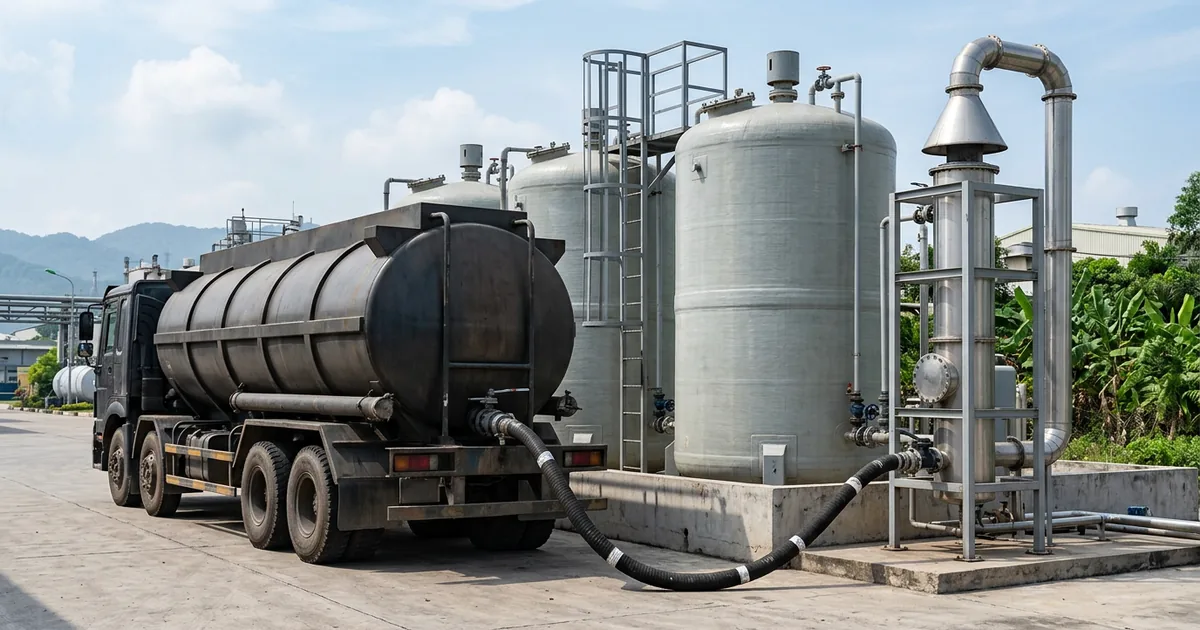
3,000+ tons/month, delivered via our dedicated fleet of5–30-tonrubber-lined and FRP-lined acid tankers (equipped with pneumatic/sealed transfer pumps for contactless unloading at farm perimeter storage tanks to preserve biosecurity) or steel-caged1,000LIBC totes. - 6 Strategic Warehouse Hubs Across Vietnam:
- Ba Ria - Vung Tau Warehouse: Phu My 1 Industrial Park, Phu My Town, Ba Ria - Vung Tau Province.
- Dong Nai Warehouse: Long Thanh Industrial Park, Long Thanh District, Dong Nai Province (Rapid dispatch to Dong Nai livestock hubs including Thong Nhat, Xuan Loc, Cam My, and Dinh Quan).
- Binh Duong Warehouse: Tan Dong Hiep Ward, Di An City, Binh Duong Province (Serving Binh Duong, Binh Phuoc, and Tay Ninh livestock corridors).
- Da Nang Warehouse: Hoa Khanh Industrial Park, Lien Chieu District, Da Nang City.
- Can Tho Warehouse: Tra Noc Industrial Park, O Mon District, Can Tho City.
- Bac Ninh Warehouse: Tien Son Industrial Park, Tien Du District, Bac Ninh Province.
- Legal Headquarters:
452/6B Tinh Lo 10, Binh Tri Dong Ward, Binh Tan District, Ho Chi Minh City.
- Total supply capacity of
- Delivery SLA & 5 Technical Quotation Factors:
- Standard Delivery SLA: Inner Ho Chi Minh City within 4 hours; Southern & Mekong Delta industrial zones and livestock hubs within 24–48 hours; Northern & Central Vietnam within 2–3 days. Contact hotline 0979 891 929 for detailed delivery scheduling and farm biosecurity unloading protocols.
- 5 Factors Determining Your Customized Technical Quotation: (1) Selected scrubbing chemical (
FeCl₃ 40%vs.HCl 32%); (2) Packaging and delivery format (5–30-tonbulk rubber-lined tanker vs.1,000LIBC totes or30kgjerrycans); (3) Per-shipment volume or monthly blanket contract commitment; (4) Delivery distance from the nearest of our 6 regional warehouses and perimeter biosecurity transfer requirements; (5) Technical support scope (on-sitepHjar testing, batch COA/SDS documentation).
To receive a customized scrubber mass-balance dosing calculation for your barn ventilation capacity and an official technical quotation within 15 minutes, contact Loc Thien Chemical Application Engineering today:
- 24/7 Technical Hotline / Zalo: 0979 891 929
- RFQ & Engineering Email: [email protected]
- Legal Headquarters: 452/6B Tinh Lo 10, Binh Tri Dong Ward, Binh Tan District, Ho Chi Minh City, Vietnam.