
Biogas H2S Removal in Swine Digesters Using Ferrous Chloride (FeCl2 30%): Gas Engine Protection, Sulfur Load Stoichiometry & Why FeSO4 Is Prohibited
Table of contents
Biogas H₂S removal in swine digesters using liquid Ferrous Chloride (FeCl₂ 30%) is an in-situ liquid-phase sulfide precipitation process that locks dissolved bisulfide ions (HS⁻) into non-volatile ferrous sulfide (FeS↓) before sour gas can partition into the HDPE lagoon headspace. Dosing FeCl₂ 30% at a practical rate of 20–26 kg (15–20 L) per kg of sulfur reduces raw biogas H₂S from 3,000–4,000 ppm to gas-engine-safe levels while co-precipitating 95–97% of dissolved ortho-phosphate (PO₄-P).
Within the end-to-end engineering framework of the chemical treatment process for post-biogas swine wastewater to meet QCVN 62:2025/BTNMT, upstream sulfur control at the pre-digester manure collection sump is the single most critical safeguard for both renewable power generation and mechanical asset longevity. This technical guide examines the reaction kinetics of Fe²⁺ in anaerobic swine slurry, the engineering gap between lower-bound gas-phase sulfur and upper-bound excreted sulfur loads, simultaneous Struvite scale prevention, and mandatory confined-space Health, Safety, and Environment (HSE) protocols.
Why 3,000–4,000 ppm H₂S in Swine Biogas Destroys Gas Generators & Triggers QCVN 05:2023/BTNMT Compliance Risks
Unlike agricultural crop digesters or municipal sludge anaerobic reactors—where raw biogas typically contains 200–800 ppm H₂S—commercial swine wastewater carries high concentrations of sulfur-bearing amino acids (methionine and cysteine) from high-protein rations alongside inorganic sulfate mineral supplements (CuSO₄, ZnSO₄, FeSO₄). When flushed manure and urine enter a covered HDPE lagoon under strict anaerobic conditions (oxidation-reduction potential ORP between -250 mV and -400 mV), proteolytic fermentation and biological sulfate reduction drive raw biogas hydrogen sulfide (H₂S) concentrations to 3,000–4,000 ppm (as documented across commercial pig biogas installations by Skerman et al., 2018), with seasonal or dietary peaks reaching 5,000–6,000 ppm when dried distillers grains with solubles (DDGS) or fishmeal are elevated.
A raw gas stream containing 3,000–4,000 ppm H₂S (4,200–5,600 mg/Nm³) is 20 to 40 times higher than the maximum fuel specification allowed by internal combustion gas engine OEMs (such as Jenbacher, MWM, Caterpillar, Cummins, and industrial biogas generator sets), which strictly require ≤ 100–200 ppm H₂S at the engine intake manifold. Feeding unconditioned or poorly desulfurized swine biogas into a generator triggers a cascade of thermo-chemical failures:
- Sulfuric acid (
H₂SO₄) corrosion of cylinder liners, turbochargers, and heat exchangers: During high-temperature combustion inside the cylinder,H₂Soxidizes into sulfur dioxide (2H₂S + 3O₂ → 2SO₂ + 2H₂O) and partially into sulfur trioxide (SO₃), which combines with water vapor in the exhaust and blow-by gas to condense as concentrated sulfuric acid (H₂SO₄). This acid attacks cylinder liners, piston crowns, exhaust valve seats, turbocharger impellers, and exhaust heat recovery units whenever metal surfaces drop below the acid dew point. - Rapid lubricating oil acidification and Total Base Number (
TBN) depletion: Acidic blow-by gases (SO₂,SO₃, and unburnedH₂S) slip past piston rings directly into the crankcase sump. The alkaline detergent additives in the engine oil are rapidly neutralized, causing the Total Base Number (TBN) to plummet and the Total Acid Number (TAN) to spike. UncheckedH₂Scuts expensive specialty gas-engine oil service intervals in half (from800–1,000 operating hoursdown to250–400 hours) while corroding copper-lead crankshaft bearings and wrist-pin bushings. - Loss of
60–80%grid electricity savings for farms and biogas ESCOs: A properly operated swine biogas combined heat and power (CHP) or generator plant supplies baseload electricity for tunnel-ventilated barns, evaporative cooling pads, feed mills, and aerobic wastewater blowers—delivering a60–80%reduction in grid power bills. However, a single engine overhaul caused byH₂SO₄pitting or intercooler perforation results in weeks of unscheduled downtime and capital repair costs that wipe out an entire year of energy savings.
Beyond mechanical asset destruction, fugitive H₂S emissions from HDPE cover seals, pressure-relief valves, unlit flares, and open manure reception pits expose livestock enterprises to strict environmental and occupational enforcement:
- National Ambient Air Quality Standard
QCVN 05:2023/BTNMT: Issued by the Ministry of Natural Resources and Environment (officially replacing bothQCVN 05:2013/BTNMTandQCVN 06:2009/BTNMT), this standard enforces a strict 1-hour average ambient fence-line limit forH₂Sof≤ 42 µg/Nm³(approximately0.03 ppm). Even a minor leak of raw biogas containing3,000 ppm H₂Scan breach the0.03 ppmfence-line threshold hundreds of meters downwind. (For barn exhaust ammonia and odor scrubbing at the tunnel fans, see our dedicated engineering guide on swine barn NH₃ and odor exhaust treatment to meet QCVN 05:2023 using FeCl₃ and HCl wet scrubbers). - Occupational Hygiene Standard
QCVN 03:2019/BYT: For farm technicians working near manure collection sumps, solid-liquid separators, and gas booster rooms, the permissible 8-hour Time-Weighted Average (TWA) workplace exposure limit forH₂Sis10 mg/m³(~7 ppm), and the 15-minute Short-Term Exposure Limit (STEL) is15 mg/m³(~10 ppm).
| Control Parameter / Regulatory Threshold | Standard / Field Value | Unit | Engineering & Legal Impact on Swine Operations |
|---|---|---|---|
Raw swine biogas H₂S concentration | 3,000 – 4,000 (peak 6,000) | ppm | Exceeds gas engine OEM intake limits by 20–40x (Skerman et al., 2018) |
Gas engine OEM fuel intake H₂S limit | ≤ 100 – 200 | ppm | Mandatory ceiling to prevent H₂SO₄ cylinder corrosion and rapid oil TBN loss |
Fence-line ambient air limit (QCVN 05:2023/BTNMT) | ≤ 42 (~0.03 ppm) | µg/Nm³ (1-hr avg) | Binding legal limit at farm boundary (replaces QCVN 05:2013 & QCVN 06:2009) |
Workplace exposure limit (QCVN 03:2019/BYT) | TWA ≤ 10 / STEL ≤ 15 | mg/m³ | Protects operators at collection pits, separators, and generator rooms |
Immediately Dangerous to Life or Health (NIOSH IDLH) | 100 (olfactory paralysis) | ppm | Paralyzes olfactory nerve; 700–1,000 ppm causes knockdown in 1–2 breaths |
Sulfide Precipitation Kinetics of FeCl₂ 30%, Comparison With FeCl₃ & Why Ferrous Sulfate (FeSO₄) Is Strictly Prohibited in Anaerobic Digesters
To eliminate H₂S at its source before dissolved sulfide can strip into the gas phase, modern biogas engineering relies on dosing soluble iron salts directly into the liquid manure stream at the pre-digester reception pit or influent header. However, selecting the correct iron salt anion determines whether the system achieves stable desulfurization or suffers biological failure.
1. One-step 1:1 stoichiometric precipitation using Ferrous Chloride (FeCl₂ 30%)
In anaerobic swine slurry at a typical pH of 6.8 to 7.6, inorganic sulfide exists predominantly as dissolved bisulfide ions (HS⁻) in dynamic equilibrium with aqueous H₂S. When liquid Ferrous Chloride FeCl₂ 30%—directly manufactured by Loc Thien Chemical under strict synthesis control (30% ± 1% w/w FeCl₂, active ferrous ion Fe²⁺ ≥ 13.2% w/w, specific gravity SG = 1.30–1.34 g/cm³ at 20 °C)—is metered into the slurry, divalent Fe²⁺ cations react instantaneously with HS⁻ and S²⁻ via a single-step precipitation pathway:
- Ionic precipitation reaction:
Fe²⁺ + HS⁻ → FeS↓ + H⁺ - Molecular reaction:
FeCl₂ + H₂S → FeS↓ + 2HCl
The thermodynamic driving force of this reaction is the extraordinarily low solubility product of ferrous sulfide (Ksp of FeS ≈ 8 × 10⁻¹⁹ at 25 °C). Because FeS is virtually insoluble across the neutral pH operating window of anaerobic digesters, dissolved sulfur is permanently sequestered as fine black FeS particulates that settle with the digestate sludge rather than volatilizing into the biogas dome.
Exact chemical stoichiometry for removing 1 kg of sulfur (S, molar mass M = 32.065 g/mol):
- Molar reaction ratio:
1 mol Fe²⁺(M = 55.845 g/mol) reacts stoichiometrically with1 mol S(32.065 g/mol). - Theoretical elemental iron demand (
1.0x):55.845 / 32.065 =1.74 kg Fe / 1 kg S. - Theoretical anhydrous
FeCl₂(100%,M = 126.75 g/mol) demand:126.75 / 32.065 =3.95 kg FeCl₂ (100%) / 1 kg S. - Conversion to commercial liquid
FeCl₂ 30%(~13.2% Fe, specific gravity~1.32 kg/L):- Theoretical
1.0xstoichiometric dose:1.74 / 0.132 =13.2 kg(approximately10.0 L) ofFeCl₂ 30%solution per1 kg S. - Practical
1.5–2.0xoperating dose: In high-solids swine manure, a fraction of dosedFe²⁺simultaneously co-precipitates with dissolved ortho-phosphate (PO₄³⁻), complexes with humic/fulvic organic acids, and experiences mass-transfer limitations. Consequently, field-proven dosing operates at a1.5–2.0xstoichiometric factor, equal to20–26 kg(15–20 L) ofFeCl₂ 30%per1 kg S.
- Theoretical
2. Kinetic comparison between FeCl₂ 30% and FeCl₃ 40%: Empirical proof from the University of Hohenheim
Process engineers frequently evaluate whether to dose FeCl₂ 30% or Ferric Chloride FeCl₃ 40% (also directly manufactured by Loc Thien Chemical within our Iron Chloride FeCl₂ & FeCl₃ product category) into anaerobic digesters. Trivalent Fe³⁺ reacts with sulfide through a two-step redox-precipitation sequence:
- Step 1 (Redox reduction of
Fe³⁺):2Fe³⁺ + HS⁻ → 2Fe²⁺ + S⁰↓ + H⁺ - Step 2 (Sulfide precipitation):
Fe²⁺ + HS⁻ → FeS↓ + H⁺ - Overall reaction:
2Fe³⁺ + 3HS⁻ → 2FeS↓ + S⁰↓ + 3H⁺
Although the theoretical molar Fe : S ratio of Fe³⁺ is 2 : 3 (1.16 kg Fe / 1 kg S), inside an anaerobic swine digester FeCl₂ 30% delivers three decisive engineering advantages over FeCl₃:
- Fastest
H₂Sprecipitation kinetics: Landmark comparative trials conducted at the University of Hohenheim (Germany — Nägele et al., 2017) evaluating multiple iron formulations in biogas digesters demonstrated thatFeCl₂achieves the fastestH₂Sremoval reaction rate of all tested iron salts. BecauseFe²⁺formsFeS↓in a direct one-step ionic reaction without requiring prior reduction fromFe³⁺toFe²⁺, it avoids generating colloidal elemental sulfur (S⁰), which can otherwise be biologically reduced back toH₂Sinside the digester. - Lower parasitic iron loss to phosphate than
Fe³⁺: TrivalentFe³⁺exhibits an extremely strong affinity for ortho-phosphate (FePO₄↓), meaning a large share ofFe³⁺dosed into phosphorus-rich swine slurry is consumed by phosphate before reacting withHS⁻. Conversely,FeCl₂rapidly scavenges sulfide first while still precipitating excess dissolved phosphorus as vivianite (Fe₃(PO₄)₂·8H₂O). - Simultaneous
95–97% PO₄-Premoval without inhibitingCH₄methanogenesis: Peer-reviewed anaerobic livestock digestion research by Oh et al. (2024) confirmed that dosingFeCl₂at an optimal concentration of0.5 g/Lremoves98%ofH₂Sand co-precipitates95–97%of solublePO₄-Pwithout inhibiting methanogenic archaea or reducing specific methane (CH₄) yield. (For a comprehensive comparison across coagulation and anaerobic applications, review our technical guides on comparing FeCl₂ vs. FeCl₃ in industrial wastewater coagulation and technical specifications of liquid FeCl₂ solutions).
3. Critical chemical moat: Why Ferrous Sulfate (FeSO₄) and Sodium Hypochlorite (NaOCl) MUST NEVER be dosed into anaerobic digesters
A costly engineering mistake observed at several livestock farms is purchasing commercial Ferrous Sulfate FeSO₄ 98% (green crystalline copperas intended for downstream aerobic physico-chemical flocculation) and dumping it into the anaerobic biogas collection pit. In anaerobic digestion engineering, dosing FeSO₄ into a biogas digester is strictly prohibited due to a self-defeating biochemical feedback loop:
- Aqueous dissociation:
FeSO₄ → Fe²⁺ + SO₄²⁻ - Biological sulfate reduction by
SRB:SO₄²⁻ + Organic Carbon (COD / CH₃COO⁻) → HS⁻ + 2HCO₃⁻(catalyzed by Sulfate-Reducing Bacteria)
Every mole of FeSO₄ added to the manure pit introduces one mole of Fe²⁺ alongside one full mole of dissolved sulfate (SO₄²⁻) directly into the anaerobic zone. Inside the covered lagoon, Sulfate-Reducing Bacteria (SRB, such as Desulfovibrio and Desulfotomaculum) immediately utilize that incoming SO₄²⁻ as a terminal electron acceptor to oxidize volatile fatty acids (VFAs), simultaneously outcompeting methanogens for acetate/H₂ (depressing CH₄ output) and reducing the newly added SO₄²⁻ straight back into toxic H₂S gas. Dosing FeSO₄ into an anaerobic digester literally feeds sulfur back into the H₂S generation cycle.
Similarly, Sodium Hypochlorite (Javen NaOCl 10%) must never be dosed into manure pits or anaerobic digesters:
- Oxidizing sulfide with
NaOCl 10%requires an exorbitant23–93 kg of NaOCl 10% per 1 kg Sbecause free chlorine is scavenged by the massive dissolved organic load (COD > 10,000 mg/L) and ammonium (NH₄⁺). - Furthermore,
NaOClreacts with concentrated swine-manure ammonium (500–1,500 mg/L NH₄⁺-N) to generate toxic chloramines (NH₂Cl,NHCl₂,NCl₃) and free chlorine residuals that bactericidal-shock methanogenic consortia, causing complete digester souring.
| Technical Comparison Criteria | Liquid FeCl₂ 30% (Loc Thien Direct Mfg.) | Liquid FeCl₃ 40% (Loc Thien Direct Mfg.) | Ferrous Sulfate FeSO₄·7H₂O (Commercial) | Sodium Hypochlorite NaOCl 10% (Commercial) |
|---|---|---|---|---|
| Counter-anion introduced | Chloride (Cl⁻) — Biologically inert to SRB | Chloride (Cl⁻) — Biologically inert to SRB | Sulfate (SO₄²⁻) — Reduced by SRB into H₂S! | Hypochlorite (OCl⁻) — Kills methanogens! |
Theoretical 1.0x dose | 1.74 kg Fe / kg S (13.2 kg or 10 L FeCl₂ 30%) | 1.16 kg Fe / kg S (8.4 kg or 6 L FeCl₃ 40%) | Invalid (regenerates H₂S inside digester) | 23 – 93 kg NaOCl 10% / kg S |
Practical 1.5–2.0x dose | 20 – 26 kg (15 – 20 L) / kg S | 15 – 22 kg (11 – 16 L) / kg S | PROHIBITED IN ANAEROBIC DIGESTERS | PROHIBITED IN ANAEROBIC DIGESTERS |
H₂S reaction kinetics | Fastest (direct 1-step FeS↓, Nägele 2017) | Moderate–Fast (2-step redox, forms S⁰) | Counter-productive (spikes SO₄²⁻ load) | Scavenged by manure COD and NH₄⁺ |
PO₄-P co-precipitation | 95–97% removal (at 0.5 g/L, Oh 2024), stops Struvite | Very high, but diverts Fe³⁺ from H₂S | Ineffective in anaerobic zone | Zero phosphate precipitation capacity |
| Correct process stage | Pre-digester manure pit & anaerobic sewer | Post-biogas Total P & humic color coagulation | Aerobic physico-chemical stage only | Final effluent disinfection & wet scrubbers |
The Lower-Bound vs. Upper-Bound Sulfur Load Gap & 2-Stage Desulfurization Engineering (Bulk FeCl₂ + Dry Polishing)
When sizing a chemical dosing system for an industrial swine enterprise—consider a standard reference benchmark of a 10,000-head finishing pig farm generating 500 m³ of biogas/day at a raw concentration of 3,000 ppm H₂S—engineers must account for the substantial disparity between the Lower Bound (gas-phase sulfur flux) and the Upper Bound (total dietary sulfur excreted in manure and urine).
1. Quantitative Lower-Bound vs. Upper-Bound sulfur mass balance (10,000 finishing pigs)
-
Lower Bound (Gas-Phase Sulfur Basis):
- At
3,000 ppm H₂S(0.3%by volume),1 m³of biogas at standard conditions contains approximately4.26 g H₂S, corresponding to~4.01–4.20 g S/m³. - For a daily biogas flow of
500 m³/day, the mass of sulfur partitioning into the gas collection header is:500 m³/day × 4.2 g S/m³ =2.1 kg S/day. - At
1.0xstoichiometry (1.74 kg Fe/kg S), this requires~3.7 kg Fe/day, equivalent to~28 kg(21 L) ofFeCl₂ 30%/day. - At a practical
1.5–2.0xoperating factor: The farm requires31–42 L of FeCl₂ 30%/day(approximately1 IBC tote (1,000 L)every3–4 weeks).
- At
-
Upper Bound (Total Excreted Sulfur Basis in Slurry):
- Mass-balance studies on swine metabolism (Peu et al., 2012) demonstrate that a finishing pig excretes between
1.5 and 6.9 g S/pig/daydepending on dietary protein and mineral formulation. Crucially,55%of total excreted sulfur is voided in urine, where100%exists as dissolved sulfate (SO₄²⁻)—an immediately bioavailable substrate forSRBconversion into sulfide inside flushing channels and reception sumps. Diets rich in fishmeal, sulfate trace-mineral premixes, orDDGSpush excretion toward the6.9 g S/pig/dayupper bound. - Across
10,000 finishing pigs, the total sulfur load entering the anaerobic system reaches15 – 69 kg S/day. - Precipitating the entirety of this liquid-phase sulfur pool (alongside competing ortho-phosphate) requires
26 – 120 kg Fe/day, or150 – 690 L of FeCl₂ 30%/day(4.5 – 21 m³/month).
- Mass-balance studies on swine metabolism (Peu et al., 2012) demonstrate that a finishing pig excretes between
| Sulfur Load Calculation Basis (10,000 Finishing Pigs) | Daily Sulfur Load (kg S/day) | Elemental Iron Demand (kg Fe/day) | FeCl₂ 30% Dosing Rate (L/day) | Monthly Consumption (m³ FeCl₂ 30%/month) | Engineering Role in Process Design |
|---|---|---|---|---|---|
Lower Bound (Gas-phase 500 m³/day @ 3,000 ppm H₂S, 1.0x) | 2.1 kg S | ~3.7 kg Fe | ~21 L/day (~28 kg) | ~0.63 m³/month | Theoretical minimum; ignores liquid-phase sulfide pool and PO₄³⁻ competition |
Target Stage-1 Practical Gas-Phase Dose (1.5–2.0x) | 2.1 kg S (basis) | 5.5 – 7.4 kg Fe | 31 – 42 L/day (41–55 kg) | 0.95 – 1.3 m³/month (~1 IBC / 3–4 wks) | Standard starting baseline for Stage-1 bulk liquid desulfurization |
Upper Bound (Total excreted S 1.5–6.9 g S/pig/day — Peu 2012) | 15 – 69 kg S | 26 – 120 kg Fe | 150 – 690 L/day (200–910 kg) | 4.5 – 21 m³/month | Represents full liquid sulfide reservoir + 95–97% PO₄-P Struvite control |
2. Why a 2-Stage Desulfurization Architecture optimizes Total Cost of Ownership (TCO)
Attempting to remove 3,000–4,000 ppm H₂S solely with a dry gas-phase iron-oxide scrubber leads to rapid media saturation (commercial iron oxide pellets hold only ~200 g S/kg media), frequent vessel opening, bed caking, and exothermic fire hazards during air regeneration. Conversely, attempting to drive gas-phase H₂S below 100 ppm solely via heavy liquid-phase overdosing pushes chemical consumption toward the Upper Bound.
Loc Thien Chemical engineers therefore design a 2-Stage Hybrid Desulfurization Architecture:
- Stage 1 — Liquid-Phase Bulk Removal & Peak Shaving via
FeCl₂ 30%at the Pre-Digester Sump:- Metering liquid Ferrous Chloride FeCl₂ 30% into the turbulent barn-flush reception pit at
1.0–2.0xstoichiometry strips60–77%of bulkH₂Simmediately (3,000–4,000 ppm → ~900–1,500 ppm), dampens diurnal concentration spikes, requires zero gas-phase pressure-vessel Capex, and eliminates the explosiveCH₄/O₂mixture risks associated with micro-aeration under the HDPE cover. - Co-benefit — Eliminating Struvite (
MgNH₄PO₄·6H₂O) pump & pipe scaling: Swine digestate contains high concentrations ofMg²⁺,NH₄⁺, andPO₄³⁻. LocalizedCO₂degassing at pump impellers and pipe elbows raisespHand precipitates rock-hard Struvite (MgNH₄PO₄·6H₂O) scale that seizes submersible pumps and chokes transfer lines. Stage-1FeCl₂ 30%dosing co-precipitates95–97%of solublePO₄-P, preventing Struvite crystallization and reducing chemical demand at the downstream post-biogas Total Phosphorus, humic color, and Coliform treatment plant using FeCl₃, Fenton, and NaOCl.
- Metering liquid Ferrous Chloride FeCl₂ 30% into the turbulent barn-flush reception pit at
- Stage 2 — Gas-Phase Dry Polishing Scrubber Ahead of the Generator:
- Pre-treated biogas (
900–1,500 ppm H₂S) passes through a compact dry adsorption vessel filled with iron oxide pellets (~200 g S/kg media) or impregnated activated carbon. - Because Stage 1 removes up to three-quarters of the sulfur load, dry media replacement intervals are extended by
3–4 times, while generator intake gas is reliably polished to< 50–100 ppm H₂S.
- Pre-treated biogas (
Quality Control Lab Perspective — Phan Cam Thuy (QC Specialist, Loc Thien Chemical Quality Assurance Lab): “When supplying
FeCl₂ 30%for anaerobic livestock digesters, our QC laboratory verifies three critical parameters on every Batch Certificate of Analysis (COA): active ferrous concentration (Fe²⁺ ≥ 13.2% w/w), specific gravity at20 °C(SG = 1.30–1.34 g/cm³), and strictly controlled free hydrochloric acid (Free HCl ≤ 1.0–1.5%). Unrefined waste pickle liquors sold on the spot market often contain excessive free acid (5–8% HCl) and unverified heavy metals; dosing such liquids erodes bicarbonate alkalinity (TAC), destabilizes the digesterFOS/TACratio, and inhibits methanogens. Factory-standardizedFeCl₂ 30%allows farm engineers to lock in exact diaphragm-pump stroke rates without risking digester acidosis.”
The pH – H₂S Speciation Curve, Emergency H₂O₂ 50% Shock Dosing & Confined-Space HSE Protocols
Operating a chemical dosing system on a swine farm requires strict adherence to aqueous sulfide acid-base equilibrium (H₂S(aq) ⇌ HS⁻ + H⁺, pKa₁ ≈ 7.0 at 25 °C). While the fundamental chemistry of sewer sulfide control is introduced in our municipal guide on H₂S odor removal and sewer corrosion control using H₂O₂ and FeCl₂, high-strength swine manure pits present far more acute life-safety hazards.
1. Dissolved sulfide speciation vs. pH in swine slurry
Technical data from ISF Schaumann illustrates how small shifts in slurry pH dramatically alter the fraction of dissolved sulfide existing as volatile, toxic H₂S gas versus non-volatile HS⁻ ions:
Swine Slurry / Digestate pH | Free Volatile H₂S Gas Fraction | Dissolved HS⁻ / S²⁻ Ion Fraction | Stripping Risk & Operational Control Implication |
|---|---|---|---|
pH = 8.0 | ~8% | ~92% | Highly Safe: Sulfur remains locked in the aqueous phase as HS⁻; minimal gas stripping |
pH = 7.5 | ~18% | ~82% | Normal fresh swine slurry window: Optimal for Fe²⁺ + HS⁻ → FeS↓ precipitation |
pH = 7.0 | ~45% | ~55% | Caution zone (pKa₁): Nearly half of dissolved sulfide exists as strippable H₂S gas |
pH = 6.0 | ~90% | ~10% | CRITICAL HAZARD (Flash Release): 90% converts into free H₂S gas, erupting from the pit! |
[!CAUTION] CRITICAL HSE LIFE-SAFETY WARNING — ACID-INDUCED
H₂SFLASH RELEASE IN MANURE PITS: Liquid iron chloride solutions (FeCl₂ 30%andFeCl₃ 40%) are strongly acidic (pH < 1–2). NEVER manually dump buckets/carboys or slug-pump a large volume of acidic iron salt into an enclosed, stagnant manure pit when agitators or flushing pumps are turned OFF! Pouring concentrated acidic iron salt into unmixed slurry causes localizedpHat the point of contact to plunge from7.5to below6.0faster thanFe²⁺can disperse. According to the speciation curve above, droppingpHfrom7.5to6.0instantaneously converts the dissolved sulfide pool from18%to90%freeH₂Sgas, triggering a lethal gas plume (> 1,000 ppm H₂S) out of the pit hatch!
- At
100 ppm H₂S(NIOSHIDLHthreshold): Rapid olfactory nerve paralysis occurs within seconds—workers lose the ability to smell rotten eggs and falsely assume the air is clear.- At
700 – 1,000 ppm H₂S(instant knockdown): Unconsciousness occurs within1 to 2 breaths, followed by respiratory arrest and death within minutes.- Mandatory On-Farm HSE Rules:
- Always meter
FeCl₂ 30%continuously at low flow via a dosing pump into a well-ventilated pre-digester pit with active hydraulic mixing or turbulent flushing flow so the natural bicarbonate buffer of the manure neutralizes acidity immediately.- Never enter a manure sump, reception pit, or valve vault without forced mechanical ventilation, continuous 4-gas monitoring (
H₂S,CH₄/LEL,O₂,CO), a Self-Contained Breathing Apparatus (SCBA), and a tripod rescue harness tended by a standby attendant.- In the event of a worker collapse inside a pit, never enter to attempt rescue without donning an
SCBA(unprotected chain-rescue attempts are the leading cause of multiple fatalities at livestock biogas facilities).
2. Emergency shock dosing with H₂O₂ 50% and NaOH 32% pH locking prior to pit desludging
Before agitating or desludging a reception pit, pulling a clogged submersible pump, or responding to an acute odor emergency, engineers apply an Alkaline-Buffered Peroxide Shock Protocol:
- Step 1 — Lock
pHwith Liquid Caustic Soda (NaOH 32%): Verify slurrypH; ifpH < 7.2, dose Liquid Caustic Soda NaOH 32% (supplied commercially by Loc Thien Chemical with ZDHC MRSL v3.1 Level 1 Certificate No.ZDHC1 127736 0001 Rev. 00issued by TÜV SÜD) to raisepHto7.5–8.0, suppressing volatileH₂Sbelow8–18%. - Step 2 — Rapid oxidation shock dose with Industrial Hydrogen Peroxide (
H₂O₂ 50%): Meter Industrial Hydrogen Peroxide H₂O₂ 50% (supplied by Loc Thien Chemical with ZDHC MRSL v3.1 Level 1 Certificate No.ZDHC1 127736 0002 Rev. 00issued by TÜV SÜD). At neutralpH(7.0–7.5),H₂O₂oxidizesH₂Sinto elemental sulfur and water at a1 : 1weight ratio:
-
Neutral-pH shock oxidation reaction:
H₂O₂ + H₂S → S⁰↓ + 2H₂O -
Shock dosage: Approximately
1.0 kg of 100% H₂O₂ per 1 kg H₂S, equivalent to~2.0 kg(~1.65–1.70 L) ofH₂O₂ 50%per1 kg H₂S. -
Field-proven knockdown speed: Full-scale swine pit trials conducted by South Dakota State University (SDSU) demonstrated that applying
H₂O₂reduced pit headspaceH₂Sfrom50 ppmdown to0.38 ppm(> 99%reduction) within exactly6 minutes, providing rapid hazard mitigation before mechanical maintenance.
Automated FeCl₂ 30% Dosing Skid Configuration & Loc Thien Chemical’s 4-Stage On-Farm Sulfur Calibration Protocol
To ensure hands-free, corrosion-proof FeCl₂ 30% injection across harsh livestock environments, Loc Thien Chemical’s Application Engineering team provides standardized Automated FeCl₂ Dosing Skid specifications and a structured 4-stage field calibration protocol.
1. Chloride-resistant materials of construction for FeCl₂ 30% dosing skids
Because FeCl₂ 30% combines high chloride (Cl⁻) concentration with strong acidity (pH < 1.5), all wetted components must strictly adhere to non-metallic or fluoropolymer specifications:
- Storage Vessel & Secondary Containment: Dose directly from
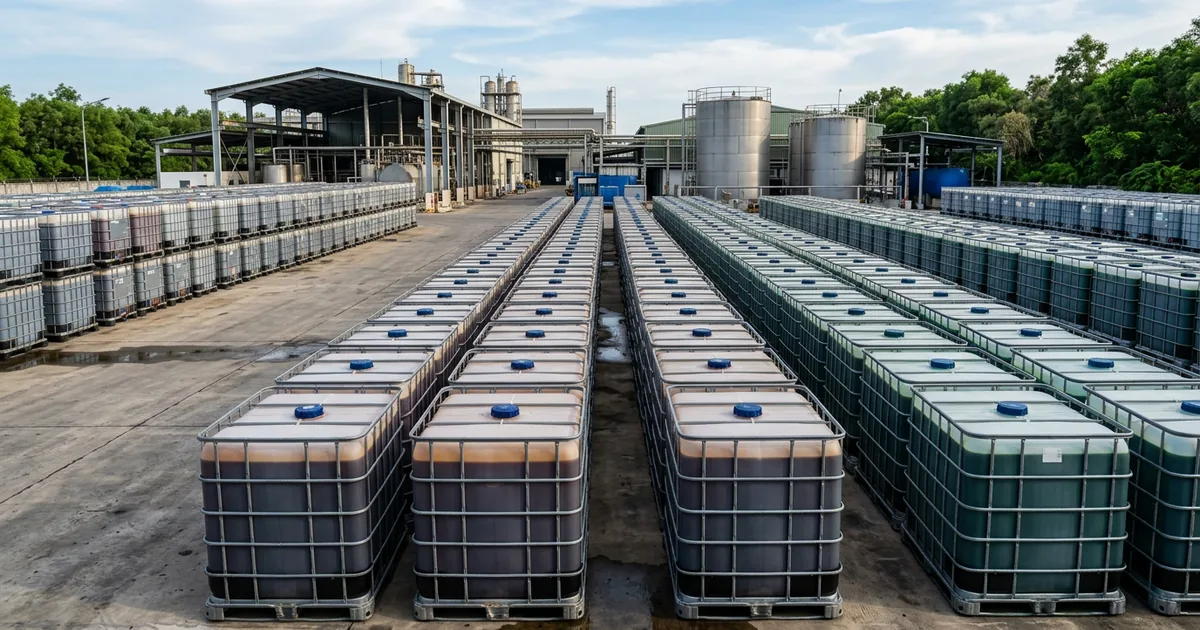
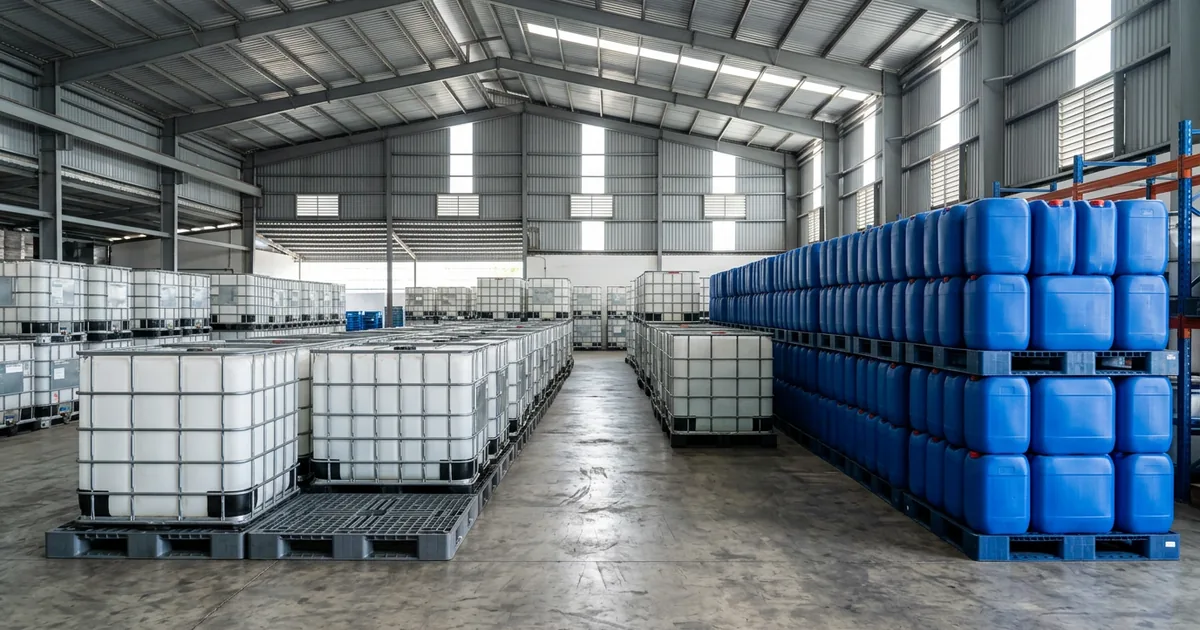
1,000 LvirginHDPEIBC totes (1,300–1,340 kgnet weight atSG = 1.30–1.34) or bulk vertical tanks (10–30 m³) fabricated from spiral-woundHDPE,PP, or Vinyl-EsterFRP. Install a secondary containment bund wall (≥ 110%of largest tank volume) in full compliance with the Law on Chemicals No.69/2025/QH15. - Metering Pump: Solenoid or motor-driven diaphragm metering pump featuring a
PVDForPPliquid head,PTFE(Teflon) diaphragm, ceramic check balls, andViton (FKM)orEPDMseals. - Piping & Interlocks: Schedule 80
uPVC,CPVC, orPEtubing equipped with a back-pressure valve, anti-siphon check valve, and calibration column. Synchronize the metering pump relay directly with the barn-flushing pump or submersible pit mixer timer soFeCl₂ 30%is injected strictly during active turbulent flow. - Strictly Prohibited Materials: Never use carbon steel, galvanized steel, copper, brass, aluminum, or 304 / 316 stainless steel on concentrated
FeCl₂ 30%lines due to rapid chloride pitting and stress-corrosion cracking.
2. Loc Thien’s 4-Stage On-Farm Sulfur Load Calibration Protocol
- Stage 1 — Baseline Sulfur & Digester Audit: Measure raw biogas
H₂S,CH₄,CO₂, andO₂before and after the dry scrubber alongside slurrypH,FOS/TACalkalinity, dissolved sulfide, andPO₄-P. - Stage 2 — Stepwise Dose-Ranging Trial (
1.0x → 1.5x → 2.0x): Operate theFeCl₂ 30%dosing pump across stepped stoichiometric intervals (10 L,15 L, and20 L per kg S) over7–14 daysto map the farm-specificH₂Sreduction curve. - Stage 3 — Steady-State KPI Verification: Lock in the optimal continuous dosing rate once Stage-1 raw
H₂Sdrops by60–80%, Stage-2 dry media differential pressure stabilizes, and generator intake gas holds steady at≤ 100–200 ppm H₂S. - Stage 4 — Biosecure Bulk & IBC Delivery: To protect swine herds against African Swine Fever (
ASF) and other pathogens, Loc Thien’s dedicated5–30-ton chemical road tankersand IBC delivery trucks follow strict wheel-dip disinfection, cab-sealing, and perimeter hose-transfer protocols at the farm boundary.
3. Direct manufacturing capacity, 6 regional warehouses & 5 cost-driving factors
As a Direct Manufacturer of Ferrous Chloride FeCl₂ 30% and Ferric Chloride FeCl₃ 40% Wastewater Grade (operating capacity 3,000+ metric tons/month) and a premier Industrial Chemical Supplier of Hydrogen Peroxide H₂O₂ 50% and Liquid Caustic Soda NaOH 32%, Loc Thien Chemical backs every shipment with international compliance credentials—including ZDHC MRSL Version 3.1 Conformance Level 1 for FeCl₂ via Conformance Summary Report CSR No. 248162921-02 and Analytical Test Report No. 248162921-02a issued by TÜV Rheinland Vietnam.
Commercial quotations for FeCl₂ 30% are tailored around 5 technical and logistical factors:
- Active
Fe²⁺concentration & acid specification: GuaranteedFe²⁺ ≥ 13.2% w/w,SG = 1.30–1.34 g/cm³, and low freeHCl ≤ 1.0–1.5%verified by Batch COA. - Packaging & transfer mode: Returnable
1,000 L IBC totesversus perimeter bulk transfer via dedicated5–30-ton chemical tankers. - Monthly sulfur-load volume commitment: Scheduled monthly or quarterly framework contracts for multi-farm livestock integrators and biogas ESCOs.
- Dispatch distance from our 6 official warehouses: Strategically positioned at Ba Ria - Vung Tau (Phu My 1 IP, Phu My Town), Dong Nai (Long Thanh IP, Long Thanh District), Binh Duong (Tan Dong Hiep Ward, Di An City), Da Nang (Hoa Khanh IP, Lien Chieu District), Can Tho (Tra Noc IP, O Mon District), and Bac Ninh (Tien Son IP, Tien Du District). (Note:
452/6B Tinh Lo 10, Binh Tri Dong Ward, Binh Tan District, Ho Chi Minh Cityis our Legal Headquarters, not a storage warehouse). - Engineering & dosing support package: On-site biogas
H₂Sauditing, online mass-balance modeling via our Chemical Dosing Calculator, and dosing skid commissioning.
Standardized delivery SLA: Inner Ho Chi Minh City within 4 hours; Southern & Mekong Delta Industrial Parks and livestock zones within 24–48 hours; Northern & Central Vietnam within 2–3 days. Contact hotline 0979 891 929 for detailed delivery procedures and receive a comprehensive technical quote within 15 minutes.
Technical Support & B2B Procurement Hotline — Loc Thien Chemical
Loc Thien Investment Development Co., Ltd. (Loc Thien Chemical) is a Direct Manufacturer of FeCl₂ 30% & FeCl₃ 40% Wastewater Grade and an Industrial Chemical Supplier of bulk chemicals (H₂O₂ 50%, NaOH 32%, PAC 31%, NaOCl 10–12%, FeSO₄ 98%) with dedicated 5–30-ton tanker delivery across Vietnam (technical quote within 15 minutes).
- Hotline / WhatsApp / Zalo (24/7): +84 979 891 929 (
0979 891 929) - Official Email: [email protected]
- Legal Headquarters: 452/6B Tinh Lo 10, Binh Tri Dong Ward, Binh Tan District, Ho Chi Minh City
- 6 Official Warehouses: Ba Ria - Vung Tau (Phu My 1 IP) | Dong Nai (Long Thanh IP) | Binh Duong (Di An City) | Da Nang (Hoa Khanh IP) | Can Tho (Tra Noc IP) | Bac Ninh (Tien Son IP)
- Quality & Compliance: ZDHC MRSL v3.1 Conformance Level 1 (9 core products via TÜV SÜD & TÜV Rheinland), Quatest 3 Tested, Batch COA & GHS 16-Section SDS
- Request Bulk Biogas Desulfurization Quote: Get a Technical Quote Within 15 Minutes