Hot-Dip Galvanizing Chemistry: Pickling Bath Control with HCl & Ammonium Chloride NH₄Cl Fluxing Technology
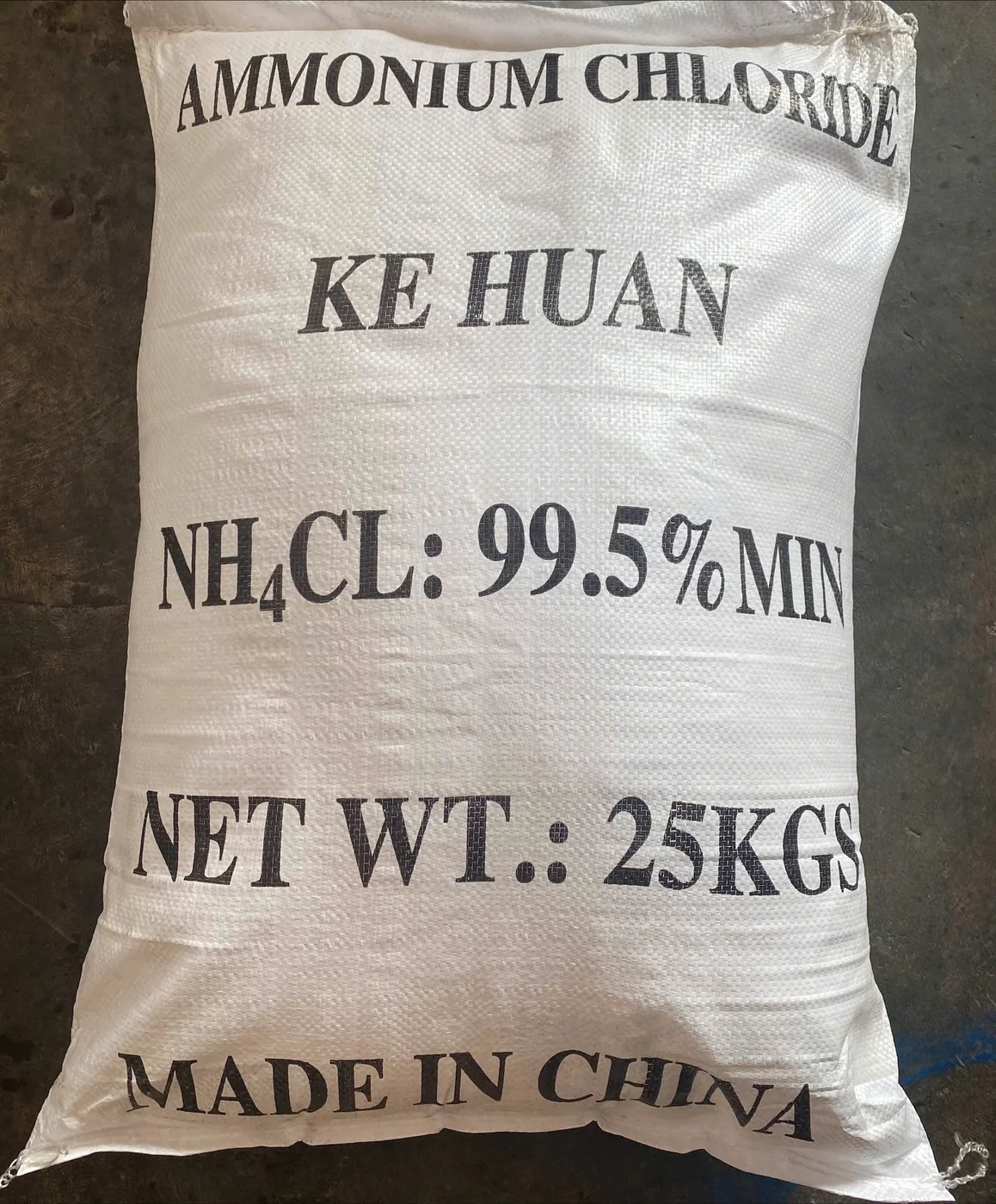
Key Technical Summary: Hot-Dip Galvanizing (HDG) engineering under international standards ASTM A123/A123M and ISO 1461 requires strict chemical coordination between acid pickling with Technical Hydrochloric Acid HCl 32% (delivered via dedicated 5–30-ton road tankers) and surface activation in a ZnCl2–NH4Cl double-salt flux bath formulated with high-purity Ammonium Chloride NH4Cl 99.5% (25kg moisture-proof bags). Maintaining flux bath density at 12–18 °Bé (1.09–1.14 g/cm3), pH 4.2–5.0, bath temperature 60–70 °C, and dissolved iron Fe2+ below 1.0 g/L prevents secondary flash oxidation prior to immersion in 445–455 °C molten zinc, reduces bottom dross generation by 55%–65%, and ensures metallurgical growth of dense Fe–Zn intermetallic alloy layers.
Table of contents
Hot-Dip Galvanizing (HDG) engineering compliant with international standards ASTM A123/A123M and ISO 1461 requires rigorous chemical synchronization between mill-scale pickling with Technical Hydrochloric Acid HCl 32% (delivered via dedicated 5–30-ton road tankers) and surface activation using high-purity Ammonium Chloride NH₄Cl 99.5% (25 kg moisture-proof bags). Maintaining the ZnCl₂–NH₄Cl double-salt flux bath at a density of 12 – 18 °Bé (1.09 – 1.14 g/cm³), pH = 4.2 – 5.0, bath temperature 60 – 70 °C, and dissolved iron Fe²⁺ < 1.0 g/L prevents secondary flash oxidation, reduces bottom dross (FeZn₁₃) generation by 55% – 65%, and promotes uniform metallurgical growth of adherent Fe–Zn intermetallic alloy layers. As a large-scale commercial bulk supplier, Loc Thien Chemical delivers every shipment with a traceable Batch COA and provides technical quotations within 15 minutes via Hotline +84 979 891 929.
1. Seven-Stage Standard Hot-Dip Galvanizing Process Architecture Under ASTM A123 / ISO 1461
In modern dry-process hot-dip galvanizing (Dry Process HDG) lines coating structural H-beams, power transmission towers, highway guardrails, and high-strength fasteners, metallurgical bond integrity between the molten zinc bath and the base steel substrate depends directly on the chemical cleanliness achieved across 7 sequential surface preparation and immersion stages:
| Process Stage | Chemical Reagents & Treatment Media | SSOT Supply Packaging Format | Target Engineering Control Parameters |
|---|---|---|---|
1. Alkaline Degreasing (Degreasing) | Liquid Caustic Soda NaOH 32% / Caustic Soda Flakes NaOH 99% + emulsifying surfactants | 5–30-ton Road Tanker / 25 kg Bag | Alkaline concentration 5% – 8% w/w, bath temperature 65 – 80 °C, 100% saponification and removal of rolling oils and machining grease. |
2. Acid Pickling (Acid Pickling) | Technical Hydrochloric Acid HCl 32% + Hexamine organic corrosion inhibitor | 5–30-ton Tanker (FRP / rubber-lined) | Free HCl concentration 12% – 16% w/w, dissolved Fe²⁺ ≤ 110 – 120 g/L, ambient 20 – 35 °C, immersion time 15 – 35 minutes. |
3. Counter-Current Rinsing (Rinsing) | Two-stage cascade overflowing industrial process water | Continuous counter-flow piping | Final rinse bath pH ≥ 4.5, dissolved iron Fe²⁺ < 0.5 g/L to prevent acid and ferrous salt drag-in into the pre-flux tank. |
4. Pre-Fluxing (Pre-Fluxing) | Ammonium Chloride NH₄Cl 99.5% complexed with Zinc Chloride (ZnCl₂) | 25 kg Double PP/PE Bag (No Tanker) | Total salt 250 – 350 g/L (12 – 18 °Bé / SG 1.09 – 1.14 g/cm³), pH = 4.2 – 5.0, bath temperature 60 – 70 °C, Fe²⁺ < 1.0 g/L. |
5. Pre-Drying (Pre-Drying) | Recirculated hot air utilizing zinc kettle flue waste heat | Forced-convection drying tunnel | Air temperature 100 – 120 °C (steel workpiece surface < 140 °C), complete free water evaporation to prevent molten zinc splatter. |
6. Molten Zinc Immersion (Dipping) | Special High Grade (SHG) Zinc ingots (Zn ≥ 99.995%) + Ni/Al master alloy | Palletized zinc ingot bundles | Kettle temperature 445 – 455 °C, angled immersion for rapid air venting, controlled withdrawal speed 1.2 – 1.5 m/min. |
7. Quenching & Passivation (Quenching) | Demineralized water bath or trivalent chromium Cr³⁺ / polymer passivator | Standard Drums / IBC Totes | Workpiece cooling below 60 °C, barrier film formation preventing wet-storage stain (White Rust — Zn(OH)₂ / 2ZnCO₃·3Zn(OH)₂). |

2. Hydrochloric Acid HCl 32% Pickling Kinetics, Hydrogen Embrittlement Control & Iron Drag-Out Prevention
Hot-rolled structural steel surfaces carry three distinct iron oxide mill-scale layers (Mill Scale): an outer ferric oxide Hematite layer (Fe₂O₃), an intermediate magnetic oxide Magnetite layer (Fe₃O₄), and an inner ferrous oxide Wüstite layer (FeO) adjacent to the base metal. Aqueous Hydrochloric Acid HCl operating at a working concentration of 12% – 16% w/w dissolves these oxide scales rapidly at ambient shop temperatures (20 – 35 °C) without requiring external steam heating:
- Chemical dissolution of Hematite, Magnetite, and Wüstite scales:
Fe₂O₃ + 6HCl → 2FeCl₃ + 3H₂OFe₃O₄ + 8HCl → 2FeCl₃ + FeCl₂ + 4H₂OFeO + 2HCl → FeCl₂ + H₂O - Ferric reduction at the steel interface and base-metal acid attack generating hydrogen gas:
2FeCl₃ + Fe (base steel substrate) → 3FeCl₂Fe (base steel substrate) + 2HCl → FeCl₂ + H₂↑
Failure to control the chemical equilibrium of the HCl pickling bath exposes galvanizing operations to three severe metallurgical and economic hazards:
- Over-Pickling Surface Roughness and Hydrogen Embrittlement (
Hydrogen Embrittlement): When freeHClconcentration is excessive without an organic pickling corrosion inhibitor (0.2% – 0.3% Hexamine / Imidazoline), the acid aggressively etches the underlying carbon steel matrix. Over-pickling creates deep surface micro-roughness (inducing runawayFe–Znalloy growth and dull, brittle gray coatings) while liberating atomic hydrogen (H•) that diffuses into steel grain boundaries. In high-tensile structural bolts (Grade 8.8,10.9) and cold-worked steel members, absorbed hydrogen triggers catastrophic delayed brittle fracture. - The
1:25Bottom Dross Multiplication Law (1 kg Fe → 25–28 kg Dross): Once dissolved ferrous iron (Fe²⁺) in the pickling tank exceeds120 g/L, solution viscosity rises sharply and causes concentratedFeCl₂liquor to cling to emerging steelwork, overwhelming the rinse tanks and contaminating the flux bath. When carried into the450 °Cmolten zinc kettle, every1 kgof elemental iron (Fe) reacts stoichiometrically with molten zinc (Fe + 13Zn → FeZn₁₃↓) to generate25 – 28 kgof hard bottom dross (Bottom Dross, containing~94% Znand~6% Fe) that settles to the kettle floor, wasting massive quantities of primeSHGzinc. - Kleingarn Pickling Curve Management: Process engineers must monitor bath specific gravity and titrate free acid and
Fe²⁺every shift (specific gravity rises from1.08 g/cm³in a fresh bath to1.24 – 1.26 g/cm³asFe²⁺approaches110 – 120 g/L). Spent pickling liquor should be rotated or regenerated onceFe²⁺reaches110 – 120 g/Land freeHCldrops below4% – 5%.
3. Physicochemical Mechanism of ZnCl₂–NH₄Cl Double-Salt Fluxing & Growth of the 4 Fe–Zn Alloy Phases
Immediately after acid pickling and water rinsing, the chemically nascent steel surface exhibits extreme reactivity and will rapidly re-oxidize in humid factory air to form a hydrated ferric oxide film (Flash Rust — FeOOH / Fe₂O₃·nH₂O) within minutes. The pre-fluxing bath (Flux Bath), formulated by combining Zinc Chloride (ZnCl₂) and Ammonium Chloride NH₄Cl 99.5% (Sal Ammoniac), acts as the essential interfacial catalyst governing molten zinc wetting.
In warm aqueous solution, these two simple chloride salts coordinate to form stable complex double salts—Diamminezinc Dichloride (ZnCl₂·2NH₄Cl or [Zn(NH₃)₂]Cl₂)—and triple salts—Triamminezinc Dichloride (ZnCl₂·3NH₄Cl)—characterized by low eutectic melting points (180 – 230 °C) and uniform crystalline film formation. As preheated steel coated with this dry crystalline complex enters the molten zinc bath at 445 – 455 °C, an instantaneous thermochemical reaction sequence occurs:
- Reaction 1 — Thermal sublimation and dissociation releasing nascent gaseous
HClabove337.8 °C:NH₄Cl (solid) ──[337.8 °C]──> NH₃↑ (gas) + HCl↑ (nascent reactive gas)ZnCl₂·2NH₄Cl ──[Δt: 450 °C]──> ZnCl₂ (molten) + 2NH₃↑ + 2HCl↑ - Reaction 2 — Millisecond stripping of trace iron oxides and surface zinc oxide films:
FeO (secondary trace oxide formed during drying) + 2HCl↑ → FeCl₂ + H₂O↑ZnO (kettle surface oxide skin) + 2NH₄Cl → ZnCl₂·2NH₃ + H₂O↑
Nascent gaseous HCl liberated directly at the steel–zinc meniscus strips away residual micro-oxides of iron (FeO) and zinc (ZnO) within milliseconds, while escaping ammonia gas (NH₃) creates a localized reducing atmosphere that lowers the surface tension of liquid zinc. Consequently, molten zinc achieves complete metallurgical wetting (Wetting) across the clean alpha-iron (α-Fe) lattice, driving interdiffusion to grow 4 distinct Fe–Zn intermetallic alloy layers:
- Gamma Phase (
Γ — Fe₃Zn₁₀): Immediately adjacent to the steel base, containing21% – 28% Fe, extremely thin (1 – 3 µm), micro-hardness~280 HV. - Delta Phase (
δ₁ — FeZn₇): Containing7.0% – 11.5% Fe, dense columnar crystal morphology, micro-hardness240 – 270 HV, providing exceptional abrasion and impact resistance. - Zeta Phase (
ζ — FeZn₁₃): Containing5.8% – 6.7% Fe, interlocking needle-like crystal network with ductile shock-absorbing characteristics, micro-hardness~180 HV. - Eta Phase (
η — Pure Zinc): Outer solidified layer of~100%pure zinc (Fe < 0.03%), hardness70 HV, delivering a bright metallic luster and sacrificial cathodic protection for the underlying steel structure.
4. Operating Parameter Matrix for Double-Salt vs. Triple-Salt Flux Baths & H₂O₂ Iron Purification Protocol
Depending on structural workpiece geometry (heavy structural beams and pipes versus threaded fasteners and complex weldments) and drying tunnel temperatures, galvanizing engineers configure the pre-flux bath using either the Double-Salt (ZnCl₂·2NH₄Cl) or Triple-Salt (ZnCl₂·3NH₄Cl) stoichiometry based on industrial-grade Ammonium Chloride NH₄Cl 99.5% (TCVN / GB/T 2946-2018 / HG/T 2321):
| Technical Parameter & Flux Bath Metric | Double-Salt System (ZnCl₂·2NH₄Cl) | Triple-Salt System (ZnCl₂·3NH₄Cl) | Loc Thien NH₄Cl 99.5% Raw Material Spec | Metallurgical Impact on Galvanized Coating |
|---|---|---|---|---|
Mass Ratio ZnCl₂ : NH₄Cl | 56% ZnCl₂ : 44% NH₄Cl (Ratio 1 : 0.79) | 46% ZnCl₂ : 54% NH₄Cl (Ratio 1 : 1.18) | Assay NH₄Cl ≥ 99.5% (dry basis) | Ensures low eutectic melting point, rapid surface activation, and controlled fume evolution. |
Total Salt Concentration & Density (20 °C) | 250 – 320 g/L (12 – 16 °Bé / SG 1.09 – 1.125) | 280 – 360 g/L (14 – 18 °Bé / SG 1.11 – 1.142) | Moisture ≤ 0.4%, free-flowing, 100% soluble | Deposits a uniform dry salt film of 15 – 25 g/m² across the steel surface. |
Standard Operating pH Window | 4.2 – 5.0 (Optimum: 4.5 – 4.8) | 4.2 – 4.8 (Optimum: 4.4 – 4.6) | pH of 200 g/L solution (25 °C): 4.5 – 5.5 | Prevents base-steel etching (pH < 4.0) and avoids insoluble Zn(OH)Cl sludge (pH > 5.2). |
Dissolved Iron (Fe²⁺) & Impurity Limits | Fe²⁺ < 1.0 g/L (Ideal < 0.5 g/L) | Fe²⁺ < 1.0 g/L (Ideal < 0.5 g/L) | Iron Fe ≤ 10 ppm · Sulfate SO₄²⁻ ≤ 0.02% | Eliminates exogenous iron carry-over into the zinc kettle that forms FeZn₁₃ bottom dross. |
| Bath Temperature & Primary Application | 60 – 70 °C · Structural beams, towers, steel pipes | 65 – 75 °C · Complex weldments, recessed corners, castings | 25 kg Dual PP/PE Bag (No Tanker) | Achieves deep crevice wetting and accelerates self-drying upon withdrawal. |
Periodic Oxidative Iron (Fe²⁺) Removal Protocol Using 50% Hydrogen Peroxide (H₂O₂)
Even with a two-stage cascade water rinse, trace ferrous ions (Fe²⁺) gradually accumulate in the flux tank via mechanical drag-in. To maintain Fe²⁺ < 1.0 g/L without dumping the high-value ZnCl₂–NH₄Cl bath, plants operate a closed-loop oxidative iron precipitation and filtration system:
- Oxidative hydrolysis reaction:
2FeCl₂ + H₂O₂ + 4NH₄OH → 2Fe(OH)₃↓ (reddish-brown ferric hydroxide floc) + 4NH₄Cl - Dose industrial Hydrogen Peroxide
H₂O₂ 50%(~1.5 – 2.0 mL of 50% H₂O₂per1 g of Fe²⁺to be oxidized) while simultaneously adding Aqueous Ammonia (NH₄OH) to buffer bathpHwithin4.6 – 5.0(never useNaOH, as sodium ionsNa⁺poison theZnCl₂–NH₄Cleutectic complex), then pump the treated liquor through a chamber filter press to removeFe(OH)₃↓cake and return crystal-clear flux solution to the tank.
5. Flux Bath Thermal Kinetics (60–70 °C), Pre-Drying Oven Control (100–120 °C) & Molten Zinc Splatter Prevention
Transferring steelwork from the aqueous pre-flux bath (60 – 70 °C) through the pre-drying tunnel (100 – 120 °C) into the molten zinc kettle (445 – 455 °C) requires strict adherence to three thermodynamic engineering rules:
- Self-Drying Effect in the Heated Flux Bath (
60 – 70 °C): Heating theZnCl₂–NH₄Clflux bath to60 – 70 °CusingTitaniumorPTFEsteam heat exchangers reduces solution viscosity by45%, enabling rapid capillary penetration into tight weld seams and vent holes. When overhead cranes hoist the steel bundle out of the warm bath, sensible heat stored within the steel mass evaporates surface water three times faster than cold fluxing. - Pre-Drying Oven Temperature Ceiling (
100 – 120 °C, Steel Surface< 140 °C): Inside the forced-convection drying tunnel heated by kettle exhaust gas recovery, circulating air temperature must be strictly regulated at100 – 120 °Cfor10 – 20 minutes. If drying temperature exceeds150 – 180 °Cor if fluxed steel sits exposed to air for over2 hours,NH₄Clprematurely sublimates out of the salt film, leaving behind oxidizedZnCl₂char that fails to strip oxides upon zinc immersion and causes severe uncoated black spots (Bare Spots). - Eliminating Explosive Molten Zinc Splatter (
Zinc Splatter Prevention): At450 °C, just1 mLof trapped liquid water inside a weld overlap or unvented tubular section flashes instantaneously into superheated steam, expanding1,650 timesin volume and triggering violent molten zinc explosions across the shop floor. Using low-moistureNH₄Cl(≤ 0.4%), ensuring complete pre-drying at100 – 120 °C, and drilling proper venting and draining holes perASTM A385eliminate this hazard. Process engineers can calculate shift-by-shift salt replenishment quantities using the Loc Thien Online Chemical Dosage Calculator.
6. Technical Illustrative Example: Optimizing a 1,800 Tons/Month Structural Steel Hot-Dip Galvanizing Line
Technical Illustrative Example (Practical engineering calculation model for a structural steel HDG plant): Consider a hot-dip galvanizing facility coating high-voltage transmission towers, structural H-beams, and high-tensile fasteners at a throughput of
1,800 tons of steel/month(12.5 mkettle holding220 tonsof molten zinc at450 °C).
- Baseline Operating Condition: The plant previously used off-grade
NH₄Clwith high moisture (1.8%), elevated iron (85 ppm), and sulfate impurities (0.22%), without automated fluxZnCl₂:NH₄Clcontrol or iron filtration (Fe²⁺in the flux bath reached4.5 g/L). Surface defect rates (dross pimples, black bare spots, rough ash inclusions) averaged8.5%, primeSHGzinc consumption stood at7.8%of steel weight, and the kettle generated14.0 tons/monthof bottom dross (Bottom Dross) plus9.2 tons/monthof zinc ash skimmings.- Synchronized Engineering Upgrade with Loc Thien Chemical:
- Converted pickling tanks to Technical Hydrochloric Acid
HCl 32%supplied via5–30-tonroad tankers, dosed with0.25% Hexamineinhibitor and automated specific-gravity alerts whenFe²⁺ ≥ 110 g/L.- Standardized the pre-flux bath using Ammonium Chloride
NH₄Cl 99.5%(25 kgmoisture-proof bags) at a double-salt ratio ofZnCl₂ : NH₄Cl = 56 : 44(14 – 16 °Bé,pH = 4.5 – 4.8at65 °C), integrated with a50% H₂O₂+NH₄OHoxidative filter press maintainingFe²⁺ < 0.6 g/L.- Stabilized the hot-air pre-drying tunnel at
110 – 120 °Cfor15 minutesprior to kettle immersion.- Quantified Engineering Results After 60 Days:
- Surface rejection rate dropped from
8.5%to< 0.8%, achieving100%coating thickness and adhesion compliance underASTM A123/ISO 1461.- Kettle bottom dross generation decreased from
14.0 tons/monthto4.8 tons/month(a65.7%reduction), while surface zinc skimmings fell by52%.- Specific
SHGzinc consumption decreased from7.8%to4.2%of galvanized steel mass (conserving over60 tonsof pure zinc ingots annually).
7. Batch COA Verification for NH₄Cl 99.5%, Anti-Caking Warehouse SOP & B2B Bulk Supply Across 6 Warehouses
Quality Assurance Insight from QC Specialist Vo Thi Nhu Hoa (Quality Control Lab — Loc Thien Chemical): “When inspecting incoming batches of
Ammonium Chloride NH₄Cl 99.5%for hot-dip galvanizing flux baths, the two most critical impurity thresholds verified on everyBatch COAare Iron (Fe ≤ 10 ppm) and Sulfate (SO₄²⁻ ≤ 0.02%) alongside Moisture (≤ 0.4%). If commercialNH₄Clcontains excessive sulfate and moisture (> 1.0%), the salt not only cakes into rock-hard blocks in storage, but sulfate ions thermally decompose in the450 °Czinc kettle to release gas bubbles that block zinc wetting and cause pinhole bare spots. At Loc Thien Chemical, every palletized25 kgbag shipment ofNH₄Cl 99.5%and every5–30-tonroad tanker ofHCl 32%undergoes strict laboratory verification prior to dispatch.”
| Plant Control Stage | Committed Technical Specification & Limit | Inspection Method & Frequency | Corrective Action Upon Deviation |
|---|---|---|---|
1. Incoming NH₄Cl 99.5% QC | NH₄Cl ≥ 99.5%; Moisture ≤ 0.4%; Fe ≤ 10 ppm; SO₄²⁻ ≤ 0.02%; 25 kg dual PP/PE bag | Verify Batch COA (TCVN / GB/T 2946-2018); inspect crystal flowability and clarity | Reject any bag with a punctured inner PE moisture liner or damp, agglomerated crystals. |
2. Incoming HCl 32% QC | Assay 31.5% – 35.0% w/w; SG = 1.15 – 1.17 g/cm³ at 20 °C; Fe ≤ 50 ppm | Hydrometer measurement at 20 °C before unloading 5–30-ton tanker into FRP tank | Verify security seals, weighbridge ticket, and alkaline fume scrubber operation on storage tank. |
| 3. In-Process Flux Bath Audit | Density 12 – 18 °Bé (1.09 – 1.14 g/cm³); pH = 4.2 – 5.0; Fe²⁺ < 1.0 g/L; 60 – 70 °C | Baumé hydrometer and digital pH meter every shift (8 hours); daily KMnO₄ titration for Fe²⁺ | If pH < 4.2: dose NH₄OH; if Fe²⁺ ≥ 1.0 g/L: dose 50% H₂O₂ to precipitate Fe(OH)₃↓ and filter-press. |
4. Warehouse NH₄Cl Storage | Stack on plastic pallets ≥ 15 cm off floor, ≥ 30 cm from walls, max 8 layers/pallet | Daily warehouse thermo-hygrometer check (< 35 °C, < 70% RH); maintain 16-section GHS SDS | Reseal inner PE liner air-tight immediately after partial dispensing; segregate from strong alkalis and oxidizers. |
Loc Thien Investment Development Company Limited (Loc Thien Chemical — Corporate Tax ID: 0313650856, Legal Head Office: 452/6B Tỉnh Lộ 10, Phường Bình Trị Đông, Quận Bình Tân, TP.HCM — legal headquarters only, not a storage warehouse) is a large-scale commercial bulk supplier distributing Ammonium Chloride NH₄Cl 99.5% (25 kg bags), Technical Hydrochloric Acid HCl 32%, Liquid Caustic Soda NaOH 32%, Hydrogen Peroxide H₂O₂ 50%, and our complete electroplating and surface finishing chemical portfolio; and is simultaneously the direct manufacturer of FeCl₂ 30% solution and wastewater-grade FeCl₃ 40% solution with a total supply capacity of 3,000+ tons/month across 6 standardized regional warehouses:
- Ba Ria - Vung Tau Warehouse: Phu My 1 Industrial Park, Phu My Town, Ba Ria - Vung Tau.
- Dong Nai Warehouse: Long Thanh Industrial Park, Long Thanh District, Dong Nai.
- Binh Duong Warehouse: Tan Dong Hiep Ward, Di An City, Binh Duong.
- Da Nang Warehouse: Hoa Khanh Industrial Park, Lien Chieu District, Da Nang City.
- Can Tho Warehouse: Tra Noc Industrial Park, O Mon District, Can Tho City.
- Bac Ninh Warehouse: Tien Son Industrial Park, Tien Du District, Bac Ninh.
- SSOT Quotation & Delivery SLAs: We provide a technical quotation within
15 minutesaccompanied by aBatch COAand16-section GHS SDScompliant with the Vietnam Law on Chemicals No.69/2025/QH15(and Decrees24/2026/NĐ-CP,25/2026/NĐ-CP,26/2026/NĐ-CP). Delivery SLA: within4 hoursin inner Ho Chi Minh City;24–48 hoursacross Southern & Mekong Delta Industrial Parks; and2–3 daysacross Northern & Central Vietnam. Please contact hotline0979 891 929for detailed delivery procedures. - 5 Transparent B2B Pricing Factors: Unit pricing is structured transparently around: (1) Purity grade and trace impurity limits (
NH₄Cl ≥ 99.5%,Fe ≤ 10 ppm); (2) Packaging and transport mode (palletized25 kgbags forNH₄Cl, dedicated5–30-tonroad tankers or1,000 LIBC totes forHCl 32%); (3) Monthly or quarterly contract volume; (4) Dispatch distance from the nearest of our 6 standardized warehouses; and (5) Requirements for third-partyQuatest 3verification or Export Processing Enterprise (EPE 0% VAT) customs clearance. Contact our 24/7 Technical Hotline at+84 979 891 929, official email[email protected], or submit an online quotation request.
8. Frequently Asked Questions (FAQ) on Ammonium Chloride NH₄Cl Fluxing for Hot-Dip Galvanizing
1. What is the optimal mass ratio between Zinc Chloride ZnCl₂ and Ammonium Chloride NH₄Cl in a hot-dip galvanizing flux bath?
In modern dry-process hot-dip galvanizing (Dry Galvanizing), standard pre-fluxing baths utilize the double-salt complex Diamminezinc Dichloride (ZnCl₂·2NH₄Cl) formulated at a mass ratio of ZnCl₂ : NH₄Cl = 56% : 44% (weight ratio 1 : 0.79), or the triple-salt complex Triamminezinc Dichloride (ZnCl₂·3NH₄Cl) at a mass ratio of ZnCl₂ : NH₄Cl = 46% : 54% (weight ratio 1 : 1.18) for complex structural geometries requiring stronger oxide stripping activity. Total dissolved salt concentration is maintained between 250 and 350 g/L, corresponding to a Baumé density of 12 – 18 °Bé (specific gravity 1.09 – 1.14 g/cm³ at 20 °C).
2. Why must galvanizing plants maintain flux bath pH at 4.2–5.0 and dissolved iron Fe²⁺ below 1.0 g/L?
If flux bath pH drops below 4.0, free acid attacks the steel substrate and generates excess FeCl₂; if pH rises above 5.2, zinc chloride hydrolyzes into insoluble white Zn(OH)Cl sludge that depletes flux activity. Whenever dissolved Fe²⁺ exceeds 1.0 g/L, every 1 kg of elemental iron dragged into the 450 °C molten zinc kettle reacts (Fe + 13Zn → FeZn₁₃↓) to form 25 – 28 kg of hard bottom dross (Bottom Dross). Plants must dose 50% H₂O₂ to oxidize Fe²⁺ into Fe(OH)₃↓ precipitate at pH = 4.5 – 5.0 adjusted with NH₄OH, followed by filter-press separation.
3. What are the required operating temperatures for the ZnCl₂–NH₄Cl flux bath and pre-drying oven to prevent molten zinc splatter?
The ZnCl₂–NH₄Cl flux bath must be maintained at 60 – 70 °C to reduce solution viscosity and impart thermal energy to the steelwork. After withdrawal, steel structures must pass through a hot-air drying oven at 100 – 120 °C to evaporate all free water and prevent explosive steam expansion and molten zinc splatter at 450 °C. Workpiece temperature must never exceed 150 °C during drying because NH₄Cl will prematurely sublimate and burn off the flux film, causing uncoated black bare spots (Bare Spots).
4. Can Ammonium Chloride NH₄Cl 99.5% be transported in road tankers and how should 25kg bags be stored to prevent caking?
Ammonium Chloride NH₄Cl 99.5% is a hygroscopic white crystalline solid and is strictly never transported in road tankers; it is supplied exclusively in 25 kg dual-layered moisture-proof bags (PP woven outer sack with a heat-sealed PE inner liner). In the warehouse, NH₄Cl bags must be stacked on plastic pallets ≥ 15 cm above the floor and ≥ 30 cm from walls in a cool, dry area (< 35 °C, relative humidity < 70% RH), with stacking height limited to a maximum of 8 bag layers.
5. How does Loc Thien Chemical supply NH₄Cl 99.5% and HCl 32% to galvanizing plants and what are the quotation and delivery SLAs?
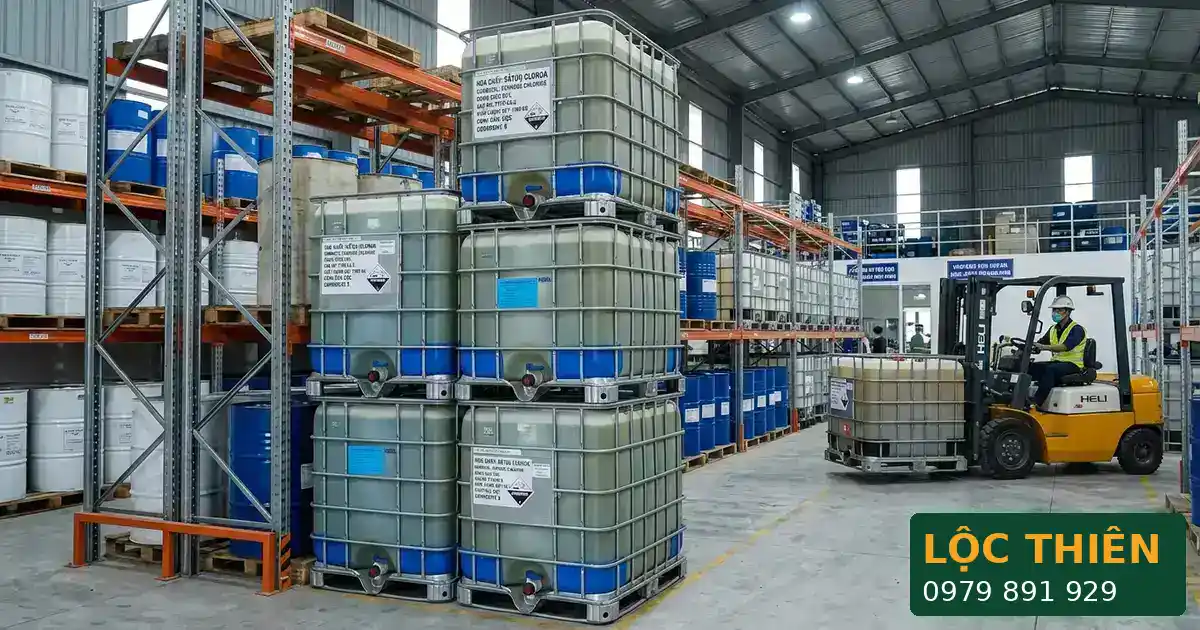
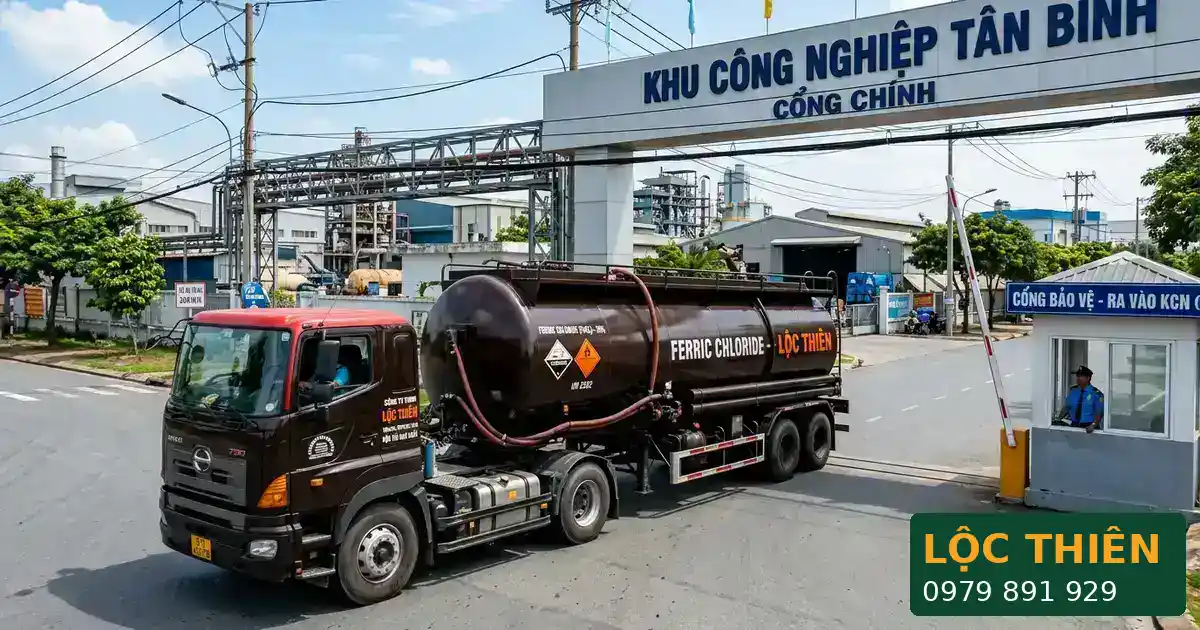
As a large-scale commercial bulk supplier (3,000+ tons/month), Loc Thien Chemical distributes synchronized shipments of Ammonium Chloride NH₄Cl 99.5% (25 kg bags) and Technical Hydrochloric Acid HCl 32% (dedicated 5–30-ton road tankers, 1,000 L IBC totes, 250 kg drums) accompanied by Batch COA and GHS SDS documentation. We guarantee a 15-minute technical quotation SLA; delivery within 4 hours in inner Ho Chi Minh City, 24–48 hours across Southern and Mekong Delta industrial parks, and 2–3 days across Northern and Central Vietnam from our 6 standardized warehouses.