FeCl₂ vs FeCl₃ — Choosing the Right Iron Coagulant: Technical Comparison & Cost Analysis
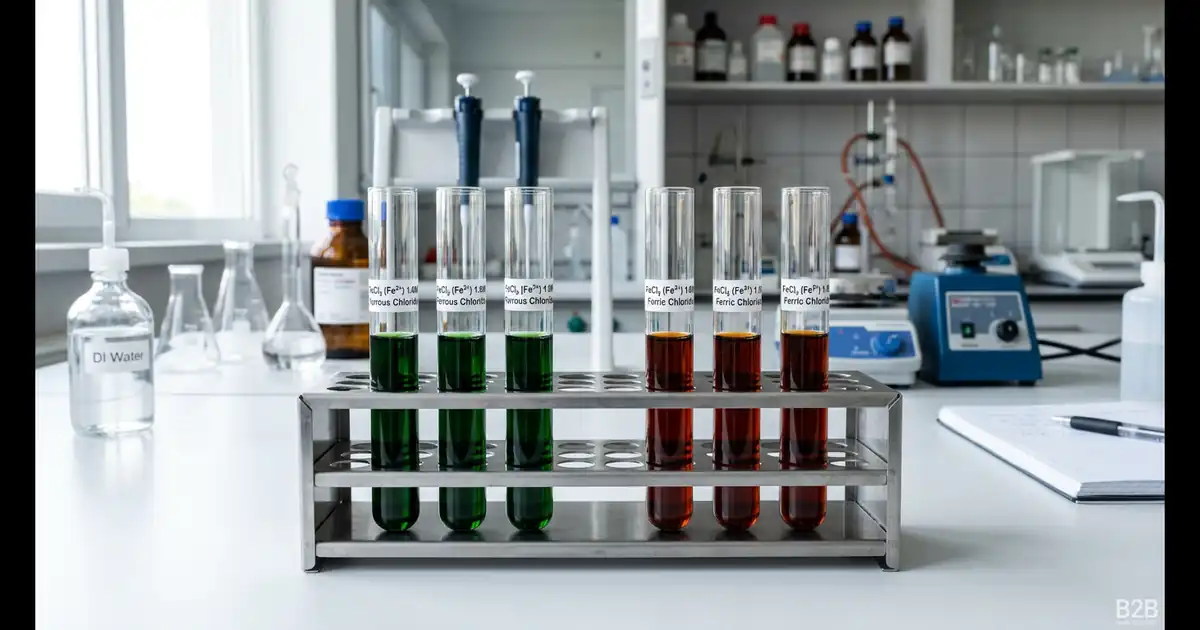
| | CAS | 7758-94-3 | 7705-08-0 | | Formula | FeCl₂ (Fe²⁺) | FeCl₃ (Fe³⁺) | | Iron valence | +2 (ferrous) | +3 (ferric) | | Loc Thien form | Liquid solution 15–30% | Liquid solution 36–40% | | Density | 1.15–1.35 g/mL | 1.40–1.45 g/mL | | Color | Pale green → brown upon oxidation | Dark brown | | Solution pH | Weakly acidic (per batch COA) | < 1 (strong acid) | | Coagulation ability | Moderate (requires higher dosage) | Excellent — primary coagulant | | Reducing/Oxidizing power | Strong reducing: Cr⁶⁺→Cr³⁺, Fenton (Fe²⁺+H₂O₂) | Mild oxidizing, mainly coagulation | | Effect on wastewater pH | Slight pH drop | Strong pH drop — requires control | | H₂S/odor control | Very good — forms FeS precipitate | Indirect | | Phosphate removal | Forms Fe₃(PO₄)₂ — effective | Forms FePO₄ — very effective | | Sludge volume | Lower | May be higher depending on water source | | Equipment corrosion | Moderate | High — requires acid-resistant materials | | Main applications | Cr⁶⁺ treatment, textile mill Fenton, H₂S removal | Municipal WWTP, drinking water, phosphate removal | | Packaging | 30L can, 200L drum, 1000L IBC, tank truck | 30L can, 200L drum, 1000L IBC, tank truck | | Documentation | COA/MSDS per batch | COA/MSDS per batch |
Coagulation Performance — FeCl₃ Is the King of Iron Coagulants
FeCl₃ is considered the most effective iron coagulant thanks to its direct hydrolysis mechanism. When FeCl₃ dissolves in water, Fe³⁺ ions hydrolyze to form positively charged Fe(OH)₃ — neutralizing negatively charged colloidal particles in wastewater and binding them into heavy settleable flocs. This process occurs immediately, without a need for intermediate oxidation.
FeCl₂ requires oxidation from Fe²⁺ to Fe³⁺ before it can participate in coagulation — a slower process that depends on DO content and wastewater pH. Therefore, FeCl₂ typically requires 30–50% higher dosage than FeCl₃ to achieve the same coagulation performance.
A study on landfill leachate showed that FeCl₃ reduced turbidity by 95.7% while FeCl₂ achieved only 56.4% under the same jar-test conditions. For municipal wastewater and drinking water treatment, FeCl₃ is the preferred choice — maximizing the floc-forming ability of Fe³⁺. See also FeCl₃ vs PAC — which coagulant is optimal for wastewater treatment for a broader perspective on common coagulants.
Cr⁶⁺ Reduction and Fenton AOP — FeCl₂’s Unique Advantages
FeCl₂ has two treatment mechanisms that FeCl₃ cannot replace: Cr⁶⁺ reduction and Fenton reaction.
Cr⁶⁺ Reduction: Fe²⁺ ions are strong reducing agents, converting Cr⁶⁺ (hexavalent chromium, toxic, carcinogenic) into Cr³⁺ (trivalent chromium, less toxic) at pH 2–3 according to the equation: 3Fe²⁺ + Cr⁶⁺ → 3Fe³⁺ + Cr³⁺. Reduction ratio: 3 mol Fe²⁺ per 1 mol Cr⁶⁺. Then raise pH to 8–9 with NaOH or Ca(OH)₂ to precipitate Cr(OH)₃.
Case Study — Plating Plant, Song Than Industrial Park (anonymized): A plating plant with capacity 150 m³/day, wastewater containing Cr⁶⁺ 45–65 mg/L. Previously used NaHSO₃ for Cr⁶⁺ reduction at a chemical cost of ~4,200 VND/m³. Switched to FeCl₂ 28% (COA batch 260804: FeCl₂ 28.3%, density 1.32) at a dosage of 580 mg/L (equivalent to 3.2 mg Fe²⁺/mg Cr⁶⁺ + 15% excess), Cr⁶⁺ effluent <0.05 mg/L — meeting QCVN 40:2011/BTNMT Column A. Chemical cost reduced to ~2,800 VND/m³, sludge volume reduced ~15% because no separate reduction step was needed.
Fenton AOP: Fe²⁺ + H₂O₂ generates •OH radicals (2.7 times stronger oxidizing power than Cl₂), treating refractory COD in textile dyeing wastewater. See detailed Fenton mechanism at optimizing Fe²⁺:H₂O₂ ratio in textile wastewater treatment.
“FeCl₂ is the mandatory choice for plating wastewater containing Cr⁶⁺. With a Fe²⁺:Cr⁶⁺ ratio of 3:1 and pH control at 2–3, reduction efficiency reaches 99.8%. FeCl₃ has no Cr⁶⁺ reduction mechanism — engineers must specify the correct chemical for each process step.” — KTV Phan Cam Thuy, CGHT, HCLT
pH Impact and Operating Cost — The Control Equation
FeCl₃ reduces wastewater pH significantly more than FeCl₂. A 36–40% FeCl₃ solution has pH <1 — each liter added can lower wastewater pH by 1–2 units, depending on alkalinity. For a 500 m³/day WWTP using FeCl₃ at 200 mg/L, neutralization with NaOH requires ~80–120 kg/day to bring pH to 6.5–7.5, adding alkali cost of ~1,500–2,500 VND/m³.
FeCl₂ has a much smaller pH drop — after Cr⁶⁺ reduction, wastewater typically drops only 0.3–0.5 pH units, significantly reducing alkali demand. When evaluating total cost per m³, FeCl₂ may be cheaper than FeCl₃ when including pH chemical costs, even though FeCl₂ per-kg price is often higher.
Cost factors must be assessed on a specific system through jar-test — not simply comparing per-kg chemical price. Loc Thien provides free jar-test support; call 0979 891 929 to schedule.
Equipment Corrosion and Storage Requirements
FeCl₃ with pH <1 corrodes carbon steel, stainless steel 304, aluminum, and copper. FeCl₃ storage tanks must be made of HDPE, PP, or FRP; metering pumps require PP/PVDF heads with PTFE seals; piping should be PVC/CPVC. Capital investment for acid-resistant equipment for FeCl₃ is 20–40% higher than systems using PAC or FeCl₂.
FeCl₂ solution has a weakly acidic pH — equipment corrosion is moderate. However, FeCl₂ is easily oxidized upon air exposure (color changes from pale green to yellow-brown as Fe²⁺ oxidizes to Fe³⁺). Store in sealed tanks, minimize DO in wastewater, and avoid prolonged air contact.
For plants already using HDPE tanks and PVC piping (as most current WWTPs do), both FeCl₂ and FeCl₃ are suitable. Plants with carbon steel equipment should consider upgrading materials if switching to FeCl₃.
Industry Applications — When to Choose FeCl₂, When to Choose FeCl₃
Drinking water / municipal wastewater: FeCl₃ is the primary coagulant — Fe(OH)₃ flocs are heavy and settle quickly, effective pH range 5–9, turbidity reduction is efficient. No residual aluminum like PAC.
Plating (containing Cr⁶⁺): FeCl₂ is mandatory for reducing Cr⁶⁺ to Cr³⁺. FeCl₃ cannot reduce Cr⁶⁺.
Textile dyeing (high COD, color): FeCl₂ + H₂O₂ (Fenton AOP) removes 90–98% color, reduces COD 60–85% at pH 3–4. FeCl₃ alone treats SS and particulate color.
Wastewater with H₂S: FeCl₂ forms FeS precipitate — effective odor control. FeCl₃ forms less stable Fe₂S₃.
Phosphate removal: Both are effective. FePO₄ (from FeCl₃) has lower solubility than Fe₃(PO₄)₂ (from FeCl₂) — FeCl₃ is superior for meeting phosphate discharge standards.
PCB etching: FeCl₃ is the standard etchant (copper etching: 2FeCl₃ + Cu → 2FeCl₂ + CuCl₂), not replaceable by FeCl₂.
See also FeCl₃ dosage for plating wastewater — mg/L to mL/m³ conversion guide and Cr⁶⁺ reduction process using FeCl₂.
Jar-Test Guide — Choosing the Right Chemical for Your ETP
A 6-jar jar-test is the standard method to determine the optimal coagulant. Recommended procedure:
- Prepare 6 wastewater samples of 1 L each, at natural pH
- Add FeCl₂ or FeCl₃ at increasing dosages (50, 100, 150, 200, 250, 300 mg/L)
- Rapid mix at 120 rpm × 3 minutes (coagulation)
- Slow mix at 30 rpm × 15 minutes (flocculation)
- Settle for 30 minutes — measure turbidity (NTU), final pH, residual Cr⁶⁺ (if any), COD, sludge volume
Track these parameters: NTU turbidity, residual Cr⁶⁺ (mg/L), COD (mg/L), final pH, settled sludge (mL/L). For plating wastewater, combine FeCl₂ for Cr⁶⁺ reduction at pH 2–3 in a separate jar, then FeCl₃ coagulation at pH 7–8. Loc Thien provides free jar-test support for new customers.
Frequently Asked Questions (FAQ)
How are FeCl₂ and FeCl₃ different?
Their iron valence differs. FeCl₂ (Fe²⁺) is a reducing agent, used for Fenton and Cr⁶⁺ reduction. FeCl₃ (Fe³⁺) is the primary coagulant for wastewater and drinking water treatment.
Can FeCl₂ replace FeCl₃ for coagulation?
Possible, but less effective — Fe²⁺ coagulates more poorly than Fe³⁺. Requires 30–50% higher dosage and may not meet effluent standards. Jar-test is recommended to determine feasibility.
Which is best for treating Cr⁶⁺ in plating wastewater?
FeCl₂ is mandatory. Fe²⁺ reduces Cr⁶⁺ → Cr³⁺ (3:1 ratio), then Cr(OH)₃ precipitates at pH 8–9. FeCl₃ cannot reduce Cr⁶⁺.
Are FeCl₂ and FeCl₃ corrosive?
FeCl₃ is highly corrosive (pH <1) — requires acid-resistant storage tanks, pumps (HDPE, PP, FRP). FeCl₂ is moderately corrosive — must be stored sealed to prevent oxidation of Fe²⁺ to Fe³⁺.
Which is cheaper, FeCl₂ or FeCl₃?
FeCl₃ is usually cheaper per kg due to large-scale production. However, when calculating total cost per m³ (including pH chemicals and sludge treatment), FeCl₂ can be competitive — a site-specific jar-test is needed.
Can FeCl₂ be used for textile dyeing wastewater?
Yes. Combine FeCl₂ + H₂O₂ (Fenton) at pH 3–4 to generate •OH radicals, removing 90–98% color and reducing COD 60–85%. See more at Fenton FeCl₂+H₂O₂ guide for textile wastewater.
🛒 Need to purchase FeCl₂ or FeCl₃? Get a quote for Ferrous Chloride FeCl₂ 15–30% — COA/MSDS per batch, delivered to industrial parks nationwide. | Get a quote for Ferric Chloride FeCl₃ 36–40% — COA/MSDS per batch, delivered to industrial parks nationwide. Hotline: 0979 891 929.
LOC THIEN INVESTMENT AND DEVELOPMENT COMPANY LIMITED Tax ID: 0313650856 Hotline: 0979 891 929 · Email: [email protected] Website: https://hoachatlocthien.com