
HCl in FeCl₃ Production
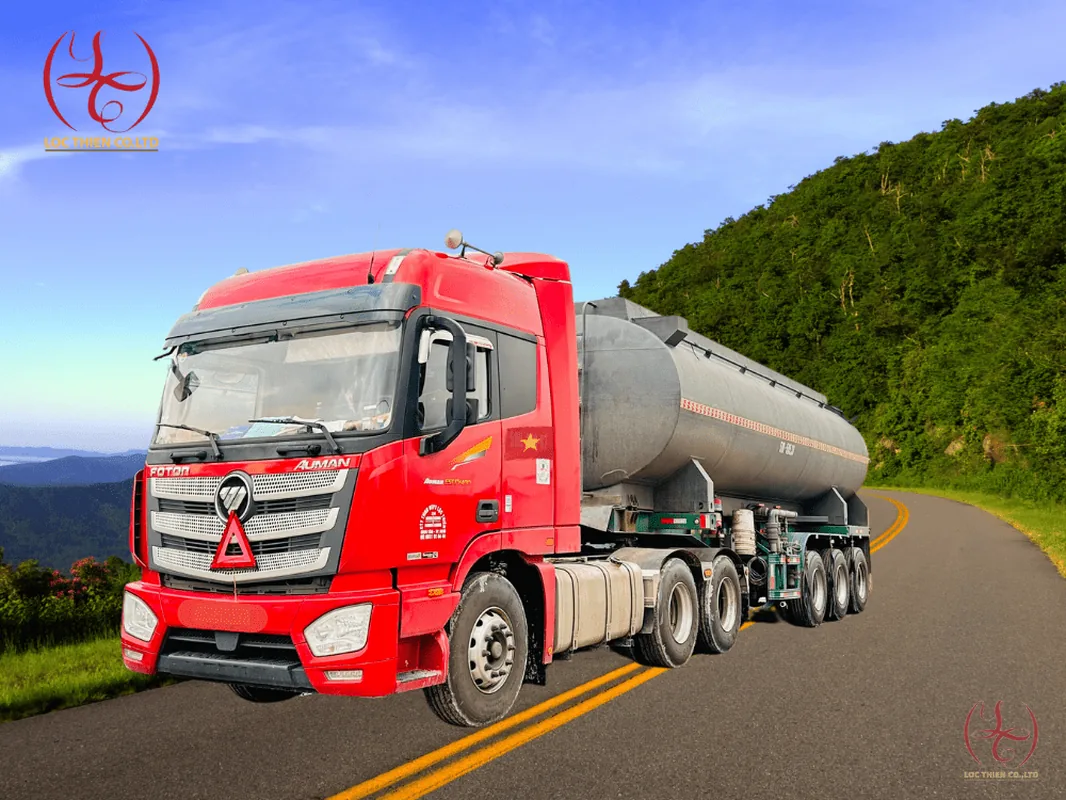
TL;DR: HCl (hydrochloric acid) is the main raw material for producing FeCl₃ (ferric chloride) through reaction with scrap iron or mill scale. Process: Fe + HCl → FeCl₂ + H₂, then oxidation of FeCl₂ to FeCl₃ using Cl₂ or O₂ with catalyst. Consumption rate ~3.2 tons of 32% HCl per 1 ton of Fe. Lộc Thiên both supplies HCl and produces FeCl₃ — an integrated chain from raw material to finished product.
Chemical Reactions for Producing FeCl₃ from HCl and Iron
The basic reaction for producing FeCl₃ from HCl and scrap iron occurs in two stages:
Stage 1 — Dissolving iron to form FeCl₂:
Fe + 2HCl → FeCl₂ + H₂
Scrap iron (steel scrap, billet scrap) reacts with HCl solution at 70–90°C to form ferrous chloride (FeCl₂) and release hydrogen gas. This is a strongly exothermic reaction, requiring rate control by adjusting HCl concentration and iron feed rate.
Stage 2 — Oxidation of FeCl₂ to FeCl₃:
2FeCl₂ + Cl₂ → 2FeCl₃ (direct chlorination method)
Or the oxychlorination method:
4FeCl₂ + 4HCl + O₂ → 4FeCl₃ + 2H₂O (with excess HCl and oxygen, temperature 70–90°C)
The oxychlorination method uses air/oxygen as the oxidizing agent instead of Cl₂, reducing cost and improving safety. According to US Patent 9,376,329, this process can operate at atmospheric pressure, utilizing heat from the exothermic reaction to maintain reaction temperature.
Final result: total HCl consumption of approximately 3.2 tons of 32% HCl per 1 ton of scrap iron, producing FeCl₃ solution at the target concentration.
FeCl₃ Production Process from HCl and Scrap Iron
Direct Method: Dissolution + Oxidation — Most Common
Step 1 — Raw material preparation:
- Scrap iron (scrap iron or steel scrap) — cleaned of oil, mechanically descaled
- 32% HCl — supplied from storage tanks or tanker trucks
Step 2 — FeCl₂ formation reaction:
- Scrap iron is fed into a reactor containing HCl solution
- Temperature maintained at 70–90°C (self-sustaining exothermic reaction after startup)
- HCl concentration gradually decreases from 32% to 3–5% by end of cycle
- H₂ gas released is collected or safely flared
Step 3 — Oxidation of FeCl₂ → FeCl₃:
- Chlorine gas or O₂ + HCl is bubbled into the FeCl₂ solution
- Oxychlorination reaction carried out in an atmospheric pressure reaction tower
- Temperature maintained at 80–95°C
- Oxidation time: 2–4 hours
Step 4 — Filtration and purification:
- Insoluble residues (oxides, silicates) removed via plate-and-frame filter
- Vacuum concentration if high-concentration FeCl₃ solution (36–40%) is required
Step 5 — Quality control:
- QC checks FeCl₃ content, residual FeCl₂, free HCl
- COA issued per batch — supervised by QC Technicians Phan Cẩm Thùy and Võ Thị Như Hòa
Dry Chlorination Method
Alternative method: heating scrap iron to 500–700°C in a stream of dry Cl₂ (10–30% excess). FeCl₃ forms as a vapor, then condenses to crystals. This method yields high-purity (≥98%) anhydrous FeCl₃, but is more complex to operate and requires strict Cl₂ gas control. Loc Thien supplies FeCl3 as a solution only; solid forms are not part of the product range.
Technical Specifications of HCl for FeCl₃ Production
| Parameter | Requirement | Method |
|---|---|---|
| HCl Concentration | 32% ± 1% | TCVN 1969-88 |
| Density (20°C) | 1.159 g/cm³ | TCVN 1969-88 |
| Fe content | ≤ 0.002% | TCVN 1969-88 |
| SO₄²⁻ content | ≤ 0.005% | TCVN 1969-88 |
| Free Cl₂ content | ≤ 0.005% | TCVN 1969-88 |
32% HCl is the standard concentration for FeCl₃ production. Too low a concentration (<28%) slows the iron dissolution reaction. Too high (>36%) generates HCl fumes and increases equipment corrosion.
Consumption Rates and Production Costs
To produce 1 ton of FeCl₃ (38% solution), raw material consumption:
| Material | Consumption | Notes |
|---|---|---|
| Scrap iron | ~0.28 tons | Scrap iron, steel scrap |
| 32% HCl | ~0.9 tons | Actual consumption with excess |
| Cl₂ or O₂ | Varies by method | Oxygen from air (free) |
At industrial scale, producing FeCl₃ from HCl and scrap iron costs 15–25% less than production from Fe₂O₃ or ore. Reason: scrap iron has low cost, fast dissolution reaction, no high-temperature calcination required.
FeCl₃ Production from Mill Scale — An Emerging Trend
Mill scale (steel rolling scale) is a byproduct from steel mills, containing 70–75% Fe in the form of FeO, Fe₃O₄, Fe₂O₃. Recent research in Environmental Science and Pollution Research (2024) demonstrates that mill scale can replace scrap iron in FeCl₃ production.
Process: mill scale + HCl (7M) → FeCl₂/FeCl₃, temperature 105°C (378 K), time 120 minutes, achieving 100% Fe dissolution efficiency and ~77% Fe³⁺ conversion rate at Fe³⁺ concentration of 52.53 g/L.
Advantages:
- Mill scale is 30–50% cheaper than scrap iron
- Utilizes steel mill waste, reducing landfill pressure
- Fine particle size (< 90 µm) increases reaction rate
- FeCl₃ produced from mill scale achieves wastewater treatment coagulation performance equivalent to commercial FeCl₃
Quality Control of Finished FeCl₃
Output QC for FeCl₃ follows these parameters, tested per batch before warehouse release:
| Parameter | 38% Solution | Method |
|---|---|---|
| FeCl₃ content | ≥ 38% | TCVN 3795-83 |
| Residual FeCl₂ | ≤ 0.5% | Titration |
| Free HCl | ≤ 0.5% | TCVN 3795-83 |
| Insolubles | ≤ 0.1% | TCVN 3795-83 |
| Density (20°C) | 1.38–1.42 g/cm³ | ASTM D891 |
| pH of 1% solution | 1.5–2.5 | ASTM E70 |
Every shipment batch includes a COA with test number and QC technician signature — the QC process ensures consistent quality across delivery batches.
Lộc Thiên’s FeCl₃ meets ZDHC MRSL Level 1 (TÜV Rheinland), certified free of 22 restricted chemical groups under ZDHC version 2.0. This is a mandatory requirement for textile dyeing, electroplating, and leather footwear factories exporting to EU and US markets.
FeCl₃ is the most effective coagulant for wastewater and water supply treatment, especially for water with color, high turbidity, and high COD.
Mechanism: Fe³⁺ hydrolyzes to form Fe(OH)₃ colloidal precipitate, which adsorbs and carries away contaminants, coagulating at pH 5.0–8.5.
Coagulant dosage comparison (study on steel mill wastewater):
| Parameter | Al₂(SO₄)₃ | Commercial FeCl₃ | FeCl₃ from HCl + mill scale |
|---|---|---|---|
| Optimal dose | 4.05 mg/L | 1.29 mg/L | 1.29 mg/L |
| Optimal pH | 7.0 | 5.0 | 5.0 |
| Polymer aid | 2.0 mg/L | 0.25 mg/L | 0.25 mg/L |
| COD efficiency | ~85% | ~93% | ~93% |
| TSS efficiency | ~88% | ~95% | ~95% |
Research published in Environmental Science and Pollution Research (2024) proves that FeCl₃ produced from HCl + mill scale (steel scrap) achieves wastewater treatment performance equivalent to commercial FeCl₃, at lower cost due to scrap recycling.
Downstream Integration: Lộc Thiên — HCl and FeCl₃
Lộc Thiên is an industrial HCl supplier and a direct FeCl₃ producer. This integration provides supply chain advantages:
- Single source: FeCl₃ buyers need not worry about raw material disruption — Lộc Thiên self-supplies input HCl
- Quality control: 32% HCl meets standards before entering the reactor, QC checks COA per batch
- Logistics optimization: HCl and FeCl₃ delivered on the same tanker truck routes
- Batch COA/MSDS: Every shipment includes test certificates from the QC lab — QC Technicians Phan Cẩm Thùy and Võ Thị Như Hòa
- 6 nationwide warehouses: Ba Ria – Vung Tau, Dong Nai, Binh Duong, Da Nang, Can Tho, Bac Ninh
Customers including water treatment plants, chemical factories, and industrial parks benefit from a closed-loop supply chain from HCl → FeCl₃.
FeCl₃ meets ZDHC MRSL Level 1 (TÜV Rheinland) — fulfilling export requirements for textile dyeing, electroplating, and manufacturing plants.
Storage and Safety of FeCl₃
FeCl₃ is a corrosive chemical (UN 2582, Class 8), acidic, rapidly rusting uncoated steel:
- Packaging: 30 m³ HDPE tanks, 1 m³ IBC, or 30L jerry cans
- Storage tank materials: PE/PP plastic, FRP, PVC — absolutely no steel
- Temperature: 5–35°C. FeCl₃ solution may crystallize below 12°C
- Shelf life: 12 months, avoid direct sunlight
- PPE: PVC/nitrile gloves, safety goggles, chemical-resistant clothing
Frequently Asked Questions (FAQ)
How much 32% HCl is needed per 1 ton of Fe?
Approximately 3.2 tons of 32% HCl for 1 ton of scrap iron, producing ~3.5 tons of 38% FeCl₃. The actual ratio depends on iron purity and HCl concentration.
Is FeCl₃ produced from HCl clean?
Yes. Commercial-grade FeCl₃ from this process achieves FeCl₃ content ≥ 38%, FeCl₂ ≤ 0.1%, free HCl ≤ 0.5%. Quality is controlled via batch COA.
Does Lộc Thiên sell HCl and FeCl₃ separately?
Yes. Lộc Thiên supplies 32% industrial HCl and FeCl₃ (38% solution) — customers can purchase individual products or a combo for integrated chain.
Does FeCl₃ have ZDHC certification?
Lộc Thiên’s FeCl₃ meets ZDHC MRSL Level 1 (TÜV Rheinland), complying with input chemical limits under sustainable fashion export standards.
How does FeCl₃ price compare to other coagulants?
FeCl₃ is typically competitive with PAC and alum. FeCl₃ delivers 10–20% higher coagulation efficiency at 30–50% lower dosage than alum, significantly reducing sludge volume.
How is FeCl₃ transported?
Plastic tanker trucks 5–30 tons for solution. Delivered to industrial parks nationwide — 4 hours in inner HCMC, 24–48 hours to Southern and Western industrial parks, 2–3 days to Northern and Central regions.
Can FeCl₃ be tested before bulk purchase?
Yes. Lộc Thiên supports 5-gallon or 1 m³ IBC sampling for jar testing at your plant — free technical consultation.
How does FeCl₃ affect wastewater pH?
FeCl₃ is acidic, lowering wastewater pH by 0.5–1.5 units at 30–50 ppm dosage. Alkali (NaOH) addition is needed to maintain optimal coagulation pH of 5.0–8.0.
Request a Quote
Lộc Thiên supplies 32% HCl and FeCl₃ to factories — batch COA/MSDS, ZDHC MRSL Level 1, delivered to industrial parks nationwide. Contact us for a combo HCl + FeCl₃ quote for integrated production chains.
Hotline: 0979 891 929
🛒 Need FeCl₃ for water treatment? FeCl₃ 38% Quote — Batch COA/MSDS, ZDHC Level 1, nationwide industrial park delivery. | Buy 32% Industrial HCl — Wholesale price, COA/MSDS, nationwide delivery. Hotline 0979 891 929.