Sodium Silicate Water Glass (Na₂SiO₃) Modulus M = 2.0–3.3 & Baumé (°Bé) Engineering Selection Guide for CO₂ Foundry Sand, Shotcrete, Paper De-Inking & Textile Bleaching
Table of contents
Select liquid Sodium Silicate (Na₂O·mSiO₂, CAS 1344-09-8, UN 3266) at Molar Modulus M = 2.2–2.5 (48–52 °Bé at 20 °C) for CO₂-cured foundry sand cores; select M = 3.0–3.3 (38–42 °Bé) for shotcrete, C-S-H concrete densifiers, paper de-inking, and H₂O₂ bleach stabilization; and select M = 2.6–2.9 (44–48 °Bé) for spiral paper-core adhesives.
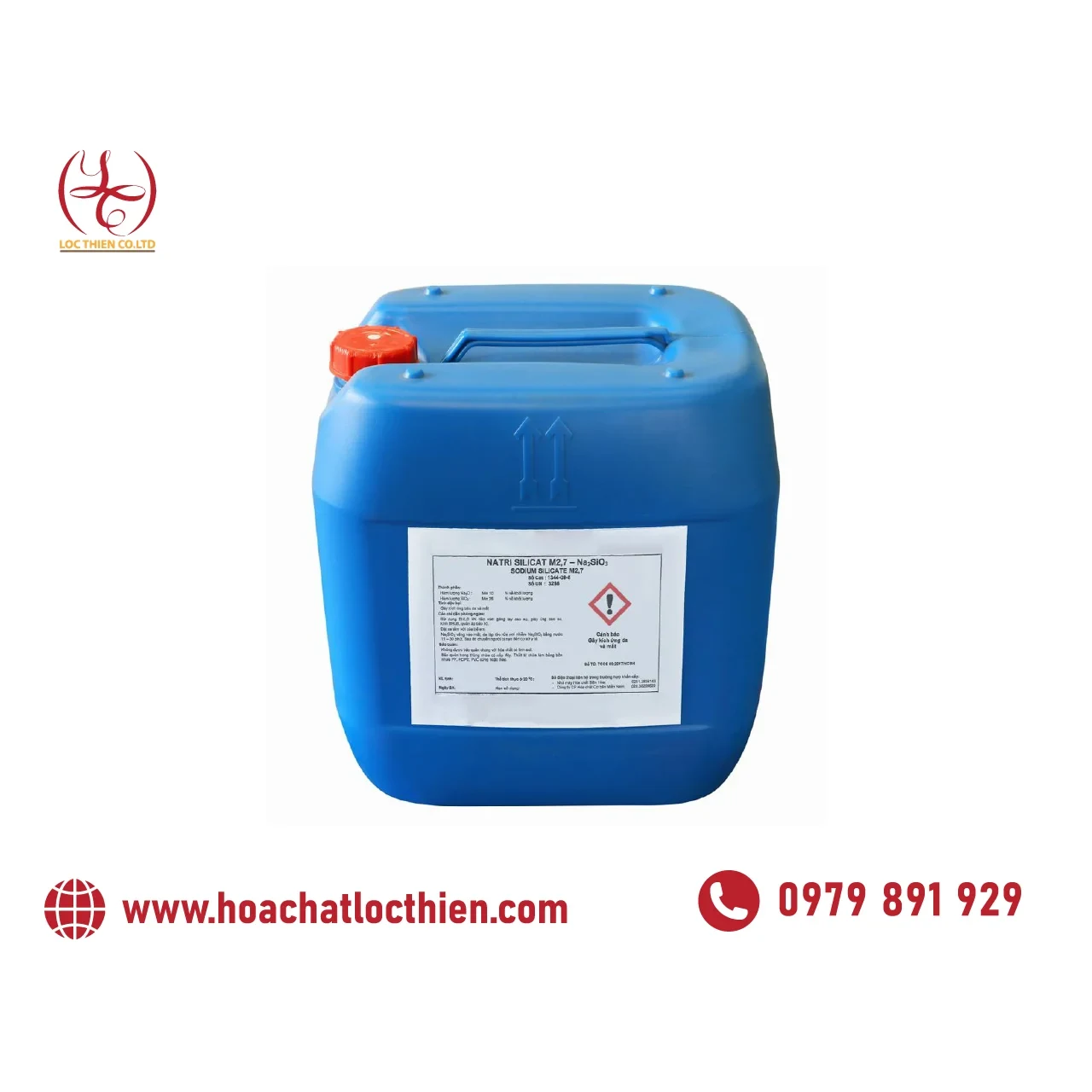
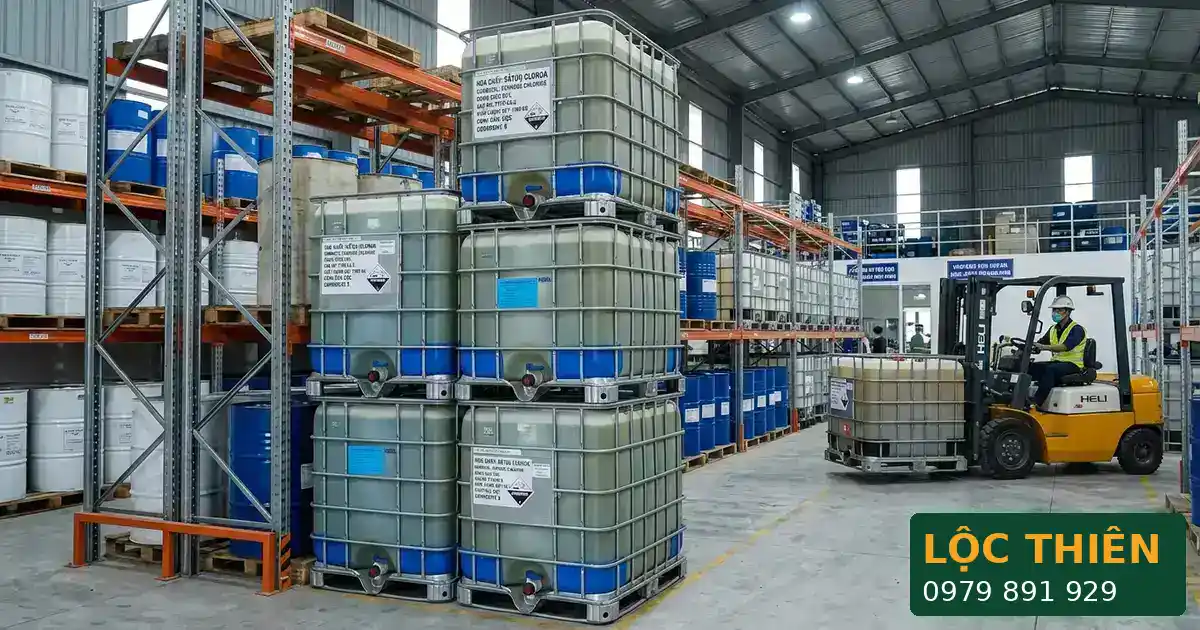
Loc Thien Chemical supplies 280–300 kg drums, 1,380–1,500 kg IBC totes, and 5–30-ton road tankers with batch COAs from 6 regional warehouses.
Request an official technical quotation & batch COA specification check within 15 minutes: Contact our B2B Chemical Engineering Desk via Email [email protected], Hotline / Vietnamese Zalo +84 979 891 929, or submit our Online Bulk Sodium Silicate RFQ Form to receive batch Certificates of Analysis (
COA per batchcertifying% Na₂O,% SiO₂, weight ratioRw, molar modulusM, and°Bé at 20 °C), 16-section GHSSDSdossiers, and a mass-to-volume tank sizing worksheet tailored to your plant.
How Do Weight Ratio (Rw) and Molar Modulus (M = Rw × 1.032) Differ on a Sodium Silicate COA, and How Does Baumé Gravity (°Bé) Govern Cold-Weather Viscosity?
Liquid Sodium Silicate (Water Glass, general stoichiometric formula Na₂O·mSiO₂, commercially abbreviated as Na₂SiO₃, CAS 1344-09-8, Dangerous Goods UN 3266) is not a single fixed-stoichiometry salt like sodium chloride; rather, it is a dynamic aqueous alkaline colloidal solution of monomeric, linear, and cyclic polysilicate anions whose industrial reactivity is governed simultaneously by Silicate Modulus (M) and Total Solids Concentration (% Na₂O + % SiO₂ w/w). Across Vietnam’s industrial basic chemicals supply chain, more than half of all mold-collapse incidents in metal foundries, adhesive delamination failures in paper-tube mills, and plugged metering pipelines involving Liquid Sodium Silicate Na₂SiO₃ (Water Glass) originate from a single procurement oversight: ordering “heavy-grade liquid silicate” by Baumé reading alone while confusing Weight Ratio (Rw) with Molar Modulus (M) on the supplier’s Certificate of Analysis (COA per batch).
1. Exact Stoichiometric Conversion Between Weight Ratio (Rw) and Molar Modulus (M)
During quality-control laboratory release testing, analytical chemists determine two primary composition variables on a mass-percentage basis (% w/w): total titratable alkali expressed as sodium oxide % Na₂O (w/w) (molar mass M_Na2O = 61.98 g/mol) and soluble silica expressed as silicon dioxide % SiO₂ (w/w) (molar mass M_SiO2 = 60.08 g/mol). Process engineers and purchasing specialists must strictly distinguish between the two resulting ratios reported across international standards:
- Silica-to-Alkali Weight Ratio (
Rw): The direct mass ratio of silicon dioxide percentage to sodium oxide percentage in the commercial solution (commonly specified in ASTM, North American, and UK technical data sheets):Rw = (% SiO₂) / (% Na₂O) - Silica-to-Alkali Molar Ratio / Molar Modulus (
M): The true molecular ratiominsideNa₂O·mSiO₂(standard across Vietnamese, Chinese GB/T, Taiwanese CNS, Korean KS, and Japanese JIS foundry and textile specifications). Because one mole ofNa₂Ois slightly heavier than one mole ofSiO₂by a factor of61.98 / 60.08 = 1.0316(standardized in engineering calculations as1.032), the exact conversion equation is:M = Rw × (61.98 / 60.08) = Rw × 1.032
Practical Batch COA Verification Example: Suppose an incoming road tanker lot of neutral-alkaline water glass intended for pulp de-inking and textile bleaching reports 9.2% Na₂O (w/w) and 28.5% SiO₂ (w/w) on its COA per batch:
- The Weight Ratio (
Rw) equals:28.5 / 9.2 = 3.10(Rw = 3.10). - The Molar Modulus (
M) equals:3.10 × 1.032 = 3.20(M = 3.20).
If an overseas corporate SOP specifies Molar Modulus M = 3.20, but a local buyer mistakenly requests Weight Ratio Rw = 3.20 (which actually corresponds to M = 3.20 × 1.032 = 3.30), the delivered solution sits right on the thermodynamic gelation boundary where polymeric silica chains spontaneously cross-link and turn turbid during cool overnight storage.
2. Converting Degrees Baumé (°Bé at 20 °C) to Specific Gravity (SG) and Managing Exponential Viscosity Spikes Below 18 °C
For aqueous industrial liquids denser than pure water at the 20 °C reference temperature, Degrees Baumé (°Bé) converts directly into Specific Gravity (SG, g/cm³ or kg/L) via the standard rational hydrometer equation:
SG = 145 / (145 - °Bé)
However, Baumé density alone never defines pumping behavior without knowing Module M. At an identical Baumé reading, a high-modulus grade (M = 3.1–3.3) contains highly polymerized three-dimensional colloidal silicate clusters that hit a steep “viscosity wall” at roughly 40–42 °Bé, whereas a high-alkali, low-modulus foundry grade (M = 2.0–2.4) depolymerizes silica chains into compact monomer/dimer ions, allowing manufacturers to concentrate the liquid all the way up to 50–52 °Bé (SG 1.526–1.559 g/cm³). Crucially, liquid sodium silicate behaves as a strongly temperature-sensitive fluid: when ambient winter temperatures across Northern Vietnam industrial zones (Bac Ninh, Hai Phong, Vinh Phuc, Thai Nguyen) drop below < 18 °C (10–15 °C during January–February cold fronts), intermolecular hydrogen bonding causes the kinematic viscosity of 48–52 °Bé grades to surge exponentially by 3× to 8× compared to summer 28–30 °C conditions. Uninsulated outdoor tanks connected to undersized suction piping or standard centrifugal water pumps will immediately suffer suction starvation, cavitation, and mechanical seal failure.
The engineering lookup table below summarizes the six core commercial grades distributed in bulk by Loc Thien Chemical (benchmarked at 20 °C, with exact analytical figures certified per batch COA):
Commercial Grade Tier (at 20 °C) | Molar Modulus (M) | Weight Ratio (Rw) | Baumé Gravity (°Bé at 20 °C) | Typical Specific Gravity SG (g/cm³ at 20 °C) | Alkali Assay % Na₂O (% w/w) | Silica Assay % SiO₂ (% w/w) | 1% w/v Solution pH & Dynamic Viscosity Profile (at 20 °C) |
|---|---|---|---|---|---|---|---|
High-Modulus Penetrating Tier (38 °Bé) | 3.20 – 3.35 | 3.10 – 3.25 | 38 °Bé | ≈ 1.355 g/cm³ (1.35–1.36) | 8.2% – 8.8% | 26.8% – 28.2% | pH 11.0–11.6; low viscosity (150–350 mPa·s), deep capillary concrete penetration |
High-Modulus Standard Tier (40 °Bé) | 3.00 – 3.22 | 2.91 – 3.12 | 40 °Bé | ≈ 1.381 g/cm³ (1.37–1.39) | 8.9% – 9.6% | 27.5% – 29.5% | pH 11.2–11.8; moderate viscosity (250–600 mPa·s), smooth AODD/gear pump metering |
Medium-Modulus Adhesive Tier (44 °Bé) | 2.60 – 2.90 | 2.52 – 2.81 | 44 °Bé | ≈ 1.436 g/cm³ (1.42–1.45) | 10.8% – 11.8% | 29.0% – 31.2% | pH 11.6–12.2; medium-high viscosity (500–1,200 mPa·s), rapid wet tack on kraft paper |
Foundry CO₂ Winter-Flow Tier (48 °Bé) | 2.30 – 2.50 | 2.23 – 2.42 | 48 °Bé | ≈ 1.495 g/cm³ (1.48–1.51) | 12.8% – 13.8% | 30.0% – 32.0% | pH 12.0–12.6; viscous (900–2,200 mPa·s), uniform quartz sand coating in cool weather |
Foundry CO₂ High-Solids Tier (50 °Bé) | 2.20 – 2.45 | 2.13 – 2.37 | 50 °Bé | ≈ 1.526 g/cm³ (1.51–1.54) | 13.5% – 14.7% | 31.0% – 33.2% | pH 12.2–12.8; heavy syrupy liquid (1,800–4,500 mPa·s), high gassed tensile strength |
Alkaline Ultra-Dense Tier (52 °Bé) | 2.00 – 2.25 | 1.94 – 2.18 | 52 °Bé | ≈ 1.559 g/cm³ (1.55–1.57) | 14.8% – 16.5% | 31.5% – 34.0% | pH 12.5–13.0; ultra-viscous (4,000–10,000+ mPa·s), requires DN50–DN80 suction & warm storage < 18 °C |
Engineering note: Specific lot values for % Na₂O, % SiO₂, SG at 20 °C, water-insoluble residue, and trace iron (Fe) are individually certified on the batch Certificate of Analysis (COA per batch) accompanying every Loc Thien Chemical delivery.
How Do Engineers Select the Optimal Sodium Silicate Modulus (M) and Baumé Grade Across CO₂ Foundry Molding, C-S-H Concrete, Pulp & Paper, and Textile Bleaching?
Each downstream manufacturing sector exploits a distinct physicochemical property of the Na₂O·mSiO₂ system: metal foundries rely on controlled CO₂-triggered sol-gel polymerization; civil tunneling and industrial flooring rely on pozzolanic reaction with free lime without residual alkali bloom; whereas pulp, paper, and packaging chemicals and industrial textile auxiliaries rely on buffered alkaline pH, colloidal dispersion, and heavy-metal chelation. Cross-using a single Na₂SiO₃ tank across different departments without verifying Module M directly triggers off-spec production scrap.
1. CO₂-Cured Foundry Sand Molds and Cores (CO₂-Silicate Foundry Process)
In gray cast iron, ductile iron, alloy steel, and industrial valve foundries operating the inorganic CO₂-silicate sand-binding process, the mandatory specification window is medium-to-low Molar Modulus M = 2.2 – 2.5 paired with high solids concentration 48 – 52 °Bé (SG 1.49–1.56 g/cm³ at 20 °C), mulled at 3.5% – 5.0% w/w relative to dry, washed silica sand (AFS 50–70, clay content < 0.5%, moisture < 0.3%). Passing dry CO₂ gas (1.0–2.0 bar for 15–45 seconds) through the rammed core box neutralizes sodium alkali while simultaneous dehydration cross-links monomeric silicate ions into a rigid three-dimensional silicic acid hydrogel film bridging adjacent quartz grains:
Na₂O·mSiO₂ + CO₂ + nH₂O → Na₂CO₃ + mSiO₂·nH₂O↓ (amorphous silica binder gel)
Foundry metallurgists must guard against two opposing failure modes caused by off-spec modulus selection:
- Consequences of Over-High Modulus (
M > 3.0): Because low-alkali polysilicate chains sit near incipient gelation, minimal ambientCO₂exposure in the sand muller causes premature surface crusting and short sand bench life. Although initial gassing appears fast, the resulting binder bridges are thin, dehydrated, and brittle, leading to friable core edges, mold drop during closing, and molten metal erosion / sand inclusion defects. - Consequences of Over-Low Modulus (
M < 2.0): ExcessNa₂Odemands prolongedCO₂gassing times (wasting gas cylinder budgets) and yields sluggish initial green strength. Far worse, at molten iron and steel pouring temperatures (1,350 – 1,580 °C), surplusNa₂Ofluxes the quartz sand grain surfaces to form low-melting sodium-silicate slag phases (eutectic ~790–850 °C). Upon cooling, the sand sinters into a monolithic vitrified glass shell around the casting, causing severe retained strength and poor shakeout (burn-on) that damages castings during shot-blasting. (Foundry engineering tip: When an automated foundry wishes to trim incomingM = 2.7–2.8stock down toM = 2.3for heavy steel sections, engineers can stoichiometrically blend calculated additions of Liquid Caustic Soda NaOH 32% prior to sand mulling).
2. Tunnel Shotcrete Accelerators, Soil Grouting, Acid-Resistant Mortars & C-S-H Concrete Floor Densifiers
In NATM tunnel shotcrete spraying, curtain grouting for deep excavations, acid-proof potassium/sodium silicate brick linings in chemical scrubbers, and warehouse concrete floor densification, structural engineers specify high Molar Modulus M = 3.0 – 3.3 at moderate concentration 38 – 42 °Bé (SG 1.35–1.41 g/cm³ at 20 °C):
- Capillary Penetration &
C-S-HCrystal Mineralization: Low viscosity (150–500 mPa·s) allows diluted38–40 °Béhigh-modulus silicate to wick3–8 mmdeep into porous concrete capillaries, where solubleSiO₂reacts irreversibly with free calcium hydroxideCa(OH)₂(portlandite liberated during Portland cement hydration) to precipitate insoluble, high-hardness Calcium Silicate Hydrate (C-S-H) gel crystals inside pore throats:Na₂O·mSiO₂ + mCa(OH)₂ + xH₂O → m(CaO·SiO₂·yH₂O)↓ (insoluble C-S-H gel) + 2NaOH - Why High Modulus (
M = 3.0 – 3.3) Is Mandatory OverM = 2.2: Maximizing theSiO₂ / Na₂Oratio delivers maximum reactive silica per unit of introduced sodium. Substituting a low-modulus foundry grade (M < 2.5) leaves excessive unreactedNa₂Oinside concrete pores, which migrates to the slab surface with evaporating moisture and reacts with atmosphericCO₂to form unsightly white powdery alkali carbonate efflorescence (blooming), delaminates epoxy floor topcoats, and elevates Alkali-Silica Reaction (ASR) micro-cracking risk.
3. Wastepaper Flotation De-Inking, Peroxide Pulp Bleaching & Spiral Paper-Core / Corrugated Adhesives
Vietnam’s packaging paper mills and paper-core converters require two distinct Na₂SiO₃ specifications across wet-end pulping versus dry-end converting lines:
- Wastepaper Flotation De-Inking (
ONP / OMG / MOW) &H₂O₂Mechanical Pulp Bleaching: SpecifyM = 3.0 – 3.2(38 – 40 °Bé) at typical dosages of1.0% – 3.0% w/won oven-dry pulp. High-modulus silicate simultaneously fulfills four chemical functions: (1) buffering pulperpHcleanly at10.0 – 11.0to swell cellulose fibers without triggering harsh alkali yellowing caused by unbuffered caustic soda (frequently balanced alongside Soda Ash Light Na₂CO₃ 99.2%); (2) acting as an inorganic colloidal dispersant that saponifies binder resins and prevents detached ink particles (5–100 µm) from redepositing onto fibers; (3) stabilizing flotation air-bubble froths; and (4) deactivating traceMn²⁺, Fe³⁺, Cu²⁺ions present in recycled fiber so Industrial Hydrogen Peroxide H₂O₂ bleaches pulp rather than decomposing wastefully into oxygen gas. - Spiral Paper Tubes, Textile Yarn Cones, Edge Protectors & Corrugated Board Lamination: Specify medium Molar Modulus
M = 2.6 – 2.9(44 – 48 °Bé,SG 1.43–1.50 g/cm³). Within this modulus window, losing just5% – 8%water into dry kraft plies triggers an immediate order-of-magnitude viscosity jump, delivering high wet green tack for high-speed spiral winding mandrels and superior dried ring-crush stiffness for film, fabric, and steel-coil cores — with zero biological mold growth in humid tropical warehouses.
4. Hydrogen Peroxide (H₂O₂) Textile Bleaching Stabilization & Mandatory ZDHC MRSL v3.1 Scope Clarity
In continuous pad-steam and exhaust jet scouring-bleaching of 100% cotton, T/C, CVC, and terry towel fabrics using Hydrogen Peroxide H₂O₂ activated by Liquid Caustic Soda NaOH 32%, trace rust flakes or dissolved transition metals (Fe³⁺, Cu²⁺, Mn²⁺) carried in raw cotton or steam condensate catalyze violent free-radical decomposition (HO•), causing localized cellulose depolymerization, fabric pinholes, and severe tensile strength loss. Dosing 1.5 – 4.0 g/L of clarified M = 3.0 – 3.2 (38 – 40 °Bé, low-iron Fe ≤ 50–100 ppm) sodium silicate reacts with bath hardness ions (Ca²⁺ / Mg²⁺) to form colloidal magnesium silicate complexes that encapsulate catalytic metal nuclei while buffering perhydroxyl anion (HOO⁻) generation across 90–98 °C bleaching cycles.
- Preventing Insoluble Silicate Scale on Dyeing Heat Exchangers: If bath
pHdrops below< 8.5 – 9.0or cold wash water hits silicate-laden fabric prematurely, polymeric silica precipitates as glassy, insoluble silicate scale (SiO₂) baked onto shell-and-tube heat exchangers, jet nozzles, and fabric surfaces (causing harsh handfeel and uneven reactive dyeing). Dyehouse SOPs must enforce an immediate hot overflow wash at≥ 80 – 85 °Cunder mildly alkaline conditions to strip residual silicate completely out of the cloth before introducing organic acid neutralization in subsequent baths. - Strict
ZDHC MRSL v3.1Portfolio Transparency (Mandatory RuleC09): FDI textile dyeing procurement and EHS teams must note our strict compliance boundary:Sodium Silicate Na₂SiO₃(CAS 1344-09-8) is NOT included among Loc Thien Chemical’s 9 ZDHC-certified products —Na₂SiO₃is supplied with verifiedCOA per batchand 16-section GHSSDSdocumentation. Meanwhile, the three core bleaching and alkali chemicals co-supplied byLOC THIEN INVESTMENT DEVELOPMENT COMPANY LIMITEDfor the exact same bleachhouse recipe hold officialCERTIFICATE (ZDHC MRSL Version 3.1 Conformance Level 1)credentials issued byTÜV SÜD Product Service GmbH / TÜV SÜD Vietnam:- Liquid Caustic Soda NaOH: Certificate No.
ZDHC1 127736 0001 Rev. 00(Report No. 2486017672-Q24VPS-CHM2869). - Hydrogen Peroxide H₂O₂: Certificate No.
ZDHC1 127736 0002 Rev. 00(Report No. 2486017673-Q24VPS-CHM2869). - Soda Ash Light Na₂CO₃ 99.2%: Certificate No.
ZDHC1 127736 0004 Rev. 00(Report No. 2438023998).
- Liquid Caustic Soda NaOH: Certificate No.
5. Four-Industry Sodium Silicate Grade Selection & Failure-Prevention Matrix
| Industrial Sector & Process Application | Recommended Grade (Molar Modulus M & °Bé at 20 °C) | Typical Dosage Basis & Core Chemical Mechanism | Common Operational Pitfalls & Engineering Safeguards |
|---|---|---|---|
| 1. CO₂-Cured Foundry Sand Molds & Cores (Cast iron, alloy steel, valve castings) | M = 2.2 – 2.5 · 48 – 52 °Bé (SG 1.49–1.56 g/cm³) | 3.5% – 5.0% w/w on dry silica sand; CO₂ gas precipitates mSiO₂·nH₂O hydrogel bridges instantaneously | Using M > 3.0 causes premature crusting, brittle friable cores, and sand erosion; using M < 2.0 wastes CO₂ and sinters into glass causing poor shakeout |
| 2. Tunnel Shotcrete, Soil Grouting, Acid-Proof Mortar & Floor Densifiers | M = 3.0 – 3.3 · 38 – 42 °Bé (SG 1.35–1.41 g/cm³) | Diluted 1:3 – 1:4 spray penetration or rapid set accelerator; reacts with free Ca(OH)₂ to form insoluble C-S-H crystals | Using M < 2.5 leaves excess Na₂O triggering white alkali efflorescence and ASR cracking; using > 48 °Bé blocks deep pore penetration |
| 3. Wastepaper Flotation De-Inking, Pulp Bleaching & Paper-Core Adhesives | De-inking/bleach: M = 3.0 – 3.2 (38–40 °Bé) · Core glue: M = 2.6 – 2.9 (44–48 °Bé) | De-inking 1.0% – 3.0% w/w (buffers pH 10–11, disperses ink, chelates Mn²⁺/Fe³⁺); core glue builds fast wet green tack | Contacting acidic alum prematurely precipitates silica gel on paper machine wires; open glue troughs form hard Na₂CO₃/SiO₂ surface crusts |
4. Textile H₂O₂ Bleaching Bath Stabilizer & Industrial Detergent Builder | M = 3.0 – 3.2 · 38 – 40 °Bé (SG 1.37–1.40 g/cm³, Fe ≤ 50–100 ppm) | 1.5 – 4.0 g/L in 90–98 °C scour-bleach baths; colloidal magnesium silicate deactivates catalytic Fe³⁺/Cu²⁺ pinhole damage | Dropping pH < 8.5 or cold quenching precipitates glassy silicate scale (SiO₂) on heat exchangers; enforce ≥ 80 °C hot alkaline wash prior to acid souring |
How Do Engineers Convert Mass, Storage Volume, and Heavy IBC Weights? Technical Illustration for a 400-Ton/Month Foundry
A frequent warehouse safety and inventory error when onboarding liquid Sodium Silicate is assuming 1,000 L = 1,000 kg as if handling water, ignoring the high specific gravity (SG = 1.38 – 1.56 kg/L at 20 °C) of concentrated silicate solutions. Miscalculating net mass per drum or IBC tote distorts monthly purchasing budgets and dangerously overloads undersized warehouse forklifts (following the same mass-density engineering discipline detailed in our Liquid Caustic Soda NaOH 32%–50% vs Flakes 99% TCO Comparison).
1. Industrial Container Net-Weight Rules (200 L Drums & 1,000 L Heavy-Duty IBC Totes)
Receiving supervisors and plant logistics planners must account for actual liquid net weights across standard industrial packaging:
200 LSteel or Heavy-WalledHDPEDrums: Across commercial40 – 50 °Bégrades (SG 1.38 – 1.53 kg/L), one200 Ldrum holds280 – 300 kgnet liquid (adding~10–18 kgdrum tare brings gross handling weight to290 – 318 kg/drum, requiring hydraulic forklift drum-clamps rather than manual ramp rolling).1,000 LSteel-CagedIBCTotes: Filled across the same specific-gravity window, one1,000 L IBC totecontains1,380 – 1,500 kgnet liquid (1.38 – 1.50 metric tonsnet; adding~58–65 kggalvanized cage and pallet tare yields a gross lift load of1.44 – 1.57 metric tons per tote). Consequently, receiving docks must deploy counterbalanced forklifts rated at≥ 2.0 – 2.5 metric tonscapacity (compact1.5-tonelectric forklifts risk forward tipping when extending masts) and use reinforced high-SG IBC cages.
2. Technical Illustration (Worked Example): CO₂-Sand Foundry Consuming 400.0 Metric Tons of Dry Quartz Sand/Month
Below is an engineering Technical illustration (worked example) (modeled for an anonymized industrial cast-iron and valve foundry operating a continuous CO₂-silicate sand mixer, strictly adhering to SSOT rules with zero published unit currency prices):
- Foundry Operating Basis: The molding line runs
25 working days/month, consuming400.0 metric tons of dry silica sand/month, corresponding to an average daily sand throughput of:400.0 ÷ 25 = 16.0 metric tons of sand/day(= 16,000.0 kg sand/day). - Selected Binder Specification: Liquid Sodium Silicate Na₂SiO₃ foundry grade at
Molar Modulus M = 2.4and50 °Bé(SG = 1.526 kg/L at 20 °C), dosed at4.5% w/won dry sand mass (mass fraction factor = 0.045). - Exact Mass and Volume Balance Calculations:
- Monthly
Na₂SiO₃liquid mass required:400.0 × 0.045 =18.00 metric tons of solution/month(= 18,000.0 kg/month). - Daily
Na₂SiO₃liquid mass consumed (over 25 working days):18,000.0 ÷ 25 =720.0 kg of solution/day. - Actual monthly liquid volume at
20 °C:18,000.0 ÷ 1.526 =11,795.5 L/month(≈ 11.80 m³/month, equivalent to a daily gear-pump metering volume of11,795.5 ÷ 25 = 471.8 L/day).
- Monthly
Comparing three commercial packaging and bulk-unloading configurations for this 18.00-ton/month (≈ 11.80 m³/month) foundry demand:
| Engineering & Logistics Metric (Technical Illustration: 400.0 Tons Sand/Month at 4.5% w/w) | Option 1: 200 L Industrial Drums (280–300 kg net; modeled at 300 kg/drum) | Option 2: 1,000 L Heavy-Duty IBC Totes (1,380–1,500 kg net; modeled at 1,500 kg/IBC at 50 °Bé) | Option 3: Dedicated 5–30-Ton Bulk Road Tanker (Direct Pumped Unloading) |
|---|---|---|---|
| Monthly Net Mass & Liquid Volume | 18,000.0 kg/month (≈ 11,795.5 L/month) | 18,000.0 kg/month (≈ 11,795.5 L/month) | 18.00 metric tons/month (≈ 11.80 m³/month) |
| Monthly Container Units Required | 18,000.0 ÷ 300 = 60 drums/month (2.4 drums/working day) | 18,000.0 ÷ 1,500 = 12.0 IBC totes (1.5-ton class)/month (or ≈ 12.4 totes if filled at 1.45 tons/IBC) | Just 1 bulk tanker trip (18-ton load)/month (or 2 × 9–10-ton split dispatches) |
| Material Handling & Tankage Setup | Forklift with drum-clamp attachment; floor storage for 15 pallets (4 drums/pallet) | Mandatory ≥ 2.0 – 2.5-ton forklift; DN50 bottom butterfly valve manifolded to gear pump | Fixed 15 – 20 m³ carbon steel or HDPE bulk tank (1.3×–1.5× safety buffer) with sealed breather |
| Clingage Residue Loss & Hidden Plant OPEX | 1.5% – 3.0% viscous heel clingage trapped inside 60 empty drums; hot-water drum rinsing labor | Low container changeover (~1 tote every 2 days); keep top cap sealed against CO₂ crusting | Lowest Total Cost of Ownership (TCO): 0% container heel loss, closed-loop automated sand-muller metering |
Pilot Trial & Pump Sizing Notice: Optimal silicate binder addition (
3.5%–5.0% w/w) or bleaching stabilizer dosage (1.5–4.0 g/L) depends on sand grain fineness (AFS), raw water hardness, and process temperature. Always verify settings via lab pilot mixes or benchJar-tests, and calculate pump flow rates using Loc Thien’s Online Chemical Dosing Calculator.
How Does Vietnam’s 2026 Chemical Regulatory Framework Apply to Na₂SiO₃, and What Two Acute GHS Class 8 Safety Red Lines Prevent Hydrogen Explosion and Pipe Seizure?
Although odorless and non-volatile, concentrated Liquid Sodium Silicate Na₂SiO₃ is a strongly alkaline corrosive liquid (pH 11.0 – 13.0 in 1% solution, exceeding pH 12.5 – 13.5 neat) regulated internationally under UN 3266, Hazard Class 8 (Corrosive liquid, basic, inorganic, n.o.s.). Aligning plant storage and piping engineering with Vietnam’s 2026 chemical regulations and two non-negotiable material compatibility rules protects facilities against confined-space hydrogen explosions and irreversible silica-gel pipeline solidification.
1. 2026 Vietnamese Chemical & Wastewater Compliance Framework
- Classification Under
Law on Chemicals No. 69/2025/QH15&Circular 01/2026/TT-BCT: Effective01/01/2026,Sodium Silicate(CAS 1344-09-8) is regulated as a standard industrial chemical — it is NOT classified as a Group 2 industrial precursor requiring purchase/sale control slips likeHClorH₂SO₄(plants co-purchasing regulated acids or conditional chemicals can review full compliance workflows in our 2026 Legal Dossier Guide for Industrial Precursors & Conditional Chemicals Under Law 69/2025 & Decrees 24–26/2026). Nonetheless, every industrial container and bulk tank must carry compliant Vietnamese GHS labeling perDecree 26/2026/ND-CPand a 16-section GHS Safety Data Sheet (SDS) formatted underCircular 01/2026/TT-BCT(available online at Sodium Silicate Safety Data Sheet (SDS)). - Class 8 Dangerous Goods Transport (
UN 3266) & Effluent Neutralization (QCVN 40:2025/BTNMT): Bulk5–30-tonroad tanker and IBC truck dispatches comply strictly with dangerous-goods road transport regulations underDecree 161/2024/ND-CPand chemical safety training mandates underDecree 25/2026/ND-CP. Alkaline washdown water from sand mixers, glue pans, or textile bleaching ranges must be routed to the plant WWTP forpHneutralization into the statutory6.0 – 9.0discharge window andTSSclarification underQCVN 40:2025/BTNMT(effective01/09/2025, with existing-facility transition roadmap through31/12/2031).
2. High-Viscosity Pump Engineering & Cold-Season Storage Best Practices (< 18 °C)
To keep viscous 44 – 52 °Bé sodium silicate flowing reliably year-round:
- Positive-Displacement Pumps & Oversized Suction Headers: Specify slow-speed internal gear pumps, rotary lobe pumps, or heavy-duty cast-iron /
316 SSair-operated double-diaphragm (AODD) pumps fed by short, floodedDN50 – DN80suction lines. For Northern Vietnam plants experiencing winter ambient drops< 18 °C, insulate outdoor bulk tanks or install low-watt-density warm-water tracing (22 – 35 °C) to prevent exponential viscosity lockup. - Preventing Atmospheric
CO₂Crusting & Nozzle Drying: Fit bulk tanks with sealed manways and moisture-trapped breather valves so ambientCO₂cannot continuously carbonate the liquid surface into abrasiveNa₂CO₃ + SiO₂crusts, and install warm-water flush connections on dosing headers prior to extended shutdowns.
3. Two Non-Negotiable GHS Class 8 Chemical Compatibility Red Lines
Emergency GHS Safety Warning: Concentrated
Liquid Sodium Silicate Na₂SiO₃(CAS 1344-09-8,UN 3266, Hazard Class 8 — Signal Word: Danger) is a strong inorganic alkali (pH 11.0 – 13.0at1% w/v) carrying GHS hazard statementsH290(May be corrosive to metals) andH314 / H318(Causes severe skin burns and irreversible corneal eye damage — consult full 16-section documentation at Sodium Silicate SDS).
- STRICT BAN ON ALUMINUM, ZINC & TIN WETTED PARTS — FLAMMABLE HYDROGEN (
H₂) EXPLOSION HAZARD: Never store, pump, or transferSodium Silicatethrough tanks, drums, valves, or camlock quick-couplings fabricated from Aluminum (Al), aluminum alloys, Zinc (Zn), galvanized steel, or Tin (Sn)! Concentrated alkaline silicate (pH 11.5 – 13.0) dissolves the protective oxide film on amphoteric metals (2Al + 2OH⁻ + 6H₂O → 2[Al(OH)₄]⁻ + 3H₂↑), generating odorless, colorless, highly flammable Hydrogen gas (H₂) that accumulates in closed tank headspaces and triggers violent deflagration/explosion upon electrostatic or mechanical spark ignition! Construct wetted storage and piping exclusively from Carbon Steel, Stainless Steel (304 / 316 SS),HDPE,PP, rigiduPVC, orETFE.- STRICT BAN ON DIRECT ACID CONTACT — IRREVERSIBLE SILICA GEL PIPELINE SEIZURE: Never allow neat
Na₂SiO₃to contact mineral or Lewis acids (HCl, H₂SO₄, HNO₃, Liquid PAC, FeCl₃, FeCl₂) inside shared pumps, manifolds, or injection tees! Localized acidification triggers instantaneous polymerization into a monolithic, rock-hard hydrated silica gel (SiO₂·nH₂O) plug that seizes pump rotors and permanently blocks pipelines — once gelled, this silica plug cannot be re-dissolved by flushing with water (forcing costly pipe cut-out replacement!). Spilled liquid creates extreme floor slip hazards and permanently etches/bonds onto glass sight-gauges or glazed tiles if allowed to dry; flush spills immediately with copious warm water. Operators must wear chemical splash goggles, face shields, and nitrile/neoprene gauntlets within15 metersof plumbed eyewash stations.

How Do Loc Thien Chemical’s 3,000+ Tons/Month Supply Network, Lab Titration QC, and 15-Minute Quote SLA Support B2B Buying Committees?
Loc Thien Chemical (Loc Thien Investment Development Co., Ltd. — Tax ID 0313650856) operates an ISO 9001:2015 and ISO 14001:2015 certified industrial chemical distribution infrastructure delivering 3,000+ metric tons/month across Vietnam’s key manufacturing corridors. Upholding strict SSOT transparency and Vietnam’s Law on Chemicals No. 69/2025/QH15, Loc Thien Chemical serves clearly as a tier-one commercial bulk industrial chemical supplier and distributor for Liquid Sodium Silicate Na₂SiO₃ (never claiming direct manufacturing of Na₂SiO₃), maintaining dedicated grade segregation across Module M = 2.0 – 3.3 (38 – 52 °Bé) for multinational FDI plants and domestic heavy industries.
QC Laboratory Field Note — QC Technician Vo Thi Nhu Hoa shares: “The single biggest quality-control trap with industrial Sodium Silicate is relying solely on a Baumé hydrometer reading at receiving. Two lots can both measure 48 °Bé at 20 °C yet differ by 0.3 to 0.5 modulus units — enough to ruin CO₂ sand core bench life or cause paper-tube adhesive delamination. Before releasing any 300 kg drum lot, 1,000 L heavy-duty IBC tote, or 5–30-ton road tanker, Loc Thien’s QC laboratory performs acidimetric titration for exact % Na₂O and gravimetric/fluoride verification for % SiO₂, reporting both Weight Ratio Rw and Molar Modulus M = Rw × 1.032 alongside 20 °C specific gravity and <0.1%–0.2% water-insolubles directly on the batch COA.”
1. Role-Based Vendor Qualification Summary for Enterprise Buying Committees
- For Procurement & Supply Chain Managers: Verified legal corporate standing (Legal Representative: Director Tran Ngoc Quang; Tax ID
0313650856; Legal Head Office at452/6B Tinh Lo 10, Binh Tri Dong Ward, Binh Tan District, Ho Chi Minh City— administrative corporate headquarters, strictly separated from chemical warehousing). Buffer stock is dispatched from 6 standardized regional warehouses:- Ba Ria - Vung Tau Warehouse:
Phu My 1 Industrial Park, Phu My Town, Ba Ria - Vung Tau - Dong Nai Warehouse:
Long Thanh Industrial Park, Long Thanh District, Dong Nai - Binh Duong Warehouse:
Tan Dong Hiep Ward, Di An City, Binh Duong - Da Nang Warehouse:
Hoa Khanh Industrial Park, Lien Chieu District, Da Nang City - Can Tho Warehouse:
Tra Noc Industrial Park, O Mon District, Can Tho City - Bac Ninh Warehouse:
Tien Son Industrial Park, Tien Du District, Bac Ninh
- Standard Delivery Lead Times (SLA): Inner Ho Chi Minh City within
4 hours; Southern & Mekong Delta industrial parks within24–48 hours; Northern & Central Vietnam industrial zones within2–3 days. Contact hotline +84 979 891 929 for detailed delivery scheduling procedures.
- Ba Ria - Vung Tau Warehouse:
- For Foundry, Process & EHS Engineers: Full technical dossier per shipment including
COA per batch(% Na₂O,% SiO₂,Rw,Module M,°Bé at 20 °C), Quatest 3 analytical benchmark records, 16-section GHSSDS(Circular 01/2026/TT-BCT), plusTÜV SÜD ZDHC MRSL v3.1 Level 1certificates for companion bleachhouse chemicals (H₂O₂ #ZDHC1 127736 0002 Rev. 00,NaOH #ZDHC1 127736 0001 Rev. 00,Na₂CO₃ #ZDHC1 127736 0004 Rev. 00), and pre-shipment lab sample dispatch for pilot sand-mulling or bleaching trials. - For Finance & Tax Controllers: Compliant Vietnamese VAT e-invoice issued under
Decree 70/2025/ND-CP, corporate bank-transfer audit trails satisfying input VAT credit rules under Vietnam’sVAT Law 2024, certified net-weight (kg/metric tons) weighbridge tickets, and flexible monthly contract credit terms.
2. Five Transparent Price Drivers for Bulk Sodium Silicate (Official Quote Within 15 Minutes)
Because quartz-soda furnace energy costs, active % Na₂O + % SiO₂ solids content, and Class 8 (UN 3266) tanker logistics vary by grade and region, Loc Thien Chemical never posts static unit prices online. Instead, our engineering desk issues an itemized technical quotation within 15 minutes based on five transparent drivers:
- Target Molar Modulus (
M) & Baumé Solids Concentration (°Bé): High-alkali concentrated foundry grades (M = 2.2–2.5,48–52 °Bé) carry higher total oxide solids than lower-density construction, de-inking, and bleaching grades (M = 3.0–3.3,38–40 °Bé). - Packaging & Unloading Mode: Dedicated
5–30-tonroad tankers eliminate container tare and clingage waste compared with1,000 L IBC totes(1,380 – 1,500 kgnet) or200 Ldrums (280 – 300 kgnet). - Monthly Off-Take Volume & Framework Contract Cadence: Scheduled monthly or quarterly call-off agreements lock in dedicated modulus inventory at your nearest hub.
- Road Freight Distance From Nearest of 6 Warehouses: Optimized dangerous-goods Class 8 routing compliant with
Decree 161/2024/ND-CP. - Purity Specifications & Commercial Terms: Low-iron limits (
Fe ≤ 50–100 ppmfor textile peroxide bleaching), third-party testing, and contract payment terms.
Included in every Loc Thien quotation: Plant-gate compliant delivery, pumped unloading into bulk storage tanks (for 5–30-ton tanker orders), COA per batch, 16-section GHS SDS (Circular 01/2026/TT-BCT), and Vietnamese VAT e-invoice.
Need engineering verification on Modulus M = 2.0–3.3 and a bulk Sodium Silicate quote for your facility? Contact Email [email protected], Hotline / Vietnamese Zalo +84 979 891 929, or Request a 15-Minute Technical Quote.
Frequently Asked Questions (FAQ)
How do I convert % Na₂O and % SiO₂ on a Sodium Silicate COA into exact Molar Modulus (M)?
First divide mass percentage % SiO₂ by % Na₂O to obtain the Weight Ratio Rw = (% SiO₂) / (% Na₂O). Next, multiply Rw by the molecular weight ratio 61.98 / 60.08 = 1.032 to obtain Molar Modulus M = Rw × 1.032. For example, a batch assaying 9.2% Na₂O and 28.5% SiO₂ has Rw = 28.5 / 9.2 = 3.10 and an exact Molar Modulus M = 3.10 × 1.032 = 3.20. Always specify clearly on purchase orders whether your target specification refers to M or Rw.
Why do CO₂-sand foundries suffer mold collapse above M > 3.0 and poor shakeout below M < 2.0?
The CO₂-silicate foundry process requires M = 2.2 – 2.5 (48 – 52 °Bé). Selecting M > 3.0 causes premature crusting in the sand mixer, short bench life, and brittle, friable core edges that erode during pouring. Conversely, selecting M < 2.0 consumes excessive CO₂ gas and leaves surplus Na₂O that fluxes silica sand at 1,350 – 1,580 °C into a fused glassy shell around the metal casting, causing severe retained strength and poor shakeout.
Does Liquid Sodium Silicate (Na₂SiO₃) carry ZDHC MRSL v3.1 Level 1 certification at Loc Thien Chemical?
No. Under LOC THIEN INVESTMENT DEVELOPMENT COMPANY LIMITED’s strict SSOT compliance policy, Sodium Silicate Na₂SiO₃ (CAS 1344-09-8) is NOT part of Loc Thien’s 9 ZDHC-certified products — it is supplied with verified COA per batch and 16-section GHS SDS documentation. For FDI textile bleachhouses requiring ZDHC MRSL v3.1 Conformance Level 1 dossiers, Loc Thien co-supplies TÜV SÜD certified Hydrogen Peroxide H₂O₂ (Cert No. ZDHC1 127736 0002 Rev. 00), Liquid Caustic Soda NaOH (Cert No. ZDHC1 127736 0001 Rev. 00), and Soda Ash Light Na₂CO₃ (Cert No. ZDHC1 127736 0004 Rev. 00).
What is the actual net weight in kilograms of one 200 L drum and one 1,000 L IBC tote of Sodium Silicate?
Because liquid Sodium Silicate has a high specific gravity (SG = 1.38 – 1.56 kg/L at 20 °C across 40 – 52 °Bé grades), never assume 1 L = 1 kg. In practice, one 200 L drum holds 280 – 300 kg net liquid, and one 1,000 L IBC tote holds 1,380 – 1,500 kg net liquid (1.44 – 1.57 metric tons gross weight including steel cage and pallet tare). Facilities must use forklifts rated ≥ 2.0 – 2.5 metric tons and settle invoices strictly on calibrated net weight (kg or metric tons).
Why must Sodium Silicate never touch Aluminum/Zinc fittings or mix directly with Acids in pipelines?
Concentrated Na₂SiO₃ (pH 11.5 – 13.0, UN 3266) aggressively attacks amphoteric metals including Aluminum (Al), Zinc (Zn), galvanized steel, and Tin (Sn), liberating flammable, explosive Hydrogen gas (H₂) inside closed tanks — use only carbon steel, 304/316 stainless steel, HDPE, PP, or rigid uPVC. Simultaneously, direct contact with acids (HCl, H₂SO₄, PAC, FeCl₃) instantaneously polymerizes silicate into rock-hard hydrated silica gel (SiO₂·nH₂O) that permanently seizes pumps and plugs pipes, which cannot be re-dissolved with water. Disclaimer: This article provides engineering and chemical-environmental regulatory updates and does not substitute formal legal counsel.
Order Liquid Sodium Silicate Na₂SiO₃ (Modulus 2.0–3.3 · 38–52 °Bé · 5–30-Ton Tankers) — 15-Minute Technical Quote:
- Supplier: Loc Thien Investment Development Co., Ltd. (
Tax ID: 0313650856)- Legal Head Office:
452/6B Tinh Lo 10, Binh Tri Dong Ward, Binh Tan District, Ho Chi Minh City, Vietnam- 6 Standardized Warehouses: Ba Ria - Vung Tau (
Phu My 1 IP) · Dong Nai (Long Thanh IP) · Binh Duong (Di An City) · Da Nang (Hoa Khanh IP) · Can Tho (Tra Noc IP) · Bac Ninh (Tien Son IP)- Email: [email protected] · Hotline & Vietnamese Zalo (24/7): +84 979 891 929 · Online RFQ: Request Quote & Batch COA Now