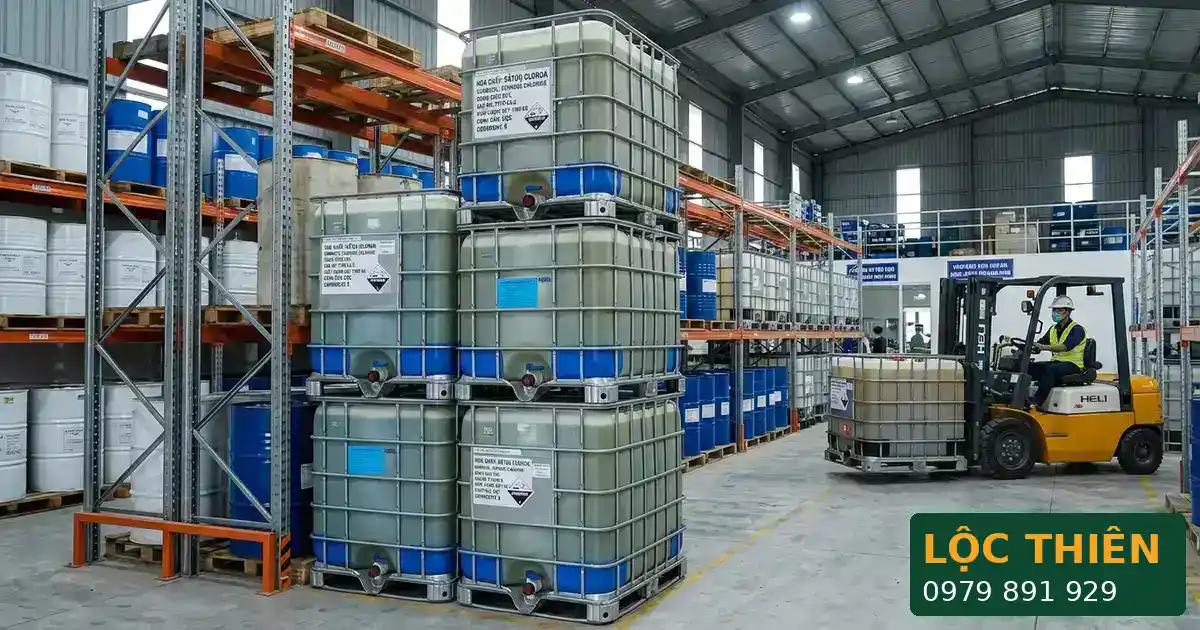

Liquid caustic soda NaOH 32%
Buy liquid caustic soda NaOH 32%-33% bulk in Vietnam. Specs, packing, industrial uses, SDS/COA on request. Loc Thien supply to industrial zones.
What is Caustic Soda NaOH?
Caustic Soda NaOH is the common name for the chemical sodium hydroxide, also known by its chemical formula NaOH. This is a strong base, typically appearing as a white solid that is highly soluble in water, forming an alkaline solution. Liquid caustic soda is widely used in various industries, including paper production, detergents, soap manufacturing, and many other applications. It is available in multiple concentrations such as NaOH 32%, NaOH 45%, NaOH 48%, and NaOH 50%, depending on usage requirements.Understanding the Molecular Structure of NaOH
The NaOH molecule, also called caustic soda or lye, has a simple structure consisting of one Na+ ion bonded to one OH- group. This single bond is relatively weak, making NaOH highly reactive with other chemicals. Molecular structure of liquid caustic soda NaOH
Physicochemical Properties of Caustic Soda NaOH
Physical Properties of NaOH
NaOH has the following characteristic physical properties:- NaOH exists as a solid at room temperature.
- It is typically white in color.
- Highly soluble in water, forming an alkaline solution and releasing heat.
- Melting point: 318°C.
- Boiling point: approximately 1,388°C.
- Density: ~2.13 g/cm³.
- Due to its strong alkalinity, liquid caustic soda can corrode many materials, especially metals, and is harmful upon contact with skin or eyes.
Chemical Properties of Liquid Caustic Soda NaOH
- Reaction with Acids (Neutralization):
NaOH + HCl→ NaCl + H2O
Here, NaOH reacts with hydrochloric acid (HCl) to form sodium chloride (NaCl) and water.- Reaction with Acidic Metal Oxides:
NaOH + CO2 → Na2CO3 + H2O
Reacts with carbon dioxide (CO2) to form sodium carbonate (Na2CO3) and water.- Reaction with Reactive Metals:
2NaOH + 2Al + 2H2O → 2NaAlO2 + 3H2
In this reaction, NaOH reacts with aluminum and water to form sodium aluminate (NaAlO2) and hydrogen gas.- Complex Formation:
→ NaOH forms a blue complex with Cu2+ ions.
- Saponification Reaction:
NaOH is used in saponification, reacting with fats to produce soap.
NaOH + Fat → Soap + Glycerol
These chemical properties of liquid caustic soda NaOH are not only fundamental for its industrial and everyday applications but also crucial in chemical research and experimentation.
How is NaOH Produced?
Industrial production of NaOH, or Sodium Hydroxide, primarily involves the electrolysis of brine (sodium chloride - NaCl) using the membrane cell process. This process occurs in three main steps:Step 1: Preparation of Brine (Sodium Chloride - NaCl):
The first step involves dissolving salt in water to form a saturated NaCl solution.
The brine is then filtered to remove impurities.
Step 2: Electrolysis Process:
The saturated brine is fed into an electrolytic cell, where it is divided by a membrane into two compartments.
- Anode (Positive Electrode): At the anode, Cl⁻ ions from NaCl are oxidized to chlorine gas (Cl2).
Reaction: 2Cl‾ − 2e‾ → Cl2
- Cathode (Negative Electrode): At the cathode, water is reduced to produce hydrogen gas (H2) and hydroxide ions (OH⁻).
Reaction: 2H2O + 2e‾ → H2 + 2OH‾
A membrane separates the anode and cathode compartments to prevent mixing of reaction products.Step 3: Recovery and Purification of NaOH:
The solution at the cathode contains NaOH, water, and a small amount of unreacted NaCl.
NaOH is separated from this solution through water evaporation, then purified and packaged as a solid or concentrated solution.
This electrolysis process not only produces NaOH but also yields hydrogen and chlorine gas as valuable byproducts. The method is not only industrially efficient but also maximizes resource utilization.
NaOH production processKey Industrial Applications of Caustic Soda NaOH Today?
Application of 32% NaOH in Industrial Wastewater Treatment
In wastewater treatment, maintaining balanced pH levels is critical. NaOH is used to raise the pH of wastewater when necessary, especially in cases of acidic wastewater.
Increasing pH enhances the efficiency of various chemical and biological treatment processes.
Contact: 0979 891 929 to purchase NaOH
NaOH in water treatment
Application in Paper Manufacturing Industry
NaOH is used in the pulp bleaching process. It helps break down lignin, a substance that binds cellulose fibers in wood, enhancing brightness and whiteness of paper.In pulp processing, NaOH is used to disrupt cellulose structure, producing smoother and more uniform pulp.
When NaOH is used, cellulose fibers in paper become softer and adhere more tightly, improving paper strength and durability.
NaOH also inhibits bacterial and fungal growth during paper production and storage.
Application of NaOH in Rayon Production
In rayon production (a regenerated cellulose fiber), NaOH is used to treat wood pulp or cotton pulp, forming cellulose xanthate, a key precursor in rayon manufacturing.
NaOH participates in converting cellulose into rayon fibers. Cellulose treated with NaOH is extruded through spinnerets to form fibers.
In viscose fiber production, another type of artificial fiber, NaOH is used to break down and restructure cellulose, producing viscose fibers with desired properties.
Using NaOH in production improves fiber characteristics such as strength, elasticity, and softness.
Use of 20% - 50% NaOH in Detergent Production
In saponification, NaOH reacts with fats and oils to produce soap and glycerin. This reaction occurs when NaOH reacts with fatty acids in fats or oils, forming soap (fatty acid salts) and glycerol.
NaOH application in detergents
Application of NaOH in Textile Industry
In the textile industry, NaOH is used to pretreat natural fibers like cotton and wool before dyeing. This process removes natural impurities and fats, making fibers cleaner and more dye-receptive.Application of Liquid Caustic Soda in Food Industry
NaOH is used in processing certain foods like olives and soy products. It helps remove acids and improves flavor and color.Used in producing some food additives, such as preservatives and stabilizers.
NaOH in food processing
Application of NaOH in Petroleum Industry
NaOH is used to neutralize acids in crude oil. Some crude oil components are acidic, and NaOH neutralizes them, reducing corrosion during refining and processing.Used in treating petroleum industry wastewater, helping neutralize and remove harmful compounds.
Application in Chemical and Pharmaceutical Industries
NaOH is a key catalyst in producing many synthetic chemicals, including plastics, detergents, and other industrial chemicals.
Used in synthesizing various pharmaceuticals. It helps adjust pH during production and facilitates necessary chemical reactions.
Safety Precautions for Handling and Storing NaOH?
Safe Handling of Liquid Caustic Soda:
Below are critical precautions for handling and storing NaOH:
- Always use full personal protective equipment (PPE), including gloves, safety goggles, lab coats or protective clothing, and safety shoes.
- Avoid direct contact with skin or eyes as it can cause severe chemical burns.
- When using NaOH, work in a well-ventilated area or under a fume hood to avoid inhaling vapors.
- When dissolving NaOH in water, add it slowly and gently to prevent sudden heat generation that may cause splashing.
NaOH Storage Precautions:
Store NaOH in tightly sealed containers, protected from moisture and leaks.
Keep NaOH in a dry, cool place away from direct sunlight.
Store NaOH away from flammable materials and substances that may react with it, such as acids and organic compounds.
Clearly label NaOH containers with corrosion warnings and safe handling instructions.
Where to Buy Reliable, High-Quality Liquid Caustic Soda NaOH in Ho Chi Minh City?
Loc Thien Chemicals proudly distributes standardized chemicals, selling NaOH with clear origins and top quality in Vietnam. We supply products like: Caustic soda flakes, caustic soda pearls, NaOH 32%, NaOH 45%, and NaOH 50% liquid. With the motto “SELLING WITH TRUST”, Loc Thien prioritizes product quality and customer service. When purchasing NaOH from us, customers benefit from:
- High-quality products with clear origins.
- Large inventory, always meeting customer demand.
- Liquid caustic soda NaOH delivered nationwide, quickly.
- Dedicated support team.
- Spacious, clean, and ventilated warehouse facilities.
For inquiries about purchasing liquid caustic soda NaOH, please contact hotline: 0979.89.1929 or visit our website: hoachatlocthien.com. We are always ready to advise and provide timely quotations.