
Ferrous Chloride (FeCl2): What It Is and Where to Buy
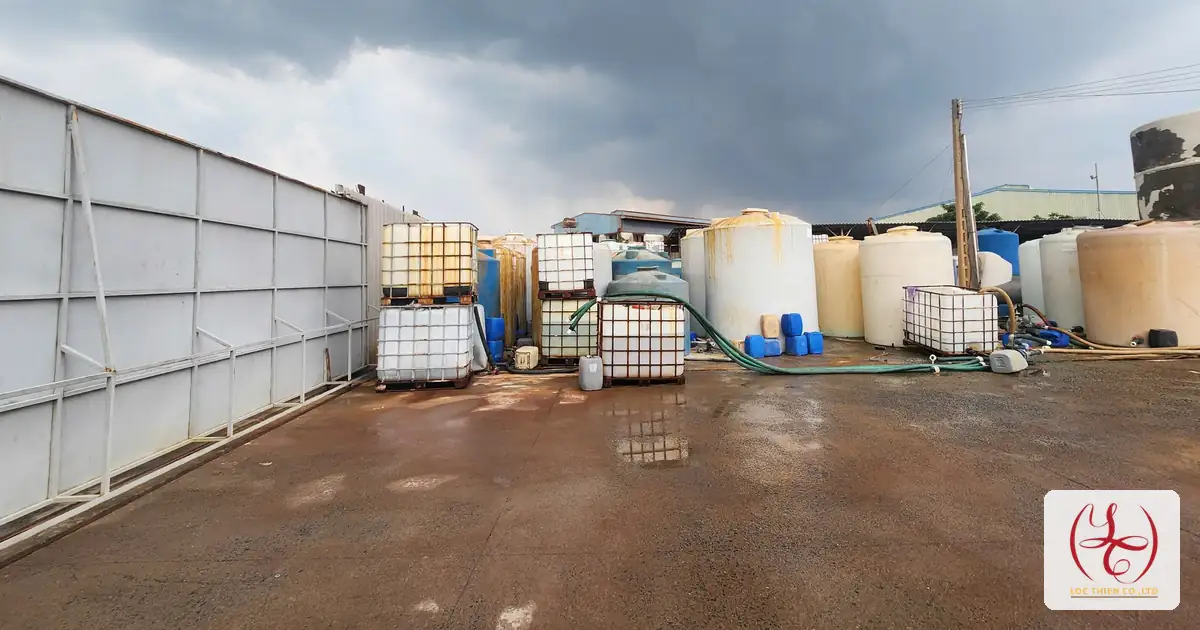
Ferrous chloride (FeCl2, also called iron(II) chloride or sắt 2 clorua, and known colloquially in Vietnam as “phèn sắt 2”; CAS 7758-94-3) is the salt of divalent iron with hydrochloric acid. In wastewater treatment the pale-green FeCl2 solution is used for coagulation, phosphate and sulfide precipitation, Cr⁶⁺ reduction in electroplating effluent and as the Fe²⁺ source for the Fenton reaction. Loc Thien produces 30% FeCl2 solution and delivers it to Binh Duong industrial parks from its Di An depot in 24–48 hours.
Scope of this article: background knowledge on ferrous chloride for students and plant operators. For delivery coverage, packaging and how to order by region, see FeCl2 for Southern Vietnam: delivery to Binh Duong and Ho Chi Minh City.
Contents
- What is ferrous chloride?
- Specifications of 30% FeCl2 solution
- What colour is FeCl2 and why does it change?
- Uses of ferrous chloride in wastewater treatment
- Cr6+ reduction with FeCl2: theoretical dose
- Storage and safety for 30% FeCl2 solution
- Where to buy ferrous chloride in Binh Duong
- Frequently asked questions
- Request a ferrous chloride quotation
What is ferrous chloride?
Ferrous chloride is an inorganic compound of Fe²⁺ and chloride ions, formula FeCl2, molar mass 126.75 g/mol. Fe²⁺ readily gives up one more electron to become Fe³⁺, so ferrous chloride is a reducing agent, not an oxidant. FeCl2 dissolves completely in water. The commercial solution is strongly acidic (pH below 1 at 30%) and corrodes many metals.
Names. “Sắt 2 clorua” is the Vietnamese reading of “sắt (II) clorua”; other names are “muối sắt 2” and ferrous chloride. “Phèn sắt 2” is a colloquial name. In chemical nomenclature FeCl2 is not an alum, because an alum is a hydrated double sulfate (for example potassium aluminium alum KAl(SO4)2·12H2O). On the market, “phèn sắt 2” is also used for iron(II) sulfate FeSO4·7H2O (green vitriol), a different substance. This article is about FeCl2.
Commercial forms. Chemically, FeCl2 also forms the pale-green hydrate crystal FeCl2·4H2O, molar mass 198.81 g/mol, density 1.93 g/cm³, melting at around 105–110 °C. These figures belong to the solid crystal; do not apply them to the solution. The product Loc Thien supplies to plants is a 30% FeCl2 solution with a density of about 1.3 g/cm³.
How it differs from ferric chloride. FeCl3 contains Fe³⁺, its solution is red-brown, and it both coagulates and oxidises. FeCl2 contains Fe²⁺, its solution is pale green, and it acts as a reducing agent. The two interconvert: a FeCl2 solution turning yellow-brown means part of the Fe²⁺ has become Fe³⁺. The article what colour is FeCl2 and how it is used in water treatment covers colour in more detail.
Specifications of 30% FeCl2 solution
The table gives reference values from Loc Thien’s FeCl2 safety data sheet (MSDS) and constants calculated from the formula. If you need figures for a specific batch, ask for them when requesting a quotation.
| Parameter | Value | Note |
|---|---|---|
| Name, CAS | Iron(II) chloride, 7758-94-3 | Formula FeCl2, 126.75 g/mol |
| Content | 30% | Loc Thien supplies the 30% solution |
| Colour, odour | Pale green to moss green; pungent odour | MSDS lists moss green |
| Density | About 1.3 g/cm³ | Do not use the crystal value of 1.93 g/cm³ |
| pH | Below 1 | Acidic solution |
| Fe²⁺ content | About 13% | 30 × 55.845 ÷ 126.75 ≈ 13.2% (calculated) |
| Boiling point | About 106 °C | Per MSDS |
| Solubility | Completely soluble in water | |
| Transport | UN 1760, Class 8, packing group III | Corrosive liquid |
| Storage | Below 35 °C, closed, away from alkali | See the storage section |
What colour is FeCl2 and why does it change?
A clean Fe²⁺ solution is pale green, deepening to moss green at high concentration. A solution turning yellow-brown signals that part of the Fe²⁺ has been oxidised to Fe³⁺. The standard electrode potential of the Fe³⁺/Fe²⁺ couple is +0.771 V, while O2/H2O at pH 0 is +1.229 V, so oxygen in air can oxidise Fe²⁺ spontaneously. The Fe³⁺ formed hydrolyses into yellow-brown hydroxo ions and oxide-hydroxides.
The process is faster when the solution is exposed to air (open drums, half-empty tanks), at higher temperature and at higher pH. There is no general numerical threshold for a 30% solution, so the safe approach is to keep it closed and cool and not to leave tanks open for long. For plants that use FeCl2 as a reducing agent (Cr⁶⁺ reduction, Fenton), the Fe²⁺ that has been lost reduces its reducing power, so the dose should be calculated from the remaining Fe²⁺ and verified by testing on real wastewater.
Uses of ferrous chloride in wastewater treatment
FeCl2 is an industrial chemical, not a consumer product. The correct uses of the solution are:
- Coagulation and flocculation. Fe²⁺ is gradually oxidised to Fe³⁺ and forms iron hydroxide flocs that carry suspended solids and colour down. Performance depends on pH and oxidation conditions, so a jar test is needed to choose the dose.
- Phosphate precipitation. Iron ions combine with phosphate into sparingly soluble iron phosphates that settle out.
- Sulfide precipitation and H2S odour reduction. Fe²⁺ + S²⁻ → FeS (black precipitate), which keeps sulfide in the sludge instead of releasing rotten-egg gas.
- Cr⁶⁺ reduction in electroplating wastewater. Fe²⁺ reduces toxic Cr⁶⁺ to Cr³⁺, which then precipitates at alkaline pH (details in the next section).
- Fenton reaction. Fe²⁺ with H2O2 produces hydroxyl radicals (•OH) that break down organics resistant to biological treatment, such as dyes in textile wastewater. The reaction runs in acidic conditions and requires H2O2 as well. See decolourising azo dyes with FeCl2 and Fenton.
- Feedstock for FeCl3. Oxidising FeCl2 gives FeCl3; see how FeCl2 and FeCl3 are prepared.
A common misunderstanding: FeCl2 is not an oxidant in electroplating. In electroplating, FeCl2 does not form the plated layer and does not oxidise metal surfaces. Its only role is as the Cr⁶⁺ reducing agent in the wastewater treatment step after plating. The article FeCl2 for Cr6+ removal in electroplating wastewater describes the operating procedure.
In the textile dyeing industry, FeCl2 helps coagulate colour and supplies Fe²⁺ for Fenton in wastewater treatment; the article iron(II) chloride in textile dyeing goes deeper into this area.
Cr6+ reduction with FeCl2: theoretical dose
Reduction of Cr⁶⁺ (as dichromate) by Fe²⁺ in acidic conditions:
Cr2O7²⁻ + 6Fe²⁺ + 14H⁺ → 2Cr³⁺ + 6Fe³⁺ + 7H2O
Each mole of Cr⁶⁺ needs 3 mol of Fe²⁺ (one mole of Cr2O7²⁻ contains 2 mol of Cr⁶⁺ and needs 6 mol of Fe²⁺). From this ratio the theoretical dose of 30% FeCl2 solution follows, with Cr = 51.996 g/mol and FeCl2 = 126.75 g/mol:
| Quantity | Calculation | Result |
|---|---|---|
| Moles of Cr⁶⁺ in 1 g | 1 ÷ 51.996 | 0.01923 mol |
| Moles of Fe²⁺ needed | 0.01923 × 3 | 0.0577 mol |
| Mass of pure FeCl2 | 0.0577 × 126.75 | 7.31 g |
| Mass of 30% solution | 7.31 ÷ 0.30 | 24.4 g, about 19 mL at density 1.3 |
Worked example (assumed figures for practice, not data from any plant): 100 m³ of wastewater containing 20 mg/L Cr⁶⁺ holds 100 × 20 = 2,000 g, that is 2 kg of Cr⁶⁺. The theoretical pure FeCl2 is 2 × 7.31 = 14.6 kg, equal to 14.6 ÷ 0.30 = 48.7 kg of 30% solution.
This is a lower bound. Real wastewater contains other reducing and oxidising species, and some Fe²⁺ is lost to atmospheric oxygen, so the actual dose is higher and must be set by jar test, dosing step by step while monitoring. The process has two stages: lower the pH to the acidic range so Fe²⁺ reduces Cr⁶⁺, then raise the pH to a mildly alkaline range with NaOH or Ca(OH)2 so that Cr³⁺ and Fe³⁺ precipitate as hydroxides and settle out. Treated water must meet the Cr⁶⁺ limit of the QCVN 40 standard currently in force.
Storage and safety for 30% FeCl2 solution
Loc Thien Technical Department: “Plants often ask why the FeCl2 in the tank has turned from pale green to yellow-brown. The cause is usually an open or long half-empty tank, which lets Fe²⁺ oxidise. Keep the tank closed, below 35 °C and away from alkali. Once the solution has changed colour, recalculate the dose from the Fe²⁺ that remains instead of using the old dose.”
Container materials. Use composite or PVC tanks; transport in rigid PVC or PE containers. The solution is incompatible with zinc, tin, aluminium, copper and their alloys (copper is attacked quickly). An acidic solution containing Cl⁻ also corrodes ordinary steel, so do not choose steel for tanks without confirmation from the tank manufacturer.
Storage conditions. Keep at room temperature, below 35 °C, in closed tanks or containers, away from heat sources. Do not store together with alkali (NaOH, Ca(OH)2), because alkali neutralises the acid and precipitates Fe²⁺. Do not share pipework or pumps with alkaline chemicals without cleaning them thoroughly.
Protective equipment. Chemical-resistant goggles, gloves, clothing and boots; an activated-carbon mask where vapour is present. The solution causes skin burns, eye damage and respiratory irritation, and is harmful if swallowed (oral LD50 in rats and rabbits: 984 mg/kg).
First aid.
- Eye contact: rinse with plenty of water for 15 minutes, then go to a medical facility.
- Skin contact: remove contaminated clothing and rinse with plenty of water.
- Inhalation: move to fresh air.
- Swallowing: do not induce vomiting; go to a medical facility immediately.
Spills and waste. Do not let it run into drains. The solution and absorbent material after an incident are collected and handled under hazardous waste regulations.
Where to buy ferrous chloride in Binh Duong
Loc Thien produces 30% FeCl2 solution directly and delivers it to wastewater treatment, textile dyeing and electroplating plants. The depot is at Tan Dong Hiep B Industrial Park, Di An (Binh Duong), the southern gateway of the province next to Ho Chi Minh City, with good road access to Binh Duong industrial parks. Expected delivery times:
- Inner Ho Chi Minh City: about 4 hours.
- Binh Duong industrial parks, the rest of the South and the Mekong Delta: 24–48 hours.
- Northern and Central Vietnam: 2–3 days.
Packaging includes cans, drums, IBC totes and 5–30-tonne tankers; large orders should be scheduled in advance. For textile dyeing plants, Loc Thien holds a ZDHC MRSL V3.1 test report performed by TÜV Rheinland on FeCl2 (No. 248162921-02a), with a pass result in the 5 substance groups tested. It is a test report, not a certificate issued batch by batch.
Why there is no fixed list price. The unit price depends on order volume, packaging, delivery region and contract type. To get a quotation within 15 minutes, send 5 items: the concentration required (30%), the expected quantity, the packaging, the industrial park or address for delivery, and the ordering frequency. Details by region are on the page FeCl2 for Southern Vietnam: delivery to Binh Duong and Ho Chi Minh City; the product page is FeCl2 iron(II) chloride.
Besides FeCl2, Loc Thien produces FeCl3 for wastewater treatment and supplies NaOH, Javel (NaOCl) and Ca(OH)2 for the same treatment systems. See the full range under water treatment chemicals.
Frequently asked questions
What is ferrous chloride, and is it the same as “phèn sắt 2”?
Ferrous chloride is FeCl2, the salt of divalent iron with hydrochloric acid. “Phèn sắt 2” is a colloquial Vietnamese name; by nomenclature FeCl2 is not an alum, because an alum is a hydrated double sulfate. The phrase “phèn sắt 2” is also often used for iron(II) sulfate FeSO4·7H2O, a different substance.
What colour is FeCl2, and why does the solution turn yellow-brown?
A FeCl2 solution is pale green to moss green. Turning yellow-brown signals that part of the Fe²⁺ has been oxidised to Fe³⁺ through exposure to air, heat or a rise in pH. Keep the tank closed, below 35 °C and away from alkali to slow this down.
What is ferrous chloride used for in wastewater treatment?
Coagulation and flocculation, phosphate precipitation, sulfide precipitation to reduce H2S odour, Cr⁶⁺ reduction in electroplating wastewater, supplying Fe²⁺ for the Fenton reaction and serving as feedstock for FeCl3. The dose varies with the wastewater, so it must be set by jar test.
Is FeCl2 an oxidant in electroplating?
No. Fe²⁺ is a reducing agent. In electroplating, FeCl2 is used only to reduce Cr⁶⁺ to Cr³⁺ in wastewater treatment; it does not form the plated layer and does not oxidise metal surfaces.
What materials can hold 30% FeCl2 solution?
Composite or PVC tanks; transport in rigid PVC or PE containers. Avoid zinc, tin, aluminium, copper and their alloys. Keep below 35 °C, closed, away from alkali and heat sources.
Does Loc Thien’s FeCl2 have a ZDHC report?
There is a ZDHC MRSL V3.1 test report performed by TÜV Rheinland, No. 248162921-02a, with a pass result in the 5 substance groups tested. It is a test report, not a certificate issued per batch, and the report does not entitle the product to carry any safety mark.
How fast can ferrous chloride be delivered in Binh Duong?
The Loc Thien depot is at Tan Dong Hiep B Industrial Park, Di An (Binh Duong). Delivery to Binh Duong industrial parks and the rest of the South takes 24–48 hours, and about 4 hours within inner Ho Chi Minh City. Call 0979 891 929 and send the 5 items above to receive a quotation within 15 minutes.
Request a ferrous chloride quotation
Need 30% FeCl2 solution for a wastewater, dyeing or electroplating system? Send a request on the contact page, call 0979 891 929 or email [email protected]. The Loc Thien Technical Department advises on dosing and on how to run a jar test on your plant’s wastewater; quotations are returned within 15 minutes.
See also: FeCl2 wastewater treatment · FeCl2 for Da Nang and Central Vietnam.
CÔNG TY TNHH ĐẦU TƯ PHÁT TRIỂN LỘC THIÊN · Tax code (MST) 0313650856 · Office: 452/6B Tinh Lo 10, Binh Tri Dong Ward, Ho Chi Minh City · Depot: Tan Dong Hiep B Industrial Park, Di An (Binh Duong) · hoachatlocthien.com