
Hydrogen Peroxide H₂O₂ Complete Guide — 35%-50%, UN 2014, Fenton & Bleaching | Lộc Thiên Chemicals
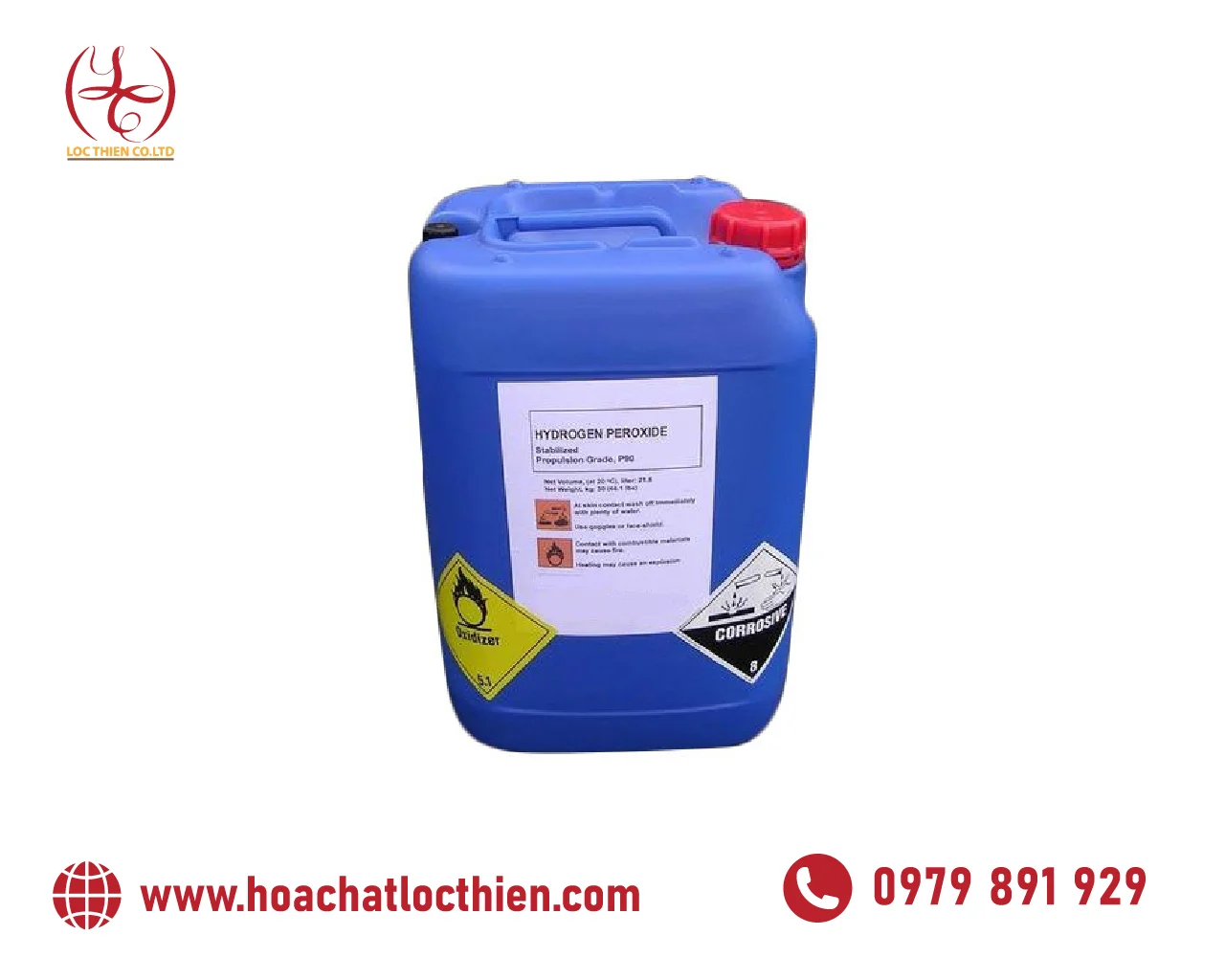
H₂O₂ Complete Guide — Concentration, UN 2014 & Industrial Applications
TL;DR: Hydrogen peroxide (H₂O₂, CAS 7722-84-1) is a strong oxidizing agent that decomposes into H₂O + O₂ leaving no toxic residue. Loc Thien supplies H₂O₂ at 35%–50% concentration, UN 2014, with lot-specific CoA/MSDS, delivered nationwide via 20 specialized tanker trucks. Key applications: Fenton reaction for COD treatment, chlorine-free textile/paper bleaching, food sterilization. Hotline 0979 891 929.
Table of Contents
- What is H₂O₂?
- UN 2014 & GHS Classification
- Detailed Technical Specifications
- H₂O₂ Concentration Comparison
- Industrial Applications (6+ Industries)
- Fenton Reaction — H₂O₂ + FeCl₂ for COD Treatment
- H₂O₂ vs NaOCl — Chlorine-Free Bleaching
- Safety & Storage
- Deep Dive into H₂O₂
- FAQ
What is H₂O₂ (Hydrogen Peroxide)?
Hydrogen peroxide (chemical formula H₂O₂, molecular weight 34.01 g/mol, CAS 7722-84-1) is an inorganic oxidizing agent — a colorless liquid with a slight characteristic odor, completely soluble in water. The unique property of H₂O₂ is that it decomposes biologically into water (H₂O) and oxygen (O₂), leaving no toxic chemical residues in the environment. This is why H₂O₂ is chosen as a replacement for Cl₂ and NaOCl in applications requiring high safety: food bleaching, pharmaceuticals, and wastewater treatment that produces no chlorine sludge.
In industry, H₂O₂ is primarily produced via the anthraquinone process (AO process), with global output of approximately 5.5 million tons/year. Common commercial concentrations: 27.5%, 35%, 50%, and 60%. In Vietnam, Loc Thien supplies H₂O₂ at 35%–50% concentration from official import sources: South Korea, Thailand, Bangladesh, and Taiwan. Each batch comes with lot-specific CoA certification and 16-section GHS-compliant MSDS under Circular 01/2026/TT-BCT, meeting safety standards for textile dyeing, paper, food, and wastewater treatment plants.
UN 2014 & GHS Classification — Significance in Transport
H₂O₂ at 20%–60% concentration is classified as UN 2014, Class 5.1 (oxidizing substance) + Class 8 (corrosive substance), Packing Group II. This UN number applies to hydrogen peroxide in aqueous solution — distinct from UN 2015 (H₂O₂ >60%, unstable) used for very high concentrations in rocket fuel and specialty applications.
Under GHS (Globally Harmonized System), H₂O₂ 35%–50% carries 3 pictograms:
- GHS03 (flame over circle) — oxidizing substance
- GHS05 (corrosion) — skin burns, serious eye damage
- GHS07 (exclamation mark) — skin, eye, respiratory irritation
Signal word: DANGER. Exothermic decomposition when in contact with heavy metals (Fe, Cu, Mn), strong alkalis, or organic impurities — can cause a runaway reaction and explosion if stored in a sealed container. H₂O₂ transport requires specialized vehicles with compatible material tanks (HDPE, 99.5%+ aluminum, or passivated 316L stainless steel), pressure relief valves, and UN 2014 hazard placards. Loc Thien operates a fleet of specialized tanker trucks with full permits for Class 5.1 + 8 hazardous chemical transport.
Detailed Technical Specifications — Lot CoA
H₂O₂ supplied by Loc Thien is certified with lot-specific CoA. Below are specifications from the official 2026 Loc Thien MSDS (revised 15/09/2026, under Circular 01/2026/TT-BCT) for the INTEROX ST 50 (Solvay) product:
Specific gravity: 1.196–1.198 kg/m³ (≈1.196–1.198 g/cm³) @ 20°C — original data from MSDS, not rounded. pH < 1 at 20°C — 50% H₂O₂ has much stronger acidity than commonly understood, due to inorganic acid stabilizers added to prevent decomposition. Melting point: −33°C — H₂O₂ does not freeze under Vietnamese climate conditions, no storage heating required unlike 98% H₂SO₄.
H₂O₂ content: 35–50% ±1% per company convention — this is the standard concentration range on the MSDS. Specific batches will have an exact assay % on the CoA. Inorganic acid stabilizers maintain pH < 1, inhibiting decomposition caused by trace metals and impurities.
| Parameter | H₂O₂ 50% (INTEROX ST 50) | Notes |
|---|---|---|
| Trade Name | INTEROX ST 50 (Solvay) | Per Loc Thien MSDS 2026 |
| H₂O₂ (% wt) | 35–50% ±1% | Concentration range; lot CoA specifies exact value |
| Specific Gravity @ 20°C (g/cm³) | 1.196–1.198 | From MSDS — not rounded |
| pH @ 20°C | < 1 | Strong acid due to stabilizers |
| Boiling Point | ~150°C | At 50% concentration |
| Melting Point | −33°C | Does not freeze in Vietnam |
| State | Clear colorless liquid | Slight pungent odor |
| Solubility | Completely miscible in water | At 20°C |
| UN Number | UN 2014 | Class 5.1 + 8 |
| Packaging | HDPE can/specialized jerrycan | Per MSDS Section 14 |
Source: MSDS Hydrogen Peroxide 35–50%, Loc Thien Company, revised 15/09/2026 per Circular 01/2026/TT-BCT. Lot-specific CoA provided upon delivery — contact 0979 891 929 for a sample CoA.
H₂O₂ Concentration Comparison — Choosing the Right Concentration
Each H₂O₂ concentration has different specific gravity, decomposition rate, and transport costs, directly impacting plant selection. H₂O₂ 50% (specific gravity 1.196 g/cm³) contains 500 kg of pure H₂O₂ per ton of product — lowest logistics cost, but higher decomposition rates require stricter warehouse temperature control. H₂O₂ 35% (specific gravity 1.132 g/cm³) is more stable in storage, safer to handle, but transport cost per kg of pure H₂O₂ is ~43% higher (due to carrying 150 kg more water per ton).
Boiling point and vapor pressure also differ: H₂O₂ 50% boils at ~150°C, while H₂O₂ 35% boils at ~108°C — close to water. This matters for plants using H₂O₂ at elevated temperatures (e.g., pulp bleaching at 80–90°C) because H₂O₂ 35% evaporates faster, reducing efficiency.
| Concentration | Specific Gravity (g/cm³) | kg H₂O₂/ton Product | pH @ 20°C | Stability | Primary Applications |
|---|---|---|---|---|---|
| 50% (INTEROX ST 50) | 1.196–1.198 | 500 | < 1 | Moderate | Fenton, paper bleaching, water treatment |
| 35% | ~1.132 | 350 | 2.0–4.0 | Higher | Food, pharmaceutical, medical |
Source: Loc Thien MSDS 2026 (50%) + industry reference (35%). 50% specific gravity from original MSDS — not rounded.
Concentration selection depends on storage infrastructure, application purpose, and safety requirements. Industrial wastewater treatment plants typically choose H₂O₂ 50% for cost optimization. Food and pharmaceutical plants choose 35% for safety and QCVN 01:2009/BYT compliance.
Industrial Applications of H₂O₂ (6+ Industries)
H₂O₂ is a versatile oxidizing agent present across industries from heavy to high-purity.
Wastewater Treatment: The most important application of H₂O₂ in heavy industry. H₂O₂ 50% is used in the Fenton reaction (H₂O₂ + Fe²⁺ → ·OH) to oxidize refractory organic compounds (hard COD, color, phenol, pesticides) in textile dyeing, chemical, and electroplating wastewater. Dosage: 50–200 mg/L H₂O₂ 50% depending on input COD, H₂O₂:Fe²⁺ ratio typically 1:2 to 1:5 (molar). Additionally, H₂O₂ is used for cyanide removal in electroplating wastewater and sulfide oxidation in tannery wastewater.
Pulp Bleaching: H₂O₂ 35–50% replaces Cl₂ in ECF (Elemental Chlorine Free) and TCF (Totally Chlorine Free) bleaching processes — mandatory standards for paper mills exporting to the EU and Japan. Operates at pH 10.5–11.5, temperature 80–90°C, retention time 2–4 hours. H₂O₂ oxidizes chromophore groups in lignin without forming dioxins — byproducts are only water and oxygen.
Textile Dyeing: H₂O₂ 35–50% is the primary bleaching agent for cotton and blended fabrics before dyeing. Bleaching conditions: pH 10.5–11 (using NaOH or Na₂SiO₃ as buffer), temperature 90–95°C, H₂O₂ 2–5% owf (on weight of fabric), time 45–60 minutes. H₂O₂ produces no AOX (adsorbable organic halogens) — a mandatory criterion under ZDHC MRSL V3.1 for export textile mills.
Food & Beverage: Food-grade H₂O₂ ≤35%, compliant with QCVN 01:2009/BYT and FDA 21 CFR 184.1366. Used for aseptic packaging sterilization (Tetrapak), dairy and brewery equipment; residual after treatment <0.1 mg/kg. H₂O₂ decomposes completely into water and oxygen at sterilization temperature — leaving no chemical residue.
Electronics & Semiconductors: Ultra-high-purity H₂O₂ 30–35% (ppt grade) used in the RCA clean process — cleaning silicon wafer surfaces before lithography. SC-1 mixture (NH₄OH:H₂O₂:H₂O = 1:1:5) removes particles and organic contaminants; SC-2 (HCl:H₂O₂:H₂O = 1:1:6) removes heavy metals. Metal impurity content <10 ppt — a requirement 1 million times stricter than technical grade.
Medical & Pharmaceutical: H₂O₂ 3–6% (diluted from 35%) used as wound antiseptic and mouthwash. H₂O₂ 35% technical grade is the raw material for producing other peroxy compounds: sodium percarbonate (oxygen bleach), sodium perborate, and benzoyl peroxide (acne treatment).
Related: See FeCl₂ (Ferrous Chloride) 25–30% — Wastewater Treatment & ZDHC Level 1 for combining Fe²⁺ + H₂O₂ in the Fenton reaction. Or see NaOH Liquid Caustic Soda 50% — the pH adjustment chemical for H₂O₂ bleaching processes.
Fenton Reaction — H₂O₂ + FeCl₂ for Refractory COD Treatment
The Fenton reaction is the most powerful application of H₂O₂ in industrial wastewater treatment. Mechanism: H₂O₂ reacts with Fe²⁺ ions to produce hydroxyl radicals (·OH) — the second strongest oxidizing agent after fluorine (E° = 2.80 V) — capable of breaking down persistent organic compounds that conventional biological and coagulation processes cannot treat.
Core reaction: Fe²⁺ + H₂O₂ → Fe³⁺ + OH⁻ + ·OH
·OH radicals react non-selectively with most organic compounds (reaction rate k = 10⁸–10¹⁰ M⁻¹s⁻¹), oxidizing them into CO₂, H₂O, and inorganic byproducts. Key operating parameters:
- Optimal pH: 2.5–4.0 (higher pH → Fe²⁺ precipitates as Fe(OH)₂; lower pH → H₂O₂ is more stable, reaction slows)
- H₂O₂:Fe²⁺ ratio: 1:2 to 1:5 mol/mol depending on wastewater type — determined by jar test
- Reference H₂O₂ 50% dosage: 0.5–5 mL/L wastewater (~50–500 mg/L pure H₂O₂)
- Efficiency: 60–90% COD reduction, 80–99% color removal in textile dyeing wastewater
At Loc Thien, H₂O₂ 50% and FeCl₂ 25–30% are supplied together — plants don't need to source from two separate suppliers. Loc Thien technicians support jar testing to determine the optimal Fe²⁺:H₂O₂ ratio for each specific wastewater type.
Case study: A textile dyeing mill in Song Than Industrial Park, flow rate 500 m³/day, input COD 800–1200 mg/L. After PAC coagulation, COD reduced to 400–600 mg/L. Fenton treatment with FeCl₂ 28% (3.2 mL/L) + H₂O₂ 50% (1.5 mL/L) at pH 3.5 — output COD 80–120 mg/L, color removal >95%, meeting QCVN 40:2011/BTNMT Column A.
H₂O₂ vs NaOCl — Why Choose Chlorine-Free Bleaching?
In the bleaching industry, H₂O₂ and NaOCl (Javel water) are two common choices — but they differ fundamentally in chemistry, safety, and environmental impact.
| Criterion | H₂O₂ 35–50% | NaOCl 10–12% (Javel) |
|---|---|---|
| Mechanism | Oxidation via active O₂ | Chlorination + oxidation |
| Byproducts | H₂O + O₂ (non-toxic) | AOX, THM, chloramines |
| Solution pH | 1.0–4.5 (mild acid) | ~13 (strong alkali) |
| Equipment Compatibility | 316L SS, 99.5%+ Al, HDPE | Titanium, PVC/CPVC, PTFE |
| Food Safety | ✅ FDA 21 CFR 184.1366 | ⚠️ Limited, requires thorough rinsing |
| Paper Bleaching | ✅ ECF/TCF | ❌ Forms dioxins |
| ZDHC Textile | ✅ AOX-free | ⚠️ Requires AOX monitoring |
| Cost/kg Product | 2–3x higher | Lower |
When to choose H₂O₂: Applications requiring chlorine-free processing (food, pharmaceuticals, export paper, ZDHC textile). When the final product must not contain AOX/THM residues.
When to choose NaOCl: Potable water disinfection, domestic wastewater treatment — where low cost is the priority and chlorine residues can be managed. Domestic paper mills not requiring ECF.
Trend: Textile dyeing and paper mills exporting to the EU, Japan, and the US are shifting strongly from NaOCl to H₂O₂ to meet ZDHC, OEKO-TEX, and GOTS standards — H₂O₂ produces no AOX, requires no dechlorination step, and simplifies wastewater treatment processes.
Safety & Storage of H₂O₂
H₂O₂ at ≥35% concentration is a strong oxidizing chemical requiring stringent safety procedures. Rule number one: avoid all contaminants — heavy metals (Fe, Cu, Mn, Cr), dirt, organic materials — as they catalyze exothermic H₂O₂ decomposition, which can lead to a runaway reaction in a sealed container.
Mandatory PPE: chemical splash goggles, chemical-resistant gloves (butyl rubber or neoprene), PVC apron, rubber boots. If H₂O₂ contacts skin: flush continuously with clean water for ≥15 minutes — H₂O₂ burns appear slowly (30–60 minutes after contact) and are persistently painful.
Storage: Tanks made of HDPE, 99.5%+ aluminum (aluminum forms a protective passivated Al₂O₃ layer), or 316L stainless steel. Tanks must have pressure relief vents — H₂O₂ slowly decomposes producing O₂; sealed containers will pressurize and explode. Storage temperature <35°C — every 10°C rise increases decomposition rate ~2.2×. Avoid direct sunlight as UV catalyzes decomposition.
Incompatibilities: Do not mix H₂O₂ with strong alkalis (NaOH, KOH) — neutralization generates heat and rapidly decomposes H₂O₂. Do not mix with reducing agents (Na₂S₂O₄, Na₂SO₃) — violent redox reaction. Do not mix with organic solvents (acetone, ethanol) — may form explosive organic peroxides.
Spill response: Isolate the area. Use water spray to dilute H₂O₂ — do not use sawdust, rags, or combustible organic materials (H₂O₂ may spontaneously ignite on contact). Neutralize slowly with Na₂SO₃ or Na₂S₂O₃ if needed.
Quotation for H₂O₂ at Loc Thien
Loc Thien supplies H₂O₂ at 35%–50% concentration, imported from South Korea, Thailand, Bangladesh, and Taiwan. Flexible packaging: 30–35 kg cans, drums, 1000L IBC totes. Every batch comes with CoA and 2026 MSDS (per Circular 01/2026/TT-BCT), traceable by lot number. Loc Thien technicians advise on concentration and optimal Fe²⁺:H₂O₂ ratio for Fenton reactions — helping plants save on chemicals and meet discharge standards. A fleet of 20 specialized tanker trucks and 6 warehouses nationwide ensure uninterrupted bulk supply, same-day delivery to industrial parks in Southern Vietnam. Hotline 0979 891 929 — quotation within 15 minutes.
🛒 Need industrial H₂O₂?
Deep Dive into H₂O₂
This hub links to the full library of in-depth articles on H₂O₂ and related chemicals at Hóa Chất Lộc Thiên.
🔬 H₂O₂ in Wastewater Treatment
- Fenton Reaction — H₂O₂ + FeCl₂ for Refractory COD Treatment
- FeCl₂ 25–30% — Technical Specifications & ZDHC Level 1
🏭 Industry Applications
🔗 Cross-Hub
- H₂O₂ vs NaOCl (Javel) in Industrial Bleaching
- What is ZDHC? — ZDHC Implementation for Textile Mills
- NaOH 50% — pH Adjustment for H₂O₂ Bleaching
Frequently Asked Questions (FAQ)
Is H₂O₂ 50% dangerous?
H₂O₂ 50% is a strong oxidizing agent that causes skin burns and serious eye damage upon contact. Full PPE required: chemical splash goggles, butyl rubber gloves, PVC apron. Avoid contact with metals and organic impurities which catalyze violent exothermic decomposition. A complete 16-section MSDS 2026 (per Circular 01/2026/TT-BCT) is provided with each batch.
What is the UN number of H₂O₂?
UN 2014 (hydrogen peroxide in aqueous solution, 20–60% concentration). Class 5.1 (oxidizing substance) + Class 8 (corrosive substance), Packing Group II. Distinct from UN 2015 for H₂O₂ >60%.
How are H₂O₂ and NaOCl (Javel) different?
H₂O₂ oxidizes via active O₂, with non-toxic H₂O + O₂ byproducts. NaOCl chlorinates, producing AOX and THM — suspected carcinogens. H₂O₂ pH 1–4.5, NaOCl pH ~13. H₂O₂ is chosen for food, pharmaceuticals, export paper/textile. NaOCl is cheaper but does not meet ZDHC or ECF/TCF standards.
What is the H₂O₂:Fe²⁺ ratio in the Fenton reaction?
The molar H₂O₂:Fe²⁺ ratio is typically 1:2 to 1:5, depending on wastewater type. Exact ratio is determined by jar test. Loc Thien supplies H₂O₂ 50% and FeCl₂ 25–30% together, with technicians providing free jar test support. Contact 0979 891 929.
How long can H₂O₂ 50% be stored?
At temperature <35°C, away from light, in HDPE/passivated aluminum tanks — H₂O₂ 50% loses <1% concentration/month. Decomposition rate increases ~2.2× for every 10°C temperature rise. Always use pressure relief vents on storage tanks. Loc Thien delivers with CoA showing the concentration at time of dispatch.
Can H₂O₂ be used in food?
Yes. H₂O₂ ≤35% food grade complies with FDA 21 CFR 184.1366 and QCVN 01:2009/BYT. Used for aseptic packaging sterilization (Tetrapak), dairy/brewery equipment. Decomposes completely at sterilization temperature, leaving no residue. Iron content ≤0.3 ppm, free acid ≤0.03%.
H₂O₂ 35% vs 50% — which concentration to choose?
Wastewater treatment plants, paper bleaching: choose 50% for optimized logistics cost. Food, pharmaceutical plants: choose 35% for better safety and regulatory compliance. Loc Thien provides free consultation based on your storage infrastructure and application needs — call 0979 891 929.
Where to buy H₂O₂ 50% at a good price with CoA/MSDS?
Loc Thien — official imports from South Korea, Thailand, Bangladesh, Taiwan. Lot-specific CoA/MSDS, delivery to industrial parks nationwide via 6 warehouses and 20 specialized tanker trucks. Hotline 0979 891 929 — quotation within 15 minutes.
See also: Water Treatment Chemicals — Full Catalog and FeCl₂ 25–30% — Cr⁶⁺ Reductant & Fenton Catalyst. Browse the complete H₂O₂ product catalog.
Article by Lan (Content Writer). Quality review: Technical Specialist Phan Cam Thuy — Loc Thien QC Department. Approved by: Vo Thi Nhu Hoa.
Updated: 16/09/2026 — Data referenced from MSDS 2026 (Circular 01/2026/TT-BCT). Actual batch CoA may vary — refer to the specific lot CoA upon delivery.
📖 Further reading:
- FeCl₂ 25–30% — Technical Specifications & ZDHC Level 1 — CAS 7758-94-3
- Javel NaOCl 10–12% — Comparison with H₂O₂ — Bleaching & disinfection
- NaOH 50% — pH Adjustment for H₂O₂ Bleaching — CAS 1310-73-2
- What is ZDHC? — Implementation for Textile Mills — Checklist & chemicals
- Textile Chemicals Catalog — Complete ZDHC chemical range
- Buy H₂O₂ 50% — Quotation in 15 minutes — Lot CoA/MSDS
🌐 Read this in other languages:
🇻🇳 Tiếng Việt
🇨🇳 中文
🇰🇷 한국어