
Ferrous Chloride (FeCl2): Overview and Industrial Uses
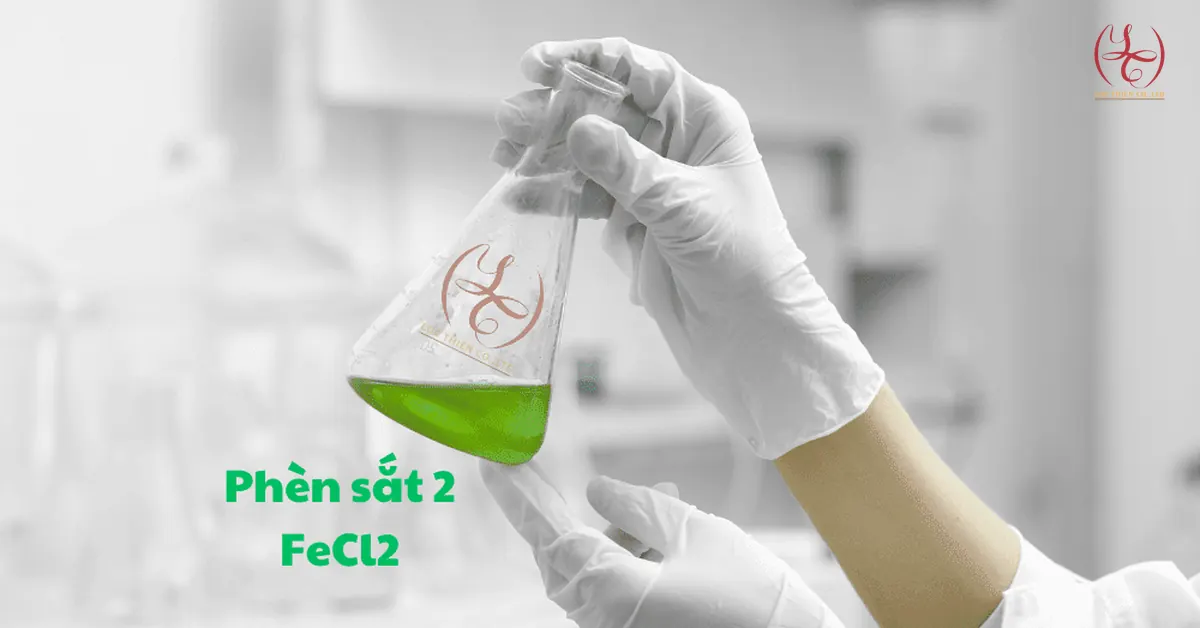
FeCl2 (iron(II) chloride, known in Vietnam as “phèn sắt 2”) is a salt, not an acid. It is an ionic compound of Fe²⁺ and Cl⁻, fully soluble in water and a reducing agent. Its solution reacts acidic and is corrosive, so protection is needed on contact. This article covers properties, industrial uses (mainly wastewater treatment), exposure safety and storage; figures for the 30% solution are kept apart from those of the FeCl2·4H2O crystal.
Contents
- What is FeCl2 (“phèn sắt 2”)? Salt or acid?
- Physical properties: FeCl2·4H2O crystal kept apart from the 30% solution
- Chemical properties of ferrous chloride
- Industrial applications of FeCl2
- Safety when handling FeCl2
- Use and storage
- Notes on using ferrous chloride in the laboratory
- Frequently asked questions
- Conclusion
What is FeCl2 (“phèn sắt 2”)? Salt or acid?
FeCl2 is iron(II) chloride: one iron atom in the +2 state with two chlorine atoms, CAS 7758-94-3, molar mass 126.75 g/mol. “Phèn sắt 2” is a folk name used in the Vietnamese water treatment trade. By chemical nomenclature FeCl2 is not an alum, since alums are hydrated double sulfate salts such as potassium aluminium sulfate KAl(SO4)2·12H2O. In some places the same name “phèn sắt 2” is used for FeSO4·7H2O (green vitriol, CAS 7782-63-0), which is an entirely different chemical; check the formula and CAS number on the label to be sure.
What kind of substance is FeCl2? A salt of the strong acid HCl and the weak base Fe(OH)2. Anhydrous FeCl2 is white to pale yellow or light grey and strongly hygroscopic. The tetrahydrate crystal (FeCl2·4H2O) is light green.
Is FeCl2 a salt or an acid? A salt. A solution of the salt reacts weakly acidic, because the Fe²⁺ ion partly hydrolyses and releases H⁺ (in fact the hydronium ion H3O⁺):
[Fe(H2O)6]²⁺ ⇌ [Fe(H2O)5(OH)]⁺ + H⁺
However, Loc Thien’s commercial 30% FeCl2 solution is very strongly acidic according to its SDS (pH below 1) because it still contains free acid; the Fe²⁺ hydrolysis adds only weak acidity. At that acidity the solution corrodes skin, eyes and many metals.
Physical properties: FeCl2·4H2O crystal kept apart from the 30% solution
A density of 1.93 g/cm³, a melting point of 105 °C and a molar mass of 198.81 g/mol are data for the tetrahydrate crystal. The solution sold on the market is a liquid with very different figures. The table separates the two so that the wrong numbers are not used for dosing or tank design.
| Parameter | FeCl2·4H2O crystal | 30% FeCl2 solution (Loc Thien) |
|---|---|---|
| Molar mass | 198.81 g/mol | FeCl2: 126.75 g/mol |
| Form, colour | Light green crystals | Liquid, light green to moss-green, pungent odour |
| Density | 1.93 g/cm³ (20 °C) | About 1.3 g/cm³ |
| Characteristic temperature | Melts at about 105 °C (loses water of crystallisation) | Boils at about 106 °C |
| Iron content | 28.1% Fe | About 13.2% Fe²⁺ (calculated) |
| pH | Not applicable | Below 1 |
| Solubility in water | Soluble | Fully soluble |
For the 30% solution, 1 litre weighs about 1.3 kg and holds about 0.4 kg of pure FeCl2. If litres are converted to kilograms with 1.93 g/cm³, the mass is overestimated by nearly half.
Chemical properties of ferrous chloride
- Soluble in water: FeCl2 dissolves readily to a light green solution that reacts acidic, as shown above.
- Reducing power: Fe²⁺ gives up an electron to become Fe³⁺, reducing Cr⁶⁺ and activating H2O2 in the Fenton reaction.
- Oxidised by air: Fe²⁺ in contact with oxygen turns into Fe³⁺ (E° Fe³⁺/Fe²⁺ = +0.771 V against +1.229 V for oxygen in acidic medium, so the reaction can occur spontaneously). A solution shifting from light green to yellow-brown signals that some Fe²⁺ has been oxidised. The acceptable level of oxidation depends on storage conditions and the process step, so check the colour and measure Fe²⁺ on site rather than relying on a fixed threshold.
- Attacks metals: an acidic solution containing Cl⁻ corrodes zinc, tin, aluminium, copper and their alloys; it does not attack glass or plastics.
- Do not mix with strong oxidisers: an acidic chloride-containing medium meeting hypochlorite (bleach) or another strong oxidiser can release toxic chlorine gas.
Industrial applications of FeCl2
The well-founded uses of FeCl2 rest on two features: Fe²⁺ can give up electrons, and iron salts form hydroxide that carries solids down. Most of them belong to the wastewater treatment line.
Industrial wastewater treatment
FeCl2 reduces toxic Cr⁶⁺ to the less toxic Cr³⁺ at 3 mol Fe²⁺ per 1 mol Cr⁶⁺ (in theory 7.31 g FeCl2 per gram of Cr⁶⁺); the pH is then raised to precipitate Cr(OH)3. With H2O2, Fe²⁺ generates ·OH radicals in the Fenton reaction, used for colour removal and breakdown of hard-to-treat organics in textile dyeing wastewater. Once oxidised to Fe³⁺, or when the pH is raised, iron salts form hydroxide that carries solids down, helping coagulation and the precipitation of phosphate and sulfide. The dose is always fixed by jar test on a real sample. Dosing, the order of chemical addition and operating examples are in the article FeCl2 in wastewater treatment; the chromium procedure is in Cr6+ reduction in plating wastewater with FeCl2.
Textile dyeing
The main role of FeCl2 in textile dyeing is treating dark-coloured wastewater by Fenton and coagulation. Industry context and operating notes are in the article FeCl2 in the textile dyeing industry.
Raw material for FeCl3
Oxidising Fe²⁺ to Fe³⁺ gives iron(III) chloride. The two salts are chosen by treatment purpose; see FeCl2 vs FeCl3 as iron coagulants.
Laboratory
In the laboratory FeCl2 is a source of Fe²⁺ for studying redox reactions and preparing iron compounds. Because Fe²⁺ solution is gradually oxidised by air, prepare it fresh when needed and keep it closed.
Deeper coverage of uses, methods and where to buy is in Iron(II) chloride (FeCl2): what it is, uses, how to use and where to buy.
Safety when handling FeCl2
Information follows the SDS of Loc Thien’s FeCl2 solution (see the FeCl2 SDS). The SDS classifies the solution as harmful if swallowed, causing skin burns and eye damage, respiratory irritation, organ damage, and long-term harm to aquatic life; the signal word is “Danger”. Oral LD50 is 984 mg/kg (rat, rabbit).
Protection when working: chemical-resistant goggles, gloves, clothing and boots; with vapour or mist, an activated-carbon respirator. Work in a ventilated area.
| Situation | First action according to the SDS |
|---|---|
| Eye contact | Rinse with plenty of water for 15 minutes, then go to a medical facility |
| Skin contact | Remove contaminated clothing, rinse with plenty of water |
| Inhalation | Move to fresh air |
| Swallowing | Do not induce vomiting; go to a medical facility at once |
These steps are initial first aid only and do not replace treatment. When someone is exposed, call emergency services and bring the SDS for the medical staff. Do not release untreated FeCl2 solution to the environment. Do not mix FeCl2 with hypochlorite or other strong oxidisers, as chlorine gas may be released.
Use and storage
- Temperature and packaging: keep at room temperature, below 35 °C, in a closed tank or container; avoid heat sources and alkali.
- Container materials: composite or PVC tanks; rigid PVC or PE drums. Avoid zinc, tin, aluminium, copper and alloys, including valves and fittings.
- Limit oxidation: keep closed and do not leave tanks open for long, because Fe²⁺ gradually turns into Fe³⁺ (the solution turns yellow-brown).
- Labelling: label with chemical name, concentration, production date and hazard symbols; keep out of reach of untrained people.
- Transport: UN 1760, class 8, packing group III according to Loc Thien’s SDS.
Notes on using ferrous chloride in the laboratory
- Work under the guidance of an experienced person; wear goggles, gloves and a lab coat.
- When diluting a concentrated solution, add the solution to water slowly while stirring, never the reverse.
- Read the label and SDS before use; check the formula so FeCl2 is not confused with FeSO4.
- Prepare Fe²⁺ solutions when needed and keep them closed, because a yellow-brown tint means oxidation has occurred.
- Collect waste according to laboratory waste rules; do not pour it down the drain.
Loc Thien Technical Department: “A common mix-up when reading about ‘phèn sắt 2’ is applying the figures of the FeCl2·4H2O crystal (1.93 g/cm³, melting at about 105 °C) to the solution. The 30% solution weighs about 1.3 g/cm³ and holds about 13.2% Fe²⁺. To convert litres to kilograms or to calculate the Fe²⁺ for a reaction, use the solution’s figures, then fix the dose by jar test.”
Frequently asked questions
Is FeCl2 a salt or an acid?
FeCl2 is a salt, formed from the strong acid HCl and the weak base Fe(OH)2. A solution of the salt is only weakly acidic, because Fe²⁺ hydrolyses and releases H⁺. Loc Thien’s commercial 30% solution has a pH below 1 according to the SDS because it still contains free acid, so it is corrosive and needs protection.
What is FeCl2?
FeCl2 is iron(II) chloride, an ionic compound of Fe²⁺ and Cl⁻, CAS 7758-94-3. The anhydrous form is white to pale yellow and hygroscopic; the tetrahydrate crystal is light green; the solution is light green to moss-green. It is a reducing agent and is easily oxidised to Fe³⁺.
Is FeCl2 soluble in water?
Yes. FeCl2 dissolves completely in water to give a light green solution that reacts acidic. A solution left in air turns yellow-brown as Fe²⁺ becomes Fe³⁺.
How does “phèn sắt 2” differ from FeSO4?
FeCl2 is iron(II) chloride (126.75 g/mol, CAS 7758-94-3), sold as a solution. FeSO4·7H2O is iron(II) sulfate heptahydrate (278.01 g/mol, CAS 7782-63-0), a crystal. They differ in anion, commercial form and iron content even though both are called “phèn sắt 2”.
What is FeCl2 used for in wastewater treatment?
Reducing Cr⁶⁺ to Cr³⁺ in plating wastewater, forming flocs for coagulation, precipitating phosphate and sulfide, and supplying Fe²⁺ for the Fenton reaction in colour removal. The dose is fixed by jar test. See FeCl2 in wastewater treatment for details.
What is the first aid after exposure to FeCl2?
Eyes: rinse with plenty of water for 15 minutes, then go to a medical facility. Skin: remove contaminated clothing and rinse with plenty of water. Swallowing: do not induce vomiting; go to a medical facility. Inhalation: move to fresh air. Always call emergency services and bring the SDS.
Where can I buy 30% FeCl2 solution?
Loc Thien manufactures 30% FeCl2 solution directly and delivers in 5–30 tonne tankers. Send a request through the contact page or call 0979 891 929; quotes within 15 minutes.
Conclusion
FeCl2 is a salt of divalent iron, commonly called “phèn sắt 2”. When researching it, keep the figures of the FeCl2·4H2O crystal apart from those of the 30% solution, and distinguish FeCl2 from FeSO4. Loc Thien manufactures 30% FeCl2 solution directly and supplies it by 5–30 tonne tanker: inner Ho Chi Minh City 4 hours, southern and Mekong Delta industrial parks 24–48 hours, northern and central Vietnam 2–3 days. See product information at 30% FeCl2 (iron(II) chloride) and send quote requests to [email protected].