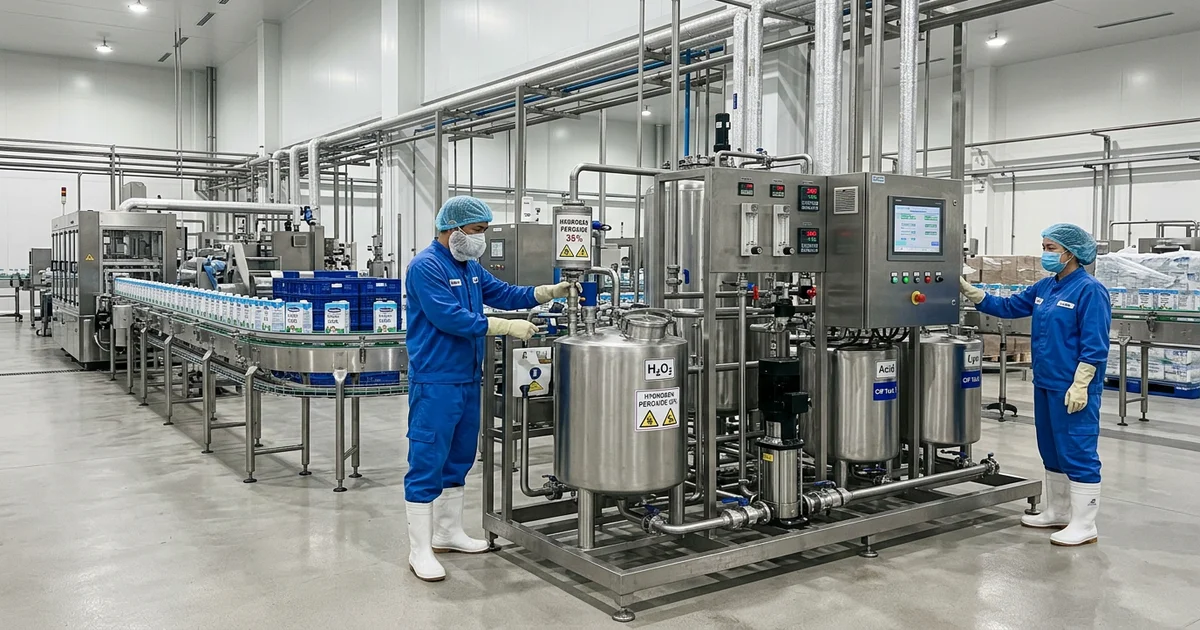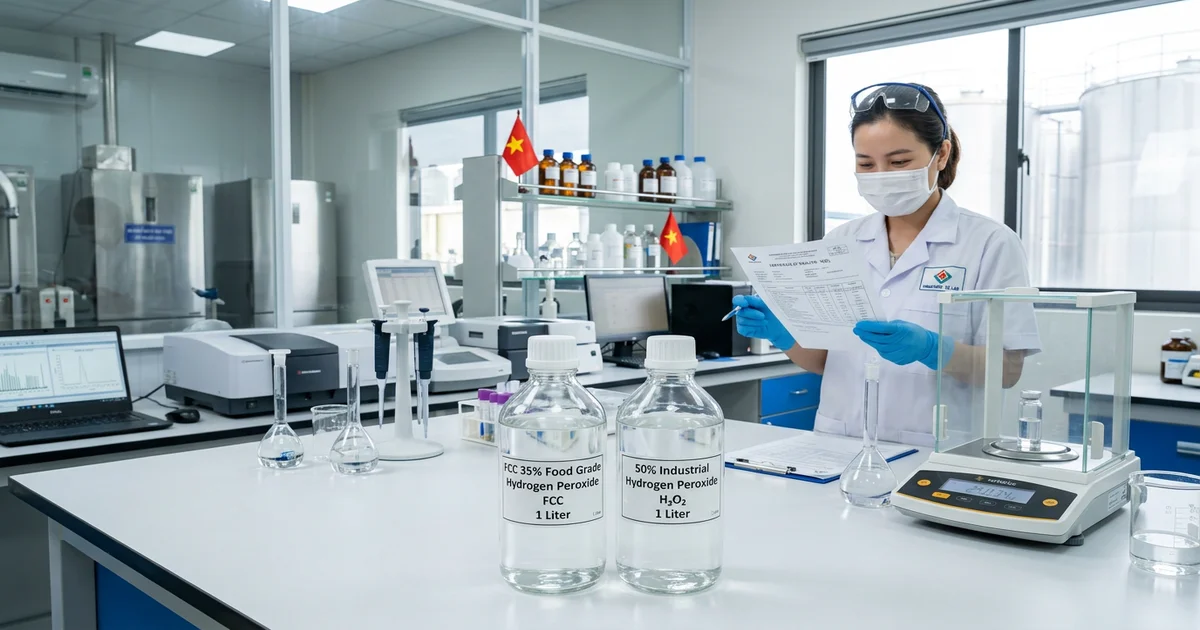
COA & MSDS H2O2 35% Food Grade FCC — Solvay Thailand | Technical Specifications
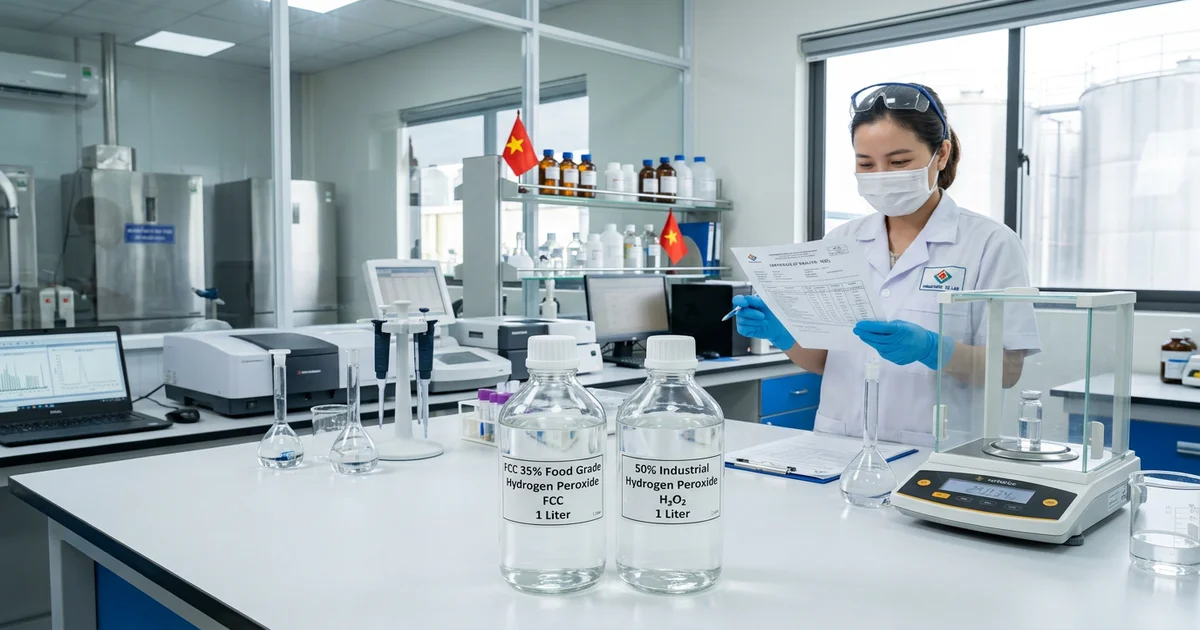
COA H2O2 35% Food Grade INTEROX FCC 35 — Solvay Thailand
Certificate of Analysis (COA) batch P69260203 is the test report for a batch of H2O2 35% food grade INTEROX FCC 35 produced by Solvay Peroxythai Limited (Map Ta Phut, Rayong, Thailand). CAS 7722-84-1, UN 2014 (Class 5.1 + 8, PG II). Actual concentration 35.5% w/w exceeds minimum spec of 35.0%, density 1.12 g/cm³ @ 20°C. All nine test parameters per Food Chemical Codex (FCC) — including As, Fe, Pb, phosphate, non-volatile residue, and tin.
Lộc Thiên directly imports from Solvay Thailand — supplies batch-specific COA for every shipment. Call 0979 891 929 to request the current batch COA.
Full COA Table — 9 FCC Parameters
Below is the COA batch P69260203 table with all 9 parameters per Food Chemical Codex standards, comparing the spec requirement against actual results.
| # | Parameter | FCC Spec | Batch P69260203 Result | Unit |
|---|---|---|---|---|
| 1 | Peroxide assay | ≥35.0 | 35.5 | % w/w |
| 2 | Stability | ≤3.00 | 0.21 | — |
| 3 | Acidity (as H₂SO₄) | ≤0.03 | 0.01 | % w/w |
| 4 | Lead (Pb) | ≤4.0 | <0.0 | mg/kg |
| 5 | Iron (Fe) | ≤0.5 | <0.0 | mg/kg |
| 6 | Arsenic (As) | ≤0.5 | <0.1 | mg/kg |
| 7 | Phosphate (PO₄) | ≤50.0 | Per batch | mg/kg |
| 8 | Non-volatile residue | ≤60.0 | Per batch | mg/kg |
| 9 | Tin (Sn) | ≤10.0 | Per batch | mg/kg |
Six parameters have specific results, all exceeding FCC spec. Three parameters — phosphate, non-volatile residue, and tin — are tested per batch by Solvay; customers receive detailed results when requesting the specific batch COA.
Explanation of Each COA Parameter
1. Peroxide Assay — Actual H2O2 Content
The most important parameter on the COA. Peroxide assay is the mass percentage concentration of H2O2 in solution, determined by iodometric-thiosulfate titration per USP/EP. Batch P69260203 achieves 35.5% w/w — exceeding the minimum spec of 35.0%. Each liter of solution contains approximately 397 grams of pure H2O2.
Practical significance: when preparing a 1% disinfectant solution for CIP or Tetra Pak, calculations should be based on the actual concentration of 35.5% — not 35.0%. A 0.5% deviation in stock concentration equates to a ~0.014% error in the diluted solution. For a factory consuming 10 tons/month, this difference represents approximately 50 kg of actual H2O2 — enough for 2–3 days of production on a small line.
2. Stability
A measure of the natural decomposition rate of H2O2 under standard storage conditions. The lower the stability value, the better — batch P69260203 achieves 0.21, 14 times lower than the maximum spec of 3.00. This is the best stability among all INTEROX FCC 35 batches imported by Lộc Thiên.
Stability directly affects storage time and inventory loss. With stability of 0.21, H2O2 FCC 35 loses approximately 1.5–2% concentration over 12 months of storage at 25°C — meaning concentration drops from 35.5% to approximately 34.8% after one year. Factories should check the COA before use if product has been stored for over 9 months.
3. Acidity
The amount of free acid calculated as H2SO4, generated during production. Batch P69260203 achieves 0.01% — 3 times lower than the spec of ≤0.03%. Low acidity reduces the risk of corrosion to 316L stainless steel tanks, CIP piping, and Tetra Pak equipment during sterilization.
High acidity (>0.03%) can cause pitting on stainless steel surfaces with prolonged contact, especially at high operating temperatures (60–80°C for Tetra Pak). With acidity of 0.01% from FCC 35, a factory running 20 CIP cycles per day can extend equipment life by 2–3 years compared to lower-quality H2O2.
4–6. Heavy Metals: Arsenic (As), Lead (Pb), Iron (Fe)
These three parameters determine the difference between food grade and industrial H2O2. Batch P69260203 shows As <0.1 mg/kg (spec ≤0.5), Fe <0.0 mg/kg (spec ≤0.5), Pb <0.0 mg/kg (spec ≤4.0) — all clean and exceeding FCC spec.
Heavy metals have 2 harmful effects: (1) they catalyze uncontrolled H2O2 decomposition — Fe and Cu at 1 ppm accelerate decomposition 10–50 times; (2) they leave residues on food after treatment. Food factories exporting to the EU and Japan are required to check the COA arsenic parameter before accepting goods — their permissible threshold is typically ≤0.3 ppm, lower than FCC spec.
Technical Specialist Phan Cẩm Thùy (15 years experience): “I once encountered a seafood factory in Tien Giang that bought ‘food grade’ H2O2 from an unclear-source supplier. When they sent samples for independent testing, the As in the H2O2 was 1.8 ppm — 3.6 times the FCC spec. They had been treating products with this H2O2 for 6 months. Fortunately the audit didn’t catch it, but if they had tested residues on products, the export shipment would have been flagged. Always request batch COA and check the As parameter before accepting into inventory.”
7. Phosphate (PO₄)
Phosphate is a stabilizer added to H2O2 to slow decomposition. FCC spec ≤50.0 mg/kg — significantly lower than industrial H2O2 which allows higher phosphate levels. Low phosphate content ensures no residue left in CIP water and food. Batch P69260203 is tested per batch by Solvay — call 0979 891 929 to request specific results.
8. Non-Volatile Residue
Solid residue remaining after evaporation of the entire H2O2 solution. FCC spec ≤60.0 mg/kg. Non-volatile residue includes inorganic stabilizers and solid impurities — low content indicates product purity. Batch P69260203 per batch — confirm details with Lộc Thiên.
9. Tin (Sn)
Tin is an impurity from production equipment or packaging (tin-coated HDPE drums). FCC spec ≤10.0 mg/kg. Batch P69260203 tested per batch — customers request results when receiving COA.
FCC Spec vs Actual Results — Batch P69260203
The table below shows the degree by which the current batch exceeds spec — data demonstrates that Solvay’s H2O2 FCC 35 doesn’t just meet the standard but far exceeds minimum requirements.
| Parameter | FCC Spec | Batch P69260203 | Exceedance |
|---|---|---|---|
| Peroxide assay | ≥35.0% | 35.5% | +0.5% (1.4%) |
| Stability | ≤3.00 | 0.21 | 14× |
| Acidity | ≤0.03% | 0.01% | 3× |
| As | ≤0.5 mg/kg | <0.1 mg/kg | 5× |
| Fe | ≤0.5 mg/kg | <0.0 mg/kg | exceeds |
| Pb | ≤4.0 mg/kg | <0.0 mg/kg | exceeds |
Significance: Solvay Thailand’s H2O2 FCC 35 has purity far exceeding FCC requirements — confirming that Solvay’s production process is stable, quality control is stringent, and the product is suitable for the most demanding food applications (export to EU, Japan, USA).
How to Read H2O2 Food Grade COA for Procurement and QC Engineers
QC engineers or procurement teams receiving COA from suppliers should check the following 5 points before accepting into inventory:
1. Confirm batch (lot) number matches. The COA must clearly state the lot number — e.g., P69260203 — matching the lot number printed on packaging (drums, tanks, or shipping documents). If the lot numbers don’t match, request an explanation from the supplier or a corrected COA.
2. Check assay (concentration) against actual requirements. COA states 35.5% — if the factory prepares CIP at 0.5%, the dilution ratio must be calculated based on actual concentration. A 0.5% error in stock concentration leads to approximately a 7% dosage error in the working solution.
3. Cross-reference heavy metals with audit requirements. Factories with IFS/BRC/FDA audits check As — COA showing As <0.1 mg/kg is safe. If As >0.3 mg/kg, alert the QC engineer before accepting into inventory.
4. Check expiry date and stability. Stability ≤0.50 is good, >1.00 requires priority use. H2O2 with high stability (>2.00) will lose concentration rapidly within 6 months — consider arranging more frequent delivery schedules.
5. Keep hard copy + scanned COA. COA is a mandatory document in audit files. Lộc Thiên sends batch COA before delivery — file in the supplier dossier.
MSDS H2O2 35% FCC — Safety Data Summary
The Material Safety Data Sheet (MSDS) for INTEROX FCC 35 is updated by Solvay for 2026, complying with Circular 01/2026/TT-BCT and GHS Rev.06. Below is a summary of key sections.
Product and Composition Information
| Item | Information |
|---|---|
| Product name | INTEROX FCC 35 |
| Chemical formula | H₂O₂ |
| CAS | 7722-84-1 |
| UN Number | UN 2014 |
| Hazard classification | Class 5.1 (oxidizer) + Class 8 (corrosive), PG II |
| HS Code | 28470000 |
| Concentration | 35.5% w/w |
| Density @ 20°C | 1.12 g/cm³ |
| Boiling point | Approx. 107°C (decomposes before boiling) |
Hazard Statements
| Code | Content |
|---|---|
| H271 | May cause fire or explosion — strong oxidizer |
| H302 | Harmful if swallowed |
| H314 | Causes severe skin burns and eye damage |
| H332 | Harmful if inhaled |
| H335 | May cause respiratory irritation |
| EUH070 | Toxic if in contact with eyes |
First Aid Measures
| Case | Treatment |
|---|---|
| Inhalation | Move victim to fresh air. If breathing difficulty, administer oxygen. Call emergency immediately. |
| Skin contact | Wash with plenty of water for at least 20 minutes. Remove contaminated clothing. Call emergency. |
| Eye contact | Rinse eyes under gentle running water for at least 20 minutes, keeping eyelids open. Call emergency immediately. |
| Ingestion | Rinse mouth with water. DO NOT induce vomiting. Drink water (if conscious). Call emergency immediately. |
Recommended Personal Protective Equipment (PPE)
- Face: Chemical splash goggles or face shield
- Respiratory: Respirator with acid/organic vapor cartridge
- Hands: Butyl rubber or neoprene gloves (thickness ≥0.4 mm)
- Body: Chemical-resistant clothing (PVC or PE)
- Feet: Chemical-resistant boots
Storage and Transport Notes
| Item | Requirement |
|---|---|
| Storage temperature | <35°C, ideally 15–25°C |
| Tank materials | HDPE, 316L stainless steel, passivated aluminum |
| Avoid contact | Heavy metals (Fe, Cu, Mn), strong alkalis, organic matter, reducing agents |
| Ventilation | Storage area must have natural or forced ventilation |
| Pressure relief | Tanks must have pressure relief valves for O₂ gas release |
| Shelf life | 12 months from production date |
| Spill handling | Dilute with water 1:10, neutralize with Na₂S₂O₃ or NaHSO₃ |
Download COA and MSDS for H2O2 35% INTEROX FCC 35
Lộc Thiên provides batch-specific COA and the 2026 edition MSDS to all customers before delivery.
COA batch P69260203 and the full INTEROX FCC 35 MSDS (16 pages) are sent via email within 15 minutes of contact. Documentation includes:
- Batch COA: 9 FCC parameters with current batch data
- MSDS 2026 edition per Circular 01/2026/TT-BCT: sections 1–16 complete
- Certificate of Origin — Solvay Thailand
- UN 2014 transport permit
Call 0979 891 929 — provide your email to receive COA and MSDS within 15 minutes. Or request a different batch COA if the current batch does not match your factory’s technical requirements.
Frequently Asked Questions about COA & MSDS H2O2 35% FCC
Is COA batch P69260203 still valid?
The COA is valid only for the specific batch P69260203. When this batch is depleted from inventory, Lộc Thiên updates with the new batch COA. Call the hotline to request the current batch COA — sent within 15 minutes.
How to distinguish real vs fake COA?
A genuine COA has 3 indicators: (1) the batch number on the COA matches the batch number printed on the packaging; (2) includes all 9 FCC parameters — no missing heavy metal parameters; (3) bears the signature and stamp of the manufacturer’s QC department (Solvay Peroxythai Limited). Fake COAs are often blurry photocopies, missing As/Fe/Pb parameters, or have no batch number or mismatched numbers.
Can I request batch COA before placing an order?
Yes — Lộc Thiên sends the current batch COA before order confirmation. Procurement can cross-reference technical specifications with internal requirements before making a decision.
Does the H2O2 35% FCC MSDS need annual updates?
Per Circular 01/2026/TT-BCT, the MSDS must be updated whenever there are changes in composition, hazardous properties, or legal regulations. Solvay updates the INTEROX FCC 35 MSDS annually — the 2026 edition is current. Lộc Thiên sends the latest MSDS to customers whenever changes occur.
Does H2O2 35% FCC need COA re-testing after entering inventory?
Recommendation: for food factories with IFS/BRC audits, re-test As and assay every 6 months if the product is stored for a long period. For CIP factories with fast turnover (1–3 months), Solvay’s COA is sufficiently reliable — re-testing is not required.
How to obtain the MSDS for fire safety documentation?
The INTEROX FCC 35 MSDS comprises 16 sections — sections 5 (fire-fighting), 6 (accidental release), 7 (handling and storage), and 9 (physical and chemical properties) are core for PCCC fire safety documentation. Lộc Thiên sends the full MSDS — provide your email via hotline 0979 891 929.
🛒 Quote for H2O2 35% Food Grade INTEROX FCC 35 — COA batch P69260203 | 📖 H2O2 Food Grade FCC 35% vs Industrial 50% — Detailed comparison | 📖 Applications of H2O2 35% food grade in processing and sanitation
Lộc Thiên — direct importer of Solvay Thailand, 6 warehouses nationwide, 20 tankers 5–30 tons. Batch COA + MSDS per shipment.
Article updated September 23, 2026. Technical specifications based on COA batch P69260203 and MSDS INTEROX FCC 35 2026 edition. Contact Lộc Thiên to confirm current batch COA.