Applications of H2O2 35% Food Grade in Processing & Industrial Sanitation | Lộc Thiên Chemical
Applications of H2O2 35% Food Grade in Processing & Industrial Sanitation
TL;DR: H2O2 35% FCC (INTEROX FCC 35, Solvay Peroxythai Limited, CAS 7722-84-1, UN 2014) is hydrogen peroxide meeting Food Chemical Codex standards, concentration 35.5% w/w per COA batch P69260203, density 1.12 g/cm³ @20°C, ultra-low heavy metals (Pb <0.0, Fe <0.0, As <0.1 mg/kg). Key applications: Tetra Pak/PET bottle/aluminum can sterilization, CIP sanitation in dairy/beer/beverages, bottled drinking water treatment replacing chlorine without THM formation, food bleaching per QCVN. Lộc Thiên directly imports Solvay Thailand, supplies 30kg HDPE drums, 5-30 ton tankers, nationwide delivery. Hotline 0979 891 929.
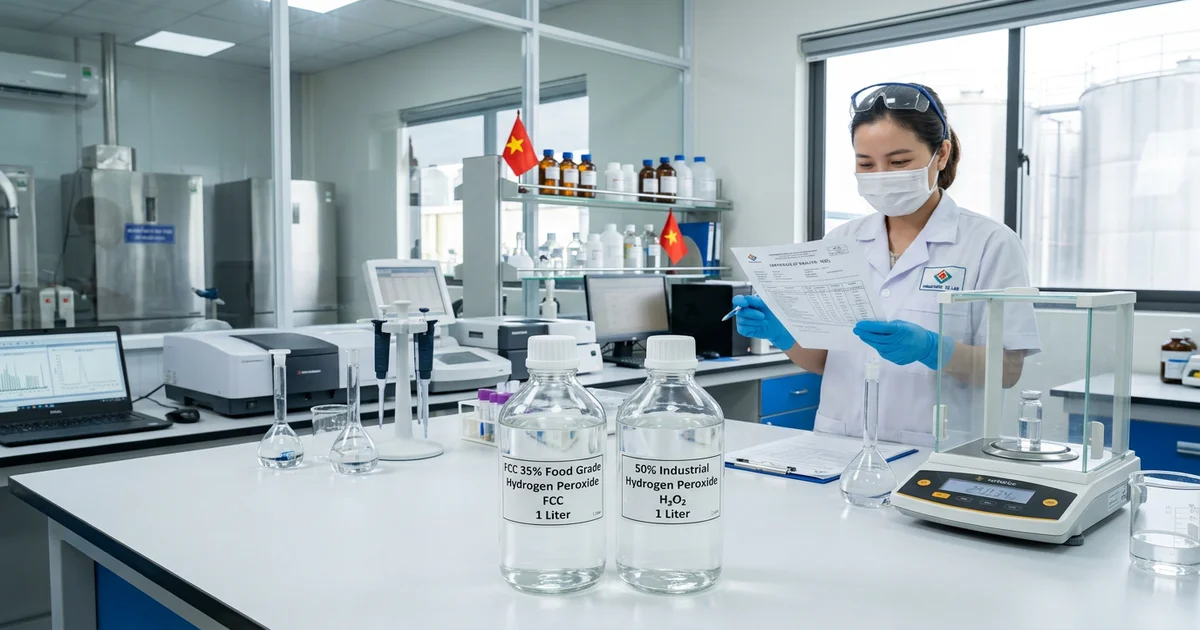
H2O2 35% FCC — How is food grade different from industrial H2O2?
Hydrogen peroxide (H2O2, CAS 7722-84-1, UN 2014, Class 5.1+8, PG II) is produced at various purity levels. Food grade differs from industrial grade in heavy metal limits, stability, and quality control processes.
INTEROX FCC 35 by Solvay Peroxythai Limited (Map Ta Phut, Rayong, Thailand) is H2O2 certified to FCC (Food Chemical Codex) — the standard issued by the US Pharmacopeia (USP) for food additives. COA batch P69260203 confirms concentration 35.5% w/w, density 1.12 g/cm³ @20°C, acidity (as H2SO4) <0.04% w/w.
The most critical parameter is heavy metal content: Pb (lead) <0.0 mg/kg, Fe (iron) <0.0 mg/kg, As (arsenic) <0.1 mg/kg. At this level, H2O2 completely decomposes into H₂O + O₂ after reaction, leaving no metal residues in food. This is why food grade H2O2 is permitted in food processing and industrial sanitation in most countries — including the EU, US FDA, Codex Alimentarius, and Vietnam per QCVN.
At density 1.12 g/cm³, each 30kg HDPE drum equates to approximately 26.8 liters of H2O2 35.5% solution. FCC H2O2 has higher stability than industrial grade thanks to specially formulated stabilizers, allowing a minimum 12-month shelf life in cool conditions (<25°C), away from direct sunlight.
“Food-grade H2O2 has strict heavy metal requirements because they catalyze uncontrolled decomposition and leave residues. With Pb and Fe below detection limits, INTEROX FCC 35 ensures no impact on color, flavor, and food safety in all applications.” — Technical Specialist Phan Cẩm Thùy, Food Chemical Expert, Lộc Thiên Chemical
Food packaging sterilization — Tetra Pak, PET bottles, aluminum cans
Packaging is a primary source of microbial contamination in food packaging processes. Packaging surfaces come into direct contact with the product; if not thoroughly sterilized, bacteria and yeast from the plant environment will spoil the product quickly. H2O2 35% FCC is the standard sterilant for aseptic liquid food packaging.
Sterilization mechanism: H2O2 decomposes into hydroxyl free radicals (•OH) — the second strongest oxidizer after fluorine, destroying microbial cell membranes, DNA, and intracellular enzymes. In liquid form at 30-35% concentration, H2O2 kills 99.999% (log 5 reduction) of bacterial spores within 10-30 seconds at 60-80°C. When converted to vapor (VHP — Vaporized Hydrogen Peroxide), efficacy increases 3-5 times due to penetration into crevices and uneven packaging surfaces.
Tetra Pak (multi-layer paper packaging): H2O2 is the only sterilant approved by Tetra Pak for aseptic lines. Standard process: packaging is sprayed or dipped in H2O2 30-35% at 70-80°C for 6-15 seconds, then dried with sterile hot air. Residual H2O2 on the surface after drying is <0.5 ppm, meeting FDA limits (0.5-1 ppm depending on food type). Four major dairy plants in Vietnam use this process on all Tetra Pak lines.
PET bottles and plastic caps: PET bottles are sterilized with H2O2 35% at a diluted concentration of 0.8-1.5% (equivalent to 8,000-15,000 ppm) sprayed as mist at room temperature, contact time 5-10 seconds. A 200 million liter/year beverage plant consumes an average of 3-5 tons of H2O2 35% FCC per month for this step. Comparison: chlorine sterilization requires longer contact time (>60 seconds) and higher concentration, while also generating THM (trihalomethanes) when contacting organic residues on bottle surfaces.
Aluminum cans and lids: For aluminum cans, H2O2 35% diluted to 0.5-1% is sprayed at 40-50°C. Aluminum has good oxidation resistance in this pH range and does not corrode. Contact time 3-5 seconds, H2O2 consumption approximately 1-1.5 kg of H2O2 35% per ton of finished cans.
🛒 Need H2O2 35% FCC for packaging sterilization? Get a quote for H2O2 35% INTEROX FCC 35 — COA per lot, nationwide delivery 5-30 tons. Hotline 0979 891 929.
Processing equipment sanitation — CIP in dairy, beer, beverages
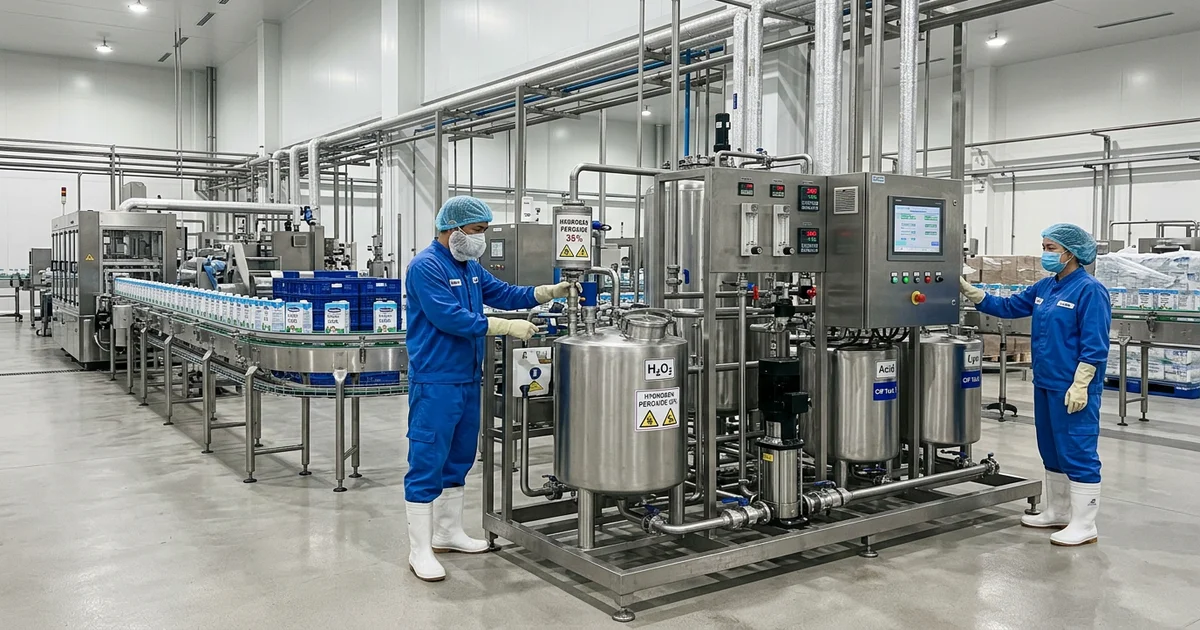
CIP (Clean-In-Place) is an automated sanitation system without equipment disassembly, a mandatory standard in food plants. A typical CIP cycle includes: pre-rinse → alkaline wash (NaOH) → rinse → acid wash → rinse → H2O2 sterilization → final rinse. H2O2 handles the final sterilization step, replacing chlorine or hot heat.
Dairy industry: Heat exchangers (HTST pasteurizer), yogurt fermentation tanks, milk transfer pipelines — all require sterilization after each batch. H2O2 35% FCC diluted to 0.1-0.5% (1,000-5,000 ppm), temperature 25-40°C, contact time 10-20 minutes. The table below compares efficacy on target microorganisms (per Journal of Dairy Science):
| Microorganism | H2O2 0.2% 10 min | H2O2 0.5% 5 min | Chlorine 200 ppm 10 min |
|---|---|---|---|
| Escherichia coli | 5.2 log reduction | 6.1 log reduction | 4.8 log reduction |
| Listeria monocytogenes | 4.7 log reduction | 5.8 log reduction | 4.1 log reduction |
| Staphylococcus aureus | 4.5 log reduction | 5.3 log reduction | 3.9 log reduction |
| Bacillus subtilis spores | 3.1 log reduction | 4.5 log reduction | 0.8 log reduction |
H2O2 outperforms chlorine on bacterial spores — a critical difference since spores survive in powdered milk environments and are difficult to eliminate. Additionally, H2O2 does not form organochlorine compounds (AOX, THM) when reacting with milk protein residues, whereas chlorine requires an anti-chlor step (neutralization with Na₂S₂O₃) before discharge.
Beer industry: Fermenters, finished beer storage tanks, beer filling pipelines — sanitation quality determines beer quality. H2O2 35% diluted to 0.3-0.5% at 20-30°C, contact time 15-20 minutes. Beer has low pH (4.0-4.5) and contains CO₂; H2O2 decomposes faster in acidic environments, leaving O₂ as micro-bubbles — beneficial for beer aroma stabilization. Compared to ozone (O₃) sterilization, H2O2 is easier to control concentration and does not require expensive ozone generator equipment.
Beverage industry: Syrup mixing lines, blending tanks, filling valves — these devices contact sugar, citric acid, food colors — forming tough biofilm. H2O2 0.5-1% at 40-50°C combined with NaOH 1% in a dual CIP cycle achieves up to 40% higher biofilm removal than chlorine (per research at the University of Applied Sciences Netherlands).
A 300 million liter/year beverage plant consumes approximately 8-12 tons of H2O2 35% FCC per year for CIP sterilization alone. Lộc Thiên supplies H2O2 in 30kg drums or 5-30 ton tankers, delivered directly to industrial parks, with COA and MSDS per lot.
See related articles: NaOH in food CIP — Concentration, temperature & application by industry | Javen in food CIP — H2O2 vs NaOCl comparison
Bottled drinking water treatment — chlorine replacement, no THM
Bottled drinking water is a market growing 12-15%/year in Vietnam (per BMI Research, 2026). Water sterilization before bottling is mandatory per QCVN 6-1:2010/BYT, with microbiological standards: E. coli = 0 CFU/100mL, Coliforms = 0 CFU/100mL, total aerobic bacteria <100 CFU/mL.
The chlorine problem: Chlorine (NaOCl, Cl₂) is a traditional, low-cost sterilant. But chlorine reacts with natural organic compounds (humic acid, fulvic acid) in source water to form THM (trihalomethanes) — a group of carcinogens classified as Group 2B by EPA and IARC. THM limits in drinking water: EPA 80 ppb, EU 100 ppb, Vietnam QCVN does not yet have a specific limit for bottled water, but export plants must meet importing country standards.
H2O2 in drinking water treatment: H2O2 35% FCC is diluted directly into the water stream at 50-200 ppm, contact time 30-60 minutes. After sterilization, residual H2O2 is removed by catalase (enzyme) or activated carbon, or left to self-decompose in storage tanks after 24-48 hours.
Comparison of H2O2 vs chlorine and ozone in bottled water treatment:
| Parameter | H2O2 35% FCC | Chlorine (NaOCl) | Ozone (O₃) |
|---|---|---|---|
| Sterilization concentration | 50-200 ppm | 2-5 ppm | 0.4-1 ppm |
| Contact time | 30-60 min | 30-60 min | 5-10 min |
| Toxic byproducts | None (only H₂O + O₂) | THM, chloramine, AOX | Bromate (BrO₃⁻) if water contains bromide |
| Residual in product | 100% removable by catalase | Requires anti-chlor | None (fast self-decomposition) |
| Taste/odor impact | Odorless | Chlorine smell if residual | Odorless |
| Chemical cost (/m³ water) | 1,200-2,500 VND | 200-500 VND | 2,000-5,000 VND (power + equipment) |
| Equipment requirements | Mixing tank, dosing pump | Dosing pump | Ozone generator, contact tank |
| Suitable for iron-rich groundwater | Yes (oxidizes iron) | No (causes color) | Yes |
H2O2 is the optimal choice for premium or export bottled water plants — where “zero THM” and clean label are required. A 50 million liter/year spring water plant switching from chlorine to H2O2 increases chemical costs by approximately 50-60 million VND/year but eliminates THM warning risks during export.
Food bleaching — permitted per QCVN
H2O2 is permitted as a bleaching agent and color modifier in food per QCVN 4-4:2016/BYT (List of permitted food additives). Specific applications include:
Animal fats and vegetable oils: H2O2 decolorizes natural pigments (carotenoids, chlorophyll) during edible oil refining. Usage concentration: 0.5-2% H2O2 35% relative to oil mass, at 60-80°C, combined with phosphoric or citric acid for pH adjustment. Residual H2O2 decomposes during water washing and deodorization. Maximum permitted limit per Codex: 5,000 mg/kg residual H2O2 in oil, far exceeding actual production levels (<100 mg/kg after refining).
Wheat flour and cereal products: In the US, H2O2 is recognized by the FDA as GRAS for flour treatment. In Vietnam, H2O2 is permitted as a flour treatment agent per QCVN, limit <1,250 mg/kg flour. H2O2 improves flour whiteness and inhibits mold. This application is common in multipurpose flour and bread flour mills.
Gelatin and hydrolyzed protein products: H2O2 35% is used in food gelatin production for bleaching and deodorizing. Gelatin production lines use H2O2 0.3-0.5% in the final bleaching stage before drying. Finished gelatin achieves whiteness >90% (Bordeaux scale) with residual H2O2 <10 ppm after drying — meeting Gelatin Manufacturers Institute of America (GMIA) standards.
H2O2 vs Chlorine vs Ozone in food sanitation
Choosing the right sanitizer depends on product type, process, and output requirements. The summary table below helps procurement and technical staff evaluate options:
| Criterion | H2O2 35% FCC | Chlorine (NaOCl 10-12%) | Ozone |
|---|---|---|---|
| CAS | 7722-84-1 | 7681-52-9 | 10028-15-6 |
| Spectrum | Broad (gram+, gram−, spores, virus, fungi) | Broad (gram+, gram−, virus) — weak on spores | Broadest — kills Cryptosporidium |
| Sterilization speed | Medium (seconds-minutes) | Fast (seconds) | Very fast (seconds) |
| Byproducts | H₂O + O₂ (clean) | THM, chloramine, AOX | Bromate if water has Br⁻ |
| Taste/odor impact | None | Yes (chlorine smell) | None |
| Equipment impact | Mild stainless steel corrosion | Strong stainless steel corrosion | Mild corrosion, rubber gasket degradation |
| Chemical cost (est.) | 3-5× higher than chlorine | Lowest | Requires ozone machine investment |
| Operation training | Simple (dosing pump) | Simple | More complex |
| Food certification | FCC, FDA GRAS, Codex | NSF/ANSI 60, Codex | FDA GRAS (water), Codex |
| Best suited for | Aseptic CIP, Tetra Pak packaging, export water | Surface sanitation, water supply | Bottled water, cold CIP |
Food industry trend 2025-2026: Plants exporting to the EU and Japan are gradually transitioning from chlorine to H2O2 or ozone to meet “zero AOX” standards and reduce chemical residues on products. Approximately 35% of large-scale food plants in Vietnam have converted at least one line to H2O2 for the final sterilization step.
Case study — 200 million liter/year beverage plant
In June 2025, a beverage plant at Mỹ Phước Industrial Park (Bình Dương) encountered chloramine residue problems in products after switching to a water source with high ammonia content >3 mg/L. Chlorine combined with ammonia formed chloramine — causing a strong chlorine odor in bottled products, customer complaint rates rising from 0.3% to 2.1% over two months.
Solution: Switch the final sterilization step from NaOCl (active chlorine 12%) to H2O2 35% FCC. The process was adjusted:
- Step 1: Chlorine 2 ppm at inlet — basic microbial control
- Step 2: H2O2 35% diluted to 80 ppm, pumped into contact tank for 45 minutes — thorough sterilization
- Step 3: Column activated carbon — remove residual H2O2 + residual chlorine
- Step 4: Bottling under sterile conditions
Results after 3 months of operation:
- Total THM reduced from 128 ppb to <5 ppb
- Chloramine reduced from 2.4 ppm to <0.1 ppm
- Taste/odor complaints dropped from 2.1% to 0.05%
- Residual H2O2 in finished product: <0.5 ppm (meeting FDA limit)
- Chemical cost increased 42% vs chlorine alone, but saved previous chloramine treatment costs (NH₃ stripping tower pump 180 million VND/year). Net cost impact: +5% total sterilization cost.
The plant now uses H2O2 35% FCC from Lộc Thiên at a frequency of 2 × 10-ton tankers/month, COA checked per lot, directly imported from Solvay Thailand.
Safety and transport of H2O2 35% food grade
H2O2 35% is classified as UN 2014 (Hydrogen peroxide, aqueous solution with not less than 20% but not more than 60% hydrogen peroxide), Class 5.1 (oxidizer) + Class 8 (corrosive), Packing Group II.
Lộc Thiên supply formats:
- 30kg HDPE drum — for medium-scale plants, small CIP batches
- 200kg HDPE drum — for direct dosing pump systems
- 5-30 ton dedicated tanker — for high-consumption plants (>5 tons/month)
- 316L stainless steel or HDPE tanker — corrosion-resistant, metal-free contamination
Storage precautions:
- Temperature <25°C — every 10°C increase doubles decomposition rate
- Avoid direct sunlight — UV catalyzes rapid decomposition
- Do not store near organic substances, flammable solvents
- Drum vents must be opened periodically to release O₂ from natural decomposition
- Check COA before receiving — actual concentration vs committed ±0.5%
Lộc Thiên supplies H2O2 35% INTEROX FCC 35 directly imported from Solvay Peroxythai Limited (Thailand). Each shipment includes COA (Certificate of Analysis) and MSDS (Material Safety Data Sheet). Nationwide delivery — 4 hours within Ho Chi Minh City, 24 hours to southern industrial parks.
Frequently Asked Questions (FAQ)
How much does H2O2 35% FCC cost?
Price depends on quantity and packaging format. 30kg drums differ from 10-30 ton tankers. Contact the hotline for an updated quote — sent within 15 minutes.
How to distinguish food grade and industrial H2O2?
Check the FCC (Food Chemical Codex) certification on the COA — food grade H2O2 has heavy metal limits of Pb <0.0, Fe <0.0, As <0.1 mg/kg. Industrial H2O2 can contain 10-100 times higher metal impurities.
What H2O2 concentration for Tetra Pak sterilization?
Standard Tetra Pak process: H2O2 30-35% at 70-80°C, contact time 6-15 seconds. Residual after drying <0.5 ppm. Do not use lower concentrations as log 5 reduction on spores is not achieved.
Does H2O2 leave residues in food?
H2O2 decomposes into H₂O + O₂ — leaving no toxic chemicals. Under processing conditions (heat, catalase enzyme), H2O2 completely decomposes within minutes. FDA permits a maximum residual of 0.5-1 ppm depending on food type.
Where to buy quality H2O2 35% FCC?
Lộc Thiên directly imports INTEROX FCC 35 from Solvay Peroxythai Limited (Thailand) — COA per lot, 30kg drums or 5-30 ton tankers. Nationwide delivery.
Does H2O2 use in food CIP require a final water rinse?
Yes — after the H2O2 step, the CIP system must rinse with RO or purified water to remove residual H2O2 before product introduction. Rinse time 5-10 minutes depending on pipe diameter.
Contact for purchasing H2O2 35% FCC — INTEROX FCC 35 Solvay
Need a quote for H2O2 35% food grade for CIP, packaging sterilization, or bottled water treatment? Lộc Thiên supplies and directly imports INTEROX FCC 35 from Solvay Thailand — COA per lot, 30kg HDPE drums, 5-30 ton tankers, nationwide delivery.
- Hotline: 0979 891 929 (quotation in 15 minutes)
- Email: [email protected]
- Office: 467/12 Điện Biên Phủ, P.25, Q.Bình Thạnh, Ho Chi Minh City
- Tax code: 0313650856
- Warehouses: Ho Chi Minh City, Đồng Nai, Bà Rịa-Vũng Tàu, Cần Thơ, Đà Nẵng, Bắc Ninh
🛒 Need H2O2 35% FCC for food? Get a quote for H2O2 35% INTEROX FCC 35 Solvay Thailand — COA/MSDS, nationwide delivery 5-30 tons. Contact the hotline for a quote in 15 minutes.