H2O2 Food Grade FCC 35% vs Industrial 50% — Technical Differences & Applications
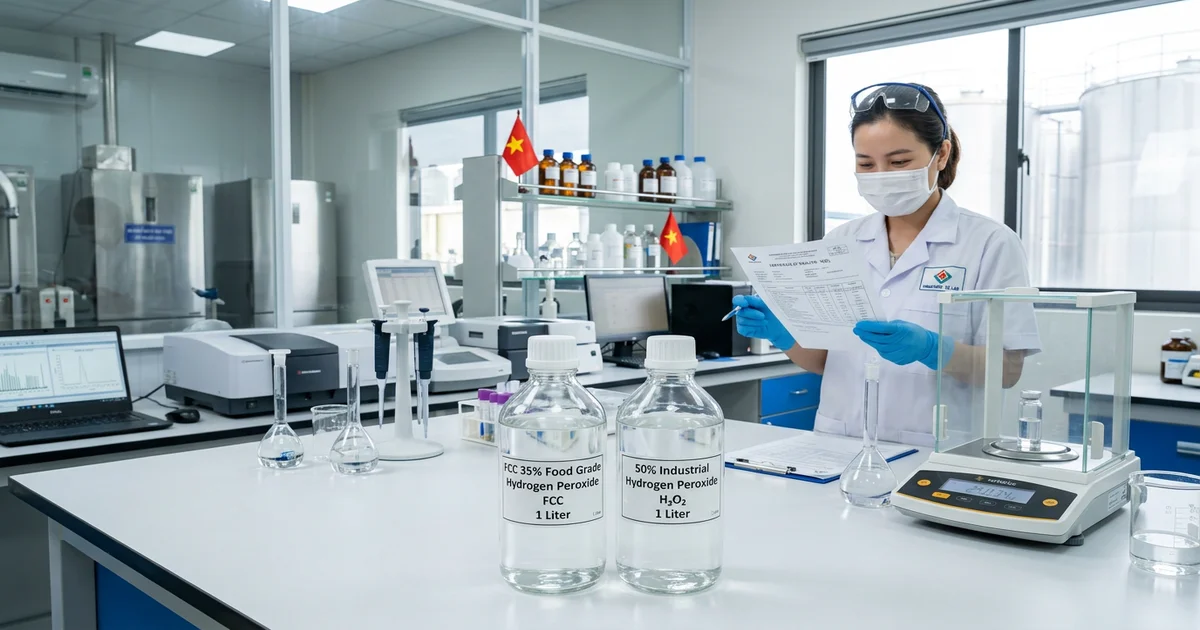
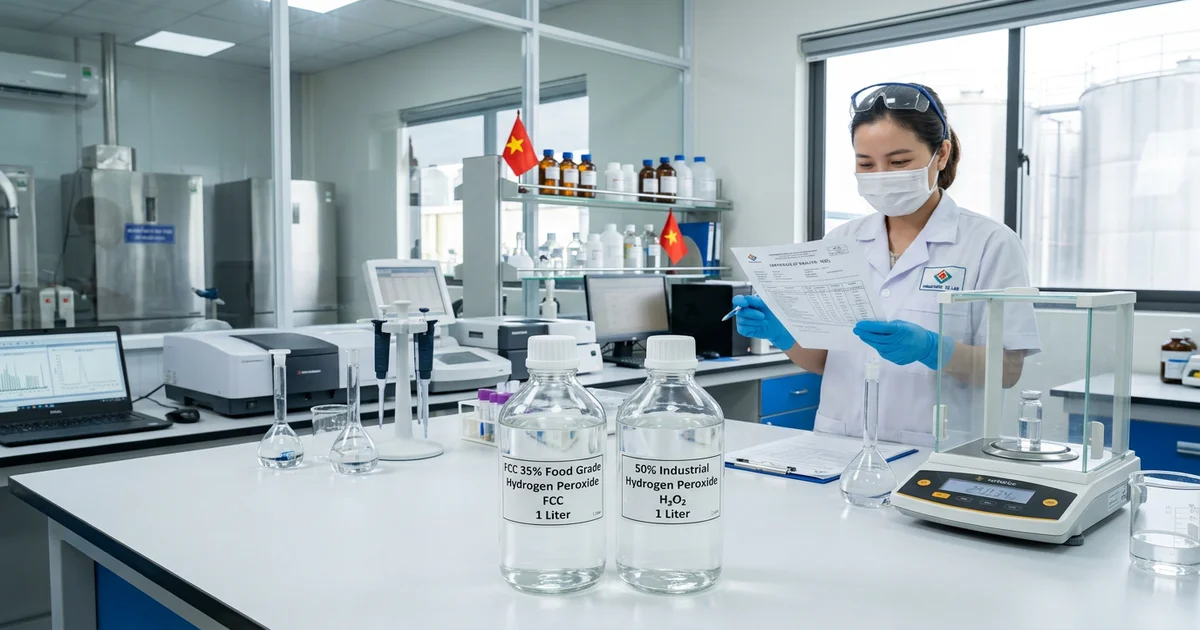
H₂O₂ food grade FCC 35% and H₂O₂ industrial 50% differ in four core factors: heavy metal impurity purity, peroxide concentration, density, and regulatory certification. FCC 35 (INTEROX FCC 35, Solvay Thailand) has As ≤0.5 ppm (4× cleaner than industrial), Fe ≤0.5 ppm (2× cleaner), Pb ≤4.0 ppm (2.5× cleaner) — meeting Food Chemical Codex and FDA 21 CFR 184.1366 standards. Industrial H₂O₂ 50% (INTEROX ST 50) has As ≤2.0 ppm, Fe ≤1.0 ppm, Pb ≤10 ppm — suitable for Fenton water treatment, textile/paper bleaching, technical disinfection, not for direct food use. Lộc Thiên directly imports Solvay Thailand — supplying batch-specific COA for both grades. Call 0979 891 929 for advice on selecting the right grade for your application.
Summary:
- FCC 35%: As ≤0.5 ppm, Fe ≤0.5 ppm, Pb ≤4.0 ppm — FCC certified, for food, pharmaceutical, cosmetic use
- Industrial 50%: As ≤2.0 ppm, Fe ≤1.0 ppm, Pb ≤10 ppm — for Fenton water treatment, bleaching, technical disinfection
- Density difference: FCC 35 density 1.12 g/cm³ lighter than industrial 50% (1.20 g/cm³) — saves transport costs
- Actual COA: FCC batch P69260203 achieves 35.5% with 3 parameters exceeding spec
- Lộc Thiên directly imports Solvay Thailand — 20 tankers 5-30 tons, 6 warehouses nationwide, COA/MSDS per lot
H₂O₂ food grade FCC 35% — definition and certification
H₂O₂ food grade FCC 35% is hydrogen peroxide meeting Food Chemical Codex (FCC) standards — a set of standards issued by the US National Academy of Sciences for food and pharmaceutical ingredients. The product INTEROX FCC 35 is manufactured by Solvay Peroxythai Limited at Map Ta Phut, Rayong, Thailand — a plant with ISO 9001 and HACCP certification.
FCC certification specifies significantly stricter heavy metal impurity limits compared to regular industrial H₂O₂: As ≤0.5 ppm, Fe ≤0.5 ppm, Pb ≤4.0 ppm, phosphate ≤50.0 mg/kg, non-volatile residue ≤60.0 mg/kg. This is why FCC H₂O₂ is recognized by the FDA as GRAS (Generally Recognized As Safe) under 21 CFR 184.1366 for food sanitation applications — industrial H₂O₂ does not meet these thresholds. With COA batch P69260203, actual concentration 35.5% exceeds the minimum spec of 35.0%, As <0.1 mg/kg, Fe <0.0 mg/kg, Pb <0.0 mg/kg — all well below FCC requirements.
Technical Expert — Phan Cẩm Thùy (Chemical Specialist Lộc Thiên, 15 years experience): “When customers ask if they can use industrial H₂O₂ for food, I always ask to see the COA. Industrial H₂O₂ 50% has As up to 2.0 ppm — 4 times the FCC limit. For food plants exporting to the EU, US, Japan, using the wrong grade can lead to shipment rejection due to heavy metal residues. Always check the COA before deciding.”
Industrial H₂O₂ 50% — characteristics and scope of use
Industrial H₂O₂ 50% (INTEROX ST 50, also manufactured by Solvay) is the most widely used hydrogen peroxide grade for water treatment, bleaching, and industrial production. The 50% concentration provides high oxidative efficiency per volume, reducing storage and transport costs compared to lower concentrations. Density 1.196-1.198 g/cm³ @ 20°C, pH <1, boiling point approximately 150°C.
The impurity specifications of industrial H₂O₂ 50% are broader than FCC: As ≤2.0 ppm, Fe ≤1.0 ppm, Pb ≤10 ppm. Although still safe for technical and environmental applications, these impurity levels do not meet requirements for direct food contact. Industrial H₂O₂ is used primarily in Fenton reactions for COD treatment, chlorine-free textile/paper bleaching (ECF/TCF), and technical surface disinfection in paper and textile dyeing plants.
Comparison table: H₂O₂ food grade FCC 35% vs industrial 50%
| Technical parameter | H₂O₂ food grade FCC 35% | H₂O₂ industrial 50% |
|---|---|---|
| Product code | INTEROX FCC 35 | INTEROX ST 50 |
| Manufacturer | Solvay Peroxythai Limited, Thailand | Solvay Peroxythai Limited, Thailand |
| Concentration (COA) | 35.5% w/w | 50% ±1% w/w |
| Density @ 20°C | 1.12 g/cm³ | 1.196–1.198 g/cm³ |
| As (spec) | ≤0.5 mg/kg | ≤2.0 mg/kg |
| Fe (spec) | ≤0.5 mg/kg | ≤1.0 mg/kg |
| Pb (spec) | ≤4.0 mg/kg | ≤10 mg/kg |
| Phosphate | ≤50.0 mg/kg | — |
| Non-volatile residue | ≤60.0 mg/kg | — |
| Stability | 0.21 (spec ≤3.00) | Per batch |
| Certification | FCC + FDA 21 CFR 184.1366 | Industrial grade |
| Target users | Food, pharmaceutical, cosmetic | Water treatment, bleaching, manufacturing |
| Packaging | 30kg HDPE drum, 5-30 ton tanker | 5-30 ton tanker, IBC, drum |
| Documentation | COA batch + MSDS 2026 | COA batch + MSDS 2026 |
Why can’t industrial H₂O₂ replace food grade H₂O₂?
The most common question from factories newly transitioning to food production: “Industrial H₂O₂ 50% has As of only 2.0 ppm, below the QCVN permitted limit, so why can’t we use it?” — Because there are three technical reasons it cannot be substituted:
First, food industry standards are not based solely on QCVN. FCC, FDA, EU Regulation 1935/2004 and Codex Alimentarius require specific impurity thresholds for food contact materials. Industrial H₂O₂ is not produced on HACCP-compliant lines — risk of metal cross-contamination from production equipment. The 2.0 ppm As in industrial H₂O₂ is 4× the FCC limit, 1.0 ppm Fe is 2× the limit. For food plants exporting to EU/Japan/US markets, partner audits will immediately flag a COA that does not state FCC.
Second, 50% concentration is not convenient for food dilution. Food grade H₂O₂ is typically used at diluted concentrations of 0.5-1.5%. From a 50% solution, dilution of 33-100× is required — difficult to control precisely, risk of concentration errors and heat generation. FCC 35% is more convenient: from 35% to 1% requires only a 1:34 ratio, with less heat generation due to the smaller concentration differential.
Third, FCC 35 density of 1.12 is lower than 1.198 of 50% — a clear transport advantage. On the same 15-ton tanker payload, FCC 35 carries more volume. Lộc Thiên’s 6 warehouses supply both grades, always advising the right type for the right application.
Specific applications of H₂O₂ food grade FCC 35%
H₂O₂ food grade FCC 35% is used in three main application areas thanks to its FCC purity meeting international food safety standards:
Food and raw material disinfection. H₂O₂ FCC 35% diluted to 0.5-1.5% is used for washing and disinfecting fruits, vegetables, seafood, and poultry in processing lines. Bactericidal mechanism: H₂O₂ decomposes to form hydroxyl free radicals (·OH) that destroy microbial cell membranes at very low concentrations, then self-decomposes into water and oxygen — leaving no residue on products. Per FDA 21 CFR 184.1366, H₂O₂ is recognized as a safe sanitizer at concentrations used per GMP (Good Manufacturing Practice).
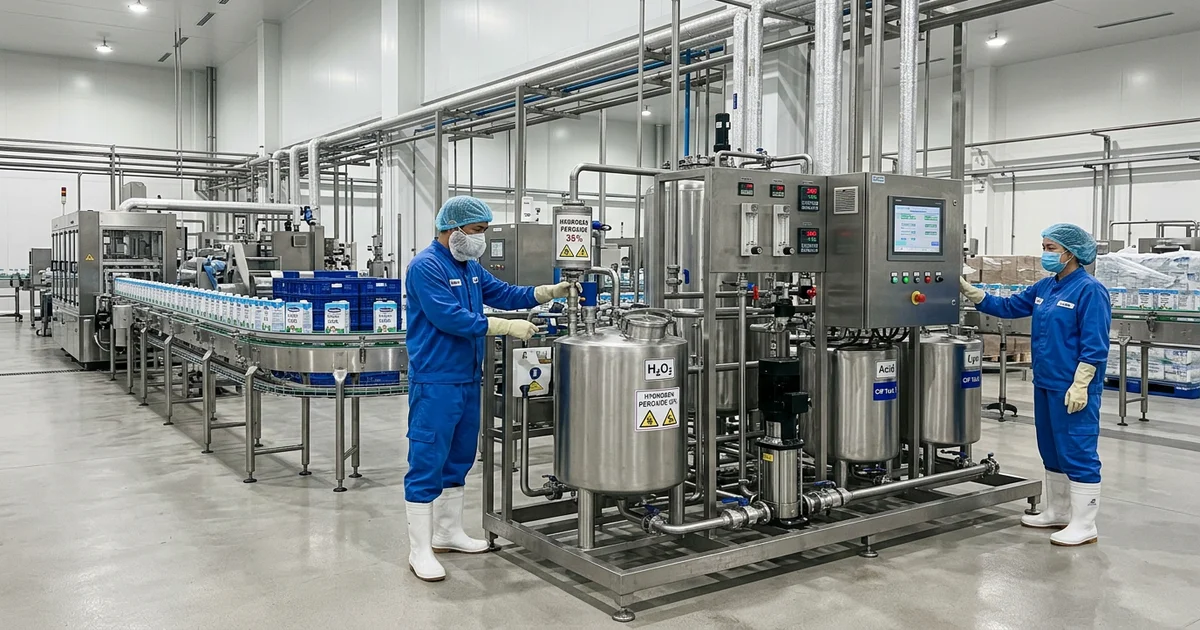
Equipment and food packaging sanitation. CIP (Clean-in-Place) systems in food plants use H₂O₂ FCC 1-3% to sanitize storage tanks, pipelines, and equipment. Tetra Pak packaging, PET bottles, and PE film are surface-treated with diluted H₂O₂ FCC 35 — cold sterilization technology that preserves packaging structure. H₂O₂ FCC packaging treatment meets HACCP standards and is accepted by the FDA as a chlorine replacement in many applications.
Pharmaceutical and cosmetic ingredients. FCC 35 is used to prepare 3-6% medical antiseptic solutions, mouthwash, toothpaste, and personal care products. As <0.1 ppm (COA batch P69260203) meets USP and EP pharmacopoeia requirements for pharmaceutical ingredients. Cosmetic plants in Tân Bình Industrial Park and Mỹ Phước Industrial Park use FCC 35 as an antibacterial component in body wash and hand sanitizer — advantage of no irritation compared to chlorine-based antibacterials.
Specific applications of industrial H₂O₂ 50%
Industrial H₂O₂ 50% serves three main technical application groups where FCC purity is not a mandatory requirement:
Fenton reaction for wastewater treatment. H₂O₂ 50% combined with FeCl₂ or FeSO₄ generates hydroxyl radicals to oxidize hard-to-degrade COD in textile dyeing, electroplating, chemical, and food processing wastewater. A textile dyeing plant with capacity 2,500 m³/day at Sóng Thần Industrial Park uses an average of 8-12 tons of H₂O₂ 50%/month for 2 Fenton tanks operating at pH 3.0, H₂O₂:Fe²⁺ ratio 1:3. The H₂O₂ consumption depends on influent COD: with COD input 3,500 mg/L, the H₂O₂:COD ratio is approximately 1.2:1 on a weight basis. COA batch of H₂O₂ 50% must verify assay at 50% ±1% before dosing.
Chlorine-free textile and paper bleaching. H₂O₂ 50% replaces chlorine in pulp and fabric bleaching — ECF (Elemental Chlorine Free) and TCF (Totally Chlorine Free) technology meeting EU export standards. A paper mill at Nhơn Trạch Industrial Park uses H₂O₂ 50% for the EO bleaching stage (Alkaline Extraction + Hydrogen Peroxide), H₂O₂ concentration in the bleaching bath 1-3%, temperature 70-90°C, pH 10.5-11.5. In textile dyeing, H₂O₂ 50% is used for cotton fabric pre-bleaching before dyeing — dosage 3-8 g/L, pH 10-12, 85-95°C.
Technical disinfection in industry. H₂O₂ 50% is used for cooling water disinfection, industrial water supply, and equipment surface treatment where food certification is not required. However, if the application involves indirect food contact (packaging washing, food conveyor belt disinfection), FCC H₂O₂ must be used.
Technical Expert — Võ Thị Như Hòa (Chemical Specialist Lộc Thiên, 12 years experience): “I once encountered a seafood processing plant that had used industrial H₂O₂ 50% for raw material disinfection for 2 years — until a Japanese partner audit found As in the products exceeding 0.5 ppm and rejected the entire container. Estimated loss of 1.2 billion VND. They switched to FCC 35 — slightly higher material cost but absolutely safe for audits.”
Case study: Food plant transitioning from industrial H₂O₂ to FCC 35
A frozen seafood processing plant at Mỹ Tho Industrial Park (Tiền Giang), capacity 15 tons of raw material/day, was using industrial H₂O₂ 50% (INTEROX ST 50) diluted to 1.5% for disinfecting catfish and shrimp before freezing. Product quality was stable, internal testing met microbiological standards.
In June 2025, an EU customer requested an additional audit per IFS Food standards. The audit team found the H₂O₂ COA did not state FCC, As >1.0 ppm — not meeting IFS food material requirements. The plant faced losing its IFS certification — equivalent to losing EU export rights (60% of production volume).
Lộc Thiên surveyed and proposed: switch to food grade INTEROX FCC 35 (Solvay Thailand), maintaining the 1.5% working concentration (only adjusting the dilution ratio from 1:33 to 1:23 due to the base concentration of 35% instead of 50%). COA batch P69260203 of FCC 35 showed As <0.1 mg/kg, Fe <0.0 mg/kg, Pb <0.0 mg/kg — exceeding FCC spec and meeting IFS requirements.
Results: IFS certification retained, plant maintained EU exports. Chemical costs increased approximately 18% (due to higher unit price of FCC vs industrial), offset by lighter density (1.12 vs 1.20) reducing transport costs per shipment by approximately 7%. Lộc Thiên delivers FCC 35 in dedicated 15-ton tankers, COA/MSDS per lot, IFS-ready documentation. Contact the hotline for similar conversion consulting.
Cost comparison: FCC 35% vs Industrial 50%
Chemical cost per kg of actual H₂O₂ depends not only on solution unit price but also on actual concentration, density, and transport costs:
| Cost factor | FCC 35% | Industrial 50% | Notes |
|---|---|---|---|
| Actual concentration | 35.5% w/w | 50% ±1% w/w | 50% contains more H₂O₂/kg |
| Density | 1.12 g/cm³ | 1.196 g/cm³ | FCC lighter — transport savings |
| Actual H₂O₂ / 15-ton truck | ~5,960 kg | ~8,970 kg | 50% carries more on same payload |
| Relative transport cost/kg actual H₂O₂ | Reference 100% | ~33% lower | Due to higher concentration |
| COA/FCC compliance cost | Included — no separate charge | Not applicable | FCC requires HACCP line |
| Price/kg solution | ~15-25% higher | Reference | Market price varies per lot |
Explanation: If buying per kg of actual H₂O₂, industrial 50% is cheaper than FCC 35% due to higher concentration and no FCC certification requirement. But if your application requires food certification (IFS, BRC, HACCP, FDA), FCC is mandatory — cannot be substituted with industrial 50% even at a lower price. For food plants, the compliance cost is already included in the FCC unit price — not a separate expense.
Frequently Asked Questions about food grade and industrial H₂O₂
Can food grade FCC and industrial H₂O₂ be used interchangeably?
No. FCC 35 meets Food Chemical Codex and FDA certification — suitable for food, pharmaceutical, cosmetic use. Industrial 50% is only for water treatment, bleaching, manufacturing — does not meet FCC impurity thresholds. If the application involves direct or indirect food contact, FCC is mandatory. Substitution can lead to audit failure and export losses.
How to distinguish food grade and industrial H₂O₂ from the COA?
An FCC food grade H₂O₂ COA must list 9 parameters: peroxide assay (≥35.0%), stability (≤3.00), acidity H₂SO₄ (≤0.03%), Pb (≤4.0 mg/kg), Fe (≤0.5 mg/kg), As (≤0.5 mg/kg), phosphate (≤50.0 mg/kg), non-volatile (≤60.0 mg/kg), Sn (≤10.0 mg/kg). An industrial H₂O₂ COA typically only lists assay, acidity and stability — not As, Fe, Pb individually. Request a batch-specific COA before purchasing — call Lộc Thiên hotline for guidance.
Does H₂O₂ food grade FCC 35 have a long shelf life?
Shelf life is 12 months from the production date. Lộc Thiên supplies lots with ≥9 months remaining. Store in a cool place (<35°C), away from direct sunlight, in HDPE tanks with pressure relief valves. Keep away from heavy metals (Fe, Cu, Mn), strong alkalis, organic substances. For every 10°C temperature increase, decomposition rate increases ~2.2 times. COA shows stability of 0.21 — excellent, indicating product stability throughout its lifecycle.
Can I buy food grade H₂O₂ FCC in small quantities?
Yes. Lộc Thiên supplies 30kg HDPE drums — suitable for laboratories, small and medium plants, or line trials. For larger volumes, 5-30 ton tankers are available. 640 drums/container (19,200 kg) for container orders. Contact the hotline — quotation in 15 minutes, sample COA before ordering.
Can H₂O₂ food grade FCC be used in agriculture?
Yes. H₂O₂ FCC 35 diluted to 0.3-0.5% is used for seed disinfection, soil treatment, and hydroponic systems — killing fungi and pathogenic bacteria, supplying oxygen to roots. However, cost should be considered as FCC has a higher unit price. For large-scale agriculture (fields, industrial greenhouses), industrial H₂O₂ may suffice if impurities are controlled — consult Lộc Thiên technical staff for specific advice.
What documentation comes with H₂O₂ food grade FCC 35?
Each shipment includes a batch COA (Certificate of Analysis) listing all 9 tested parameters and an MSDS 2026 per Circular 01/2026/TT-BCT. Lộc Thiên sends COA and MSDS by email before delivery. VAT invoices issued for every order. Contact us to request the current batch COA before ordering.
Conclusion — which H₂O₂ for your application?
H₂O₂ food grade FCC 35% and H₂O₂ industrial 50% are not competing products — they serve two clearly distinct application groups. FCC 35 is for food, pharmaceutical, and cosmetic plants requiring FCC/FDA certification — with As ≤0.5 ppm, Fe ≤0.5 ppm, Pb ≤4.0 ppm, and a full 9-parameter batch COA. Industrial 50% is for Fenton water treatment, textile/paper bleaching, and chemical manufacturing — with As ≤2.0 ppm, higher concentration optimizing operational costs.
🛒 Ready to order? Get a quote for H2O2 35% Food Grade INTEROX FCC 35 — COA batch P69260203, delivered to industrial parks nationwide. | 📖 Applications of H2O2 35% in Food Processing
Lộc Thiên directly imports Solvay Thailand for both grades — 20 dedicated tankers 5-30 tons, 6 warehouses nationwide (Ho Chi Minh City, Bình Dương, Đồng Nai, Hanoi, Đà Nẵng, Cần Thơ), delivery within 24 hours to key industrial parks. COA/MSDS per lot, quotation in 15 minutes.
Call now 0979 891 929 — provide your application, concentration, quantity, and delivery location for advice on the right H₂O₂ grade.
Article updated 23/09/2026. Technical specifications based on COA batch P69260203 and MSDS version 2026. Contact Lộc Thiên to confirm current batch COA.