H2O2 35% Food Grade in Dairy, Beer & Beverages — Applications & Standards
H2O2 35% Food Grade in Dairy, Beer & Beverages — Applications & Standards
TL;DR: H2O2 35% FCC (INTEROX FCC 35, Solvay Peroxythai Limited, CAS 7722-84-1, UN 2014, concentration 35.5% w/w COA P69260203, density 1.12 g/cm³) is the standard CIP sterilant for dairy (HTST equipment, yogurt fermenters), beer (fermenters, filling lines) and beverages (PET bottles, syrup lines). Standards: FDA 21 CFR 184.1366, FCC, HACCP. H2O2 35% food grade differs from industrial grade in As ≤0.5 ppm, Fe ≤0.5 ppm, Pb ≤4.0 ppm limits. Lộc Thiên directly imports, supplies 30kg HDPE drums and 5–30 ton tankers, nationwide delivery. Hotline 0979 891 929.
H2O2 FCC 35 in the Dairy Industry — CIP Equipment Sterilization and Tetra Pak Packaging
The dairy industry is one of the most demanding sectors for sanitation because milk is a nutrient-rich environment for microbial growth. A single drop of milk at room temperature can contain millions of bacteria after 4–6 hours. H2O2 35% FCC plays a central role in the CIP cycle of modern dairy plants, from heat exchanger sterilization to aseptic Tetra Pak packaging.
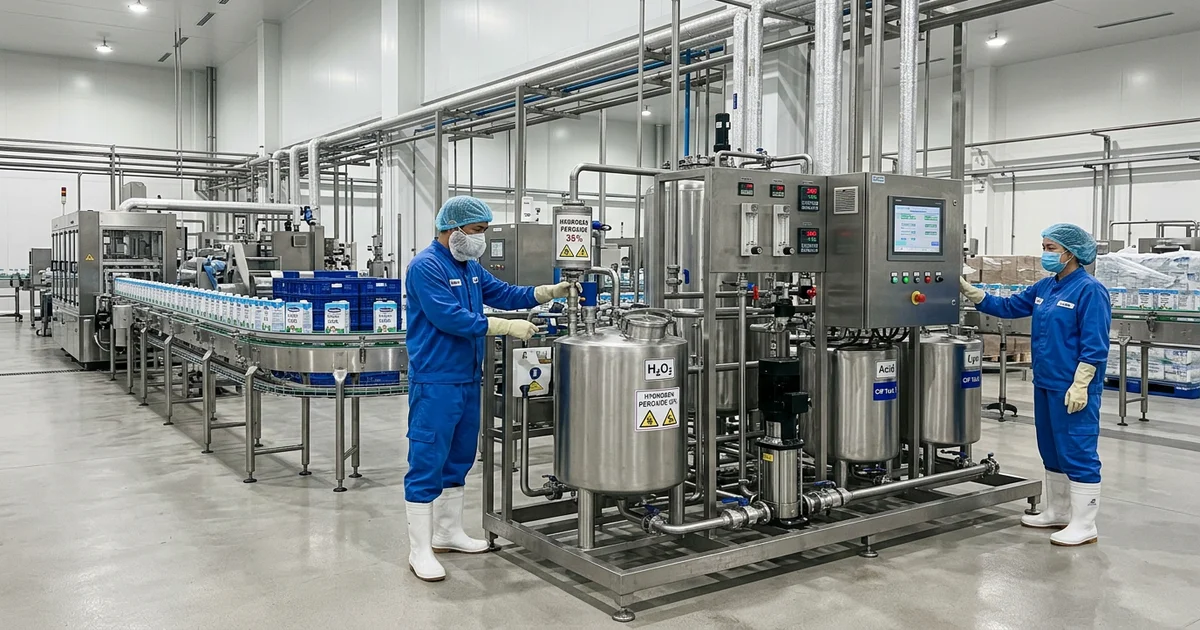
CIP in UHT milk plants: The CIP cycle for HTST (High Temperature Short Time — pasteurization at 72°C/15 sec) systems includes a final sterilization step using H2O2 35% diluted to 0.1–0.3% (1,000–3,000 ppm) at 25–40°C, with a contact time of 15–20 minutes. Each CIP cycle consumes approximately 2–4 kg of H2O2 35% for a 50m DN50 pipeline (approximately 100L capacity). Plate heat exchangers after the acid wash step are sterilized with H2O2 at 0.2% at 30°C — achieving log 5 reduction on Listeria monocytogenes and Staphylococcus aureus within 10 minutes of contact.
Yogurt and fermented products: Yogurt fermenters are the most sensitive equipment because a single cross-contamination with foreign bacteria can ruin an entire batch (tens of thousands of liters). After each batch, stainless steel fermenters are CIP-treated with H2O2 0.3–0.5% at 40°C, minimum contact time 20 minutes. A 50,000 L/day yogurt factory in Tan Dong Hiep A Industrial Park (Binh Duong) uses H2O2 35% FCC for 2 fermenters of 25,000L each — consuming approximately 1,200 kg of H2O2 35%/month for CIP alone. After sterilization, fermenters are rinsed twice with RO water to ensure H2O2 residue <0.5 ppm before loading the next batch.
Tetra Pak packaging sterilization: Tetra Pak is not just packaging — it is an integrated aseptic system. On Tetra Pak TBA/22 lines (speed 7,500 packs/hour), packaging material passes through a H2O2 bath at 30–35% at 70–80°C for 6–15 seconds. H2O2 consumption: approximately 1.2 kg of H2O2 35% per 1,000 packs of 200mL — equivalent to 30–40 tons/year for a single line running 2 shifts. Four major dairy plants in Vietnam each operate 3–5 Tetra Pak lines, with total FCC 35% H2O2 consumption for packaging sterilization estimated at 600–800 tons/year.
Milk powder: Milk powder plants use spray drying — Vaporized Hydrogen Peroxide (VHP) is used to sterilize the drying chamber and powder cyclone. VHP concentration 10–30 ppm in hot air stream at 60–80°C, duration 60–90 minutes. A 15,000 ton/year milk powder plant in Long An implemented VHP for the drying chamber, reducing CIP time from 8 hours to 4 hours compared to previous steam sterilization.
See: Applications of H2O2 35% food grade in processing and industrial sanitation — CIP industry overview
H2O2 FCC 35 in the Beer Industry — Fermenter, Pipeline and Filling Sanitation
The beer industry imposes strict aseptic requirements because foreign microorganisms (lactic acid bacteria, Enterobacter, wild yeast) spoil the flavor and clarity of beer. According to research from the MBAA (Master Brewers Association of the Americas), 80% of beer quality incidents originate from incomplete CIP sterilization.
Fermenters and bright beer tanks: Stainless steel 304L fermenters are the central equipment of a brewery. Common sizes: 100–500 m³ for medium-scale breweries. The fermenter CIP cycle follows a 6-step process: CO₂ release → warm water rinse → alkaline wash NaOH 2% at 75°C/30 min → rinse → H2O2 sterilization 0.3% (3,000 ppm) at 25°C/20 min → sterile water rinse. H2O2 35% FCC diluted achieves >99.99% kill (log 4 reduction) against Saccharomyces cerevisiae and Lactobacillus brevis within 10 minutes — equivalent to the performance of PAA 0.2% but without leaving acetic acid residues that affect beer pH.
Beer lines: The pipeline network transporting beer from fermenter → aging tank → filter → filling tank spans 50–200m per branch. Pipelines are where biofilm forms most easily, especially at dead legs and divert valves. The pipeline sterilization cycle uses H2O2 0.5% (5,000 ppm) at 30°C, flow velocity 1.5–2 m/s (creating turbulent flow for mechanical scouring), contact time 15–25 minutes. Comparison: sterilization with hot water at 85°C requires 30–40 minutes and consumes 60–70% more thermal energy.
Filling and capping lines: The bottling hall has the highest aseptic requirements since no further heat treatment occurs after filling. H2O2 35% diluted to 0.8–1.5% is sprayed as a mist into glass or PET bottles before filling. Concentration and duration depend on bottle type — returnable glass bottles require higher concentration due to rough surfaces and residual beer deposits: 1.2% H2O2 at 50°C/12 seconds. New PET bottles: 0.8% H2O2 at 40°C/8 seconds.
Microbrewery case study: A 50,000 L/year craft brewery in Tan Binh Industrial Park faced Lactobacillus contamination in the fermenter — beer pH dropped from 4.3 to 3.8 after 3 days, losing hop aroma. After switching from PAA 0.15% to H2O2 0.3% for fermenter CIP, combined with UV treatment on the CIP water line, beer pH stabilized at 4.2–4.4. Chemical sterilization costs increased from 8 million to 12 million VND/month, but the batch spoilage rate dropped from 12% to 1.5%.
H2O2 FCC 35 in Beverages — Water Treatment, PET Bottle and Syrup Line Sanitation
Beverages include bottled products (spring water, purified water), carbonated soft drinks (CSD), fruit juice, and sports drinks. Each type has its own microbial and chemical residue challenges.
Source water treatment — THM-free disinfection: In beverage plants, source water is treated through multi-stage filtration (sand, activated carbon), softening, RO, and finally disinfection. H2O2 35% FCC replaces chlorine in the final disinfection step — dose 50–150 ppm, contact time 30–45 minutes in stainless steel tanks. Advantage: no THM or chloramine formation when source water contains ammonia or natural organic compounds. A 300 million L/year soft drink plant in Hoc Mon switched from chlorine to H2O2 for the final step — reducing THM from 85 ppb to <3 ppb, meeting EU export standards. H2O2 cost at 150 ppm ≈ 2,800 VND/m³ water compared to 450 VND/m³ for chlorine, but saves the dechlorination step with Na₂S₂O₃ and costs of recycling AOX-containing CIP water.
PET bottle and cap sterilization: Beverage filling lines run at 12,000–36,000 bottles/hour. PET bottles are sprayed with H2O2 0.8–1.2% mist at room temperature for 6–10 seconds. H2O2 35% consumption: 1.5–2.5 kg per 1,000 bottles of 500mL. Bottle caps are also sterilized with H2O2 diluted to 1% at 40°C — sterile air is typically used to dry caps after immersion.
Syrup lines: Soft drink syrup — a high-concentration sugar solution (60–67°Brix) with citric acid, flavors, and food coloring — is an ideal medium for yeast and mold. Syrup lines are CIP-treated daily. H2O2 0.5% combined with NaOH 1% in a dual-step CIP cycle achieves 40% higher biofilm removal efficiency on sugar residues than PAA alone (per a 2025 study by the International Society of Beverage Technologists). Additional advantage: H2O2 does not create acid residues that lower syrup pH — a critical factor for flavor system stability.
Bag-in-Box (BIB) tanks for dispensed beverages: BIB systems used in restaurants and cafes. Syrup tanks (stainless 304, 500–1,000L) are sterilized with H2O2 0.3% at 30°C/15 minutes between batches. H2O2 evaporates without residue, leaving no impact on syrup flavor — unlike PAA which leaves a mild acetic acid odor.
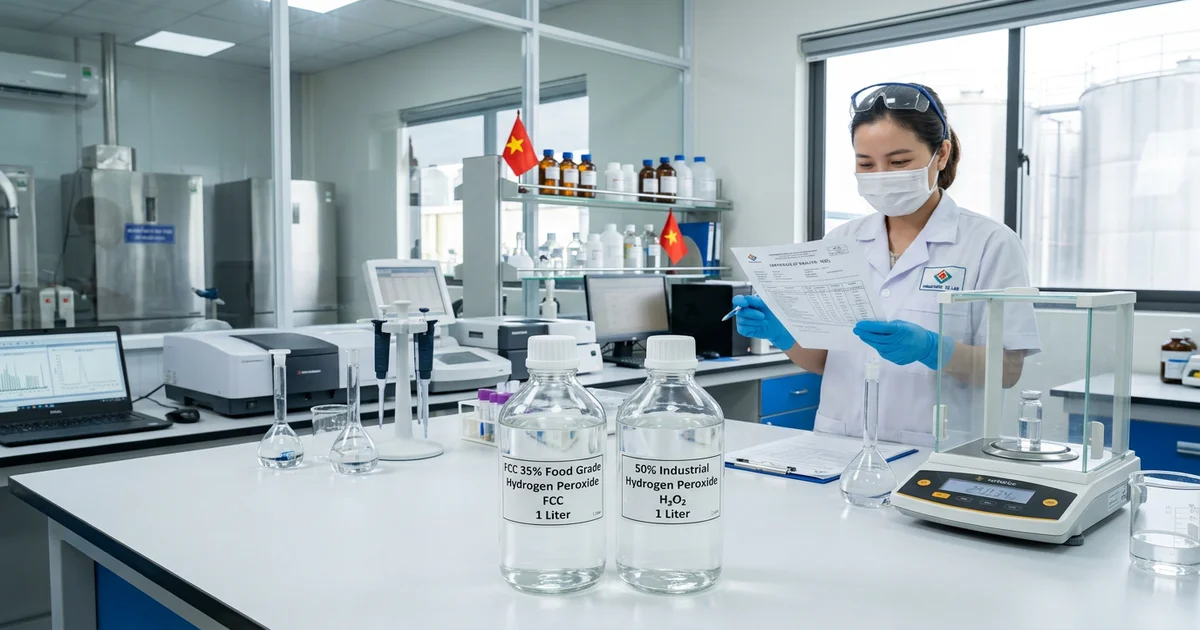
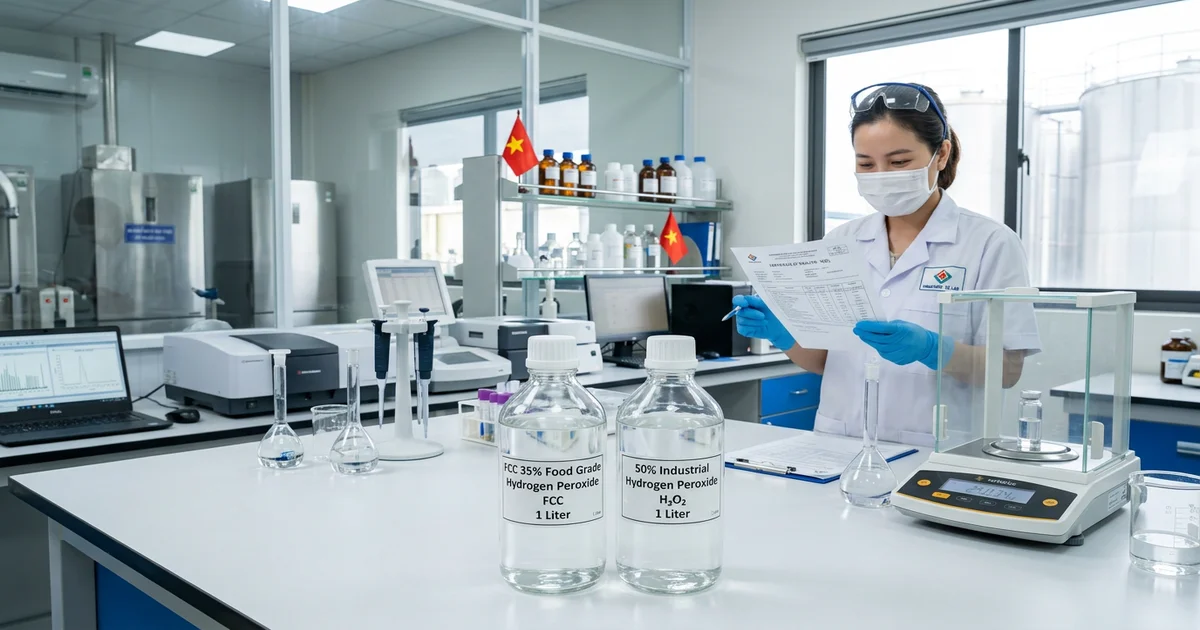
See: H2O2 food grade FCC 35% vs industrial 50% — technical differences and certification
Comparison Table — H2O2 vs PAA vs Steam in Food CIP
The choice between H2O2, PAA (peracetic acid), and steam depends on equipment type, operating cost, and residue requirements. PAA is a mixture of acetic acid + H2O2; steam is a traditional method using moist heat. The table below compares the three options on technical and economic criteria:
| Criteria | H2O2 35% FCC | PAA (5–15%) | Steam |
|---|---|---|---|
| Mechanism | Oxidation via •OH radicals | Oxidation + acidification (dual) | Protein denaturation by heat |
| Use concentration | 0.1–0.5% (CIP) / 30–35% (Tetra Pak) | 0.05–0.2% | Saturated steam 100–121°C |
| Optimal temperature | 25–60°C (CIP) / 70–80°C (packaging) | 15–40°C | 121°C (autoclave) / 100°C (CIP) |
| Contact time | 10–20 min (CIP) / 6–15 sec (packaging) | 5–15 min | 15–30 min (thermal hold) |
| Post-CIP residue | H₂O + O₂ (needs rinse) | Acetic acid + H₂O + O₂ | None (condensed water) |
| Product pH impact | None | pH drop 0.2–0.5 (needs neutralization) | None |
| Equipment corrosion | Mild (304L ok) | Moderate (acid, 316L recommended) | Low (pure water) |
| Biofilm control | Good (with NaOH) | Moderate — weak on thick biofilm | Better (mechanical + heat) |
| Chemical cost (/m³ CIP) | 18,000–45,000 VND | 25,000–60,000 VND | 50,000–80,000 VND (fuel + water) |
| Training requirement | Moderate | Moderate | Low (boiler operation requires license) |
| Best suited for | Tetra Pak, cold CIP, export water | Short pipelines, fruit | Heat-resistant equipment, closed CIP |
Assessment: H2O2 balances cost and effectiveness — optimal for cold CIP (25–40°C) and packaging sterilization. PAA offers faster kill rates at low temperatures but leaves acetic acid residues requiring thorough rinsing. Steam is safest for residues but has high energy consumption and is unsuitable for plastic/PET equipment (thermal deformation). 2025–2026 trend: new food plants select H2O2 for cold CIP (saving 40–50% energy vs steam) and use steam for terminal equipment (fillers, valve blocks).
Standards — FDA 21 CFR 184.1366, FCC, HACCP
FDA 21 CFR 184.1366: Hydrogen peroxide is recognized by the US FDA as GRAS (Generally Recognized As Safe) as an antimicrobial agent and antioxidant in food processing under section 184.1366 of Title 21 Code of Federal Regulations. Permitted limits:
- Use as a sterilant in cheese and milk processing: maximum residual in final product <0.05% (500 ppm) H2O2, by weight of finished cheese.
- Use as a flour treatment agent: <1,250 mg/kg flour.
- Use in food yeast production: no absolute quantity limit but must follow GMP (Good Manufacturing Practice).
- Use as CIP antimicrobial: no specific residue limit because H2O2 decomposes before product contact; practical requirement is H2O2 residue <0.5 ppm on packaging surfaces after drying.
FCC (Food Chemical Codex): Standard issued by the USP (United States Pharmacopeia), establishing impurity thresholds for chemicals used as food additives. For H2O2 FCC, key requirements:
- As ≤0.5 ppm (INTEROX FCC 35 Solvay: <0.1 mg/kg — 5× above standard)
- Fe ≤0.5 ppm (Solvay: <0.0 mg/kg)
- Pb ≤4.0 ppm (Solvay: <0.0 mg/kg)
- H2O2 content: 30.0–36.0% w/w (COA P69260203: 35.5%)
- Acidity (as H₂SO₄): ≤0.03% w/w
HACCP in Food CIP: The Hazard Analysis and Critical Control Points system requires food plants to identify CCPs (Critical Control Points) for each sanitation step. With H2O2 in CIP, typical CCPs include:
- Minimum H2O2 concentration at the farthest spray device: checked with peroxide test strips 0–500 ppm or online electrochemical sensors.
- Minimum contact time: verified by digital timer linked to PLC.
- Minimum temperature: monitored by RTD sensor at the lowest temperature gradient point.
- Post-rinse residue: checked with 0–2 ppm test strips on equipment surfaces before the next production batch.
Standard practice: plants with FSSC 22000 or ISO 22000 certification maintain CIP records — concentration, temperature, time, flow pressure, test strip results — for each cycle. This ensures traceability in the event of a microbial incident.
Case Study — 80 Million L/Year Brewery Switches from PAA to H2O2 for CIP
In March 2026, a group brewery (call it BrewCo) at Long Hau Industrial Park (Long An) experienced PAA residue issues in beer after fermenter CIP. PAA 0.15% (peracetic acid) was used for CIP of 8 fermenters of 350 m³ each. After the CIP cycle, acetic acid residues were detected at 2–5 ppm in the first beer batch after each cleaning cycle — causing beer pH to drop from 4.3 to 4.0–4.1, altering sensory flavor.
Root cause: PAA in long pipelines (>150m from CIP station to farthest fermenter) was trapped at dead legs and valve gaps — the 15-minute rinse was insufficient. Low CIP temperature (20°C) also slowed PAA decomposition below design rates.
Solution: Switched the final CIP step to H2O2 35% FCC at 0.4% (4,000 ppm) at 30°C, hold time 25 minutes, followed by a 10-minute RO water rinse. Additional modification: installed an online peroxide sensor at the CIP outlet to confirm actual concentration.
Results after 6 months:
- H2O2 residue in first-batch beer: <0.1 ppm (internal target limit <0.5 ppm)
- Beer pH stable at 4.2–4.3 (no batch-to-batch adjustment needed)
- CIP chemical costs reduced 18% (H2O2 0.4% cheaper than PAA 0.15% on active ppm basis)
- CIP time reduced by 5 minutes per cycle (eliminated PAA rinse step)
- Total savings: approximately 380 million VND/year for 8 fermenters
BrewCo now uses H2O2 35% FCC from Lộc Thiên — 3 tankers of 20 tons/month, COA batch P69260203, direct import from Solvay Thailand.
“Switching from PAA to H2O2 for fermenter CIP was the right technical decision when acetic acid residues were affecting product flavor. H2O2 leaves no organic residues, pH remains unchanged, and costs are lower for large volumes. However, concentration must be tightly controlled — below 0.3% will not kill Lactobacillus spores, above 0.5% requires more rinsing to remove residual oxidizing radicals.” — Technical Specialist Võ Thị Như Hòa, Food Chemical Supervisor, Lộc Thiên Chemical
Frequently Asked Questions (FAQ)
What H2O2 concentration for dairy CIP?
0.1–0.3% (1,000–3,000 ppm) at 25–40°C, contact time 10–20 minutes. For yogurt fermenters: 0.3–0.5%, 20 minutes, temperature 40°C.
Does H2O2 affect beer flavor?
No — H2O2 decomposes into H₂O + O₂. Unlike PAA (which leaves acetic acid lowering pH), H2O2 does not change beer pH (stable at 4.2–4.5). O₂ released as micro-bubbles may benefit hop aroma stability.
How does PAA differ from H2O2 in CIP?
PAA = CH₃CO₃H (peracetic acid) = mixture of acetic acid + H2O2. PAA kills faster at low temperatures but leaves acetic acid residues requiring thorough rinsing, causes higher corrosion, and costs 20–40% more than H2O2 at equivalent biocidal performance.
Can steam replace H2O2 in CIP?
Yes — for heat-resistant equipment (stainless fermenters, pipelines). But energy consumption is high (60–80 kW/hour for boiler), cannot be used for PET/plastic, CIP time is longer. H2O2 is a cold CIP solution saving 40–50% energy.
What standards apply to food grade H2O2 in dairy, beer, beverages?
FDA 21 CFR 184.1366 (GRAS), FCC (Food Chemical Codex), HACCP, Codex Alimentarius. Vietnam: QCVN 4-4:2016/BYT (permitted food additives).
How does Lộc Thiên’s H2O2 35% FCC differ from Chinese H2O2?
INTEROX FCC 35 Solvay Thailand — As <0.1 ppm, Fe <0.0 ppm, Pb <0.0 ppm (actual COA data). Generic Chinese H2O2 typically has >15 ppm total heavy metals. Batch-specific COA accompanies every shipment.
Does H2O2 CIP require anti-chlor or neutralization?
No — H2O2 decomposes naturally into H₂O + O₂. Only an RO water rinse of 5–10 minutes after CIP is needed. Chlorine requires mandatory anti-chlor (Na₂S₂O₃ or ascorbic acid) before discharge.
Contact for H2O2 35% FCC — INTEROX FCC 35 Solvay Thailand
Need a quote for H2O2 35% food grade for dairy, beer, or beverage CIP? Lộc Thiên directly imports INTEROX FCC 35 from Solvay Peroxythai Limited (Thailand) — batch-specific COA, 30kg HDPE drums, 5–30 ton tankers, nationwide delivery within 4h HCMC / 24h southern industrial parks.
- Hotline: 0979 891 929 (quote in 15 minutes)
- Email: [email protected]
- Office: 467/12 Dien Bien Phu, P.25, Binh Thanh Dist., HCMC
- Tax ID: 0313650856
- Warehouses: HCMC, Dong Nai, Ba Ria-Vung Tau, Can Tho, Da Nang, Bac Ninh
🛒 Need H2O2 35% FCC for food? Quote for H2O2 35% INTEROX FCC 35 Solvay Thailand — COA/MSDS, nationwide delivery 5-30 tons. Hotline 0979 891 929 — quote in 15 minutes.