ZDHC Level 1 Hydrogen Peroxide H2O2 50% Cotton Scouring & Bleaching Guide: Zero-AOX Chemistry, Catalytic Pinholing Prevention & Catalase De-Oxidation
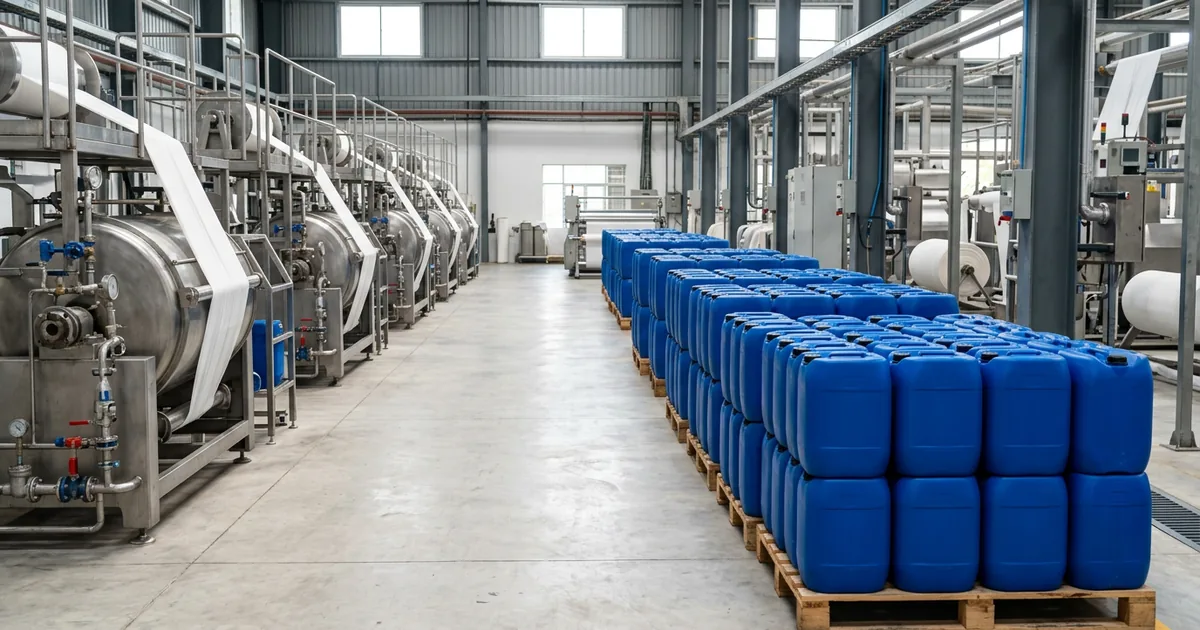
Table of contents
Combined cotton scouring and bleaching with industrial Hydrogen Peroxide H₂O₂ 50% w/w (CAS 7722-84-1, UN 2014) certified to TÜV SÜD ZDHC MRSL v3.1 Level 1 (#ZDHC1 127736 0002 Rev. 00) operates at pH 10.5–11.2 and 95–98 °C, decomposing into H₂O + O₂ (0% AOX) before Catalase enzyme de-oxidation at 40–55 °C below 1 ppm.
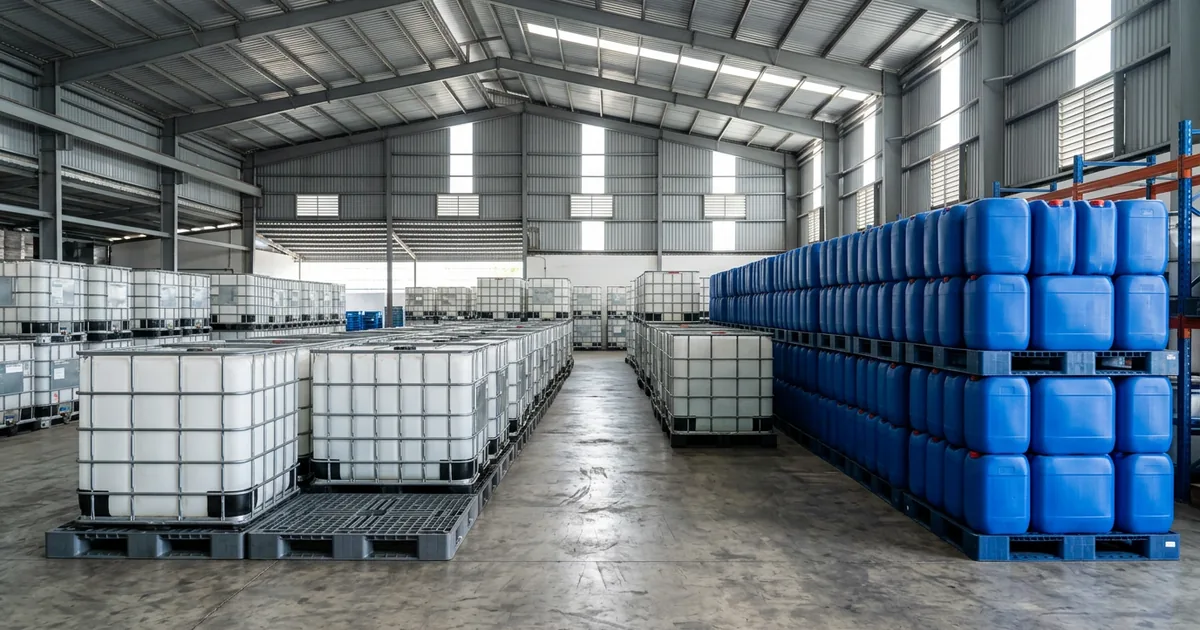
Loc Thien Chemical supplies 35 kg vented jerricans, 1,000 L IBC totes (≈ 1,195 kg net), and 5–30-ton 316L tankers with batch COAs across 6 warehouses.
Request an official technical quotation & TÜV SÜD ZDHC Level 1 dossier within 15 minutes: Contact our B2B Textile Engineering Desk via Email [email protected], Hotline / Vietnamese Zalo +84 979 891 929, or submit our Online H₂O₂ 50% Bulk RFQ Form to receive
TÜV SÜDCertificate#ZDHC1 127736 0002 Rev. 00(Report #2486017673-Q24VPS-CHM2869), per-shipment batch COAs across Thailand, Korea, and Bangladesh origins, and a custom pretreatment mass-balance calculation sheet for your dyehouse.
How Do Thailand INTEROX ST 50 (Solvay), South Korea, and Bangladesh H₂O₂ 50% Grades Compare Against Legacy Chlorine Bleaching Under ZDHC Level 1?
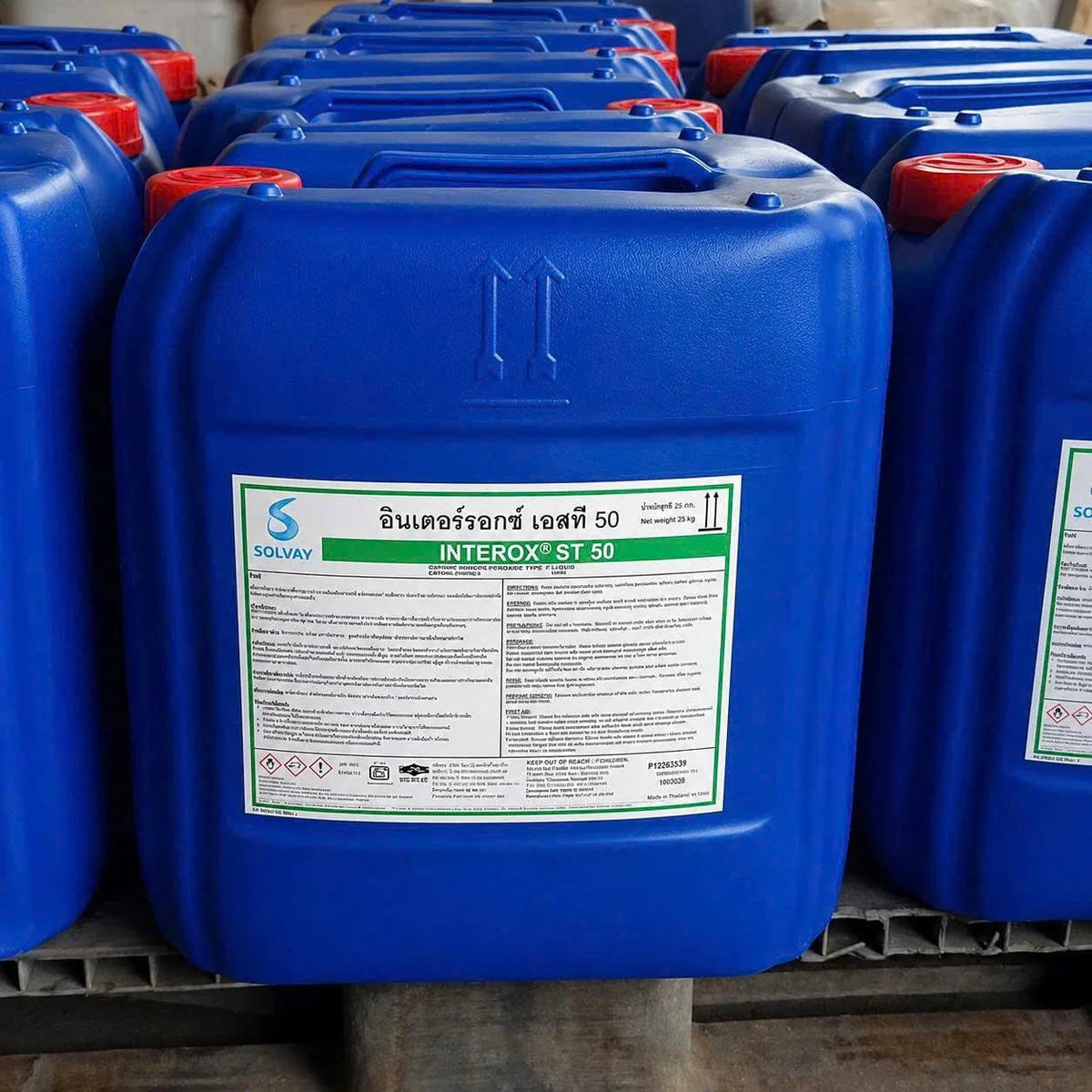
Industrial Hydrogen Peroxide H₂O₂ 50% w/w (chemical formula H₂O₂, CAS 7722-84-1, dangerous goods transport code UN 2014) is the primary ecological oxidizing agent for wet pretreatment (combined scouring and bleaching) of 100% natural cotton knits, woven cotton poplin/twill, Cotton/Elastane (Spandex) stretch fabrics, Polyester/Cotton (T/C, CVC) blends, and regenerated cellulosic fibers (Viscose, Modal, Lyocell) destined for European Union, North American, and Japanese apparel brands. Across Vietnam’s specialized industrial Hydrogen Peroxide H₂O₂ portfolio and integrated textile dyeing & finishing chemical range, Loc Thien Chemical — operating strictly as a tier-one commercial bulk chemical supplier and industrial distributor — maintains continuous multi-warehouse stock of four core commercial SKUs: flagship Thailand Hydrogen Peroxide H₂O₂ 50% INTEROX ST 50 (Solvay), high-consistency South Korea Hydrogen Peroxide H₂O₂ 50%, cost-optimized Bangladesh Hydrogen Peroxide H₂O₂ 50%, and multi-packaging bulk Industrial Hydrogen Peroxide H₂O₂ 50%.
Global apparel supply chains phased out chlorine-based cotton bleaching (Sodium Hypochlorite NaOCl or Calcium Hypochlorite Ca(OCl)₂ — see our dedicated disinfectant engineering review in Sodium Hypochlorite NaOCl 10%–12% vs Calcium Hypochlorite Ca(OCl)₂ 70%) because active hypochlorite anions (ClO⁻) chlorinate natural cotton waxes, pectins, lignins, and residual nitrogenous proteins inside the scouring liquor. That halogenation pathway generates persistent, bio-accumulative Adsorbable Organic Halides (AOX) that trigger non-compliance under both ZDHC Wastewater Guidelines V2.2 and QCVN 40:2025/BTNMT, while leaving bound chloramine residues on cellulose fibers that cause severe fabric yellowing during high-temperature stenter heat-setting (170 – 195 °C) and irreversible tensile strength loss. Conversely, alkaline-activated H₂O₂ 50% decomposes stoichiometrically into pure water and molecular oxygen (2H₂O₂ → 2H₂O + O₂), delivering 0% AOX formation, permanent high Berger whiteness indices (WI 78 – 86 prior to optical brighteners), complete seed-husk (cotton mote) decolorization, and superior fiber elasticity preservation.
1. Exact ZDHC MRSL v3.1 Conformance Level 1 Certification Scope Held by Loc Thien Chemical
Export-oriented FDI knit and woven dyehouses audited by international fashion brands must register every wet-processing chemical input on the ZDHC Gateway — Chemical Inventory List (CIL) at ZDHC MRSL Version 3.1 conformance tiers. Procurement and EHS managers evaluating LOC THIEN INVESTMENT DEVELOPMENT COMPANY LIMITED (Loc Thien Chemical) can rely on verifiable, document-backed certification boundaries with zero ambiguity:
- Hydrogen Peroxide (
H₂O₂,CAS 7722-84-1): Formally certified underCERTIFICATE (ZDHC MRSL Version 3.1 Conformance Level 1)issued byTÜV SÜD Product Service GmbH/TÜV SÜD Vietnam— Certificate No.ZDHC1 127736 0002 Rev. 00| Analytical Test Report No.2486017673-Q24VPS-CHM2869(Certificate Holder:LOC THIEN INVESTMENT DEVELOPMENT COMPANY LIMITED). - Alkaline Scouring & Bleaching Activator — Liquid Caustic Soda NaOH 32% (
Sodium Hydroxide,CAS 1310-73-2): Simultaneously certified underTÜV SÜD ZDHC MRSL Version 3.1 Conformance Level 1— Certificate No.ZDHC1 127736 0001 Rev. 00| Analytical Test Report No.2486017672-Q24VPS-CHM2869. - Strict Compliance Boundary for Bleaching Stabilizers & Enzymes: When dyehouses purchase Sodium Silicate Liquid Na₂SiO₃ (Waterglass) as an inorganic peroxide stabilizer alongside
H₂O₂ 50%, Loc Thien supplies complete per-batch COAs and 16-section GHS SDS documentation forNa₂SiO₃. However, we state transparently thatNa₂SiO₃andCatalase Enzymeare NOT part of Loc Thien’s 9 core products holding ZDHC MRSL v3.1 Level 1 certificates (never extrapolate or misassign ZDHC certificate numbers to non-listed auxiliaries).
2. Engineering & Compliance Comparison: Three Industrial H₂O₂ 50% Origins vs Chlorine Bleaching
| Technical, Packaging & Compliance Criterion | Thailand INTEROX ST 50 (Solvay) H₂O₂ 50% | South Korea Industrial H₂O₂ 50% | Bangladesh Industrial H₂O₂ 50% | Legacy Chlorine Bleach (NaOCl 10%–12% / Ca(OCl)₂) |
|---|---|---|---|---|
Active Peroxide Assay (% w/w Basis) | 50.0% ± 0.5% – 1.0% w/w H₂O₂ (flagship Solvay Thailand specification) | 50.0% ± 1.0% w/w H₂O₂ (tight lot-to-lot assay consistency) | 50.0% ± 1.0% w/w H₂O₂ (standard commercial industrial specification) | 10%–12% w/v available chlorine (NaOCl) or 70% w/w (Ca(OCl)₂) |
Specific Gravity (SG) at 20 °C (g/cm³) | 1.195 – 1.196 g/cm³ at 20 °C (verified per batch COA) | 1.195 – 1.196 g/cm³ at 20 °C (verified per batch COA) | 1.194 – 1.198 g/cm³ at 20 °C (verified per batch COA) | 1.16 – 1.21 g/cm³ at 20 °C (for liquid NaOCl solution) |
Free Acidity (Expressed as H₂SO₄) | ≤ 0.03% w/w (acid-stabilized neat pH < 1.0 – 2.5 to prevent shelf loss) | ≤ 0.03% – 0.04% w/w (excellent stability in tropical storage) | ≤ 0.04% – 0.05% w/w (formulated for industrial bulk turnover) | Strongly alkaline neat solution (pH 11.5 – 13.0); degrades rapidly in heat |
Trace Iron (Fe) & Thermal Stability (96–100 °C) | Fe ≤ 0.5 ppm · Thermal stability ≥ 97% – 98% (proprietary stabilizer system) | Fe ≤ 0.5 ppm · Thermal stability ≥ 96% – 97% | Fe ≤ 0.5 – 1.0 ppm · Thermal stability ≥ 95% – 96% | Not applicable; violently decomposed by trace Ni, Cu, Fe, Co ions |
Effluent AOX Load & Fabric Handle Impact | 0% AOX (H₂O + O₂ only); permanent Berger whiteness, zero heat yellowing | 0% AOX (H₂O + O₂ only); clean cotton mote removal, high DP retention | 0% AOX (H₂O + O₂ only); reliable general bleaching, pulp & Fenton | High toxic AOX formation; retained chlorine causes yellowing & tendering |
Loc Thien ZDHC MRSL v3.1 Coverage | Covered under TÜV SÜD Certificate #ZDHC1 127736 0002 Rev. 00 (Level 1) | Covered under TÜV SÜD Certificate #ZDHC1 127736 0002 Rev. 00 (Level 1) | Covered under TÜV SÜD Certificate #ZDHC1 127736 0002 Rev. 00 (Level 1) | NaOCl holds separate WWTP CSR, restricted from export cotton bleaching |
| Packaging & Bulk Delivery Modes | Virgin blue PE jerrican 35 kg net fitted with one-way vented cap | 35 kg vented jerrican, 1,000 L IBC (≈ 1,195 kg net), 5–30-ton 316L tanker | 35 kg vented jerrican, 1,000 L IBC (≈ 1,195 kg net) | 30 kg jerrican, 200 L drum, 1,000 L IBC, 5–30-ton tanker (NaOCl) |
| Primary Industrial Application Fit | Gold standard for tier-1 FDI knit/elastane & EU/US/Japan export orders | High-throughput Korean & Taiwanese FDI dyehouses requiring uniform shade lots | Commodity woven/towel bleaching, pulp & paper brightening, WWTP Fenton oxidation | Final WWTP effluent disinfection, hard-surface sanitation, odor scrubbing |
Engineering note: Exact analytical results for % H₂O₂ w/w, specific gravity at 20 °C, free acidity as H₂SO₄, trace iron (ppm), and 96–100 °C decomposition stability are documented on the batch Certificate of Analysis (COA per batch) accompanying every Loc Thien Chemical delivery.
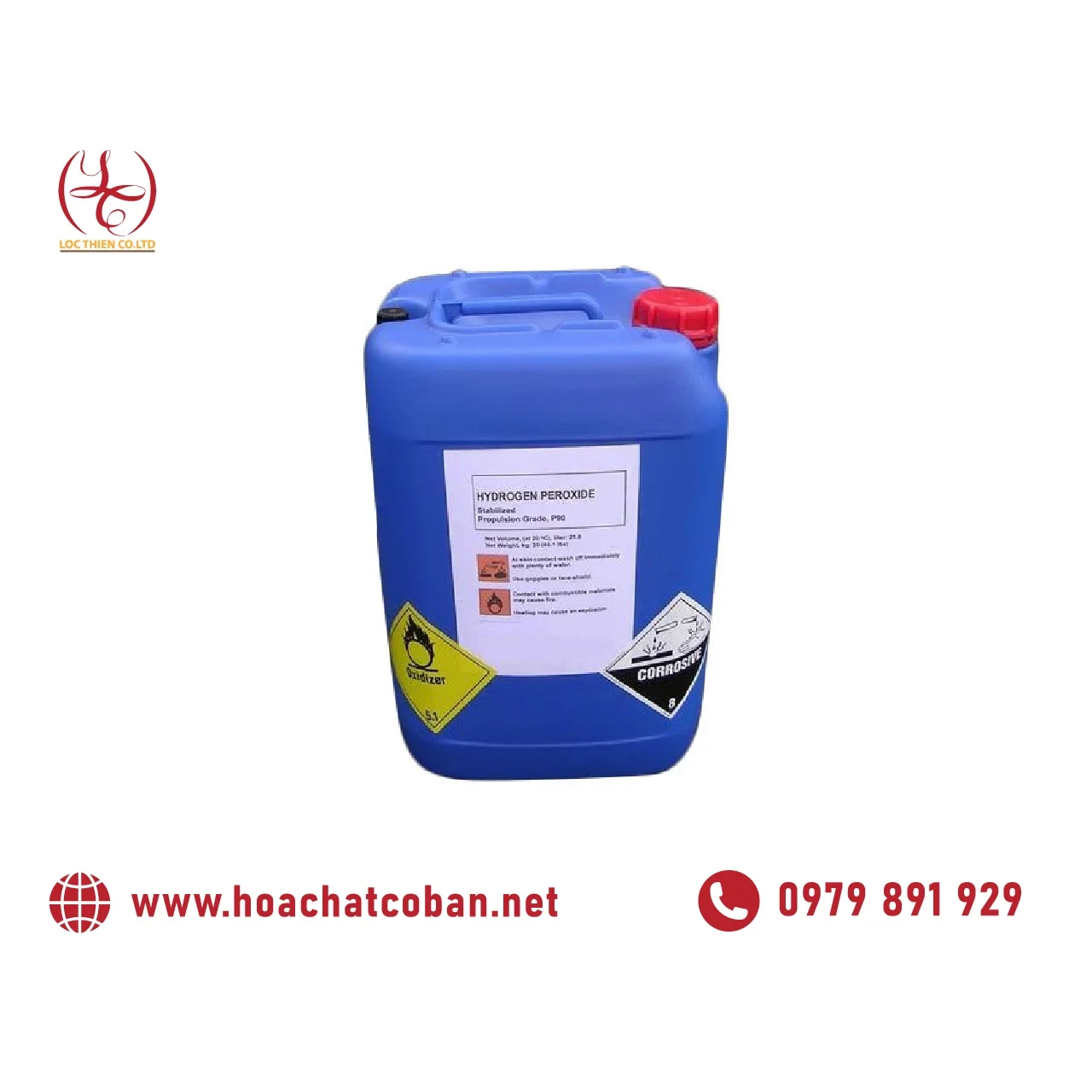
How Does Perhydroxyl Ion (HOO⁻) Activation Work, How Do Dyehouses Prevent Fe²⁺/Cu²⁺ Catalytic Pinholing, and Why Is Catalase Enzyme Essential Before Reactive Dyeing?
Selective chromophore oxidation during cotton bleaching with Hydrogen Peroxide H₂O₂ 50% w/w is governed by the controlled generation of the nucleophilic perhydroxyl anion (HOO⁻), rather than un-ionized molecular H₂O₂ or destructive free hydroxyl radicals (•OH). Inside sealed commercial 35 kg jerricans or 1,000 L IBC totes, industrial H₂O₂ 50% is mildly acidified (neat pH < 1.0 – 2.5) to suppress spontaneous decomposition, rendering unbuffered peroxide virtually inactive as a textile bleaching agent. When dosed into an alkaline combined scouring-bleaching bath activated with Liquid Caustic Soda NaOH 32%, H₂O₂ behaves as a weak acid (pKa ≈ 11.6 at 25 °C, shifting downward toward ~10.5 near 95 °C) according to the fundamental equilibrium:
H₂O₂ + OH⁻ ⇌ HOO⁻ + H₂O (Nucleophilic perhydroxyl anion activation equilibrium)
1. The Optimal Operating Window (pH 10.5 – 11.2, 95 – 98 °C, 45 – 60 Minutes): Balancing Scouring Absorbency, Whiteness & Zero-AOX Effluent
In batch exhaust pretreatment of knitted cotton and cotton/spandex on low-liquor-ratio Jet or Overflow dyeing machines (liquor ratio L:R = 1:8 – 1:10) — as well as continuous Pad-Steam saturated-steam ranges for woven fabrics — maintaining bath alkalinity within pH 10.5 – 11.2 at 95 – 98 °C for 45 – 60 minutes synchronizes three critical chemical mechanisms:
- Simultaneous Alkaline Scouring of Non-Cellulosic Impurities (
4% – 8%of greige cotton weight): HotNaOHsaponifies natural cotton waxes and fats, hydrolyzes pectins and proteins, swells hemicellulose cuticles, and loosens dark lignified cotton seed coat fragments (motes), achieving instantaneous drop absorbency (< 1 – 3 secondsperAATCC Test Method 79) essential for level dyeing. - Controlled Perhydroxyl (
HOO⁻) Bleaching Without Wasteful Oxygen Foaming: BelowpH 10.0, insufficientHOO⁻anions form, leaving grey fabrics under-bleached with visible black motes. AbovepH 11.5without adequate stabilization, bimolecular self-decomposition (H₂O₂ + HOO⁻ → H₂O + O₂↑ + OH⁻) outpaces fiber diffusion — evolving violentO₂gas foam that causes fabric rope ballooning/entanglement inside Jet nozzles while exhausting peroxide prematurely before whiteness develops. - Zero-AOX Compliance With
QCVN 40:2025/BTNMT&ZDHC Wastewater Guidelines V2.2: Because spent peroxide breaks down exclusively intoH₂Oand dissolvedO₂, switching 100% of pretreatment away from chlorine eliminatesAOXand free chlorine toxicity ahead of biological activated-sludge tanks. This directly supports plant compliance underQCVN 40:2025/BTNMT(National Technical Regulation on Industrial Wastewater, promulgated viaCircular 06/2025/TT-BTNMTunder Vietnam’s consolidated Ministry of Agriculture and Environment; existing facilities operating prior to01/09/2025follow the statutory transition roadmap through31/12/2031, with mandatory enforcement from01/01/2032, regulatingColor ≤ 50 / 100 / 150 Pt-CoandTotal Fe ≤ 2.0 / 10 / 10 mg/Lacross Columns A / B / C).
2. Root-Cause Elimination of Catalytic Pinholing & Cellulose Degree of Polymerization (DP) Loss Caused by Trace Fe²⁺ / Fe³⁺ / Cu²⁺
The single most expensive quality claim in cotton and cotton/elastane knitwear pretreatment is catalytic pinholing — hundreds of microscopic razor-sharp holes or localized bursting-strength failures appearing across finished rolls after dyeing and stenter framing, accompanied by a steep drop in cellulose Degree of Polymerization (DP) from ~2,500 in greige cotton down below 1,200. Catalytic pinholing is triggered by localized Fenton-type free-radical chemistry:
- Whenever softened process water carries rust scale from corroded steam/water pipes, greige fabric contains broken knitting-needle steel micro-filings or loom grease contaminated with brass wear particles, or off-spec caustic soda introduces dissolved transition-metal ions exceeding
Fe²⁺ / Fe³⁺ / Cu²⁺ > 0.1 – 0.2 mg/L(ppm), those metal ions adsorb onto localized cellulose hydroxyl sites and catalyze runaway homolytic cleavage ofH₂O₂:Fe²⁺ + H₂O₂ → Fe³⁺ + •OH + OH⁻andFe³⁺ + HOO⁻ → Fe²⁺ + •O₂⁻ + H⁺ - Unlike gentle nucleophilic
HOO⁻anions, the hydroxyl free radical (•OH, redox potential+2.80 V) violently abstracts hydrogen atoms from C1–C4 carbon positions along the cellulose backbone, converting structural cellulose into brittle alkali-soluble oxycellulose right around the metallic speck. Subsequent high-pressure jet circulation washes away the degraded oxycellulose, leaving characteristic pinholes! - Three-Layer Engineering Defense Against Pinholing:
- Ultra-Pure Peroxide Selection: Standardize on Thailand INTEROX ST 50 (Solvay) or South Korea H₂O₂ 50% certified to
ZDHC Level 1withFe ≤ 0.5 ppmand96–100 °Cthermal stability≥ 96%–98%. At a4.0 g/Lbleaching dose (~1:250dilution),0.5 ppmiron in neatH₂O₂contributes less than0.002 mg/Liron to the dyebath. - Process Water & Greige Acid Demineralization: Maintain dyehouse softened water strictly at
Hardness < 20–30 mg/L CaCO₃,Total Fe < 0.05–0.1 mg/L, andCu < 0.01 mg/L. For dusty greige cotton knits suspected of rust specks, insert a15-minutemild acidic demineralization pre-wash (pH 4.5–5.0with organic acid + iron-specific chelator at50–60 °C) and drain prior to alkaline bleaching. - Synergistic Peroxide Stabilization: Combine high-alkali-stable organic sequestrants (
DTPA-freebiodegradable phosphonates, polyhydroxy-carboxylates, or gluconates compliant withZDHC MRSL v3.1) with Sodium Silicate Na₂SiO₃ +Mg²⁺hardness ions (forming colloidal magnesium silicate buffer complexes that smoothly regulateHOO⁻release while passivating trace metal catalytic centers; in low-liquor Jet machines, pair silicate with a polymeric dispersant to prevent heat-exchanger silicate scaling).
- Ultra-Pure Peroxide Selection: Standardize on Thailand INTEROX ST 50 (Solvay) or South Korea H₂O₂ 50% certified to
3. Residual Peroxide Elimination via Catalase Enzyme Prior to Reactive Dyeing: Preventing ΔE > 1.0 Shade Shifts & Saving 15–25 m³ Water/Ton
After dropping the alkaline scouring-bleaching bath and running one hot rinse (80–85 °C), swollen cotton fiber lumens still retain 50 – 300 ppm of residual H₂O₂. When dyeing cotton with Reactive Dyes (vinylsulfone, monochlorotriazine, or bifunctional reactive systems), even > 5 ppm of residual H₂O₂ remaining in the dyebath oxidatively cleaves azo/formazan/anthraquinone dye chromophores and hydrolyzes reactive anchor groups before covalent fixation — causing catastrophic shade tailing, pale unlevel blotches, and batch-to-batch color deviation (ΔE > 1.0) requiring costly stripping and re-dyeing.
Historically, dyehouses either wasted 4–5 hot overflow rinses or dosed inorganic reducing agents (Sodium Bisulfite NaHSO₃ or Sodium Hydrosulfite Na₂S₂O₄). However, any slight overdose of chemical reducing agent carries over into the dye liquor and reductively destroys azo reactive dyes just as severely as residual peroxide, while adding extra sulfate/sulfite TDS salinity to wastewater! Modern Best Available Technique (BAT) dyehouses execute selective biocatalytic de-oxidation using Catalase Enzyme (EC 1.11.1.6):
- Cool & Neutralize Into the Biocatalytic Window: Refill with fresh water to bring fabric and bath temperature down to
40 – 55 °C(never inject catalase above> 65 – 70 °C, which thermally denatures the heme-protein active site!) and neutralize core fiber alkali topH 6.0 – 7.5using organic acid (aceticorcitric/formic acid) circulated for5–10 minutes. - Ultra-Selective Enzymatic Decomposition (
15 – 20 Minutes): Dose0.1 – 0.3 g/LindustrialCatalase Enzymeand circulate for15 – 20 minutes. One catalase molecule converts millions of peroxide molecules per second exclusively via2H₂O₂ → 2H₂O + O₂↑, with zero chemical reactivity toward reactive dyes, Glauber’s salt (Na₂SO₄), soda ash (Na₂CO₃), or cotton cellulose. - Mandatory
Merckoquant (< 1 ppm)Gate Check & Same-Bath Reactive Dyeing: Squeeze liquor directly from a fabric rope seam and test with aMerckoquant Peroxide Teststrip confirming< 1 ppm(0 ppm) residualH₂O₂. Once verified zero, operators dose electrolyte salt and reactive dyestuffs directly into the exact same enzyme bath without draining — eliminating2 – 3hot rinse baths, saving15 – 25 m³of softened water and0.4 – 0.7 tonsof steam per metric ton of cotton, and adding0 mg/LTDS!
4. Process Control Matrix: Combined Cotton Scouring-Bleaching & Catalase De-Oxidation SOP
| Pretreatment Stage & Engineering Target | Standard Operating Window (SOP) | Typical Chemical Recipe & Reference Dose | In-Process QC Gate & Consequence of Deviation |
|---|---|---|---|
STAGE 1: Exhaust Combined Scouring & Bleaching (Jet / Overflow Machine, Cotton Knit, L:R = 1:8 – 1:10) | Ramp 1.5–2.0 °C/min to 95 – 98 °C · Bath pH 10.5 – 11.2 · Hold 45 – 60 minutes | H₂O₂ 50%: 3.0 – 6.0 g/L · NaOH 100%: 1.5 – 3.0 g/L (≈ 4.7 – 9.4 g/L NaOH 32%) · Organic/Silicate stabilizer: 0.8 – 2.0 g/L · Wetting/detergent: 0.5 – 1.5 g/L | Residual bath H₂O₂ at end of hold = 15%–25% of initial charge (prevents silicate/alkali yellowing); AATCC 79 absorbency < 3 sec |
CONTINUOUS OPTION: Woven Pad-Steam Bleaching (Open-width Cotton / CVC / T/C, Wet Pick-up 80%–100%) | Saturator pad at 25 – 35 °C · Tight steamer 100 – 102 °C saturated steam for 25 – 45 minutes · pH 10.6 – 11.0 | H₂O₂ 50%: 15 – 35 g/L · NaOH 100%: 8 – 18 g/L (≈ 25 – 56 g/L NaOH 32%) · Non-scaling roll stabilizer: 4 – 10 g/L · Low-foam alkali penetrant: 2 – 5 g/L | Left-center-right nip pressure variance < 2% to prevent side-to-center whiteness shading; counter-current 85–95 °C wash boxes |
DEFECT CONTROL: Anti-Pinholing Safeguard (Preventing Catalytic •OH Cellulose Cleavage & DP Drop) | Monitor feed water + optional 15-min acidic demineralization (pH 4.5–5.0) if greige carries needle rust | Softened water: Fe < 0.1 mg/L, Cu < 0.01 mg/L, Hardness < 30 mg/L CaCO₃ · Use ZDHC Level 1 H₂O₂ 50% (Fe ≤ 0.5 ppm) + Fe/Cu chelator | Trace Fe²⁺/Cu²⁺ > 0.2 mg/L triggers localized Fenton •OH radicals, causing widespread pinholes and severe burst-strength loss |
| STAGE 2: Catalase Enzyme Peroxide Killer (Pre-Reactive Dyeing Same-Bath Conditioning) | Drop alkaline bath & 1 warm wash · Refill & cool to 40 – 55 °C · Adjust pH 6.0 – 7.5 (organic acid) · Run 15 – 20 min | Catalase Enzyme: 0.1 – 0.3 g/L · Organic acid buffer: 0.5 – 1.2 g/L · 0% Bisulfite/Hydrosulfite reducing salts | Verify Merckoquant Peroxide Test < 1 ppm (0 ppm) before adding salt & reactive dye; > 5 ppm H₂O₂ causes ΔE > 1.0 off-shade |
How Do Engineers Calculate Monthly Chemical Consumption for a 10-Ton/Day (300-Ton/Month) Cotton Dyehouse? Technical Illustration
Accurate chemical procurement budgeting, GHS storage bund sizing, and packaging selection (35 kg vented jerricans vs 1,000 L IBC totes vs 5–30-ton bulk road tankers) depend on rigorous stoichiometric mass-balance modeling anchored to liquor ratio (L:R) and active % w/w concentration (applying the same dry-basis engineering discipline demonstrated in our Liquid Caustic Soda NaOH 32%–50% vs Caustic Soda Flakes 99% TCO Guide).
1. Design Basis for the Technical Illustration (10.0 Metric Tons Greige Cotton/Day Knitwear Mill)
Below is a transparent Technical illustration (worked example) (modeled for an export cotton knitwear pretreatment dyehouse processing 10.0 metric tons of greige cotton fabric/day, operating 30 days/month for a total monthly output of 300.0 metric tons of fabric/month, fully anonymized and adhering strictly to Loc Thien’s SSOT zero-published-price rule):
- Jet Dyeing Fleet & Liquor Ratio (
L:R): Low-liquor-ratioJet / Overflowmachines operating at a weighted average liquor ratio ofL:R = 1:8(8.0 m³of scouring-bleaching bath per1.0 metric tonof dry greige cotton).- Daily bleaching liquor volume:
10.0 tons/day × 8.0 m³/ton = 80.0 m³/day(= 80,000 L/day). - Monthly bleaching liquor volume (
30 operating days):80.0 m³/day × 30 days/month = 2,400.0 m³/month.
- Daily bleaching liquor volume:
- Standard Combined Scouring-Bleaching Formulation:
- Hydrogen Peroxide H₂O₂ 50% w/w recipe concentration:
4.0 g/L(= 4.0 kgof commercialH₂O₂ 50%per1.0 m³of bleaching liquor). - Active alkali concentration expressed as
100%pureNaOH:2.5 g/L(= 2.5 kgof100% NaOHper1.0 m³of bleaching liquor), metered automatically using commercial Liquid Caustic Soda NaOH 32% w/w (SG ≈ 1.35 kg/L at 20 °C).
- Hydrogen Peroxide H₂O₂ 50% w/w recipe concentration:
2. Step-by-Step Daily & Monthly Mass Balance and Packaging Unit Conversions
Hydrogen Peroxide H₂O₂ 50% w/wConsumption (CAS 7722-84-1,SG = 1.195 – 1.196 g/cm³ at 20 °C):- Daily commercial
H₂O₂ 50%mass consumed:80.0 m³/day × 4.0 kg/m³ = 320.0 kg/dayofH₂O₂ 50%(corresponding to a specific fabric consumption factor of320.0 kg ÷ 10.0 tons = 32.0 kg/tonof greige cotton, or3.2% o.w.f.). - Total monthly commercial
H₂O₂ 50%intake (30 days):320.0 kg/day × 30 days/month = 9,600.0 kg/month(= 9.60 metric tonsofH₂O₂ 50%/month). - Commercial Packaging Equivalence:
- Supplied in
35 kgnet virgin PE jerricans with one-way vented caps (INTEROX ST 50 Thailand/South Korea/Bangladesh):9,600.0 kg ÷ 35 kg/jerrican = 274.29 jerricans/month(≈ 274.3 jerricans (35 kg)/month, scheduled cleanly across2–3palletized box-truck drops per month). - Supplied in
1,000 Lvented IBC totes (atSG 1.195 kg/L at 20 °C, one1,000 LIBC holds1,000 L × 1.195 kg/L = 1,195 kgnetH₂O₂ 50%— never equate1,000 Lto1,000 kg):9,600.0 kg ÷ 1,195 kg/IBC = 8.03 IBC totes/month(≈ 8.0 IBC totes (1,000 L)/month).
- Supplied in
- Daily commercial
Liquid Caustic Soda NaOH 32% w/wCo-Consumption (CAS 1310-73-2,TÜV SÜD ZDHC Level 1 #ZDHC1 127736 0001 Rev. 00):- Daily
100%dry-basisNaOHdemand:80.0 m³/day × 2.5 kg/m³ = 200.0 kgpureNaOHequivalent. - Daily commercial
Liquid NaOH 32%solution metered:200.0 kg ÷ 0.32 = 625.0 kg/dayofNaOH 32%solution (= 62.5 kgNaOH 32%solution per ton of cotton). - Total monthly commercial
Liquid NaOH 32%intake (30 days):625.0 kg/day × 30 days/month = 18,750.0 kg/month(= 18.75 metric tonsofNaOH 32%solution/month — fulfilled seamlessly by just1 dedicated tanker delivery of 18–20 tons/monthfrom Loc Thien’s5–30-tonroad tanker fleet!).
- Daily
3. Monthly Chemical & Utility Mass-Balance Table (10.0 Tons Cotton/Day = 300.0 Tons/Month Mill)
| Pretreatment Input / Utility Metric (Technical Illustration: 10.0 Tons Cotton/Day · 300.0 Tons/Month · L:R = 1:8) | Bath Concentration (80.0 m³/day Liquor) | Specific Consumption per 1.0 Ton Cotton | Daily Commercial Mass Required | Monthly Commercial Mass (30 Days) | Optimal Packaging & Logistics Mode From Loc Thien |
|---|---|---|---|---|---|
Hydrogen Peroxide H₂O₂ 50% w/w (ZDHC Level 1 #ZDHC1 127736 0002 Rev. 00) | 4.0 g/L neat H₂O₂ 50% | 32.0 kg H₂O₂ 50%/ton fabric | 320.0 kg H₂O₂ 50%/day (≈ 267.6 L/day) | 9,600.0 kg/month (9.60 metric tons H₂O₂ 50%/month) | ≈ 274.3 vented jerricans (35 kg)/month or 8.0 vented IBC totes (1,000 L = 1,195 kg net)/month; large mills use 5–30-ton 316L tankers |
Liquid Caustic Soda NaOH 32% w/w (ZDHC Level 1 #ZDHC1 127736 0001 Rev. 00) | 2.5 g/L NaOH 100% (= 7.8125 g/L NaOH 32%) | 62.5 kg NaOH 32% soln/ton | 625.0 kg NaOH 32% soln/day (≈ 463.0 L/day) | 18,750.0 kg/month (18.75 metric tons NaOH 32%/month) | Single 18–20-ton bulk road tanker trip/month (from our 5–30-ton fleet) pumped directly into dyehouse bulk HDPE/Steel tank |
| Peroxide Stabilizer / Sodium Silicate Na₂SiO₃ (Batch COA/SDS provided; outside 9 ZDHC SKUs) | 1.0 – 1.5 g/L (adjusted to feed water hardness) | 8.0 – 12.0 kg/ton fabric | 80.0 – 120.0 kg/day | 2.40 – 3.60 metric tons/month | 200 L drums or 1,000 L IBC totes consolidated with scheduled dyehouse chemical deliveries |
Catalase Enzyme Peroxide De-Oxidation (40–55 °C, pH 6.0–7.5, 15–20 min same-bath) | 0.15 – 0.25 g/L (across 80.0 m³/day de-ox bath) | 1.2 – 2.0 kg/ton fabric | 12.0 – 20.0 kg/day | 360.0 – 600.0 kg/month | Eliminates 2–3 hot rinses, saving 15 – 25 m³ water/ton (= 4,500 – 7,500 m³/month softened water & WWTP hydraulic load!) |
Mandatory Pilot & Jar-Test Verification Notice: Actual
H₂O₂ 50%(3.0–6.0 g/L) andNaOHdosages vary depending on raw cotton origin (US Pima, Australian, West African, or Indian cotton mote density), yarn count, machine liquor ratio (1:6vs1:10), and target shade depth. Plant operating dosages must always be validated via laboratory pilot bleaching trials andKMnO₄bath titration (and for WWTP Fenton color oxidation, via bench-scale Jar-test trials on actual effluent). Size your dosing pumps and day tanks rapidly using Loc Thien’s Online Chemical Dosing Calculator.
What Conditional-Chemical Rules (Decree 24/2026/ND-CP Item 409) and Acute GHS Overpressure & Fire Safeguards (UN 2014) Govern H₂O₂ 50%?
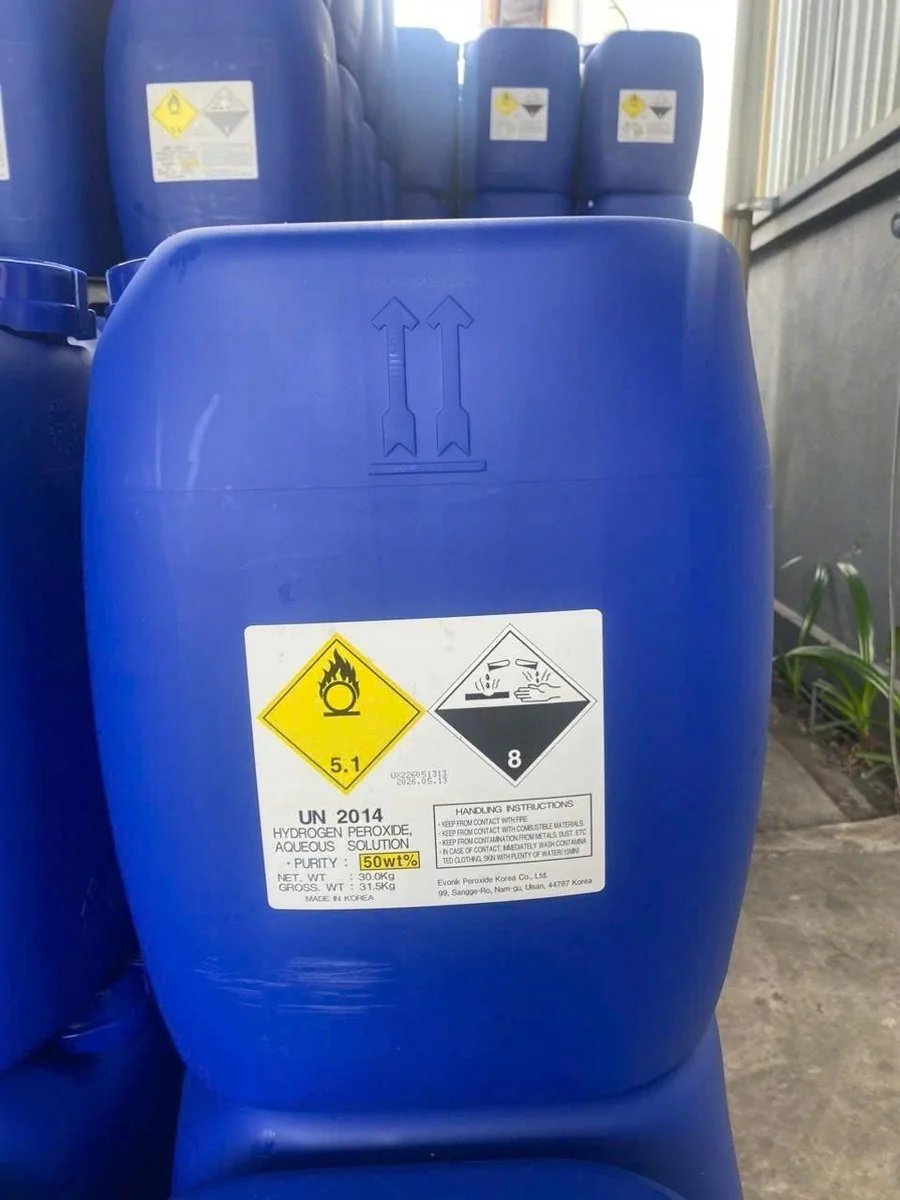
Industrial Hydrogen Peroxide H₂O₂ 50% w/w carries dual-hazard dangerous-goods classification under UN 2014 — Primary Class 5.1 Strong Oxidizing Liquid plus Subsidiary Class 8 Corrosive Substance — and falls directly under Vietnam’s 2026 conditional-chemical regulatory regime. EHS and compliance officers can review the complete statutory framework across chemical categories in our 2026 Legal Compliance Guide for Industrial Precursors & Conditional Chemicals Under Law 69/2025 & Decrees 24–26/2026.
1. Vietnam 2026 Chemical Regulatory Compliance (Law 69/2025/QH15 & Decree 24/2026/ND-CP)
- Conditional Production & Trading Chemical (
Appendix II — Item 409 of Decree 24/2026/ND-CP): Under Vietnam’sLaw on Chemicals No. 69/2025/QH15(effective01/01/2026) andDecree 24/2026/ND-CP(issued and effective17/01/2026), Hydrogen Peroxide (CAS 7722-84-1) is listed under both Appendix I (priority basic industrial chemicals) and Appendix II — Item409(Conditional industrial chemicals when concentration exceeds> 5% w/w). UnlikeHClorH₂SO₄(which are Appendix III Group 2 industrial precursors requiring electronic purchase-sale control slips), textile mills purchasingH₂O₂ 50%for internal fabric pretreatment do not file precursor control slips, but must source exclusively from licensed conditional-chemical distributors compliant withDecree 26/2026/ND-CP, maintain a 16-section Vietnamese GHS Safety Data Sheet (SDS) perCircular 01/2026/TT-BCTon the shop floor, and enforce chemical safety training, PPE, and spill-response plans underDecree 25/2026/ND-CP. - Class 5.1 + Class 8 Dangerous Goods Road Transport (
Decree 161/2024/ND-CP): AqueousH₂O₂solutions between20%and60% w/ware regulated asUN 2014, Hazard Class 5.1 (Subsidiary Risk 8), Packing Group II. Every box truck delivering35 kgvented jerricans /1,000 LIBCs and every dedicated5–30-tonpassivated316Lstainless-steel tanker operated by Loc Thien Chemical carries valid Class 5.1/Class 8 dangerous-goods transport permits and strict segregation from acids, alkalis, reducing salts, and organic solvents.
2. Acute GHS Safety Gate: Preventing Sealed-Container Overpressure Explosions & Organic Fire Hazards
Urgent GHS Safety Warning:
Hydrogen Peroxide Solution H₂O₂ 50% w/w(CAS 7722-84-1,UN 2014, Class 5.1 Oxidizer + Class 8 Corrosive, Signal Word:Danger) carries GHS hazard statementsH272(May intensify fire; oxidizer),H302 + H332(Harmful if swallowed or if inhaled as mist/vapor),H314(Causes severe skin burns — direct splash contact causes immediate painful white skin micro-embolism bleaching), andH318(Causes serious, potentially irreversible eye damage). Download the complete 16-section emergency response guide at Hydrogen Peroxide H₂O₂ 35%–50% Safety Data Sheet (SDS).
- SEALED-CONTAINER OVERPRESSURE RUPTURE HAZARD (
UN 2014— MANDATORY VENTED CAPS): Even under cool indoor storage,H₂O₂ 50%slowly evolves trace oxygen gas (O₂). Every35 kgjerrican,1,000 LIBC tote, and bulk storage tank MUST be equipped with a functioning one-way pressure-relief vented cap (Vented Cap/ breather valve) and stored strictly upright. NEVER replace a vented cap with a non-vented airtight plug, and STRICTLY NEVER pour unused or dispensedH₂O₂from a measuring pitcher or day tank back into the original35 kgjerrican or1,000 LIBC tote! Introducing even micrograms of ferric rust (Fe³⁺), copper (Cu²⁺), airborne dirt, or caustic soda (NaOH) triggers runaway self-accelerating exothermic decomposition (2H₂O₂ → 2H₂O + O₂↑ + 98.2 kJ/mol), boiling the liquid above100 °Cand generating massiveO₂gas volume that violently ruptures or explodes sealed containers and blocked pipe sections!- FIRE/EXPLOSION INCOMPATIBILITIES & WETTED MATERIAL RULES: Store
H₂O₂ 50%in a cool (< 30–32 °C), shaded, ventilated bunded bay equipped with emergency deluge showers and abundant flushing water — strictly segregated from flammable organic solvents (Acetone, Isopropanol IPA, Methanol, Toluene), machine lubricants/grease, oily cotton rags, wooden pallets (spilledH₂O₂ 50%drying on wood or rags can ignite spontaneously!), dyehouse reducing agents (Sodium Hydrosulfite Na₂S₂O₄, Thiourea Dioxide, Sodium Bisulfite NaHSO₃), and heavy-metal salts (FeCl₂, FeCl₃, CuSO₄, KMnO₄). Piping, valves, and bulk tanks MUST use nitric-acid passivated316L / 304Lstainless steel, high-purity aluminum (1060 / 5254), UV-stabilized virginHDPE,uPVC, orPTFE/PVDF— NEVER use copper, brass, bronze, carbon steel, cast iron, or natural rubber. Metering pumps must feature an auto-degassing liquid end and pressure-relief loop; never trapH₂O₂between two closed isolation valves!
What Vendor Qualification Dossiers, 5 Transparent Price Drivers, and 6-Warehouse Logistics Does Loc Thien Chemical Deliver to FDI Textile Mills?
Loc Thien Chemical (Loc Thien Investment Development Co., Ltd. — Tax ID 0313650856) operates an ISO 9001:2015 and ISO 14001:2015 certified industrial chemical supply chain delivering 3,000+ metric tons/month across Vietnam’s textile dyeing, spinning, denim washing, pulp & paper, and environmental engineering sectors. Fully compliant with Law on Chemicals No. 69/2025/QH15 and Decrees 24–26/2026/ND-CP, Loc Thien enables FDI dyehouses to consolidate both TÜV SÜD ZDHC MRSL v3.1 Level 1 pretreatment workhorses — Hydrogen Peroxide H₂O₂ 50% (#ZDHC1 127736 0002 Rev. 00) and Liquid Caustic Soda NaOH 32% (#ZDHC1 127736 0001 Rev. 00) — under a single audited vendor code.
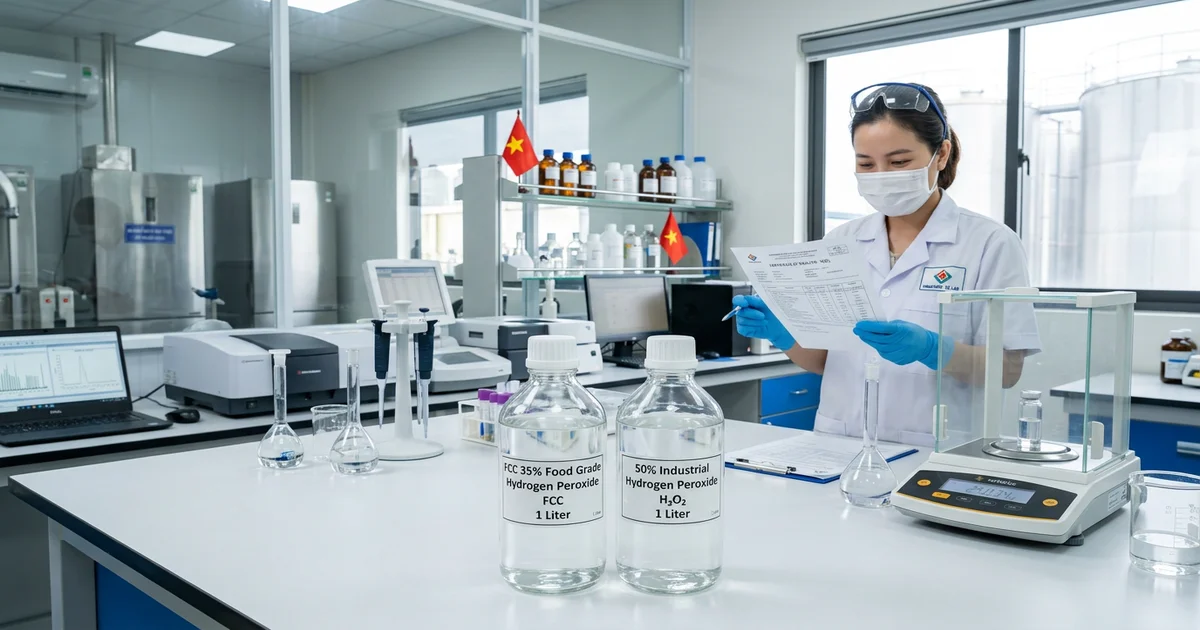
QC Laboratory Field Note — QC Specialist Phan Cam Thuy shares: “When qualifying incoming lots of Hydrogen Peroxide H₂O₂ 50% destined for export knitwear scouring-bleaching houses, the two decisive analytical safeguards verified by Loc Thien’s QC laboratory on every batch COA are 96–100 °C thermal stability (consistently ≥ 97% on Solvay Thailand INTEROX ST 50 and ≥ 96% on Korean lots) and trace iron control at Fe ≤ 0.5 ppm to eliminate catalytic pinholing risk. Alongside permanganate assay verification (50.0% ± 0.5%–1.0% w/w) and specific gravity checks at 20 °C (1.195–1.196 g/cm³), our dispatch team inspects 100% of one-way vented caps on every 35 kg blue PE jerrican and 1,000 L IBC tote prior to loading, enclosing TÜV SÜD Certificate No. ZDHC1 127736 0002 Rev. 00 for immediate ZDHC Gateway CIL upload.”
1. Role-Specific Qualification Summary for Enterprise Buying Committees
- For Procurement Managers: Transparent corporate governance established in 2016 (Legal Representative: Director Tran Ngoc Quang; Tax ID
0313650856; Legal Head Office at452/6B Tinh Lo 10, Binh Tri Dong Ward, Binh Tan District, Ho Chi Minh City— registered administrative headquarters, strictly separate from hazardous chemical storage facilities). Dedicated safety stock is positioned across 6 standardized regional warehouses:- Ba Ria - Vung Tau Warehouse:
Phu My 1 Industrial Park, Phu My Town, Ba Ria - Vung Tau - Dong Nai Warehouse:
Long Thanh Industrial Park, Long Thanh District, Dong Nai - Binh Duong Warehouse:
Tan Dong Hiep Ward, Di An City, Binh Duong - Da Nang Warehouse:
Hoa Khanh Industrial Park, Lien Chieu District, Da Nang City - Can Tho Warehouse:
Tra Noc Industrial Park, O Mon District, Can Tho City - Bac Ninh Warehouse:
Tien Son Industrial Park, Tien Du District, Bac Ninh
- Standard Delivery Lead Times (SLA): Inner Ho Chi Minh City within
4 hours; Southern & Mekong Delta industrial parks within24–48 hours; Northern & Central Vietnam industrial zones within2–3 days. Contact hotline +84 979 891 929 for detailed delivery scheduling procedures.
- Ba Ria - Vung Tau Warehouse:
- For Dyehouse Managers & EHS Engineers: Full technical compliance pack comprising per-shipment
COA per batch(clearly stating Thailand Solvay, South Korea, or Bangladesh origin), Quatest 3 analytical benchmarks, 16-section GHSSDS(Circular 01/2026/TT-BCT),TÜV SÜD ZDHC MRSL v3.1 Level 1certificates (#ZDHC1 127736 0002 Rev. 00forH₂O₂&#ZDHC1 127736 0001 Rev. 00forNaOH), plus laboratory sample dispatch and water-metal troubleshooting support. - For Finance & Accounting Controllers: Compliant Vietnamese VAT e-invoice issued under
Decree 70/2025/ND-CP, corporate bank-transfer documentation satisfying input VAT credit audits under Vietnam’sVAT Law 2024, certified net-weight weighbridge tickets, and flexible contract credit terms for monthly/quarterly supply agreements.
2. Five Transparent Price Drivers for Bulk H₂O₂ 50% Supply (Formal Quote Within 15 Minutes)
Because international Class 5.1/Class 8 maritime container freight (UN 2014) and upstream anthraquinone hydrogenation feedstock indices shift by shipment window, Loc Thien Chemical never posts misleading static unit prices online. Instead, our engineering desk issues an itemized technical quotation within 15 minutes structured around five transparent drivers:
- Producer Origin & Stabilizer Grade: Thailand INTEROX ST 50 (Solvay), South Korea H₂O₂ 50%, or cost-efficient Bangladesh H₂O₂ 50%.
- Packaging & Unloading Format: Palletized
35 kgvented PE jerricans,1,000 Lvented IBC totes (≈ 1,195 kgnet), or bulk5–30-tonpassivated316Lstainless-steel road tankers. - Monthly Off-Take Volume & Bundled Pretreatment Contracts: Combining scheduled monthly call-offs of
H₂O₂ 50%alongsideLiquid NaOH 32%optimizes dedicated dangerous-goods fleet dispatch. - Delivery Radius From Nearest of 6 Regional Warehouses: Compliant
UN 2014Class 5.1 + Class 8 road transport underDecree 161/2024/ND-CPandDecree 25/2026/ND-CP. - Audit Dossier Scope & Commercial Payment Terms:
TÜV SÜD ZDHC Level 1documentation, per-lot COA verification, third-party lab testing, and contract payment terms.
Included in every Loc Thien quotation: Door-to-mill licensed DG transport, safe pump unloading into passivated bulk tanks (for 5–30-ton tanker orders), COA per batch, 16-section GHS SDS (Circular 01/2026/TT-BCT), TÜV SÜD ZDHC Level 1 certificate copy, and Vietnamese VAT e-invoice.
Need an immediate side-by-side quotation across Thailand Solvay, Korea, and Bangladesh H₂O₂ 50% with ZDHC Level 1 certificates? Contact Email [email protected], Hotline / Vietnamese Zalo +84 979 891 929, or Request a 15-Minute Technical Quote.
Frequently Asked Questions (FAQ)
Why do EU, US, and Japanese apparel brands prohibit Sodium Hypochlorite (NaOCl) cotton bleaching in favor of ZDHC Level 1 Hydrogen Peroxide H₂O₂ 50%?
Bleaching raw cotton with Sodium Hypochlorite (NaOCl) or Calcium Hypochlorite Ca(OCl)₂ chlorinates natural cotton waxes, lignins, and pectins, generating persistent toxic Adsorbable Organic Halides (AOX) in dyehouse effluent that violate ZDHC Wastewater Guidelines V2.2 and OEKO-TEX Standard 100 ecological thresholds, while causing heat-setting yellowing (170–195 °C) and fiber tendering. By contrast, Hydrogen Peroxide H₂O₂ 50% certified to TÜV SÜD ZDHC MRSL v3.1 Conformance Level 1 (#ZDHC1 127736 0002 Rev. 00) decomposes cleanly into H₂O + O₂ (0% AOX), delivering high permanent whiteness without halogen pollution.
What causes widespread catalytic pinholing on cotton knits during H₂O₂ bleaching, and how do dyehouses eliminate it permanently?
Catalytic pinholing occurs when trace transition-metal ions — Fe²⁺, Fe³⁺, or Cu²⁺ > 0.1 – 0.2 mg/L originating from rusty steam/water pipes, knitting-needle steel specks on greige cloth, or impure alkalis — catalyze localized Fenton-type homolytic cleavage of H₂O₂ at 95–98 °C, generating destructive hydroxyl free radicals (•OH) that sever cellulose chains around the metal particle. Dyehouses eliminate pinholing by combining ZDHC Level 1 H₂O₂ 50% (Fe ≤ 0.5 ppm), softened water control (Fe < 0.1 mg/L, Cu < 0.01 mg/L), mild acidic pre-demineralization for rust-contaminated greige, and an alkali-stable organic chelator/stabilizer system.
Why must dyehouses cool the bath to 40–55 °C, adjust pH to 6.0–7.5, and verify < 1 ppm H₂O₂ with Catalase Enzyme before reactive dyeing?
Even > 5 ppm of residual H₂O₂ left inside cotton fibers oxidatively destroys reactive dye chromophores and reactive vinylsulfone/triazine groups, producing severe batch-to-batch shade shifts (ΔE > 1.0) and blotchy unlevelness. Because Catalase Enzyme is a biological heme-protein denatured above > 65–70 °C or pH > 9.0, operators cool the clean bath to 40 – 55 °C, neutralize to pH 6.0 – 7.5 with organic acid, circulate catalase for 15 – 20 minutes, and confirm < 1 ppm (0 ppm) on a Merckoquant Peroxide Test strip before dosing salt and reactive dyes directly into the same bath — saving 15 – 25 m³ of water per ton of cotton with zero added TDS.
What is the actual net weight of a 1,000 L IBC tote of H₂O₂ 50%, and why must dispensed H₂O₂ never be poured back into its original container?
At 20 °C, industrial H₂O₂ 50% w/w has a specific gravity of 1.195 – 1.196 g/cm³, meaning one 1,000 L vented IBC tote contains approximately 1,195 kg net liquid (≈ 1.195 metric tons net), while standard vented PE jerricans hold 35 kg net. Operators must strictly never pour dispensed or leftover H₂O₂ back into the original 35 kg jerrican or 1,000 L IBC tote: trace iron, copper, dust, or alkali contamination triggers runaway exothermic catalytic decomposition (98.2 kJ/mol), evolving rapid O₂ gas pressure capable of violently rupturing UN 2014 containers.
Is Sodium Silicate (Na₂SiO₃) bleaching stabilizer included in Loc Thien Chemical’s 9 ZDHC MRSL v3.1 Level 1 certified products?
No. Loc Thien Chemical enforces strict compliance transparency: Hydrogen Peroxide H₂O₂ (Cert No. ZDHC1 127736 0002 Rev. 00) and Caustic Soda NaOH (Cert No. ZDHC1 127736 0001 Rev. 00) are part of the 9 flagship products certified to ZDHC MRSL Version 3.1 Conformance Level 1 by TÜV SÜD under LOC THIEN INVESTMENT DEVELOPMENT COMPANY LIMITED. Sodium Silicate Liquid Na₂SiO₃ is supplied with full per-batch COA and GHS SDS documentation (Circular 01/2026/TT-BCT), but lies outside the 9 ZDHC-certified SKUs. Disclaimer: This guide provides textile pretreatment engineering and chemical-environmental regulatory updates and does not substitute formal legal counsel.
Order ZDHC Level 1 Hydrogen Peroxide H₂O₂ 50% (Thailand Solvay · South Korea · Bangladesh) & Bulk Liquid NaOH 32% — 15-Minute Technical Quote:
- Supplier: Loc Thien Investment Development Co., Ltd. (
Tax ID: 0313650856)- Legal Head Office:
452/6B Tinh Lo 10, Binh Tri Dong Ward, Binh Tan District, Ho Chi Minh City, Vietnam- 6 Standardized Warehouses: Ba Ria - Vung Tau (
Phu My 1 IP) · Dong Nai (Long Thanh IP) · Binh Duong (Di An City) · Da Nang (Hoa Khanh IP) · Can Tho (Tra Noc IP) · Bac Ninh (Tien Son IP)- Email: [email protected] · Hotline & Vietnamese Zalo (24/7): +84 979 891 929 · Online RFQ: Request Quote, Batch COA & TÜV SÜD ZDHC Certificate